Page 60 of 224
2. Wrap the vinyl
around the roller tube
twice. Tuck the edges
of the vinyl inside the
end cap with each
wrap.
3. Fold the edges of
the vinyl towards the
center, making sure that the edges clear the end cap
slots. Use tape or a rubber band to hold the vinyl to
the left side of the tube.
4. Push in the right
end cap (marked RH)
about
1¤4of the total
length to disengage the
clutch and hold the
end cap in while
turning the roller tube
toward you 14 times.
5. Let go of the right end cap. The clutch will now
engage and stop the shade from losing its spring
tension.
6. Unfold the vinyl and place it into the end cap
slots.
7. Insert the shade into the side mounting brackets
and check to make sure that it operates properly.
The cover may cause injury in a sudden stop
or accident if it is not securely installed.
REMOTE ENTRY SYSTEM (IF EQUIPPED)
The remote entry system allows you to lock or
unlock all vehicle doors, trunk and liftgate without a
key.
The remote entry features only operate with the
ignition in the OFF position.
If there is any potential remote keyless entry
problem with your vehicle, ensureALL key fobs
Controls and features
60
Page 63 of 224
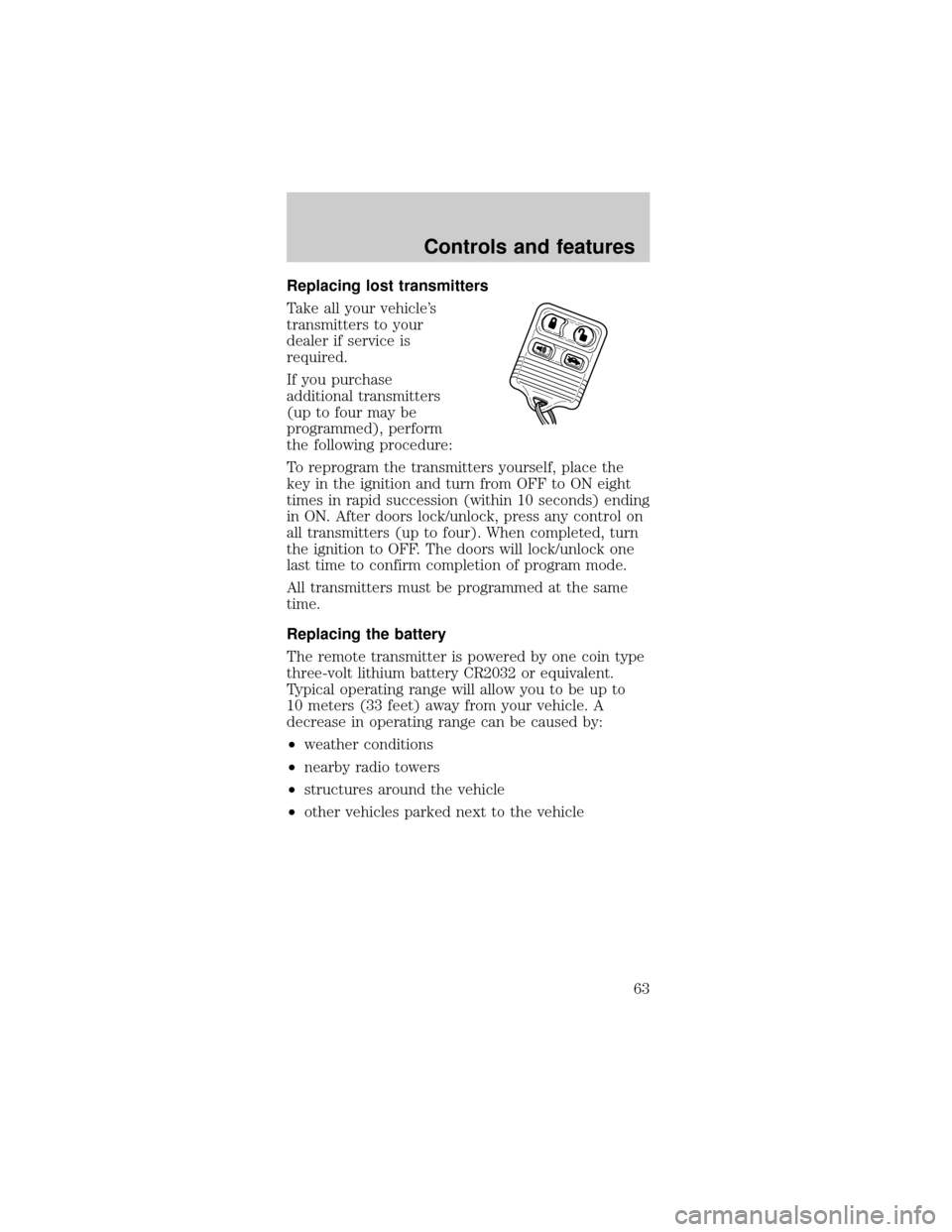
Replacing lost transmitters
Take all your vehicle's
transmitters to your
dealer if service is
required.
If you purchase
additional transmitters
(up to four may be
programmed), perform
the following procedure:
To reprogram the transmitters yourself, place the
key in the ignition and turn from OFF to ON eight
times in rapid succession (within 10 seconds) ending
in ON. After doors lock/unlock, press any control on
all transmitters (up to four). When completed, turn
the ignition to OFF. The doors will lock/unlock one
last time to confirm completion of program mode.
All transmitters must be programmed at the same
time.
Replacing the battery
The remote transmitter is powered by one coin type
three-volt lithium battery CR2032 or equivalent.
Typical operating range will allow you to be up to
10 meters (33 feet) away from your vehicle. A
decrease in operating range can be caused by:
²weather conditions
²nearby radio towers
²structures around the vehicle
²other vehicles parked next to the vehicle
Controls and features
63
Page 66 of 224
Disarming the system
You can disarm the system by any of the following
actions:
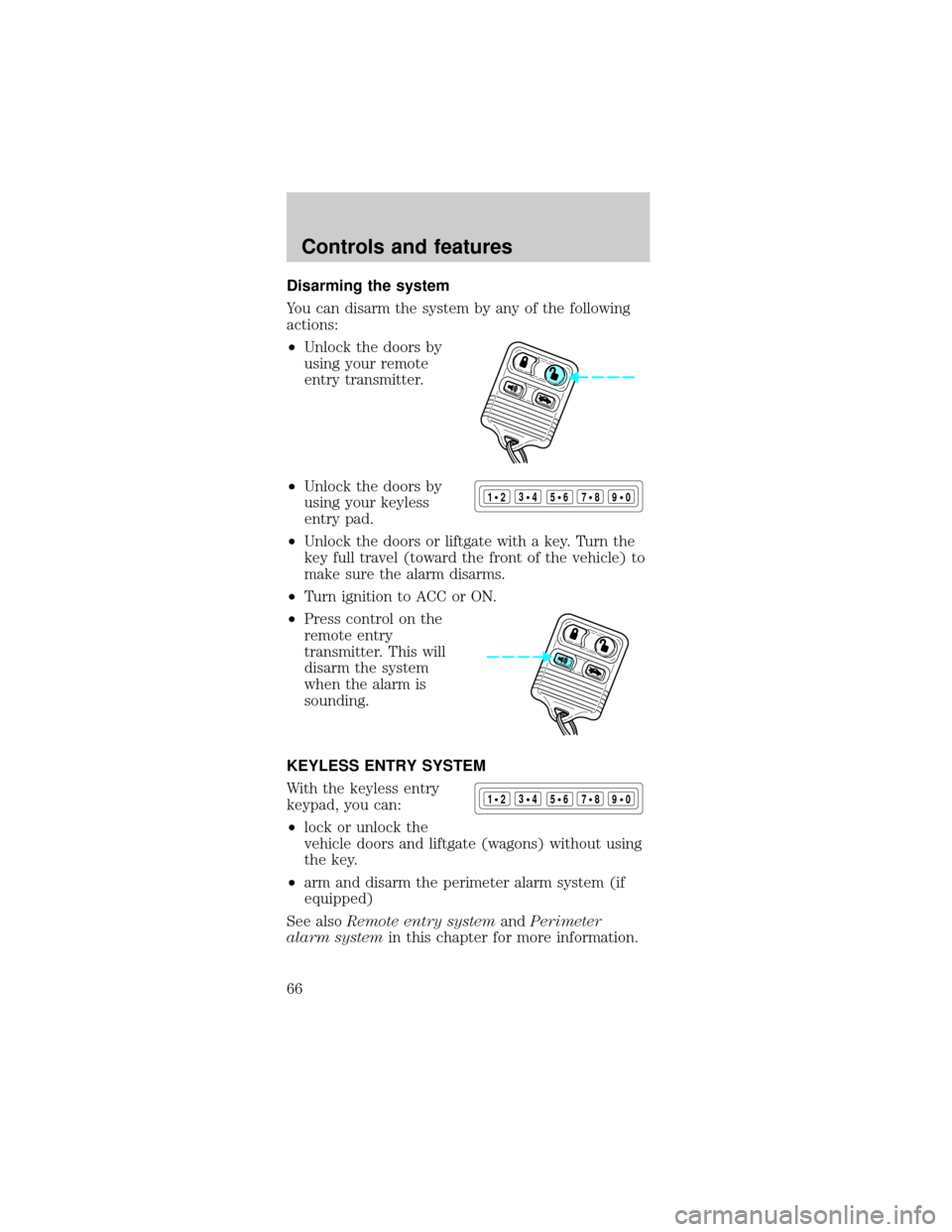
²Unlock the doors by
using your remote
entry transmitter.
²Unlock the doors by
using your keyless
entry pad.
²Unlock the doors or liftgate with a key. Turn the
key full travel (toward the front of the vehicle) to
make sure the alarm disarms.
²Turn ignition to ACC or ON.
²Press control on the
remote entry
transmitter. This will
disarm the system
when the alarm is
sounding.
KEYLESS ENTRY SYSTEM
With the keyless entry
keypad, you can:
²lock or unlock the
vehicle doors and liftgate (wagons) without using
the key.
²arm and disarm the perimeter alarm system (if
equipped)
See alsoRemote entry systemandPerimeter
alarm systemin this chapter for more information.
123
45678
90
123
45678
90
Controls and features
66
Page 77 of 224
3rd seat (wagon only)
The third seat faces the rear of the vehicle. For
height and weight limits, see the label on the seat
cushion. When the seat is down, the back of your
wagon has a flat surface for carrying cargo.
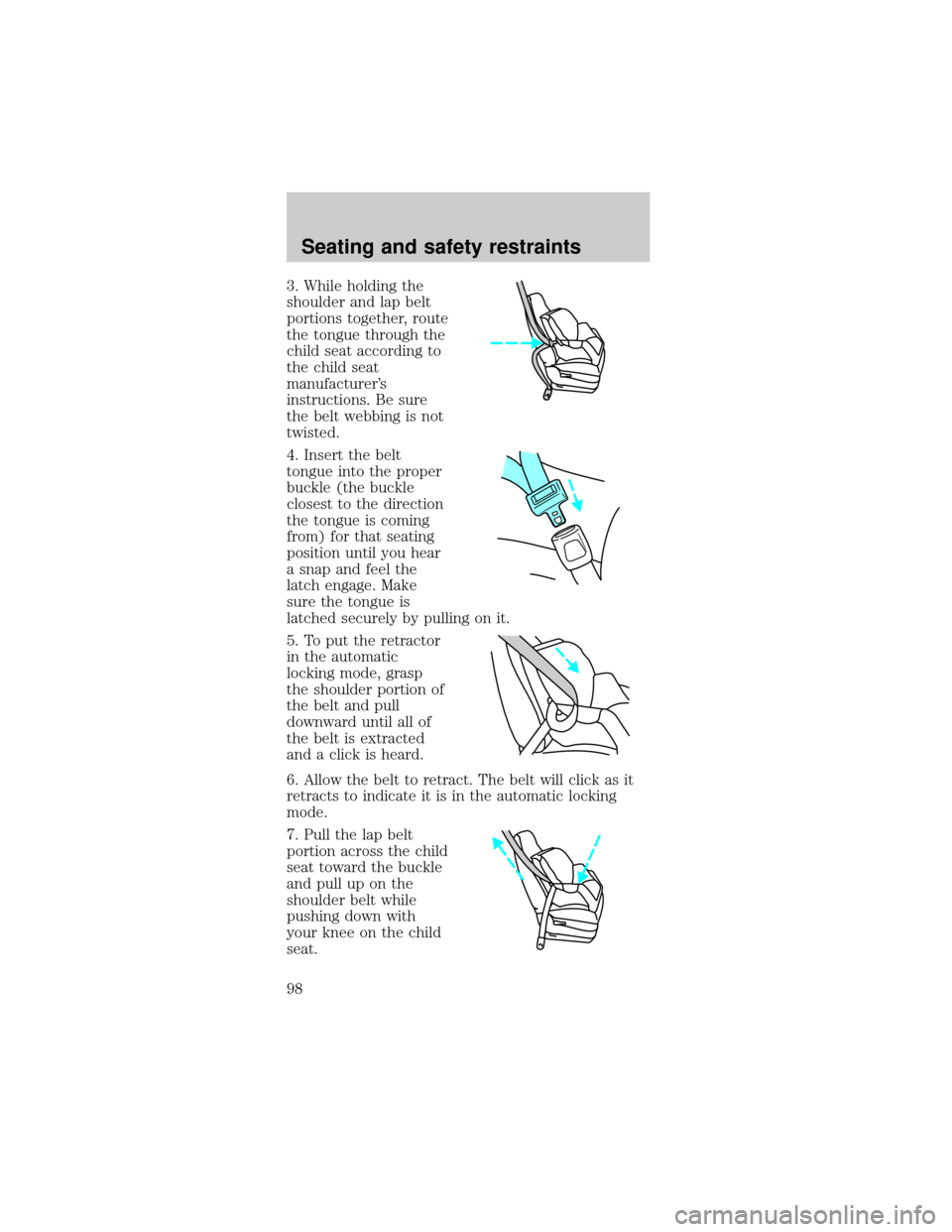
To open up the seat:
1. Unlock the floor
panel with the key,
then use the handle to
fold the floor panel
toward the front of the
car.
2. Remove the cargo
cover. The cargo cover
must be removed or
the seatback will not
latch in the upright
position.
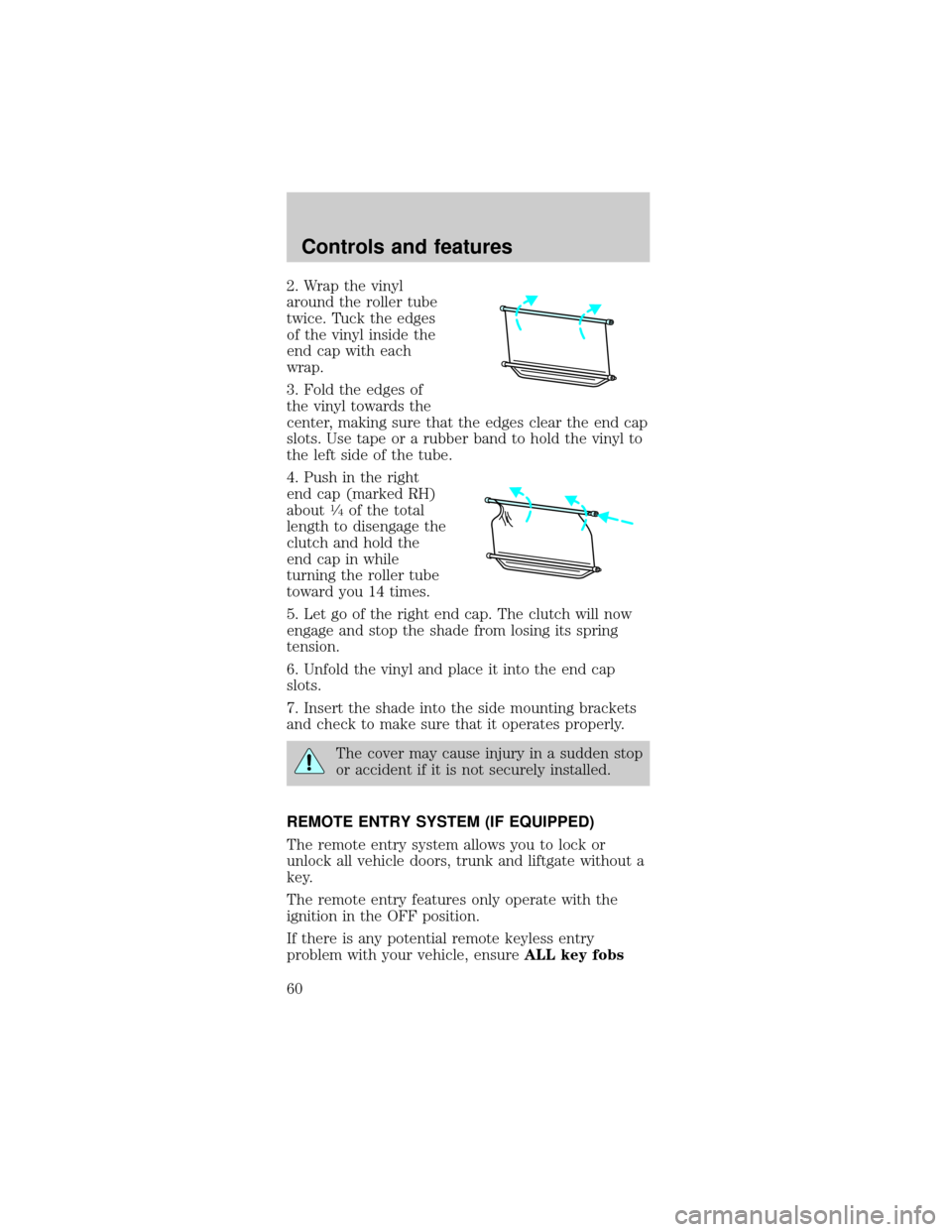
3. Lift the remote latch
release on the left side
of the compartment
and fold the remaining
floor panel until it
latches. Make sure the
seatback is locked in
the upright position.
To close the seat, make sure the safety belts are
properly stowed, then lift the remote latch release
and push the seat down until it latches. Pull up on
the handle and push the floor panel into place.
Seating and safety restraints
77
Page 86 of 224
The lap belts should fit snugly and as low as
possible around the hips, not around the
waist.
Front and rear seat occupants, including
pregnant women, should wear safety belts
for optimum protection in an accident.
Each seating position in your vehicle has a
specific safety belt assembly which is made
up of one buckle and one tongue that are designed
to be used as a pair. 1) Use the shoulder belt on
the outside shoulder only. Never wear the shoulder
belt under the arm. 2) Never swing the safety belt
around your neck over the inside shoulder. 3)
Never use a single belt for more than one person.
Due to folding rear seats, sometimes the buckles and
tongues toward the center of the vehicle may be
hidden by the rear edge of the seat cushion. Pull
them out so they will be accessible.
While you are fastened in the seat belt, the shoulder
belt adjusts to your movement. However, if you
brake hard, turn hard or your vehicle receives an
impact of 8 km/h (5 mph) or more, the safety belt
will become locked and help reduce your forward
movement.
To unfasten the belt, push the red release button on
the end of the buckle. This allows the tongue to
unlatch from the buckle. While the belt retracts,
guide the tongue to its original position to prevent it
from striking you or the vehicle.
Safety belt extension assembly
If the safety belt assembly is too short, even when
fully extended, 20 cm (8 inches) can be added to
the safety belt assembly by adding a safety belt
Seating and safety restraints
86
Page 98 of 224
3. While holding the
shoulder and lap belt
portions together, route
the tongue through the
child seat according to
the child seat
manufacturer's
instructions. Be sure
the belt webbing is not
twisted.
4. Insert the belt
tongue into the proper
buckle (the buckle
closest to the direction
the tongue is coming
from) for that seating
position until you hear
a snap and feel the
latch engage. Make
sure the tongue is
latched securely by pulling on it.
5. To put the retractor
in the automatic
locking mode, grasp
the shoulder portion of
the belt and pull
downward until all of
the belt is extracted
and a click is heard.
6. Allow the belt to retract. The belt will click as it
retracts to indicate it is in the automatic locking
mode.
7. Pull the lap belt
portion across the child
seat toward the buckle
and pull up on the
shoulder belt while
pushing down with
your knee on the child
seat.
Seating and safety restraints
98
Page 116 of 224

When parking, do not use the gearshift in
place of the parking brake. Always set the
parking brake fully and make sure that the
gearshift is securely latched in Park (P). Turn off
the ignition whenever you leave your vehicle.
Never leave your vehicle unattended while it is
running. If you do not take these precautions, your
vehicle may move unexpectedly and injure
someone.
VEHICLE LOADING
Before loading a vehicle, familiarize yourself with the
following terms:
²Base Curb Weight: Weight of the vehicle
including any standard equipment, fluids,
lubricants, etc. It does not include passengers or
aftermarket equipment.
²Payload: Combined maximum allowable weight of
cargo, passengers and optional equipment. The
payload equals the gross vehicle weight rating
minus base curb weight.
²GVW (Gross Vehicle Weight): Base curb weight
plus payload weight. The GVW is not a limit or a
specification.
²GVWR (Gross Vehicle Weight Rating):
Maximum total weight of the base vehicle,
passengers, optional equipment and cargo. The
GVWR is specific to each vehicle and is listed on
the Safety Compliance Label on the driver's door
pillar.
²GAWR (Gross Axle Weight Rating): Carrying
capacity for each axle system. The GAWR is
specific to each vehicle and is listed on the Safety
Compliance Label on the driver's door pillar.
²GCW (Gross Combined Weight): The combined
weight of the towing vehicle (including passengers
and cargo) and the trailer.
Driving
116
Page 117 of 224
²GCWR (Gross Combined Weight Rating):
Maximum combined weight of towing vehicle
(including passengers and cargo) and the trailer.
The GCWR indicates the maximum loaded weight
that the vehicle is designed to tow.
²Maximum Trailer Weight Rating: Maximum
weight of a trailer the vehicle is permitted to tow.
The maximum trailer weight rating is determined
by subtracting the vehicle curb weight for each
engine/transmission combination, any required
option weight for trailer towing and the weight of
the driver from the GCWR for the towing vehicle.
²Maximum Trailer Weight: maximum weight of a
trailer the loaded vehicle (including passengers
and cargo) is permitted to tow. It is determined
by subtracting the weight of the loaded trailer
towing vehicle from the GCWR for the towing
vehicle.
²Trailer Weight Range: Specified weight range
that the trailer must fall within that ranges from
zero to the maximum trailer weight rating.
Remember to figure in the tongue load of your
loaded trailer when figuring the total weight.
Do not exceed the GVWR or the GAWR
specified on the certification label.
Do not use replacement tires with lower load
carrying capacities than the originals because they
may lower the vehicle's GVWR and GAWR
limitations. Replacement tires with a higher limit
than the originals do not increase the GVWR and
GAWR limitations.
The Certification Label, found on the inside pillar of
the driver's door, lists several important vehicle
weight rating limitations. Before adding any
additional equipment, refer to these limitations. If
you are adding weight to the front of your vehicle,
(potentially including weight added to the cab), the
Driving
117