1999 FORD RANGER jump seat
[x] Cancel search: jump seatPage 72 of 216

Pull lever up to adjust seatback.
Using the manual lumbar support
Turn the lumbar support control
clockwise to increase firmness.
Turn the lumbar support control
counterclockwise to increase
softness.
REAR SEATS
Center facing jump seat (2 door SuperCab) (if equipped)
To open, pull inboard and down on the seat handle.
To stow the seat, pull seat bottom back to the fully upright position.
Do not install a child seat in a center facing jump seat.
Seating and safety restraints
72
Page 73 of 216
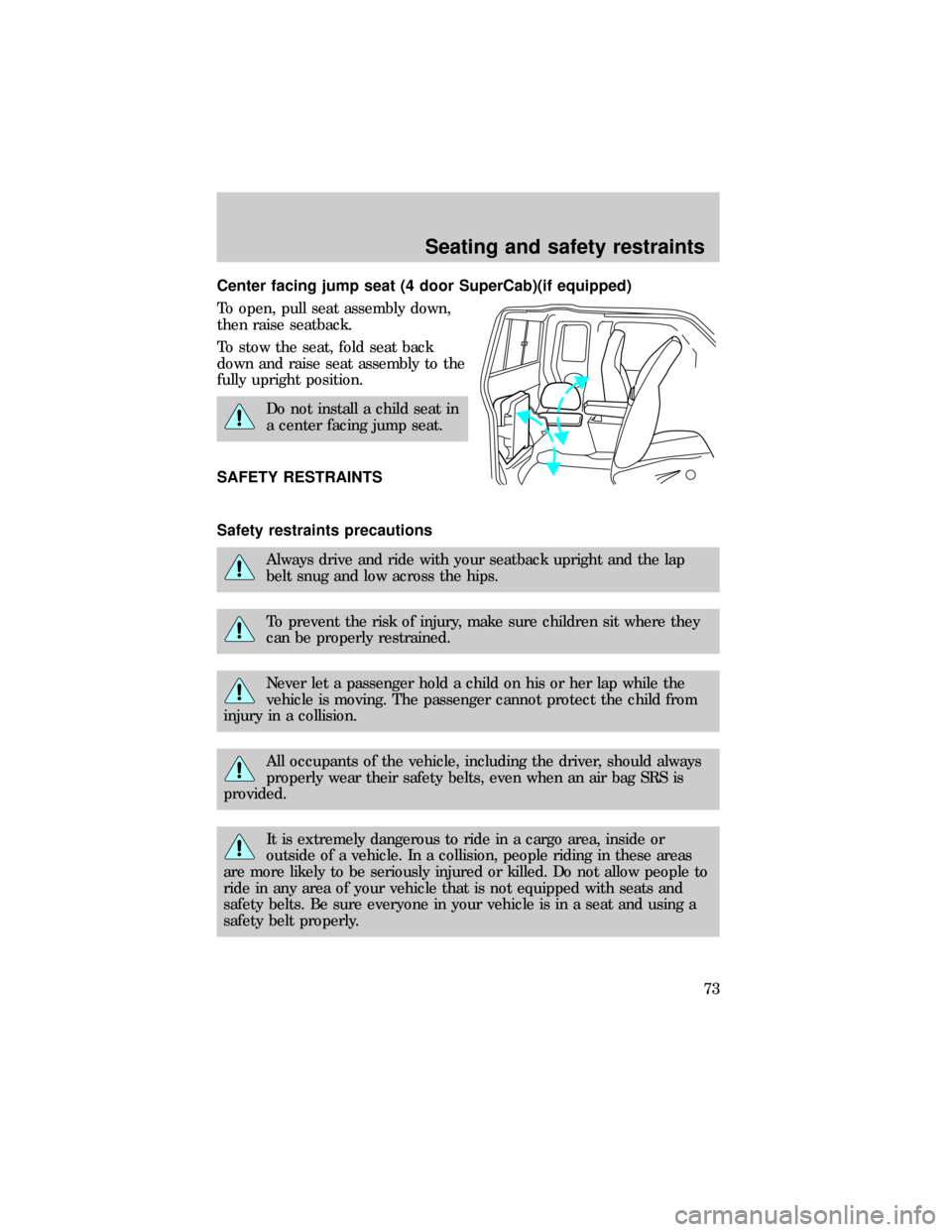
Center facing jump seat (4 door SuperCab)(if equipped)
To open, pull seat assembly down,
then raise seatback.
To stow the seat, fold seat back
down and raise seat assembly to the
fully upright position.
Do not install a child seat in
a center facing jump seat.
SAFETY RESTRAINTS
Safety restraints precautions
Always drive and ride with your seatback upright and the lap
belt snug and low across the hips.
To prevent the risk of injury, make sure children sit where they
can be properly restrained.
Never let a passenger hold a child on his or her lap while the
vehicle is moving. The passenger cannot protect the child from
injury in a collision.
All occupants of the vehicle, including the driver, should always
properly wear their safety belts, even when an air bag SRS is
provided.
It is extremely dangerous to ride in a cargo area, inside or
outside of a vehicle. In a collision, people riding in these areas
are more likely to be seriously injured or killed. Do not allow people to
ride in any area of your vehicle that is not equipped with seats and
safety belts. Be sure everyone in your vehicle is in a seat and using a
safety belt properly.
Seating and safety restraints
73
Page 79 of 216
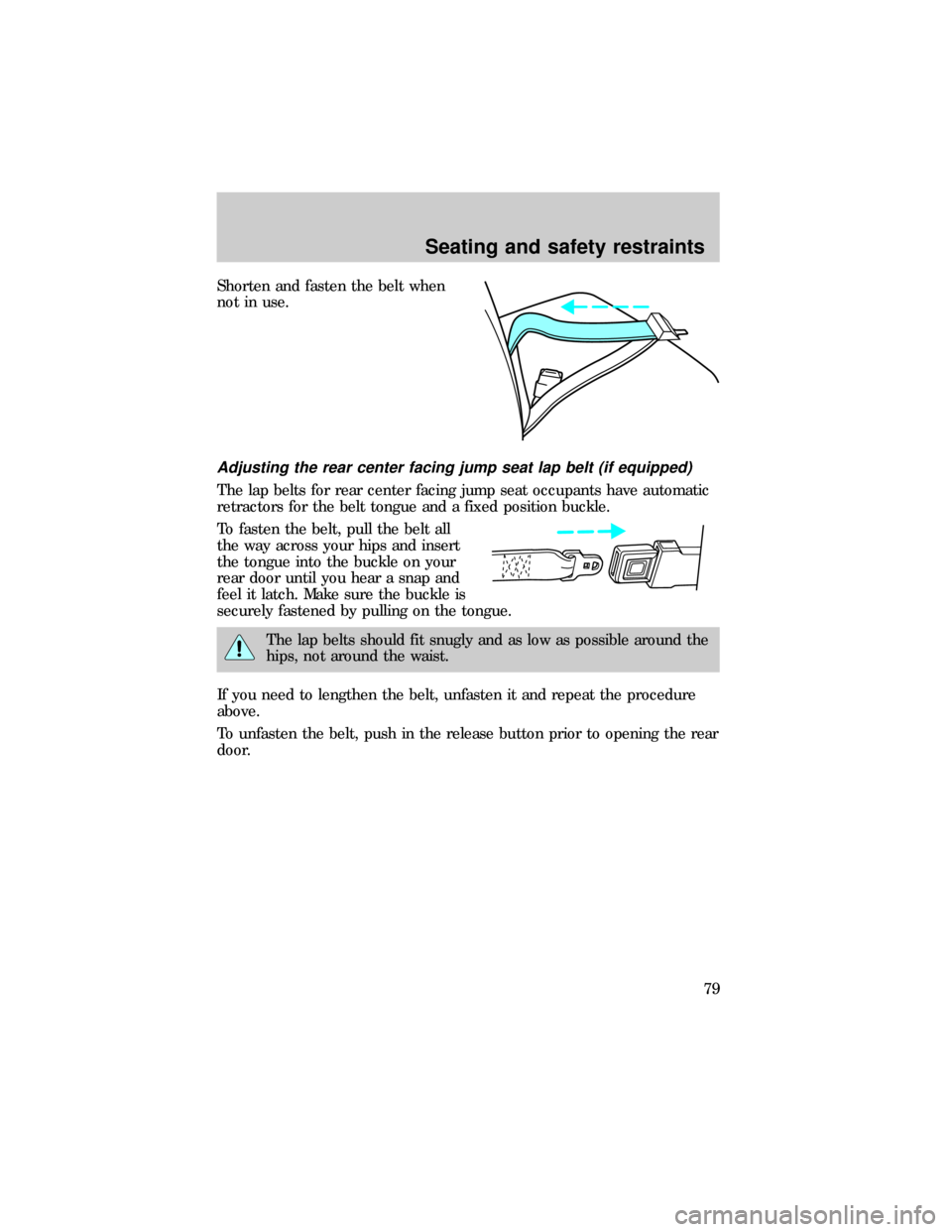
Shorten and fasten the belt when
not in use.
Adjusting the rear center facing jump seat lap belt (if equipped)
The lap belts for rear center facing jump seat occupants have automatic
retractors for the belt tongue and a fixed position buckle.
To fasten the belt, pull the belt all
the way across your hips and insert
the tongue into the buckle on your
rear door until you hear a snap and
feel it latch. Make sure the buckle is
securely fastened by pulling on the tongue.
The lap belts should fit snugly and as low as possible around the
hips, not around the waist.
If you need to lengthen the belt, unfasten it and repeat the procedure
above.
To unfasten the belt, push in the release button prior to opening the rear
door.
Seating and safety restraints
79
Page 91 of 216
Never let a passenger hold a child on his or her lap while the
vehicle is moving. The passenger cannot protect the child from
injury in a collision.
Always follow the instructions and warnings that come with any infant or
child restraint you might use.
When possible, place children in the rear seat of your vehicle. Accident
statistics suggest that children are safer when properly restrained in the
rear seating positions than in the front seating positions.
Do not install a child seat in a center facing jump seat.
Children and safety belts
If the child is the proper size, restrain the child in a safety seat.
Children who are too large for child safety seats (as specified by your
child safety seat manufacturer) should always wear safety belts.
Follow all the important safety restraint and air bag precautions that
apply to adult passengers in your vehicle.
If the shoulder belt portion of a combination lap and shoulder belt can
be positioned so it does not cross or rest in front of the child's face or
neck, the child should wear the lap and shoulder belt. Moving the child
closer to the center of the vehicle may help provide a good shoulder belt
fit.
Do not leave children, unreliable adults, or pets unattended in
your vehicle.
To improve the fit of lap and shoulder belts on children who have
outgrown child safety seats, Ford recommends use of a belt-positioning
booster seat that is labelled as conforming to all Federal motor vehicle
safety standards. Belt-positioning booster seats raise the child and
provide a shorter, firmer seating cushion that encourages safer seating
posture and better fit of lap and shoulder belts on the child.
A belt-positioning booster should be used if the shoulder belt rests in
front of the child's face or neck, or if the lap belt does not fit snugly on
both thighs, or if the thighs are too short to let the child sit all the way
back on the seat cushion when the lower legs hang over the edge of the
Seating and safety restraints
91
Page 96 of 216
Attaching safety seats with tether straps
Some manufacturers make safety seats that include a tether strap that
goes over the back of the vehicle seat and attaches to an anchoring
point. Other manufacturers offer the tether strap as an accessory.
Contact the manufacturer of your child safety seat for information about
ordering a tether strap.
In SuperCabs equipped with Center Facing Jump Seats, the tether strap
anchor bracket should be installed only at the center of the cab's back
panel with the child seat in the front center seating position. Installing
an anchor bracket at the right rear of the cab may increase risk of injury
to an occupant of the right rear center facing jump seat in the event of a
collision or a sudden stop. If a tether child seat is installed in the right
front seating position, secure the tether strap to the webbing of the
buckled right rear lap belt.
You can attach a tether strap anchor bracket to the cab inner back panel
by using a tether anchor kit (613D20) available at no charge from any
Ford dealer.
Do not install a child seat in a center facing jump seat.
Tether anchorage hardware
Tether anchorage hardware kits (part number 613D20) including
instructions, may be obtained at no charge from any Ford or
Lincoln-Mercury dealer.
Tighten the anchor according to specifications. Otherwise, the
safety seat may not be properly secured and the child may be
injured in a sudden stop or collision.
Seating and safety restraints
96
Page 142 of 216
Location of the spare tire and tools
The spare tire and tools for your vehicle are stowed in the following
locations:
Tool Location
Spare tire Under the vehicle, just forward of the rear
bumper
Jack, jack handle,
wheel nut wrenchRegular Cab: behind seats and underneath the
jack and tools cover
SuperCab: stowed in the passenger side rear cab
compartment or behind the jump seat in a
separate tool bag
Four-door models: stowed behind the front seats,
between jump seats and underneath jack and tool
covers.
Key, spare tire lock
(if equipped)In the glove box
Removing the spare tire
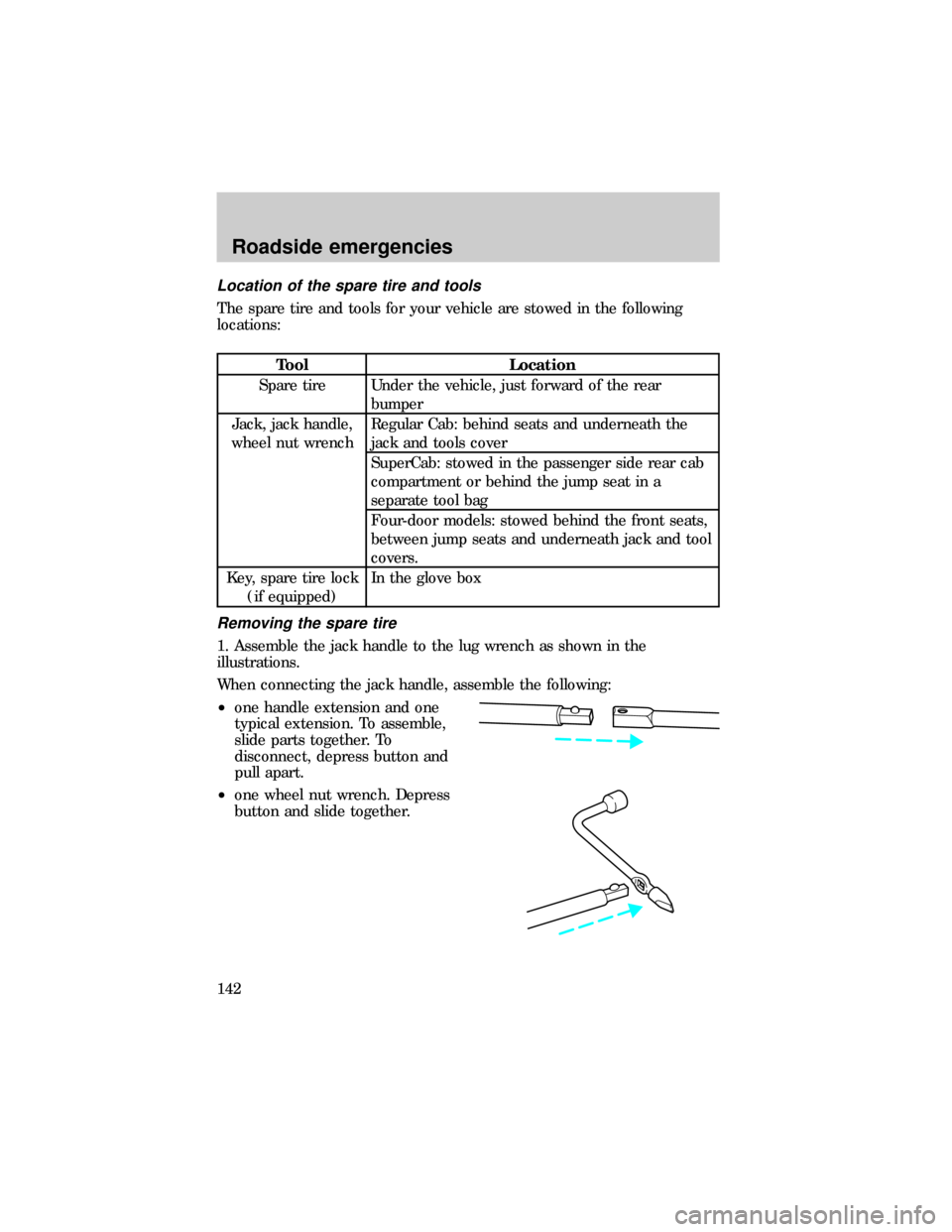
1. Assemble the jack handle to the lug wrench as shown in the
illustrations.
When connecting the jack handle, assemble the following:
²one handle extension and one
typical extension. To assemble,
slide parts together. To
disconnect, depress button and
pull apart.
²one wheel nut wrench. Depress
button and slide together.
Roadside emergencies
142
Page 212 of 216

locking/unlocking doors ...........65
replacement/additional
transmitters ...............................67
replacing the batteries .............66
Safety belts (see Safety
restraints) ....................................11
Safety restraints
cleaning the safety belts ...81,199
extension assembly ..................80
for children ..........................90,91
lap belt .................................78,79
warning light and chime .....11,80
Seat belts (see Safety
restraints) ................73,74,75,76,77
Seats ............................................71
child safety seats ......................92
Servicing your vehicle .......152,153
Snowplowing .................................3
Spark plugs, specifications .......200
Special notice ................................3
ambulance conversions ..............3
utility-type vehicles ....................3
Specification chart, lubricants .202
Speed control ..............................56
Speedometer ...............................14
Starting your vehicle ......97,98,100
jump starting ............146,147,149
Steering wheel
tilting .........................................61
Tachometer .................................13
Tires .............................173,174,175
changing .............141,142,143,144
checking the pressure ............175replacing ..................................176
rotating ....................................175
snow tires and chains ............177
tire grades ...............................174
treadwear ................................174
Towing
recreational towing ..........130,131
wrecker ....................................151
Traction-lok rear axle ...............120
Transfer case
fluid checking .........................169
Transmission ......................107,166
fluid, checking and adding
(automatic) ......................166,167
fluid, checking and adding
(manual) .................................168
manual operation ....................112
Trip odometer .............................14
Vehicle dimensions ...................205
Vehicle Identification Number
(VIN) ..........................................208
Vehicle loading ..........................121
camper bodies ........................132
Ventilating your vehicle ...........102
Warning chimes .............................6
Washer fluid ..............................162
Water, Driving through .............121
Windows .................................62,63
Windshield washer fluid and
wipers
checking and cleaning ............172
operation ...................................62
replacing wiper blades ...........173
Index
212