1999 FORD RANGER weight
[x] Cancel search: weightPage 92 of 216
seat cushion. You may wish to discuss the special needs of your child
with your pediatrician.
SAFETY SEATS FOR CHILDREN
Child and infant or child safety seats
Use a safety seat that is recommended for the size and weight of the
child. Carefully follow all of the manufacturer's instructions with the
safety seat you put in your vehicle. If you do not install and use the
safety seat properly, the child may be injured in a sudden stop or
collision.
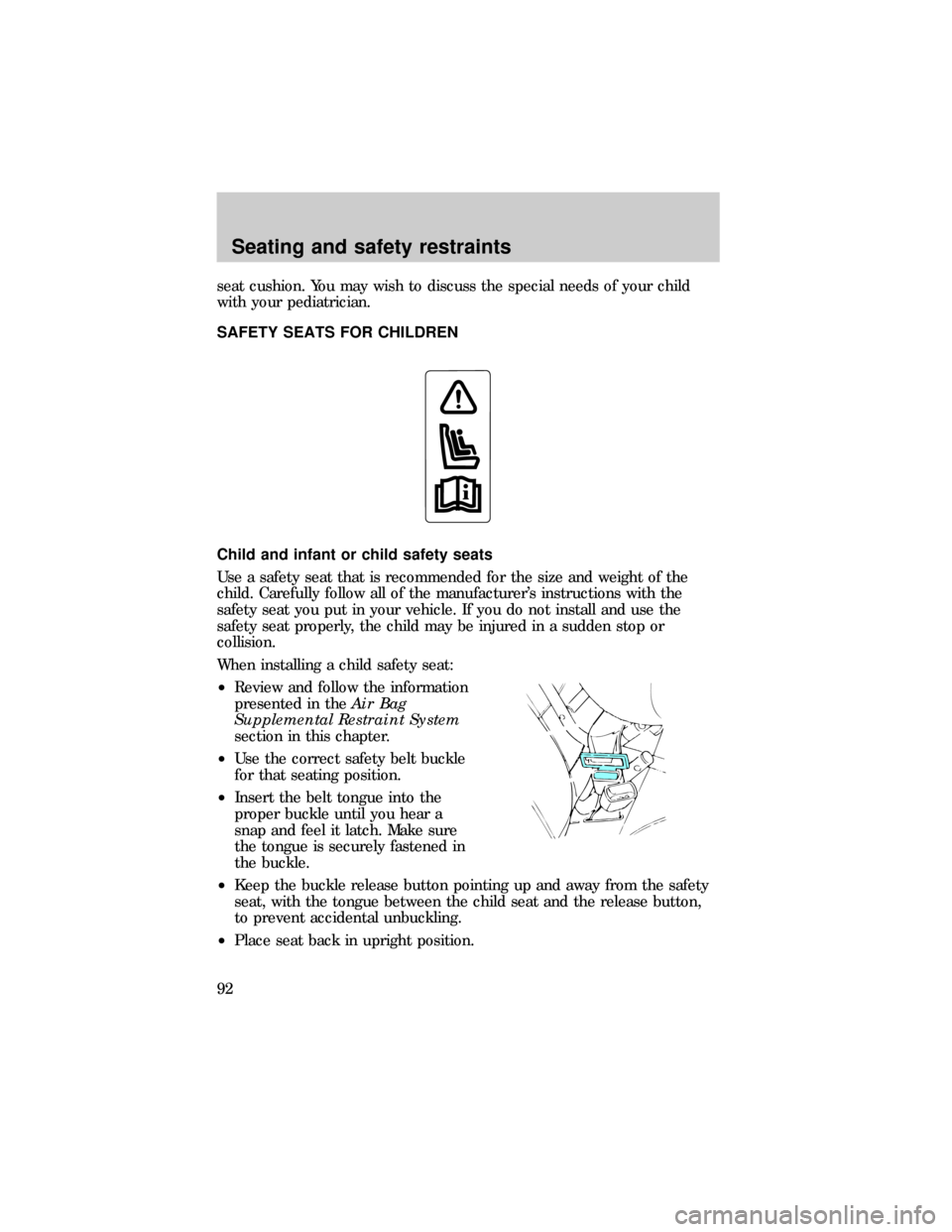
When installing a child safety seat:
²Review and follow the information
presented in theAir Bag
Supplemental Restraint System
section in this chapter.
²Use the correct safety belt buckle
for that seating position.
²Insert the belt tongue into the
proper buckle until you hear a
snap and feel it latch. Make sure
the tongue is securely fastened in
the buckle.
²Keep the buckle release button pointing up and away from the safety
seat, with the tongue between the child seat and the release button,
to prevent accidental unbuckling.
²Place seat back in upright position.
Seating and safety restraints
92
Page 121 of 216

DRIVING THROUGH WATER
Do not drive quickly through standing water, especially if the depth is
unknown. Traction or brake capability may be limited and if the ignition
system gets wet, your engine may stall. Water may also enter your
engine's air intake and severely damage your engine.
If driving through deep or standing water is unavoidable, proceed very
slowly. Never drive through water that is higher than the bottom of the
hubs.
Once through the water, always try the brakes. Wet brakes do not stop
the vehicle as effectively as dry brakes. Drying can be improved by
moving your vehicle slowly while applying light pressure on the brake
pedal.
Driving through deep water where the transmission is submerged
may allow water into the transmission and cause internal
transmission damage.
VEHICLE LOADING
Before loading a vehicle, familiarize yourself with the following terms:
²Base Curb Weight: Weight of the vehicle including any standard
equipment, fluids, lubricants, etc. It does not include passengers or
aftermarket equipment.
²Payload: Combined maximum allowable weight of cargo, passengers
and optional equipment. The payload equals the gross vehicle weight
rating minus base curb weight.
²GVW (Gross Vehicle Weight): Base curb weight plus payload
weight. The GVW is not a limit or a specification.
²GVWR (Gross Vehicle Weight Rating): Maximum total weight of
the base vehicle, passengers, optional equipment and cargo. The
GVWR is specific to each vehicle and is listed on the Safety
Compliance Label on the driver's door pillar.
²GAWR (Gross Axle Weight Rating): Carrying capacity for each
axle system. The GAWR is specific to each vehicle and is listed on the
Safety Compliance Label on the driver's door pillar.
Driving
121
Page 122 of 216

²GCWR (Gross Combined Weight Rating): Maximum combined
weight of towing vehicle (including passengers and cargo) and the
trailer. The GCWR indicates the maximum loaded weight that the
vehicle is designed to tow.
²Maximum Trailer Weight Rating: Maximum weight of a trailer the
vehicle is permitted to tow. The maximum trailer weight rating is
determined by subtracting the vehicle curb weight for each
engine/transmission combination, any required option weight for trailer
towing and the weight of the driver from the GCWR for the towing
vehicle.
²Maximum Trailer Weight: maximum weight of a trailer the loaded
vehicle (including passengers and cargo) is permitted to tow. It is
determined by subtracting the weight of the loaded trailer towing
vehicle from the GCWR for the towing vehicle.
²Trailer Weight Range: Specified weight range that the trailer must
fall within that ranges from zero to the maximum trailer weight rating.
Remember to figure in the tongue load of your loaded trailer when
figuring the total weight.
Do not exceed the GVWR or the GAWR specified on the Safety
Compliance Certification Label.
Do not use replacement tires with lower load carrying capacities than the
originals because they may lower the vehicle's GVWR and GAWR
limitations. Replacement tires with a higher limit than the originals do
not increase the GVWR and GAWR limitations.
The Certification Label, found on the inside pillar of the driver's door,
lists several important vehicle weight rating limitations. Before adding
any additional equipment, refer to these limitations. If you are adding
weight to the front of your vehicle, (potentially including weight added
to the cab), the weight added should not exceed the Front Axle Reserve
Capacity (FARC). Additional frontal weight may be added to the front
axle reserve capacity provided you limit your payload in other ways (i.e.
restrict the number of passengers or amount of cargo carried).
Driving
122
Page 123 of 216

You may add equipment throughout your vehicle if the total weight
added is equal to or less than the Total Axle Reserve Capacity (TARC)
weight. You should NEVER exceed the Total Axle Reserve Capacity.
Always ensure that the weight of passengers, cargo and equipment being
carried is within the weight limitations that have been established for
your vehicle including both Gross Vehicle Weight and Front and Rear
Gross Axle Weight Rating limits. Under no circumstance should these
limitations be exceeded. Exceeding any vehicle weight rating limitation
could result in serious damage to the vehicle and/or personal injury.
Calculating the load your vehicle can carry/tow
1. Use the appropriate maximum gross combined weight rating (GCWR)
chart to find the maximum GCWR for your type engine and rear axle
ratio.
2. Weigh your vehicle as you customarily operate the vehicle without
cargo. To obtain correct weights, try taking your vehicle to a shipping
company or an inspection station for trucks.
3. Subtract your loaded vehicle weight from the maximum GCWR on the
following charts. This is the maximum trailer weight your vehicle can tow
and must fall below the maximum shown under maximum trailer weight
on the chart.
TRAILER TOWING
Your vehicle may tow a class I, II or III trailer provided the maximum
trailer weight is less than or equal to the maximum trailer weight listed
for your engine and rear axle ratio on the following charts.
Your vehicle's load capacity is designated by weight, not by volume, so
you cannot necessarily use all available space when loading a vehicle.
Towing a trailer places an additional load on your vehicle's engine,
transmission, axle, brakes, tires and suspension. Inspect these
components carefully after any towing operation.
Driving
123
Page 124 of 216

Trailer towing table (4x2 manual transmission)
Engine Rear
axle
ratioMaximum
GCWR-kg
(lbs.)Maximum
trailer
weight-kg (lbs.)
(0-maximum)Maximum frontal
area of trailer-m
2
(ft2)
Regular Cab 4x2
2.5L 3.73 2 177 (4 800) 0-726 (0-1 600) Equal to frontal area
of base vehicle
2.5L 4.10 2 177 (4 800) 0-726 (0-1 600) Equal to frontal area
of base vehicle
3.0L 3.73 2 721 (6 000) 0-1 234 (0-2 720) 4.64 (50)
4.0L 3.55 3 175 (7 000) 0-1 660 (0-3 660) 4.64 (50)
SuperCab 4x2
2.5L 3.73 2 177 (4 800) 0-653 (0-1 440) Equal to frontal area
of base vehicle
2.5L 4.10 2 177 (4 800) 0-653 (0-1 440) Equal to frontal area
of base vehicle
3.0L 3.73 2 271 (6 000) 0-1 170 (0-2 580) 4.64 (50)
4.0L 3.55 3 175 (7 000) 0-1 597 (0-3 520) 4.64 (50)
For high altitude operation, reduce GCW by 2% per 300 meters (1 000
ft.) elevation.
For definition of terms used in this table seeVehicle Loadingearlier
in this chapter.
To determine maximum trailer weight designed for your particular
vehicle, seeCalculating the loadearlier in this chapter.
Maximum trailer weight is shown. The combined weight of the
completed towing vehicle (including hitch, passengers and cargo) and
the loaded trailer must not exceed the Gross Combined Weight Rating
(GCWR).
Trailer tow table (4x4 manual transmission)
Engine Rear
axle
ratioMaximum
GCWR-kg
(lbs.)Maximum
trailer
weight-kg (lbs.)Maximum frontal
area of trailer-m
2
(ft2)
Regular Cab
Driving
124
Page 125 of 216
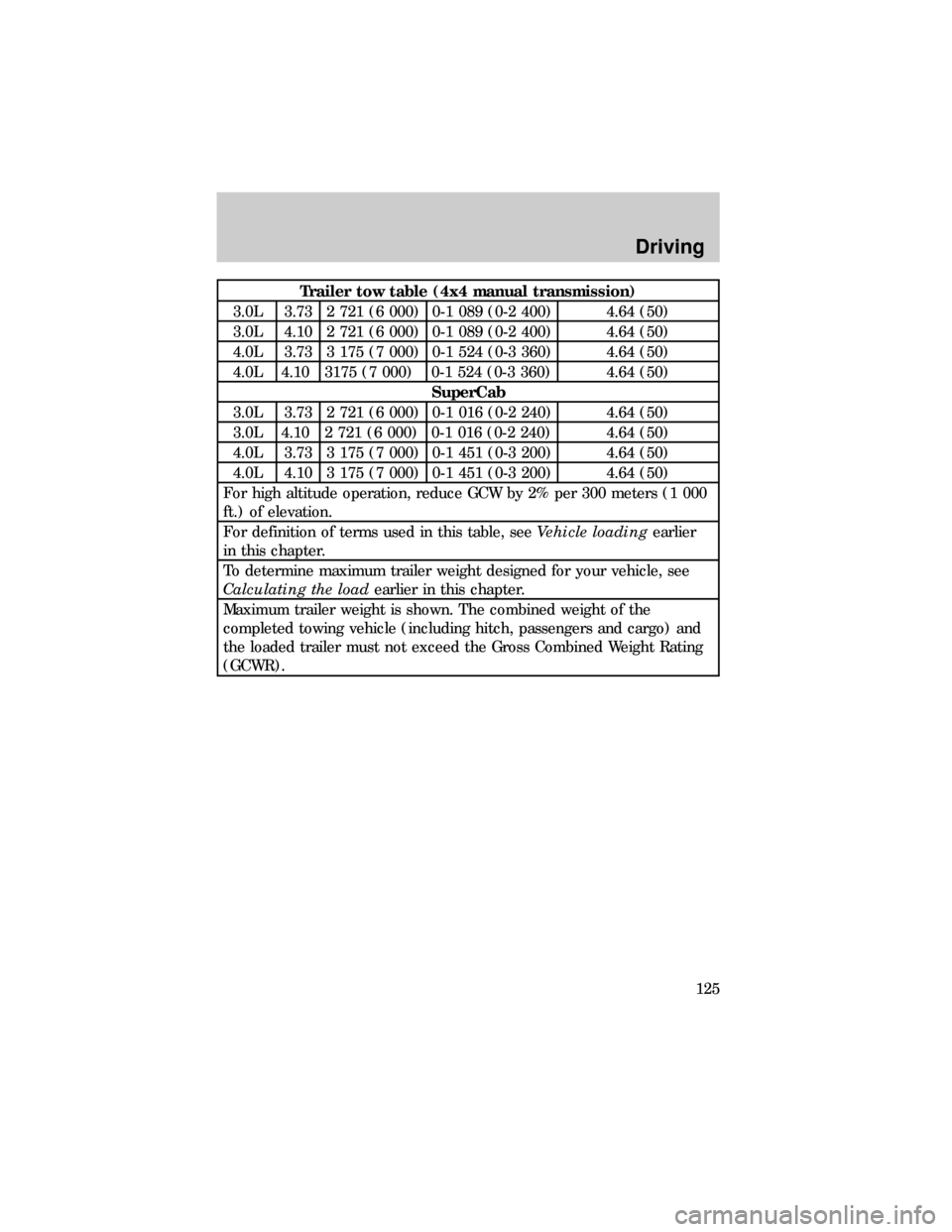
Trailer tow table (4x4 manual transmission)
3.0L 3.73 2 721 (6 000) 0-1 089 (0-2 400) 4.64 (50)
3.0L 4.10 2 721 (6 000) 0-1 089 (0-2 400) 4.64 (50)
4.0L 3.73 3 175 (7 000) 0-1 524 (0-3 360) 4.64 (50)
4.0L 4.10 3175 (7 000) 0-1 524 (0-3 360) 4.64 (50)
SuperCab
3.0L 3.73 2 721 (6 000) 0-1 016 (0-2 240) 4.64 (50)
3.0L 4.10 2 721 (6 000) 0-1 016 (0-2 240) 4.64 (50)
4.0L 3.73 3 175 (7 000) 0-1 451 (0-3 200) 4.64 (50)
4.0L 4.10 3 175 (7 000) 0-1 451 (0-3 200) 4.64 (50)
For high altitude operation, reduce GCW by 2% per 300 meters (1 000
ft.) of elevation.
For definition of terms used in this table, seeVehicle loadingearlier
in this chapter.
To determine maximum trailer weight designed for your vehicle, see
Calculating the loadearlier in this chapter.
Maximum trailer weight is shown. The combined weight of the
completed towing vehicle (including hitch, passengers and cargo) and
the loaded trailer must not exceed the Gross Combined Weight Rating
(GCWR).
Driving
125
Page 126 of 216
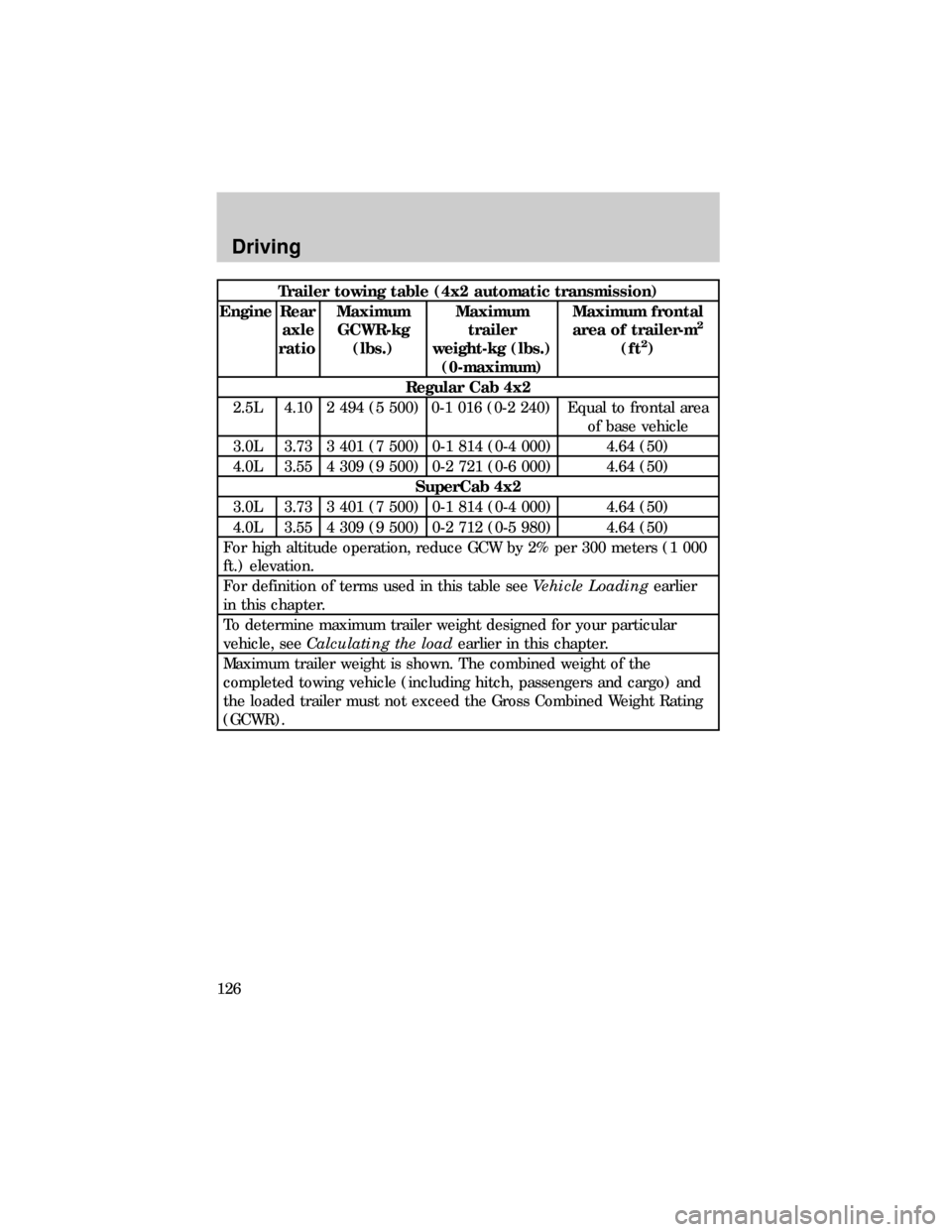
Trailer towing table (4x2 automatic transmission)
Engine Rear
axle
ratioMaximum
GCWR-kg
(lbs.)Maximum
trailer
weight-kg (lbs.)
(0-maximum)Maximum frontal
area of trailer-m
2
(ft2)
Regular Cab 4x2
2.5L 4.10 2 494 (5 500) 0-1 016 (0-2 240) Equal to frontal area
of base vehicle
3.0L 3.73 3 401 (7 500) 0-1 814 (0-4 000) 4.64 (50)
4.0L 3.55 4 309 (9 500) 0-2 721 (0-6 000) 4.64 (50)
SuperCab 4x2
3.0L 3.73 3 401 (7 500) 0-1 814 (0-4 000) 4.64 (50)
4.0L 3.55 4 309 (9 500) 0-2 712 (0-5 980) 4.64 (50)
For high altitude operation, reduce GCW by 2% per 300 meters (1 000
ft.) elevation.
For definition of terms used in this table seeVehicle Loadingearlier
in this chapter.
To determine maximum trailer weight designed for your particular
vehicle, seeCalculating the loadearlier in this chapter.
Maximum trailer weight is shown. The combined weight of the
completed towing vehicle (including hitch, passengers and cargo) and
the loaded trailer must not exceed the Gross Combined Weight Rating
(GCWR).
Driving
126
Page 127 of 216

Trailer tow table (4x4 automatic transmission)
Engine Rear
axle
ratioMaximum
GCWR-kg
(lbs.)Maximum
trailer
weight-kg (lbs.)Maximum frontal
area of trailer-m
2
(ft2)
Regular Cab
3.0L 3.73 3 401 (7 500) 0-1 751 (0-3 860) 4.64 (50)
3.0L 4.10 3 628 (8 000) 0-1 978 (0-4 360) 4.64 (50)
4.0L 3.73 4 309 (9 500) 0-2 640 (0-5 820) 4.64 (50)
4.0L 4.10 4 309 (9 500) 0-2 640 (0-5 820) 4.64 (50)
SuperCab
3.0L 3.73 3 401 (7 500) 0-1 678 (0-3 700) 4.64 (50)
3.0L 4.10 3 628 (8 000) 0-1 905 (0-4 200) 4.64 (50)
4.0L 3.73 4 309 (9 500) 0-2 567 (5 660) 4.64 (50)
4.0L 4.10 4 309 (9 500) 0-2 567 (0-5 660) 4.64 (50)
For high altitude operation, reduce GCW by 2% per 300 meters
(1 000 ft.) of elevation.
For definition of terms used in this table, seeVehicle loadingearlier
in this chapter.
To determine maximum trailer weight designed for your vehicle, see
Calculating the loadearlier in this chapter.
Maximum trailer weight is shown. The combined weight of the
completed towing vehicle (including hitch, passengers and cargo) and
the loaded trailer must not exceed the Gross Combined Weight Rating
(GCWR).
Do not exceed the GVWR or the GAWR specified on the Safety
Compliance Certification Label.
Towing trailers beyond the maximum recommended gross trailer
weight could result in engine damage, transmission/axle damage,
structural damage, loss of control, and personal injury.
Driving
127