Page 128 of 216
Preparing to tow
Use the proper equipment for towing a trailer, and make sure it is
properly attached to your vehicle. See your dealer or a reliable trailer
dealer if you require assistance.
Hitches
For towing trailers up to 907 kg (2 000 lb), use a weight carrying hitch
and ball which uniformly distributes the trailer tongue loads through the
underbody structure. Use a frame-mounted weight distrubuting hitch for
trailers over 907 kg (2 000 lb).
Do not install a single or multi-clamp type bumper hitch, or a hitch
which attaches to the axle. Underbody mounted hitches are acceptable if
they are installed properly. Follow the towing instructions of a reputable
rental agency.
Whenever a trailer hitch and hardware are removed, make sure all
mounting holes in the underbody are properly sealed to prevent noxious
gases or water from entering.
Safety chains
Always connect the trailer's safety chains to the vehicle. To connect the
trailer's safety chains, cross the chains under the trailer tongue and allow
slack for turning corners.
If you use a rental trailer, follow the instructions that the rental agency
gives to you.
Do not attach safety chains to the bumper.
Trailer brakes
Electric brakes and manual, automatic or surge-type brakes are safe if
installed properly and adjusted to the manufacturer's specifications. The
trailer brakes must meet local and Federal regulations.
Do not connect a trailer's hydraulic brake system directly to your
vehicle's brake system. Your vehicle may not have enough
braking power and your chances of having a collision greatly increase.
The braking system of the tow vehicle is rated for operation at the
GVWR not GCWR.
Driving
128
Page 129 of 216

Trailer lamps
Trailer lamps are required on most towed vehicles. Make sure your
trailer lamps conform to local and Federal regulations. See your dealer or
trailer rental agency for proper instructions and equipment for hooking
up trailer lamps.
Using a step bumper
The optional step bumper is equipped with an integral hitch and requires
only a ball with a 19 mm (3/4 inch) shank diameter. The bumper has a
907 kg (2 000 lb.) trailer weight and 91 kg (200 lb.) tongue weight
capability.
The rated capcities (as shown in this guide) for trailer towing with the
factory bumper are only valid when the trailer hitch ball is installed
directly into the ball hole in the bumper. Addition of bracketry to either
lower the ball hitch position or extend the ball hitch rearward will
significantly increase the loads on the bumper and its attachments. This
can result in the failure of the bumper or the bumper attachments. Use
of any type of hitch extensions should be considered abuse.
Driving while you tow
Do not drive faster than 88 km/h (55 mph) when towing a trailer.
Speed control may shut off if you are towing on long, steep grades.
When towing a trailer:
²Use a lower gear when towing up or down steep hills. This will
eliminate excessive downshifting and upshifting for optimum fuel
economy and transmission cooling.
²Anticipate stops and brake gradually.
Exceeding the GCWR rating may cause internal transmission
damage and void your warranty coverage.
Servicing after towing
If you tow a trailer for long distances, your vehicle will require more
frequent service intervals. Refer to your maintenance guide and or
service guide for more information.
Driving
129
Page 131 of 216
These guidelines are designed to ensure that your transmission is not
damaged due to insufficient lubrication.
2WD (automatic transmissions)
²Release the parking brake and place the transmission in N (Neutral).
²Maximum speed is 56 km/h (35 mph).
²Maximum distance is 80 km (50 miles).
If a distance of 80 km (50 miles) or a speed of 56 km/h (35 mph) must
be exceeded, you must disconnect the driveshaft. Mark the driveshaft
and axle flanges to ensure proper position when reconnecting the
driveshaft. Refer to the ªWorkshop Manualº for proper fastener torque
specifications.
When disconnecting/installing the driveshaft, the parking brake
must be set and the wheels blocked to ensure the vehicle does
not roll.
With the driveshaft disconnected, the maximum speed is 88 km/h (55
mph) and there are no mileage restrictions.
See your dealer for help with disconnecting the driveshaft.
2WD (manual transmissions)
²Release the parking brake and place the transmission in the neutral
position.
²Maximum speed is 56 km/h (35 mph).
²Maximum distance is limited by towing equipment manufacturer's
recommendation.
4WD ± Electronic shift transfer case
²Release the parking brake and place transmission in the neutral
position.
²Shift the transfer case to 2H (2WD high).
Both the 4WD HIGH and 4WD LOW indicator lights in the instrument
cluster will be off when the 4WD control is in 2WD.
Driving
131
Page 132 of 216
For automatic transmissions,maximum speed is 56 km/h (35 mph)
and maximum distance is 80 km (50 miles).
²If you must exceed the distance or 80 km (50 miles) and/or speed of
56 km/h (35 mph), you must remove the rear driveshaft. Mark the
driveshaft and axle flanges to ensure proper position when
reconnecting the driveshaft. Refer to the ªWorkshop Manualº for
proper fastener torque specifications.
When disconnecting/installing the driveshaft, the parking brake
must be set and the wheels blocked to ensure the vehicle does
not roll.
²When the driveshaft is disconnected, the maximum speed is 88 km/h
(55 mph) and the distance is unlimited.
For manual transmissions,maximum speed is 88 km/h (55 mph) and
distance is unlimited.
Limited vehicle operation, such as driving the vehicle at a campsite, can
be accomplished with the rear driveshaft removed by using the front
drive to propel the vehicle. To operate the vehicle in this condition, you
mustfollow these guidelines:
²Place the transfer case in 4WD by rotating the 4WD control to 4WD
HIGH.
²Drive the vehicle only on good surface roads to avoid excessive loads
on the front-wheel drive system.
²Maximum speed is 56 km/h (35 mph).
²Maximum distance is 80 km (50 miles).
²Avoid quick acceleration and steep grades.
To return the vehicle to a towable condition, youmustplace the transfer
case in 2WD by rotating the 4WD control to 2WD. Both the 4WD HIGH
and 4WD LOW indicator lights in the instrument cluster will be off when
the 4WD control is in 2WD.
In addition, it is recommended that you follow the instruction provided
by the manufacturer of the towing apparatus.
CAMPER BODIES
Your Ranger Pickup is not recommended for slide±in camper bodies.
Driving
132
Page 136 of 216
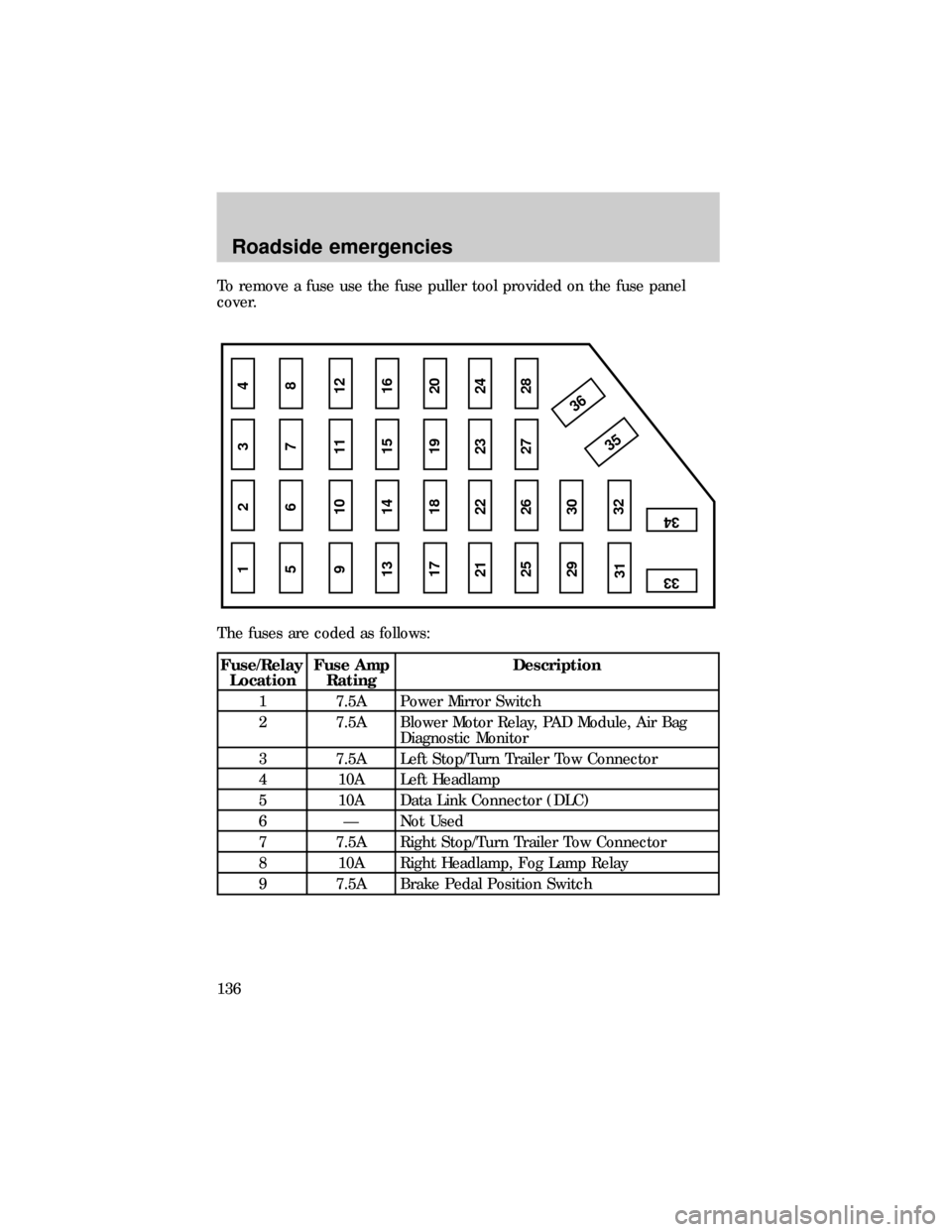
To remove a fuse use the fuse puller tool provided on the fuse panel
cover.
The fuses are coded as follows:
Fuse/Relay
LocationFuse Amp
RatingDescription
1 7.5A Power Mirror Switch
2 7.5A Blower Motor Relay, PAD Module, Air Bag
Diagnostic Monitor
3 7.5A Left Stop/Turn Trailer Tow Connector
4 10A Left Headlamp
5 10A Data Link Connector (DLC)
6 Ð Not Used
7 7.5A Right Stop/Turn Trailer Tow Connector
8 10A Right Headlamp, Fog Lamp Relay
9 7.5A Brake Pedal Position Switch
1 234
5 678
9 101112
13 14 15 16
17 18 19 20
21 22 23 24
25 26
29 30
35 36
313233
34
27 28
Roadside emergencies
136
Page 137 of 216

Fuse/Relay
LocationFuse Amp
RatingDescription
10 7.5A Speed Control Servo/Amplifier Assembly,
Generic Electronic Module (GEM), Shift Lock
Actuator, Blend Door Actuator, A/C-Heater
Assembly, Turn Signals
11 7.5A Instrument Cluster, Daytime Running Lights
(DRL), RABS Resistor
12 Ð Not Used
13 20A Brake Pedal Position Switch
14 20A or 10A 20A: If equipped with Rear Anti-Lock Brake
System (RABS) Module.
10A: If equipped with 4 Wheel Anti-Lock
Brake System (4WABS) Module, 4WABS Main
Relay
15 7.5A Air Bag Indicator Lamp, Alternator Indicator
Lamp
16 30A Windshield Wiper Motor, Wiper Hi-Lo Relay,
Wiper Run/Park Relay
17 25A Cigar Lighter
18 15A Driver's Unlock Relay, All-Unlock Relay,
All-Lock Relay
19 25A PCM Power Diode
20 7.5A RAP Module, Generic Electronic Module
(GEM), Radio
21 15A Flasher (Hazard)
22 20A Auxiliary Power Socket
23 Ð Not Used
24 7.5A Clutch Pedal Position (CPP) switch, Starter
Interrupt Relay, Anti-Theft
25 7.5A Generic Electronic Module (GEM),
Instrument Cluster
26 10A Battery Saver Relay, Electronic Shift Relay,
Interior Lamp Relay, Power Window Relay,
Electronic Shift Control Module, Dome/Map
Lamp, GEM
Roadside emergencies
137
Page 139 of 216
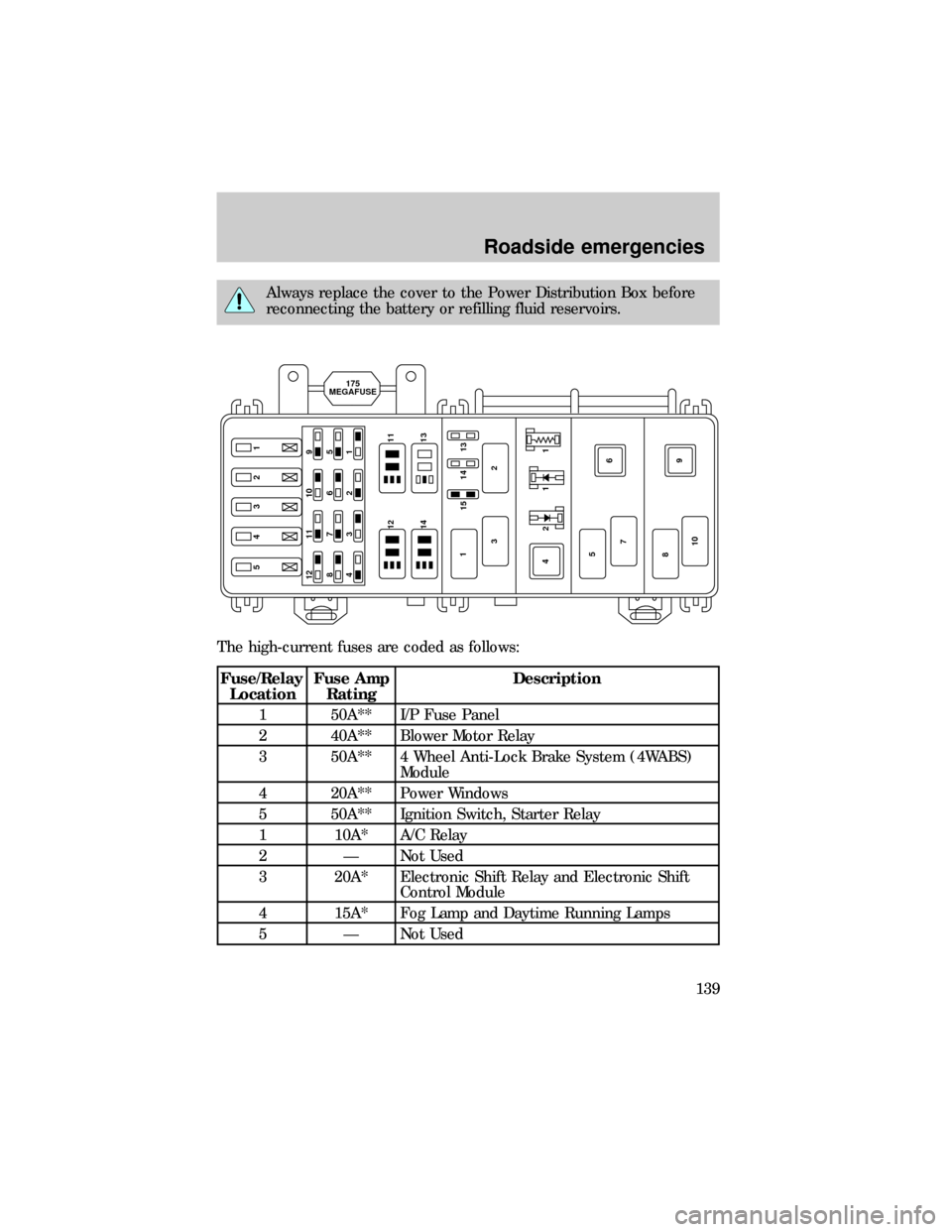
Always replace the cover to the Power Distribution Box before
reconnecting the battery or refilling fluid reservoirs.
The high-current fuses are coded as follows:
Fuse/Relay
LocationFuse Amp
RatingDescription
1 50A** I/P Fuse Panel
2 40A** Blower Motor Relay
3 50A** 4 Wheel Anti-Lock Brake System (4WABS)
Module
4 20A** Power Windows
5 50A** Ignition Switch, Starter Relay
1 10A* A/C Relay
2 Ð Not Used
3 20A* Electronic Shift Relay and Electronic Shift
Control Module
4 15A* Fog Lamp and Daytime Running Lamps
5 Ð Not Used
5432112 11 10 9
876 5
432 1
14 15 13
9 6
10 87 5 41
2 3
211
175
MEGAFUSE
11
13 12
14
Roadside emergencies
139
Page 140 of 216
Fuse/Relay
LocationFuse Amp
RatingDescription
6 10A* Powertrain Control Module
7 30A* 4 Wheel Anti-lock Brake System (4WABS)
Module
8 30A* PCM Relay
9 20A* Fuel Pump Relay and RAP Module
10 15A* Horn Relay
11 15A* Parklamps Relay and Main Light Switch
12 30A* Main Light Switch and Multifunction Switch
13 15A* Heated Oxygen Sensor, EGR Vacuum
Regulator, EVR Solenoid, Camshaft Position
Sensor (CMP), Canister Vent Solenoid
14 30A* Generator Voltage Regulator
15 Ð Not Used
1 Ð Wiper Park Relay
2 Ð A/C Relay
3 Ð Wiper Hi/Lo Relay
4 Ð PCM Power Relay
5 Ð Fuel Pump Relay
6 Ð Starter Relay
7 Ð Horn Relay
8 Ð Fog Lamp Control Relay
9 Ð Blower Motor Relay
10 Ð Foglamp Isolation Relay
11 Ð Not Used
12 Ð Not Used
13 Ð Park Lamp/Trailer Tow Relay
14 Ð Washer Pump Relay
1 Ð RABS Resistor
1 Ð RABS Diode
2 Ð Electronic Engine Controls Diode
* Mini Fuses ** Maxi Fuses
Roadside emergencies
140