Page 128 of 216
Preparing to tow
Use the proper equipment for towing a trailer, and make sure it is
properly attached to your vehicle. See your dealer or a reliable trailer
dealer if you require assistance.
Hitches
For towing trailers up to 907 kg (2 000 lb), use a weight carrying hitch
and ball which uniformly distributes the trailer tongue loads through the
underbody structure. Use a frame-mounted weight distrubuting hitch for
trailers over 907 kg (2 000 lb).
Do not install a single or multi-clamp type bumper hitch, or a hitch
which attaches to the axle. Underbody mounted hitches are acceptable if
they are installed properly. Follow the towing instructions of a reputable
rental agency.
Whenever a trailer hitch and hardware are removed, make sure all
mounting holes in the underbody are properly sealed to prevent noxious
gases or water from entering.
Safety chains
Always connect the trailer's safety chains to the vehicle. To connect the
trailer's safety chains, cross the chains under the trailer tongue and allow
slack for turning corners.
If you use a rental trailer, follow the instructions that the rental agency
gives to you.
Do not attach safety chains to the bumper.
Trailer brakes
Electric brakes and manual, automatic or surge-type brakes are safe if
installed properly and adjusted to the manufacturer's specifications. The
trailer brakes must meet local and Federal regulations.
Do not connect a trailer's hydraulic brake system directly to your
vehicle's brake system. Your vehicle may not have enough
braking power and your chances of having a collision greatly increase.
The braking system of the tow vehicle is rated for operation at the
GVWR not GCWR.
Driving
128
Page 129 of 216

Trailer lamps
Trailer lamps are required on most towed vehicles. Make sure your
trailer lamps conform to local and Federal regulations. See your dealer or
trailer rental agency for proper instructions and equipment for hooking
up trailer lamps.
Using a step bumper
The optional step bumper is equipped with an integral hitch and requires
only a ball with a 19 mm (3/4 inch) shank diameter. The bumper has a
907 kg (2 000 lb.) trailer weight and 91 kg (200 lb.) tongue weight
capability.
The rated capcities (as shown in this guide) for trailer towing with the
factory bumper are only valid when the trailer hitch ball is installed
directly into the ball hole in the bumper. Addition of bracketry to either
lower the ball hitch position or extend the ball hitch rearward will
significantly increase the loads on the bumper and its attachments. This
can result in the failure of the bumper or the bumper attachments. Use
of any type of hitch extensions should be considered abuse.
Driving while you tow
Do not drive faster than 88 km/h (55 mph) when towing a trailer.
Speed control may shut off if you are towing on long, steep grades.
When towing a trailer:
²Use a lower gear when towing up or down steep hills. This will
eliminate excessive downshifting and upshifting for optimum fuel
economy and transmission cooling.
²Anticipate stops and brake gradually.
Exceeding the GCWR rating may cause internal transmission
damage and void your warranty coverage.
Servicing after towing
If you tow a trailer for long distances, your vehicle will require more
frequent service intervals. Refer to your maintenance guide and or
service guide for more information.
Driving
129
Page 130 of 216

Trailer towing tips
²Practice turning, stopping and backing up in an area before starting on
a trip to get the feel of the vehicle trailer combination. When turning,
make wider turns so the trailer wheels will clear curbs and other
obstacles.
²Allow more distance for stopping with a trailer attached.
²The trailer tongue weight should be 10±15% of the loaded trailer
weight.
²After you have traveled 80 km (50 miles), thoroughly check your
hitch, electrical connections and trailer wheel lug nuts.
²When stopped in traffic for long periods of time in hot weather, place
the gearshift in P (Park) (automatic transmissions) or N (Neutral)
(manual transmissions). This aids engine cooling and air conditioner
efficiency.
²Vehicles with trailers should not be parked on a grade. If you must
park on a grade, place wheel chocks under the trailer's wheels.
Launching or retrieving a boat
When backing down a ramp during boat launching or retrieval,
²Do not allow the static water level to rise above the bottom edge of
the rear bumper and
²Do not allow waves to break higher than 15 cm (six inches) above the
bottom edge of the rear bumper.
Exceeding these limits may allow water to enter critical vehicle
components, adversely affecting driveability, emissions, reliability and
causing internal transmission damage.
Replace the rear axle lubricant anytime the axle has been submerged in
water. Rear axle lubricant quantities are not to be checked or changed
unless a leak is suspected or repair required.
Disconnect the wiring to the trailer before backing the trailer into the
water. Reconnect the wiring to the trailer after the trailer is removed
from the water.
Recreational towing (all wheels on the ground)
Follow these guidelines for your specific powertrain combination to tow
your vehicle with all four wheels on the ground (such as behind a
recreational vehicle).
Driving
130
Page 136 of 216
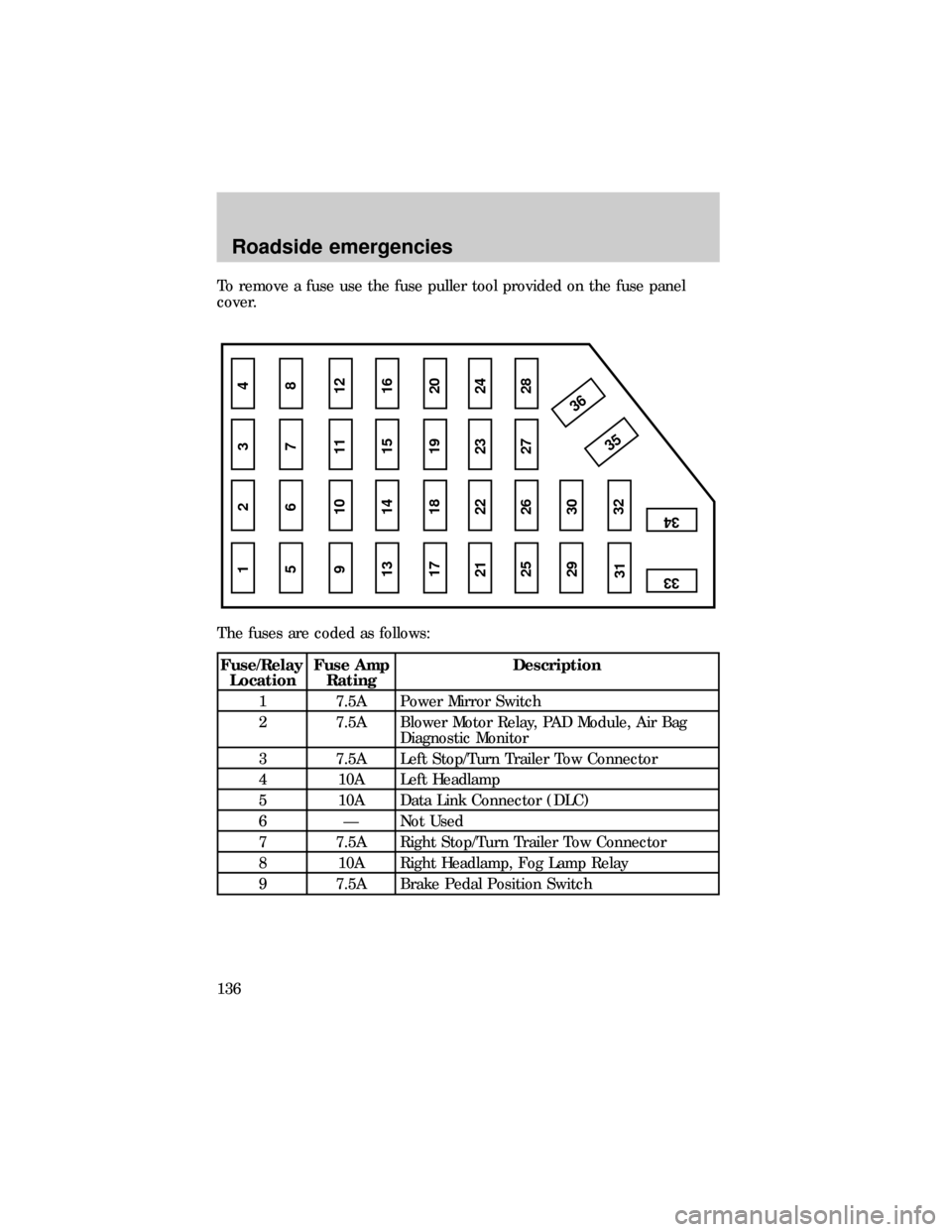
To remove a fuse use the fuse puller tool provided on the fuse panel
cover.
The fuses are coded as follows:
Fuse/Relay
LocationFuse Amp
RatingDescription
1 7.5A Power Mirror Switch
2 7.5A Blower Motor Relay, PAD Module, Air Bag
Diagnostic Monitor
3 7.5A Left Stop/Turn Trailer Tow Connector
4 10A Left Headlamp
5 10A Data Link Connector (DLC)
6 Ð Not Used
7 7.5A Right Stop/Turn Trailer Tow Connector
8 10A Right Headlamp, Fog Lamp Relay
9 7.5A Brake Pedal Position Switch
1 234
5 678
9 101112
13 14 15 16
17 18 19 20
21 22 23 24
25 26
29 30
35 36
313233
34
27 28
Roadside emergencies
136
Page 138 of 216
Fuse/Relay
LocationFuse Amp
RatingDescription
27 15A Electric Shift, Backup Lamps, Daytime
Running Lamps (DRL), Transmission Control
Switch, Pulse Vacuum Hub Lock
28 7.5A Generic Electronic Module (GEM), Radio
29 15A Radio
30 10A RABS Test Connector
31 Ð Not Used
32 Ð Not Used
33 15A Headlamps, Daytime Running Lamps (DRL)
Module, Instrument Cluster
34 Ð Not Used
35 15A Park Lamp/Trailer Tow Relay
36 Ð Not Used
Power distribution box
The power distribution box is
located in the engine compartment
near the battery. The power
distribution box contains
high-current fuses that protect your
vehicle's main electrical systems
from overloads.
Always disconnect the battery before servicing high current
fuses.
Roadside emergencies
138
Page 140 of 216
Fuse/Relay
LocationFuse Amp
RatingDescription
6 10A* Powertrain Control Module
7 30A* 4 Wheel Anti-lock Brake System (4WABS)
Module
8 30A* PCM Relay
9 20A* Fuel Pump Relay and RAP Module
10 15A* Horn Relay
11 15A* Parklamps Relay and Main Light Switch
12 30A* Main Light Switch and Multifunction Switch
13 15A* Heated Oxygen Sensor, EGR Vacuum
Regulator, EVR Solenoid, Camshaft Position
Sensor (CMP), Canister Vent Solenoid
14 30A* Generator Voltage Regulator
15 Ð Not Used
1 Ð Wiper Park Relay
2 Ð A/C Relay
3 Ð Wiper Hi/Lo Relay
4 Ð PCM Power Relay
5 Ð Fuel Pump Relay
6 Ð Starter Relay
7 Ð Horn Relay
8 Ð Fog Lamp Control Relay
9 Ð Blower Motor Relay
10 Ð Foglamp Isolation Relay
11 Ð Not Used
12 Ð Not Used
13 Ð Park Lamp/Trailer Tow Relay
14 Ð Washer Pump Relay
1 Ð RABS Resistor
1 Ð RABS Diode
2 Ð Electronic Engine Controls Diode
* Mini Fuses ** Maxi Fuses
Roadside emergencies
140
Page 141 of 216
CHANGING THE TIRES
If you get a flat tire while driving, do not apply the brake heavily.
Instead, gradually decrease your speed. Hold the steering wheel firmly
and slowly move to a safe place on the side of the road.
Temporary spare tire information
Your vehicle may have a temporary or conventional spare tire. The
temporary spare tire for your vehicle is labeled as such. It is smaller than
a regular tire and is designed for emergency use only. Replace this tire
with a full-size tire as soon as possible.
It is not recommended that the vehicle be operated in 4WD modes with
a temporary spare. If 4WD operation is necessary, do not operate above
speeds of 16 km/h (10 mph) or for distances above 80 km (50 miles).
If you use the temporary spare tire continuously or do not follow
these precautions, the tire could fail, causing you to lose control
of the vehicle, possibly injuring yourself or others.
When driving with the temporary spare tiredo not:
²exceed 80 km/h (50 mph) under any circumstances
²load the vehicle beyond maximum vehicle load rating listed on the
Safety Compliance Label
²tow a trailer
²use tire chains
²drive through an automatic car wash, because of the vehicle's reduced
ground clearance
²try to repair the temporary spare tire or remove it from its wheel
²use the wheel for any other type of vehicle
Conventional spare tire information
If you have the conventional spare tire, you can use it as a spare or a
regular tire. The spare is identical to the other tires on your vehicle,
although the wheel may not match.
Roadside emergencies
141
Page 166 of 216

4. Check the fluid level on the dipstick. It should be between the arrows
in the FULL HOT range. Do not add fluid if the level is within this range.
5. If the fluid is low, add fluid in small amounts, continuously checking
the level until it reaches the FULL HOT range. Be sure to put the
dipstick back in the reservoir.
TRANSMISSION FLUID
Checking automatic transmission fluid
Refer to your maintenance guide and or service guide for scheduled
intervals for fluid checks and changes. Your transmission does not
consume fluid. However, the fluid level should be checked if the
transmission is not working properly, i.e., if the transmission slips or
shifts slowly or if you notice some sign of fluid leakage.
Automatic transmission fluid expands when warmed. To obtain an
accurate fluid check, drive the vehicle until it is warmed up
(approximately 30 km [20 miles]). If your vehicle has been operated for
an extended period at high speeds, in city traffic during hot weather or
pulling a trailer, the vehicle should be turned off for about 30 minutes to
allow fluid to cool before checking.
1. Drive the vehicle 30 km (20 miles) or until it reaches normal operating
temperature.
2. Park the vehicle on a level surface and engage the parking brake.
3. With the parking brake engaged and your foot on the brake pedal,
start the engine and move the gearshift lever through all of the gear
ranges. Allow sufficient time for each gear to engage.
4. Latch the gearshift lever in P (Park) and leave the engine running.
5. Remove the dipstick, wiping it clean with a clean, dry lint free rag.
6. Install the dipstick making sure it is fully seated in the filler tube.
7. Remove the dipstick and inspect the fluid level. The fluid should be in
the designated areas for normal and room temperature.
Maintenance and care
166