Page 130 of 216

SERVICE RECOMMENDATIONS
To help you service your vehicle:
²We highlight do-it-yourself items in the engine
compartment for easy location.
²We provide a Scheduled Maintenance Guide which
makes tracking routine service easy.
If your vehicle requires professional service, your
dealership can provide necessary parts and service.
Check your ªWarranty Guideº to find out which parts
and services are covered.
Use only recommended fuels, lubricants, fluids and
service parts conforming to specifications. Motorcraft
parts are designed and built to provide the best
performance in your vehicle.
PRECAUTIONS WHEN SERVICING YOUR
VEHICLE
Be especially careful when inspecting or servicing
your vehicle.
²Do not work on a hot engine.
²When the engine is running, keep loose clothing,
jewelry or long hair away from moving parts.
²Do not work on a vehicle with the engine running
in an enclosed space, unless you are sure you
have enough ventilation.
²Keep all lit cigarettes, open flames and other lit
material away from the battery and all fuel related
parts.
If you disconnect the battery, the engine must
ªrelearnº its idle conditions before your vehicle will
drive properly, as explained in theBatterysection in
this chapter.
Working with the engine off
²Automatic transmission:
1. Set the parking brake and ensure the gearshift is
securely latched in P (Park).
Maintenance and care
130
Page 131 of 216
2. Turn off the engine and remove the key.
3. Block the wheels to prevent the vehicle from
moving unexpectedly.
²Manual transmission:
1. Set the parking brake.
2. Depress the clutch and place the gearshift in 1
(First).
3. Turn off the engine and remove the key.
4. Block the wheels to prevent the vehicle from
moving unexpectedly.
Working with the engine on
²Automatic transmission:
1. Set the parking brake and ensure the gearshift is
securely latched in P (Park).
2. Block the wheels to prevent the vehicle from
moving unexpectedly.
Do not start your engine with the air cleaner
removed and do not remove it while the
engine is running.
²Manual transmission:
1. Set the parking brake, depress the clutch and
place the gearshift in N (Neutral).
2. Block the wheels to prevent the vehicle from
moving unexpectedly.
Do not start your engine with the air cleaner
removed and do not remove it while the
engine is running.
Maintenance and care
131
Page 133 of 216
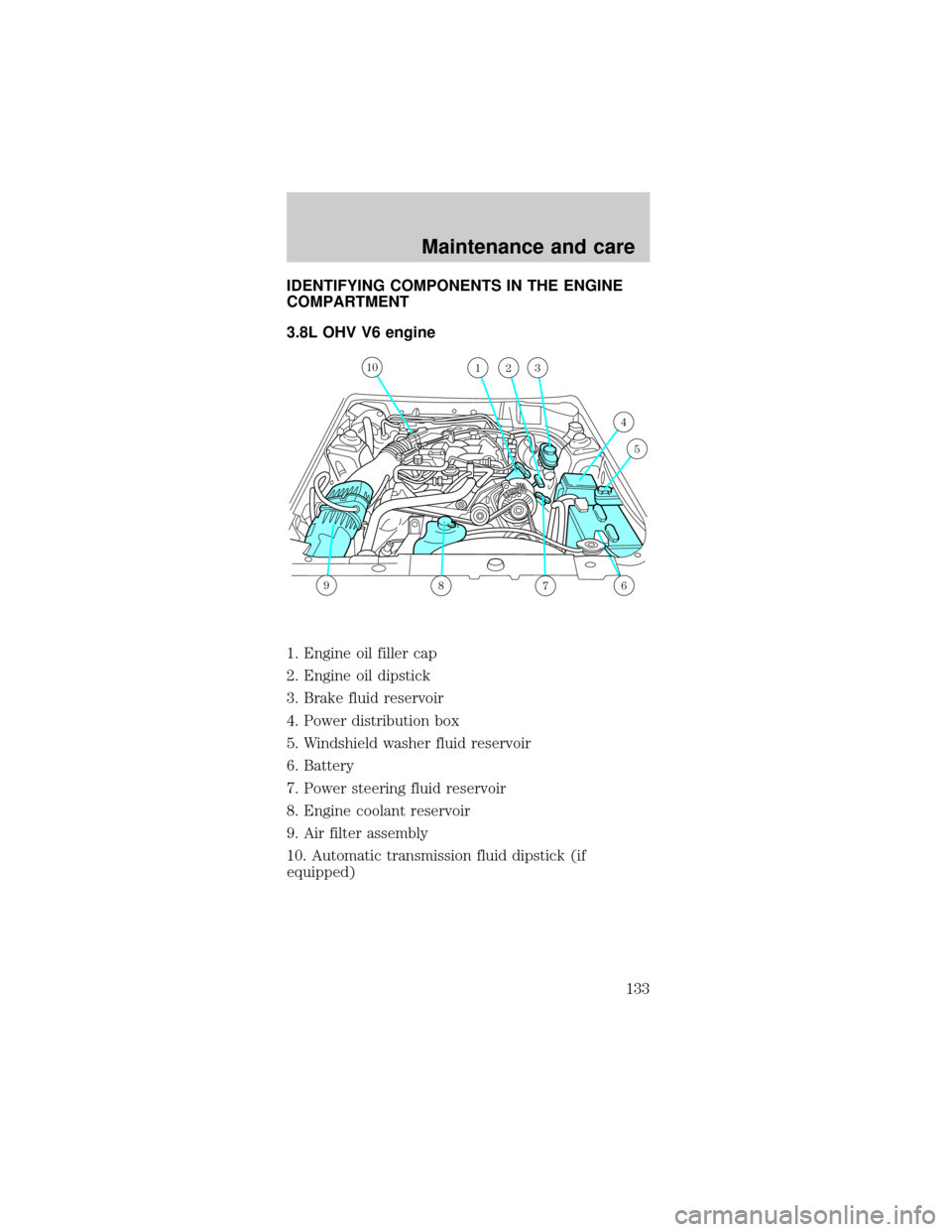
IDENTIFYING COMPONENTS IN THE ENGINE
COMPARTMENT
3.8L OHV V6 engine
1. Engine oil filler cap
2. Engine oil dipstick
3. Brake fluid reservoir
4. Power distribution box
5. Windshield washer fluid reservoir
6. Battery
7. Power steering fluid reservoir
8. Engine coolant reservoir
9. Air filter assembly
10. Automatic transmission fluid dipstick (if
equipped)
6
1023
4
5
789
1
Maintenance and care
133
Page 134 of 216
4.6L SOHC V8 engine
1. Engine oil dipstick
2. Brake fluid reservoir
3. Power distribution box
4. Windshield washer fluid reservoir
5. Battery
6. Engine coolant reservoir
7. Power steering fluid reservoir
8. Engine oil filler cap
9. Air filter assembly
10. Automatic transmission fluid dipstick (if
equipped)
ENGINE OIL
Checking the engine oil
Refer to the Scheduled Maintenance Guide for the
appropriate intervals for checking the engine oil.
1. Make sure the vehicle is on level ground.
56798
23
4
110
Maintenance and care
134
Page 135 of 216
2. Turn the engine off and wait a few minutes for
the oil to drain into the oil pan.
3. Set the parking brake and ensure the gearshift is
securely latched in P (Park) (automatic
transmissions) or 1 (First) (manual transmissions).
4. Open the hood. Protect yourself from engine heat.
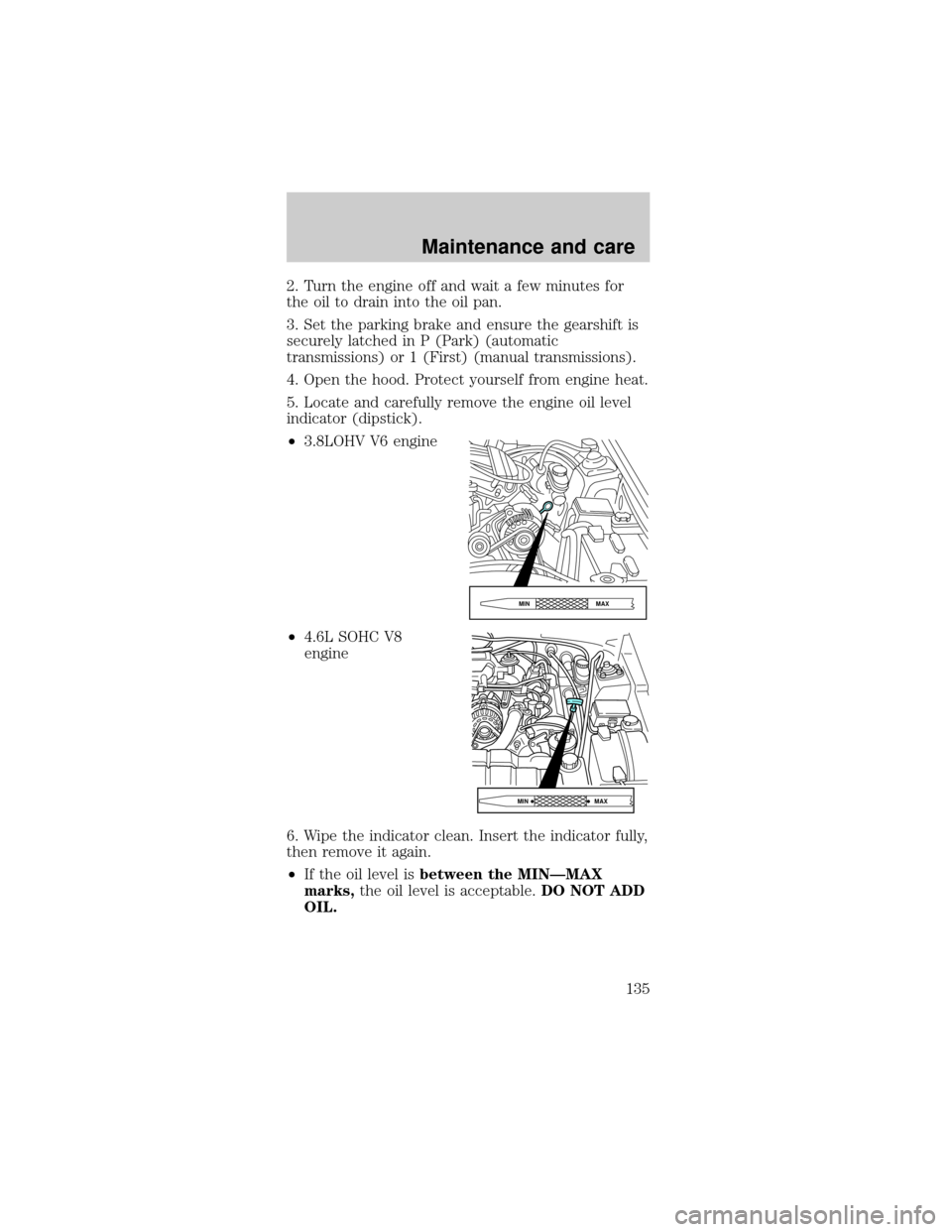
5. Locate and carefully remove the engine oil level
indicator (dipstick).
²3.8LOHV V6 engine
²4.6L SOHC V8
engine
6. Wipe the indicator clean. Insert the indicator fully,
then remove it again.
²If the oil level isbetween the MINÐMAX
marks,the oil level is acceptable.DO NOT ADD
OIL.
MAX MIN
MAX MIN
Maintenance and care
135
Page 146 of 216

If your vehicle is
equipped with a 4.6L
V8 engine,check the
power steering fluid
level with the engine at
ambient temperature.
Allow at least one-half
hour after driving for
the power steering
fluid to cool.
1. Start the engine and
allow the engine to
idle.
2. Turn the steering
wheel left and right
several times.
3. Turn the engine off.
4. Check the fluid level in the reservoir. It should be
between the MIN and MAX lines. Do not add fluid if
the level is within this range.
5. If the fluid is low, add fluid in small amounts,
continuously checking the level until it reaches the
correct operating range. Be sure to put the cap back
on the reservoir.
TRANSMISSION FLUID
Checking automatic transmission fluid
Refer to your Scheduled Maintenance Guide for
scheduled intervals for fluid checks and changes.
Your transmission does not consume fluid. However,
the fluid level should be checked if the transmission
is not working properly, i.e., if the transmission slips
or shifts slowly or if you notice some sign of fluid
leakage.
Automatic transmission fluid expands when warmed.
To obtain an accurate fluid check, drive the vehicle
until it is at normal operating temperature
(approximately 30 km [20 miles]). If your vehicle has
MAXMIN
Maintenance and care
146
Page 148 of 216
![FORD MUSTANG 1999 4.G Owners Manual could result when the vehicle reaches normal
operating temperature.
The transmission fluid
should be in this range
if at normal operating
temperature (66ÉC-77ÉC [150ÉF-170ÉF]).
The transmission fl](/manual-img/11/5206/w960_5206-147.png "FORD MUSTANG 1999 4.G Owners Manual could result when the vehicle reaches normal
operating temperature.
The transmission fluid
should be in this range
if at normal operating
temperature (66ÉC-77ÉC [150ÉF-170ÉF]).
The transmission fl")
could result when the vehicle reaches normal
operating temperature.
The transmission fluid
should be in this range
if at normal operating
temperature (66ÉC-77ÉC [150ÉF-170ÉF]).
The transmission fluid
should be in this range
if at ambient
temperature (10ÉC-35ÉC [50ÉF-95ÉF]).
High fluid level
Fluid levels above the
safe range may result
in transmission failure.
An overfill condition of transmission fluid may cause
shift and/or engagement concerns and/or possible
damage.
High fluid levels can be caused by an overheating
condition.
Adjusting automatic transmission fluid levels
Before adding any fluid, make sure the correct type
is used. The type of fluid used is normally indicated
on the dipstick and/or dipstick handle and also in
theLubricant specificationssection in the
Capacities and specificationschapter.
Use of a non-approved automatic transmission
fluid may cause internal transmission
component damage.
If necessary, add fluid in 250 mL (1/2 pint)
increments through the filler tube until the level is
correct.
If an overfill occurs,
excess fluid should be
removed by a qualified
technician.
Maintenance and care
148
Page 151 of 216
Batteries normally produce explosive gases
which can cause personal injury. Therefore,
do not allow flames, sparks or lighted substances
to come near the battery. When working near the
battery, always shield your face and protect your
eyes. Always provide proper ventilation.
When lifting a plastic-cased battery,
excessive pressure on the end walls could
cause acid to flow through the vent caps, resulting
in personal injury and/or damage to the vehicle or
battery. Lift the battery with a battery carrier or
with your hands on opposite corners.
Keep batteries out of reach of children.
Batteries contain sulfuric acid. Avoid contact
with skin, eyes or clothing. Shield your eyes when
working near the battery to protect against
possible splashing of acid solution. In case of acid
contact with skin or eyes, flush immediately with
water for a minimum of 15 minutes and get
prompt medical attention. If acid is swallowed, call
a physician immediately.
Because your vehicle's engine is electronically
controlled by a computer, some control conditions
are maintained by power from the battery. When the
battery is disconnected or a new battery is installed,
the engine must relearn its idle and fuel trim
strategy for optimum driveability and performance.
To begin this process:
1. Set your parking brake.
2. Put the gearshift in P (Park) (automatic
transmission) or the neutral position (manual
transmission), turn off all accessories and start the
engine.
3. Let the engine idle for at least one minute.
Maintenance and care
151