Page 170 of 264
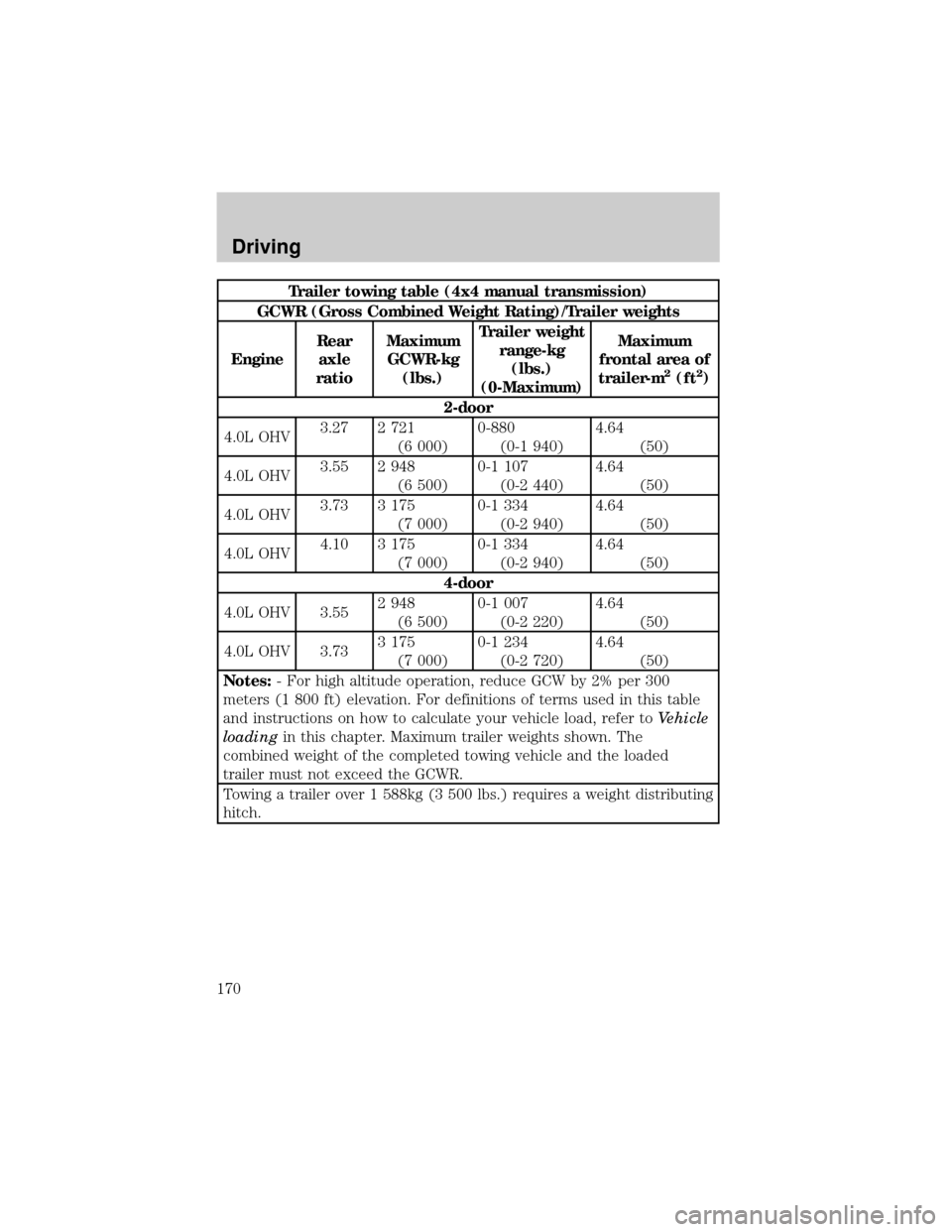
Trailer towing table (4x4 manual transmission)
GCWR (Gross Combined Weight Rating)/Trailer weights
EngineRear
axle
ratioMaximum
GCWR-kg
(lbs.)Trailer weight
range-kg
(lbs.)
(0-Maximum)Maximum
frontal area of
trailer-m
2(ft2)
2-door
4.0L OHV3.27 2 721
(6 000)0-880
(0-1 940)4.64
(50)
4.0L OHV3.55 2 948
(6 500)0-1 107
(0-2 440)4.64
(50)
4.0L OHV3.73 3 175
(7 000)0-1 334
(0-2 940)4.64
(50)
4.0L OHV4.10 3 175
(7 000)0-1 334
(0-2 940)4.64
(50)
4-door
4.0L OHV 3.552 948
(6 500)0-1 007
(0-2 220)4.64
(50)
4.0L OHV 3.733 175
(7 000)0-1 234
(0-2 720)4.64
(50)
Notes:- For high altitude operation, reduce GCW by 2% per 300
meters (1 800 ft) elevation. For definitions of terms used in this table
and instructions on how to calculate your vehicle load, refer toVehicle
loadingin this chapter. Maximum trailer weights shown. The
combined weight of the completed towing vehicle and the loaded
trailer must not exceed the GCWR.
Towing a trailer over 1 588kg (3 500 lbs.) requires a weight distributing
hitch.
Driving
170
Page 171 of 264
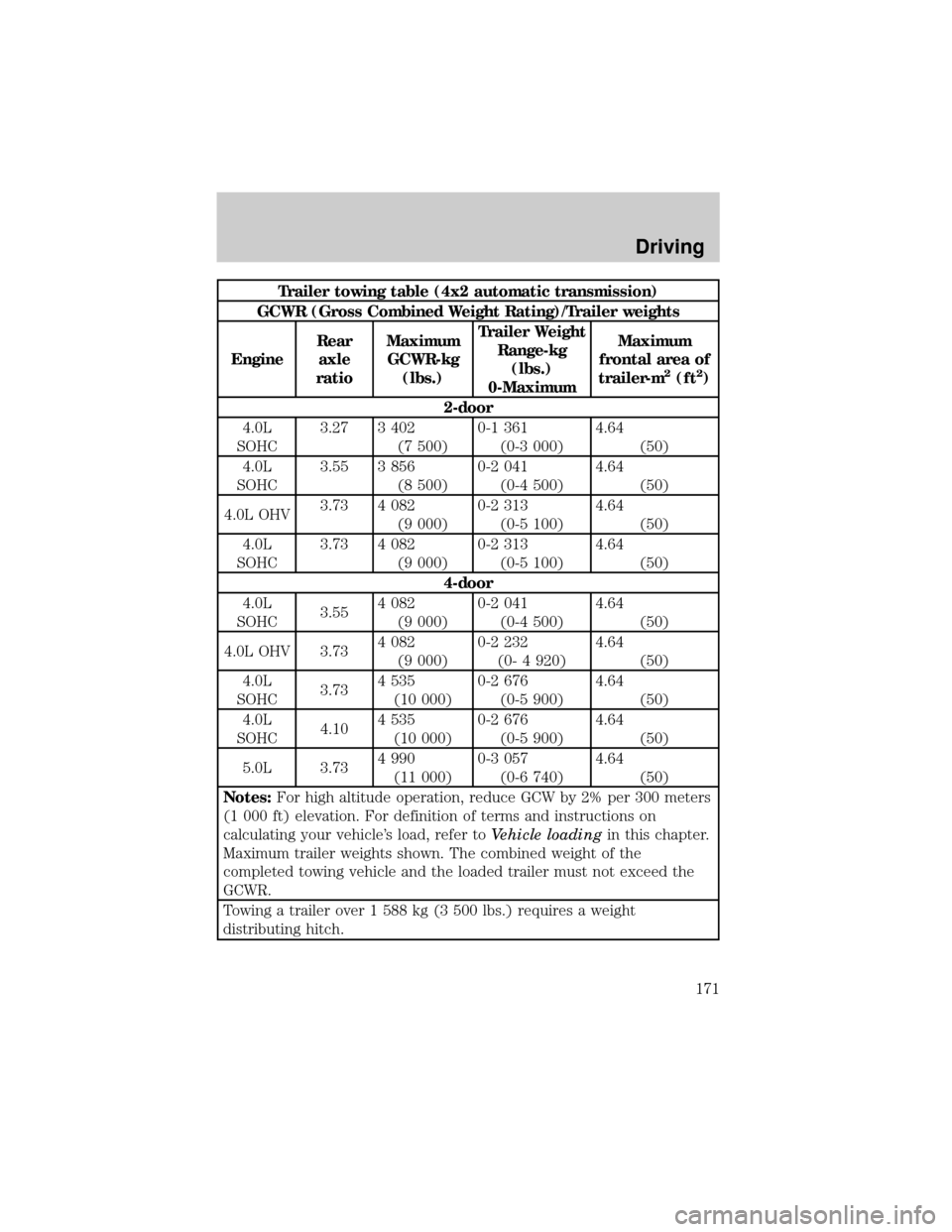
Trailer towing table (4x2 automatic transmission)
GCWR (Gross Combined Weight Rating)/Trailer weights
EngineRear
axle
ratioMaximum
GCWR-kg
(lbs.)Trailer Weight
Range-kg
(lbs.)
0-MaximumMaximum
frontal area of
trailer-m
2(ft2)
2-door
4.0L
SOHC3.27 3 402
(7 500)0-1 361
(0-3 000)4.64
(50)
4.0L
SOHC3.55 3 856
(8 500)0-2 041
(0-4 500)4.64
(50)
4.0L OHV3.73 4 082
(9 000)0-2 313
(0-5 100)4.64
(50)
4.0L
SOHC3.73 4 082
(9 000)0-2 313
(0-5 100)4.64
(50)
4-door
4.0L
SOHC3.554 082
(9 000)0-2 041
(0-4 500)4.64
(50)
4.0L OHV 3.734 082
(9 000)0-2 232
(0- 4 920)4.64
(50)
4.0L
SOHC3.734 535
(10 000)0-2 676
(0-5 900)4.64
(50)
4.0L
SOHC4.104 535
(10 000)0-2 676
(0-5 900)4.64
(50)
5.0L 3.734 990
(11 000)0-3 057
(0-6 740)4.64
(50)
Notes:For high altitude operation, reduce GCW by 2% per 300 meters
(1 000 ft) elevation. For definition of terms and instructions on
calculating your vehicle's load, refer toVehicle loadingin this chapter.
Maximum trailer weights shown. The combined weight of the
completed towing vehicle and the loaded trailer must not exceed the
GCWR.
Towing a trailer over 1 588 kg (3 500 lbs.) requires a weight
distributing hitch.
Driving
171
Page 172 of 264
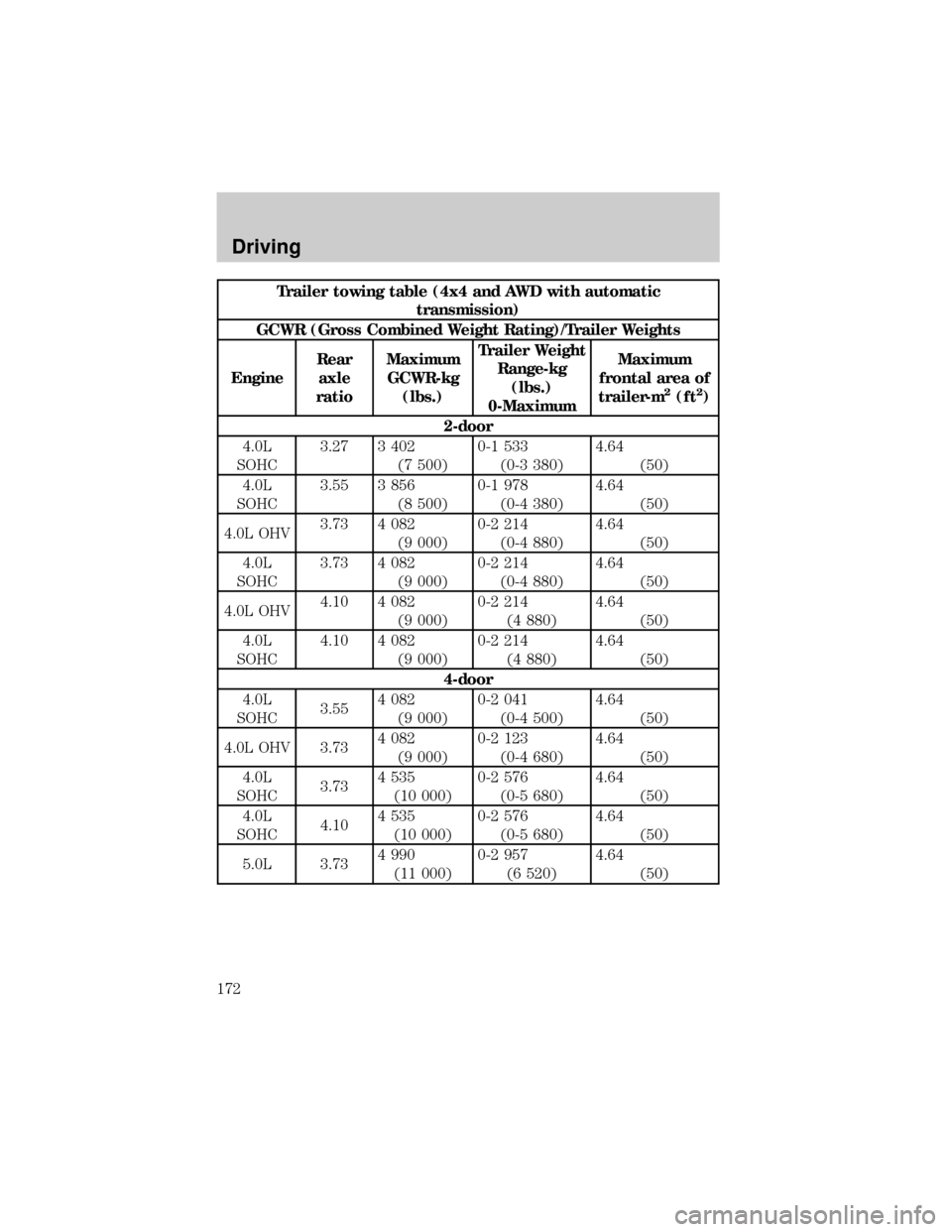
Trailer towing table (4x4 and AWD with automatic
transmission)
GCWR (Gross Combined Weight Rating)/Trailer Weights
EngineRear
axle
ratioMaximum
GCWR-kg
(lbs.)Trailer Weight
Range-kg
(lbs.)
0-MaximumMaximum
frontal area of
trailer-m
2(ft2)
2-door
4.0L
SOHC3.27 3 402
(7 500)0-1 533
(0-3 380)4.64
(50)
4.0L
SOHC3.55 3 856
(8 500)0-1 978
(0-4 380)4.64
(50)
4.0L OHV3.73 4 082
(9 000)0-2 214
(0-4 880)4.64
(50)
4.0L
SOHC3.73 4 082
(9 000)0-2 214
(0-4 880)4.64
(50)
4.0L OHV4.10 4 082
(9 000)0-2 214
(4 880)4.64
(50)
4.0L
SOHC4.10 4 082
(9 000)0-2 214
(4 880)4.64
(50)
4-door
4.0L
SOHC3.554 082
(9 000)0-2 041
(0-4 500)4.64
(50)
4.0L OHV 3.734 082
(9 000)0-2 123
(0-4 680)4.64
(50)
4.0L
SOHC3.734 535
(10 000)0-2 576
(0-5 680)4.64
(50)
4.0L
SOHC4.104 535
(10 000)0-2 576
(0-5 680)4.64
(50)
5.0L 3.734 990
(11 000)0-2 957
(6 520)4.64
(50)
Driving
172
Page 173 of 264
Trailer towing table (4x4 and AWD with automatic
transmission)
Notes:For high altitude operation, reduce GCW by 2% per 300 meters
(1 000 ft) elevation. For definition of terms and instructions on
calculating your vehicle's load, refer toVehicle loadingin this chapter.
Maximum trailer weights shown. The combined weight of the
completed towing vehicle and the loaded trailer must not exceed the
GCWR.
Towing a trailer over 1 588 kg (3 500 lbs.) requires a weight
distributing hitch.
Do not exceed the GVWR or the GAWR specified on the Safety
Compliance Certification Label.
Towing trailers beyond the maximum recommended gross trailer
weight exceeds the limit of the vehicle and could result in
engine damage, transmission damage, structural damage, loss of
control, and personal injury.
Preparing to tow
Use the proper equipment for towing a trailer, and make sure it is
properly attached to your vehicle. See your dealer or a reliable trailer
dealer if you require assistance.
Hitches
Do not use hitches that clamp onto the vehicle bumper. Use a load
carrying hitch. You must distribute the load in your trailer so that 10% of
the total weight of the trailer is on the tongue.
Use a frame-mounted weight distributing hitch for trailers over
1 588 kg (3 500 lb).
Driving
173
Page 175 of 264

Driving while you tow
Do not drive faster than 88 km/h (55 mph) when towing a trailer.
Speed control may shut off if you are towing on long, steep grades.
When towing a trailer:
²Use a lower gear when towing up or down steep hills. This will
eliminate excessive downshifting and upshifting for optimum fuel
economy and transmission cooling.
²Anticipate stops and brake gradually.
Exceeding the GCWR rating may cause internal transmission
damage and void your warranty coverage.
Servicing after towing
If you tow a trailer for long distances, your vehicle will require more
frequent service intervals. Refer to your Scheduled Maintenance guide
for more information.
Trailer towing tips
²Practice turning, stopping and backing up in an area before starting on
a trip to get the feel of the vehicle trailer combination. When turning,
make wider turns so the trailer wheels will clear curbs and other
obstacles.
²Allow more distance for stopping with a trailer attached.
²The trailer tongue weight should be 10±15% of the loaded trailer
weight.
²After you have traveled 80 km (50 miles), thoroughly check your
hitch, electrical connections and trailer wheel lug nuts.
²When stopped in traffic for long periods of time in hot weather, place
the gearshift in P (Park) (automatic transmissions) or N (Neutral)
(manual transmissions). This aids engine cooling and air conditioner
efficiency.
²Vehicles with trailers should not be parked on a grade. If you must
park on a grade, place wheel chocks under the trailer's wheels.
Driving
175
Page 176 of 264

Launching or retrieving a boat
When backing down a ramp during boat launching or retrieval,
²Do not allow the static water level to rise above the bottom edge of
the rear bumper and
²Do not allow waves to break higher than 15 cm (six inches) above the
bottom edge of the rear bumper.
Exceeding these limits may allow water to enter critical vehicle
components, adversely affecting driveability, emissions, reliability and
causing internal transmission damage.
Replace the rear axle lubricant anytime the axle has been submerged in
water. Rear axle lubricant quantities are not to be checked or changed
unless a leak is suspected or repair required.
Disconnect the wiring to the trailer before backing the trailer into the
water. Reconnect the wiring to the trailer after the trailer is removed
from the water.
Recreational towing (all wheels on the ground)
(Neutral tow kit accessory)
On vehicles equipped with a 4.0L engine, an accessory is available that
allows you to tow your vehicle, behind another vehicle, with all the
wheels on the ground. Contact your dealer for more details. Do not tow
your vehicle with all wheels on the ground unless you install the neutral
tow kit as vehicle damage may occur.
Driving
176
Page 188 of 264
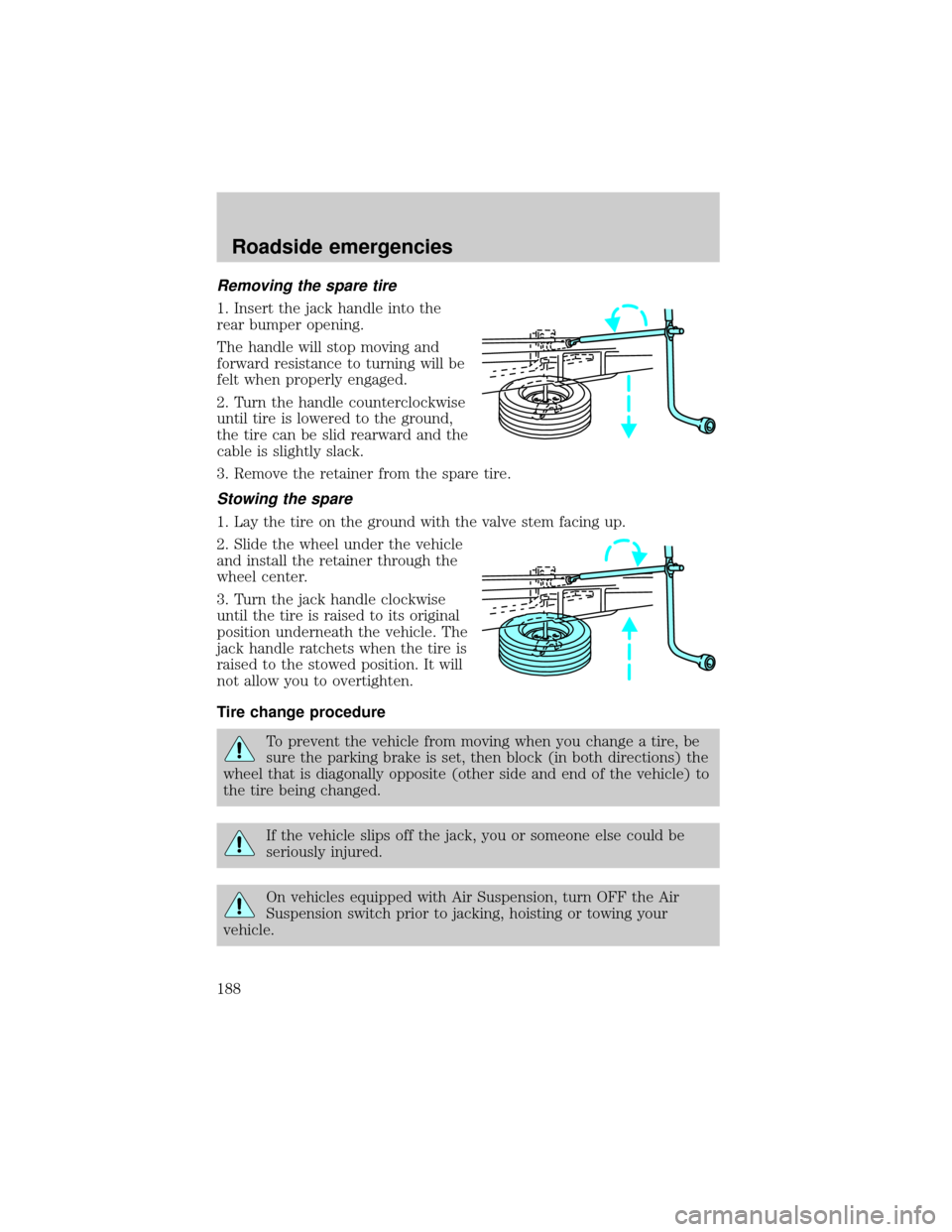
Removing the spare tire
1. Insert the jack handle into the
rear bumper opening.
The handle will stop moving and
forward resistance to turning will be
felt when properly engaged.
2. Turn the handle counterclockwise
until tire is lowered to the ground,
the tire can be slid rearward and the
cable is slightly slack.
3. Remove the retainer from the spare tire.
Stowing the spare
1. Lay the tire on the ground with the valve stem facing up.
2. Slide the wheel under the vehicle
and install the retainer through the
wheel center.
3. Turn the jack handle clockwise
until the tire is raised to its original
position underneath the vehicle. The
jack handle ratchets when the tire is
raised to the stowed position. It will
not allow you to overtighten.
Tire change procedure
To prevent the vehicle from moving when you change a tire, be
sure the parking brake is set, then block (in both directions) the
wheel that is diagonally opposite (other side and end of the vehicle) to
the tire being changed.
If the vehicle slips off the jack, you or someone else could be
seriously injured.
On vehicles equipped with Air Suspension, turn OFF the Air
Suspension switch prior to jacking, hoisting or towing your
vehicle.
Roadside emergencies
188
Page 198 of 264
4. Remove the jumper cable from the positive (+) terminal of the
disabled vehicle's battery.
After the disabled vehicle has been started and the jumper cables
removed, allow it to idle for several minutes so the engine computer can
relearnits idle conditions.
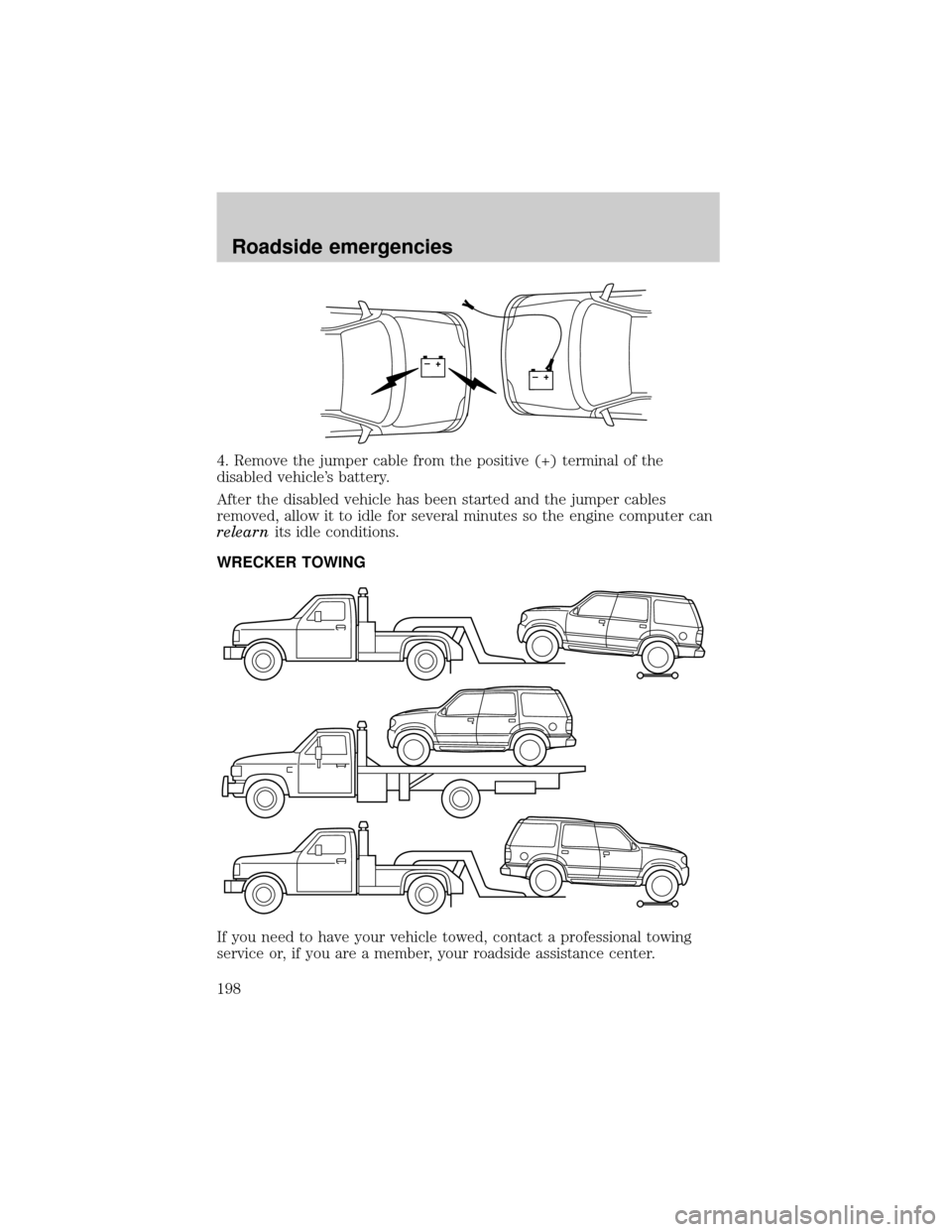
WRECKER TOWING
If you need to have your vehicle towed, contact a professional towing
service or, if you are a member, your roadside assistance center.
+–+–
Roadside emergencies
198