1999 FORD EXPLORER change wheel
[x] Cancel search: change wheelPage 188 of 264
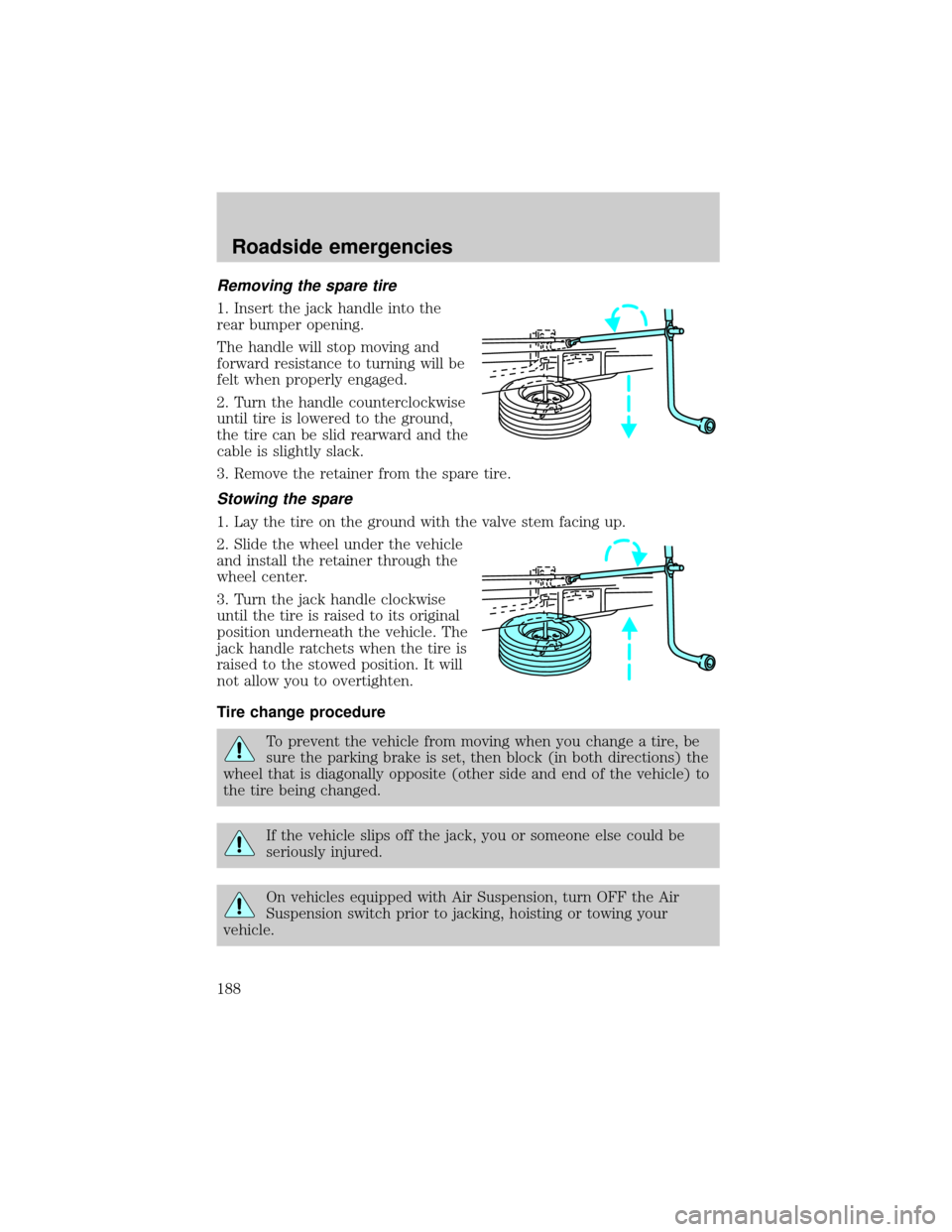
Removing the spare tire
1. Insert the jack handle into the
rear bumper opening.
The handle will stop moving and
forward resistance to turning will be
felt when properly engaged.
2. Turn the handle counterclockwise
until tire is lowered to the ground,
the tire can be slid rearward and the
cable is slightly slack.
3. Remove the retainer from the spare tire.
Stowing the spare
1. Lay the tire on the ground with the valve stem facing up.
2. Slide the wheel under the vehicle
and install the retainer through the
wheel center.
3. Turn the jack handle clockwise
until the tire is raised to its original
position underneath the vehicle. The
jack handle ratchets when the tire is
raised to the stowed position. It will
not allow you to overtighten.
Tire change procedure
To prevent the vehicle from moving when you change a tire, be
sure the parking brake is set, then block (in both directions) the
wheel that is diagonally opposite (other side and end of the vehicle) to
the tire being changed.
If the vehicle slips off the jack, you or someone else could be
seriously injured.
On vehicles equipped with Air Suspension, turn OFF the Air
Suspension switch prior to jacking, hoisting or towing your
vehicle.
Roadside emergencies
188
Page 189 of 264
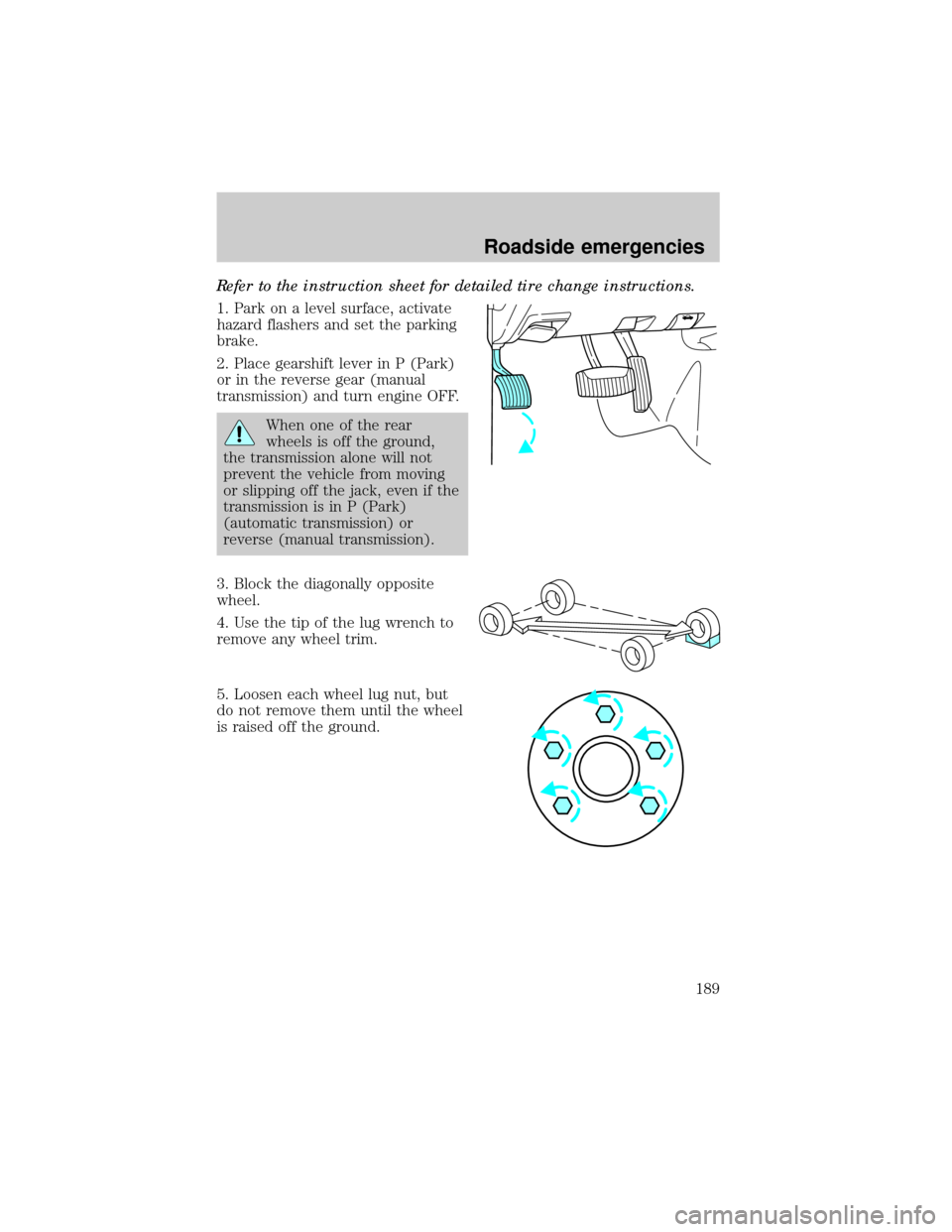
Refer to the instruction sheet for detailed tire change instructions.
1. Park on a level surface, activate
hazard flashers and set the parking
brake.
2. Place gearshift lever in P (Park)
or in the reverse gear (manual
transmission) and turn engine OFF.
When one of the rear
wheels is off the ground,
the transmission alone will not
prevent the vehicle from moving
or slipping off the jack, even if the
transmission is in P (Park)
(automatic transmission) or
reverse (manual transmission).
3. Block the diagonally opposite
wheel.
4. Use the tip of the lug wrench to
remove any wheel trim.
5. Loosen each wheel lug nut, but
do not remove them until the wheel
is raised off the ground.
Roadside emergencies
189
Page 215 of 264

1. Start the engine and let it run until it reaches normal operating
temperature (the engine coolant temperature gauge indicator will be
near the center of the normal area between H and C).
2. While the engine idles, turn the steering wheel left and right several
times.
3. Turn the engine off.
4.If your vehicle is equipped with a 4.0L OHV V6 engine,check the
fluid level on the dipstick. It should be within the FULL HOT range. Do
not add fluid if the level is within this range.
5.If your vehicle is equipped with a 4.0L SOHC V6 or a 5.0L V8
engine,check the fluid level in the reservoir. It should be between the
MIN and MAX lines. Do not add fluid if the level is within this range.
6. If the fluid is low, add fluid in small amounts, continuously checking
the level until it reaches the correct operating range. Be sure to put the
cap back on the reservoir.
TRANSMISSION FLUID
Checking automatic transmission fluid
Refer to your Scheduled Maintenance Guide for scheduled intervals for
fluid checks and changes. Your transmission does not consume fluid.
However, the fluid level should be checked if the transmission is not
working properly, i.e., if the transmission slips or shifts slowly or if you
notice some sign of fluid leakage.
Automatic transmission fluid expands when warmed. To obtain an
accurate fluid check, drive the vehicle until it is warmed up
(approximately 30 km [20 miles]). If your vehicle has been operated for
an extended period at high speeds, in city traffic during hot weather or
pulling a trailer, the vehicle should be turned off for about 30 minutes to
allow fluid to cool before checking.
1. Drive the vehicle 30 km (20 miles) or until it reaches normal operating
temperature.
2. Park the vehicle on a level surface and engage the parking brake.
3. With the parking brake engaged and your foot on the brake pedal,
start the engine and move the gearshift lever through all of the gear
ranges. Allow sufficient time for each gear to engage.
4. Latch the gearshift lever in P (Park) and leave the engine running.
Maintenance and care
215
Page 233 of 264

Habits
²Smooth, moderate operation can yield up to 10% savings in fuel.
²Steady speeds without stopping will usually give the best fuel
economy.
²Idling for long periods of time (greater than one minute) may waste
fuel.
²Anticipate stopping; slowing down may eliminate the need to stop.
²Sudden or hard accelerations may reduce fuel economy.
²Slow down gradually.
²Drive at reasonable speeds (traveling at 105 km /h [65 mph] uses 15%
more fuel than traveling at 88 km/h [55 mph]).
²Revving the engine before turning it off may reduce fuel economy.
²Use of the air conditioner or defroster may reduce fuel economy.
²Use of speed control (if equipped) may improve fuel economy. Speed
control can help maintain a constant speed and reduce speed changes.
You may want to turn off the speed control in hilly terrain as
unnecessary shifting between third and fourth gears may occur and
could result in reduced fuel economy.
²Warming up a vehicle on cold mornings is not required and may
reduce fuel economy.
²Resting your foot on the brake pedal while driving may reduce fuel
economy.
²Combine errands and minimize stop-and-go driving.
Maintenance
²Keep tires properly inflated and use only recommended size.
²Operating a vehicle with the wheels out of alignment will reduce fuel
economy.
²Use recommended engine oil. Refer toLubricant Specifications.
²Perform all regularly scheduled maintenance items. Follow the
recommended maintenance schedule and owner maintenance checks
found in your vehicle Scheduled Maintenance Guide.
Maintenance and care
233
Page 258 of 264

Engine oil
checking and adding ..............207
dipstick ....................................205
specifications ...................205,207
Exhaust fumes ..........................143
Floor mats .................................103
Four-Wheel Drive
vehicles ..............................9,10,157
control trac .............................157
description .......................157,159
driving off road ................160,162
electronic shift ..........................31
Fuel
choosing the right fuel ...........228
comparisons with EPA fuel
economy estimates .................234
detergent in fuel .....................229
filling your vehicle
with fuel ...........................227,230
gauge .........................................14
quality ......................................229
running out of fuel .................230
safety information relating to
automotive fuels .....................227
Fuses ............................179,180,181
Gas mileage
(see Fuel economy) .........231,232,
233,234
Gauges .........................................11
engine coolant temperature
gauge .........................................12
engine oil pressure gauge ........14
GVWR
(Gross Vehicle Weight Rating)
calculating ...............................167
Hazard flashers .........................178
Head restraints ...........116,118,119
Headlamps
aiming ......................................241
autolamp system .......................97
bulb specifications ..................240
high beam ..............................9,19warning chime ..........................11
Heating ........................................20
heating and air conditioning
system .............................20,21,22
Hood ..........................................201
Ignition .......................................252
Inspection/maintenance (I/M)
testing ........................................236
Instrument panel
cleaning ...................................245
Keyless entry system
autolock ............................109,110
keypad .....................................111
locking and unlocking doors ..112
programming entry
code ..................................111,112
Keys
key in ignition chime ...............11
positions of the ignition ...........79
Lamps
daytime running light ...............19
fog lamps ...................................19
headlamps .................................19
headlamps, flash to pass ..........20
instrument panel, dimming .....20
replacing bulbs ...............236,237,
238,239,240
Lane change indicator
(see Turn signal) ........................79
Liftgate ......................................103
Lights, warning and indicator
air bag ..........................................7
anti-lock brakes (ABS) ..............8
anti-theft .....................................9
brake ............................................8
charging system ..........................9
check coolant ..............................9
cruise indicator .........................10
door ajar ....................................10
fuel reset .....................................7
overdrive off ..............................10
safety belt ...................................8
Index
258