Page 177 of 216

²Perform all regularly scheduled maintenance items. Follow the
recommended maintenance schedule and owner maintenance checks
found in your vehicle Scheduled Maintenance Guide.
Conditions
²Heavily loading a vehicle or towing a trailer may reduce fuel economy
at any speed.
²Carrying unnecessary weight may reduce fuel economy (approximately
2 km/h [1 mpg] is lost for every 180 kg [400 lb] of weight carried).
²Adding certain accessories to your vehicle (for example bug
deflectors, rollover/light bars, running boards, ski/luggage racks) may
reduce fuel economy.
²Use of fuel blended with alcohol may lower fuel economy.
²Fuel economy may decrease with lower temperatures during the first
12±16 km (8±10 miles) of driving.
²Flat terrain driving improves fuel economy over hilly roads.
²Transmissions give their best fuel economy when operated in the top
cruise gear and with steady pressure on the gas pedal.
²Four-wheel-drive operation (if equipped) is less fuel efficient than
two-wheel-drive operation.
²Close windows for high speed driving.
EPA window sticker
Every new vehicle should have the EPA window sticker. Contact your
dealer if the window sticker is not supplied with your vehicle. The EPA
window sticker should be your guide for the fuel economy comparisons
with other vehicles.
It is important to note the box in the lower left corner of the window
sticker. These numbers represent the Range of Km/L (MPG) expected on
the vehicle, depending upon the driver's method of operation and
conditions.
Maintenance and care
177
Page 178 of 216
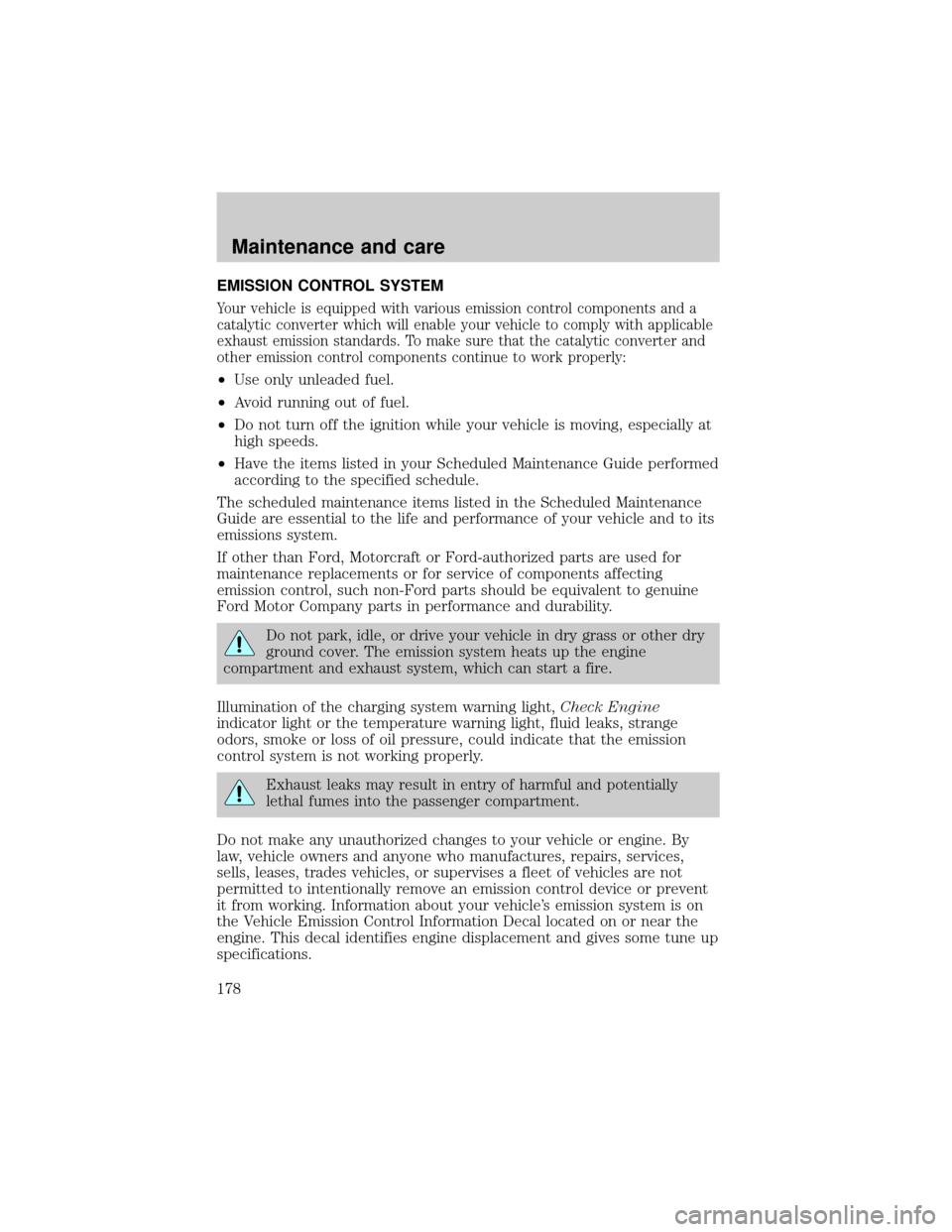
EMISSION CONTROL SYSTEM
Your vehicle is equipped with various emission control components and a
catalytic converter which will enable your vehicle to comply with applicable
exhaust emission standards. To make sure that the catalytic converter and
other emission control components continue to work properly:
²Use only unleaded fuel.
²Avoid running out of fuel.
²Do not turn off the ignition while your vehicle is moving, especially at
high speeds.
²Have the items listed in your Scheduled Maintenance Guide performed
according to the specified schedule.
The scheduled maintenance items listed in the Scheduled Maintenance
Guide are essential to the life and performance of your vehicle and to its
emissions system.
If other than Ford, Motorcraft or Ford-authorized parts are used for
maintenance replacements or for service of components affecting
emission control, such non-Ford parts should be equivalent to genuine
Ford Motor Company parts in performance and durability.
Do not park, idle, or drive your vehicle in dry grass or other dry
ground cover. The emission system heats up the engine
compartment and exhaust system, which can start a fire.
Illumination of the charging system warning light,Check Engine
indicator light or the temperature warning light, fluid leaks, strange
odors, smoke or loss of oil pressure, could indicate that the emission
control system is not working properly.
Exhaust leaks may result in entry of harmful and potentially
lethal fumes into the passenger compartment.
Do not make any unauthorized changes to your vehicle or engine. By
law, vehicle owners and anyone who manufactures, repairs, services,
sells, leases, trades vehicles, or supervises a fleet of vehicles are not
permitted to intentionally remove an emission control device or prevent
it from working. Information about your vehicle's emission system is on
the Vehicle Emission Control Information Decal located on or near the
engine. This decal identifies engine displacement and gives some tune up
specifications.
Maintenance and care
178
Page 186 of 216

Avoid getting wax on the windshield. If you have wax applied at a
commercial car wash, it is recommended that you clean the wiper blades
and windshield as described inCleaning the wiper blades and
windshield.
Repairing paint chips
Minor scratches or paint damage from road debris may be repaired with
touch-up paint, repair foil or aerosol paint spray from the Ford Car Care
Chemicals line. Observe the application instructions on the products.
Remove particles such as bird droppings, tree sap, insect remains, tar
spots, road salt and industrial fallout immediately.
Cleaning the wheels
Wash with the same detergent as the body of your vehicle. Do not use
acid-based or alcohol-based wheel cleaners, steel wool, fuel or strong
detergents. Never use abrasives that will damage the finish of special
wheel surfaces. Use a tar remover to remove grease and tar.
The brushes used in some automatic car washes may damage the finish
on your wheels. Before going to a car wash, find out if the brushes are
abrasive.
Underbody
Flush the complete underside of vehicle frequently. Keep body drain
holes unplugged. Inspect for road damage.
Maintenance and care
186
Page 188 of 216

Cleaning the wiper blades and windshield
If the wiper blades do not wipe properly, clean the wiper blade rubber
element with undiluted windshield washer solution or a mild detergent.
To avoid damaging the blades, do not use fuel, kerosene, paint thinner or
other solvents.
If the wiper still does not wipe properly, this could be caused by
substances on the windshield such as tree sap and some hot wax
treatments used by commercial car washes. Clean the outside of the
windshield with a non-abrasive cleanser such as the non-abrasive
Bon-Amitpowder. Rinse thoroughly with clean water.Do notuse
abrasive cleansers on glass as they may cause scratches. The windshield
is clean if beads do not form when you rinse it with water. The
windshield and wiper blades should be cleaned on a regular basis, and
blades or rubber elements replaced when worn.
Cleaning the instrument panel
Clean with a damp cloth, then dry with a dry cloth.
Avoid cleaner or polish that increases the gloss of the upper portion of
the instrument panel. The dull finish in this area helps protect the driver
from undesirable windshield reflection.
Cleaning the overhead console
Clean with a damp cloth, then wipe dry with a dry cloth.
Avoid cleaner or polish that increases the gloss of the console. The dull
finish in this area helps protect the driver from undesirable windshield
reflection.
Cleaning the interior fabric
Remove dust and loose dirt with a whisk broom or a vacuum cleaner.
Remove fresh spots immediately. Do not use household or glass cleaners.
These agents can stain and discolor the fabric. Use a mild soap and
water solution if necessary.
Maintenance and care
188
Page 190 of 216
Motorcraft part numbers
Component 4.6L V8 engine 5.4L V8 engine
Air filter element FA-1634 FA-1634
Battery BTX-65-650 BTX-65-650
Fuel filter FG-986B FG-986B
Oil filter FL-820-S FL-820-S
PCV valve EV-233 EV-233
Spark plugs* AWSF-32PP** AWSF-22E
* Refer to Vehicle Emissions Control Information (VECI) decal for spark
plug gap information.
** If a spark plug is removed for inspection, it must be reinstalled in the
same cylinder. Cylinders No. 1, 2, 3 and 4 have a ªPGº suffix. Cylinders
No. 5, 6, 7 and 8 have a ªPº suffix. If a spark plug needs to be replaced,
use only spark plugs with the service part number suffix letter as shown
on the engine decal.
Capacities and specifications
190
Page 191 of 216
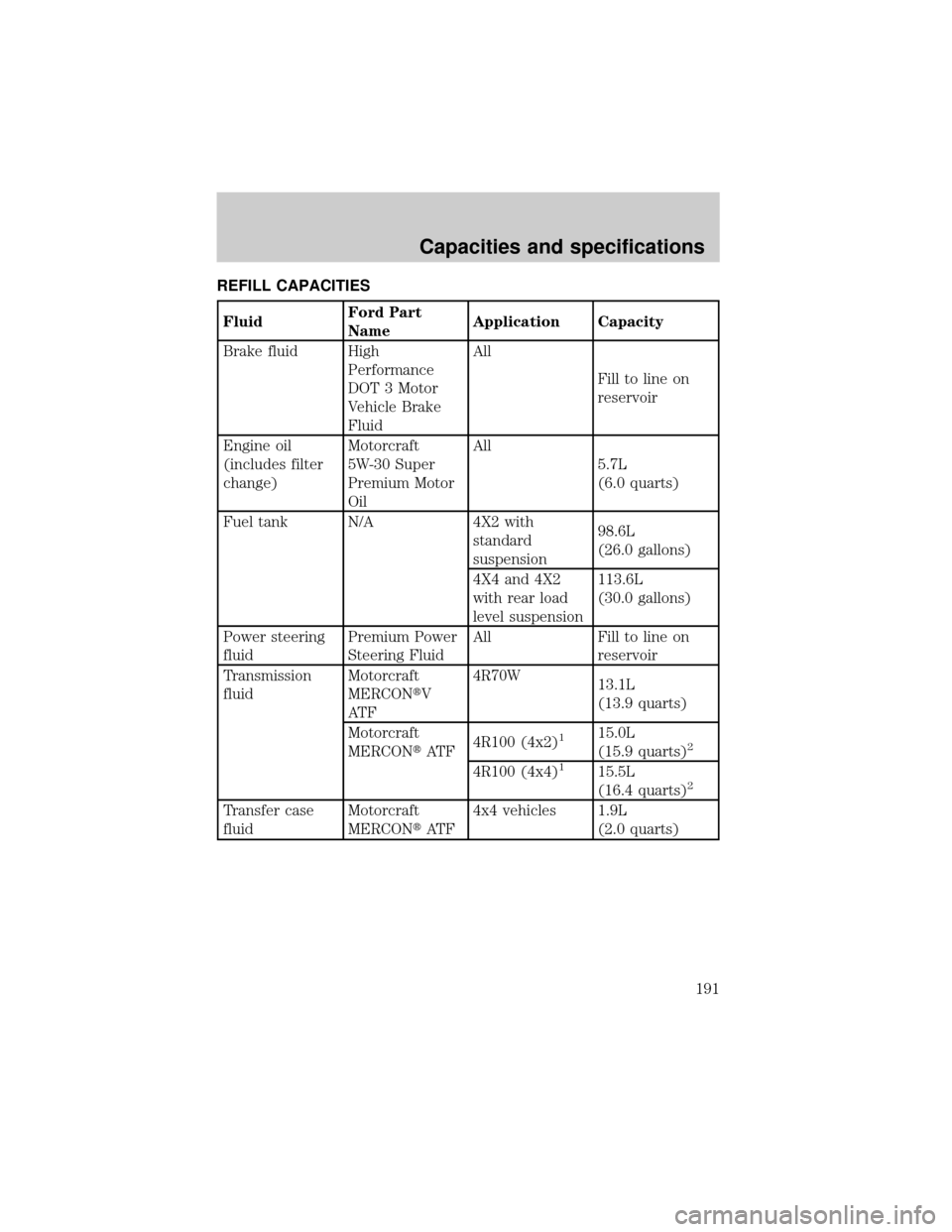
REFILL CAPACITIES
FluidFord Part
NameApplication Capacity
Brake fluid High
Performance
DOT 3 Motor
Vehicle Brake
FluidAll
Fill to line on
reservoir
Engine oil
(includes filter
change)Motorcraft
5W-30 Super
Premium Motor
OilAll
5.7L
(6.0 quarts)
Fuel tank N/A 4X2 with
standard
suspension98.6L
(26.0 gallons)
4X4 and 4X2
with rear load
level suspension113.6L
(30.0 gallons)
Power steering
fluidPremium Power
Steering FluidAll Fill to line on
reservoir
Transmission
fluidMotorcraft
MERCONtV
AT F4R70W
13.1L
(13.9 quarts)
Motorcraft
MERCONtAT F4R100 (4x2)
115.0L
(15.9 quarts)2
4R100 (4x4)115.5L
(16.4 quarts)2
Transfer case
fluidMotorcraft
MERCONtAT F4x4 vehicles 1.9L
(2.0 quarts)
Capacities and specifications
191
Page 194 of 216
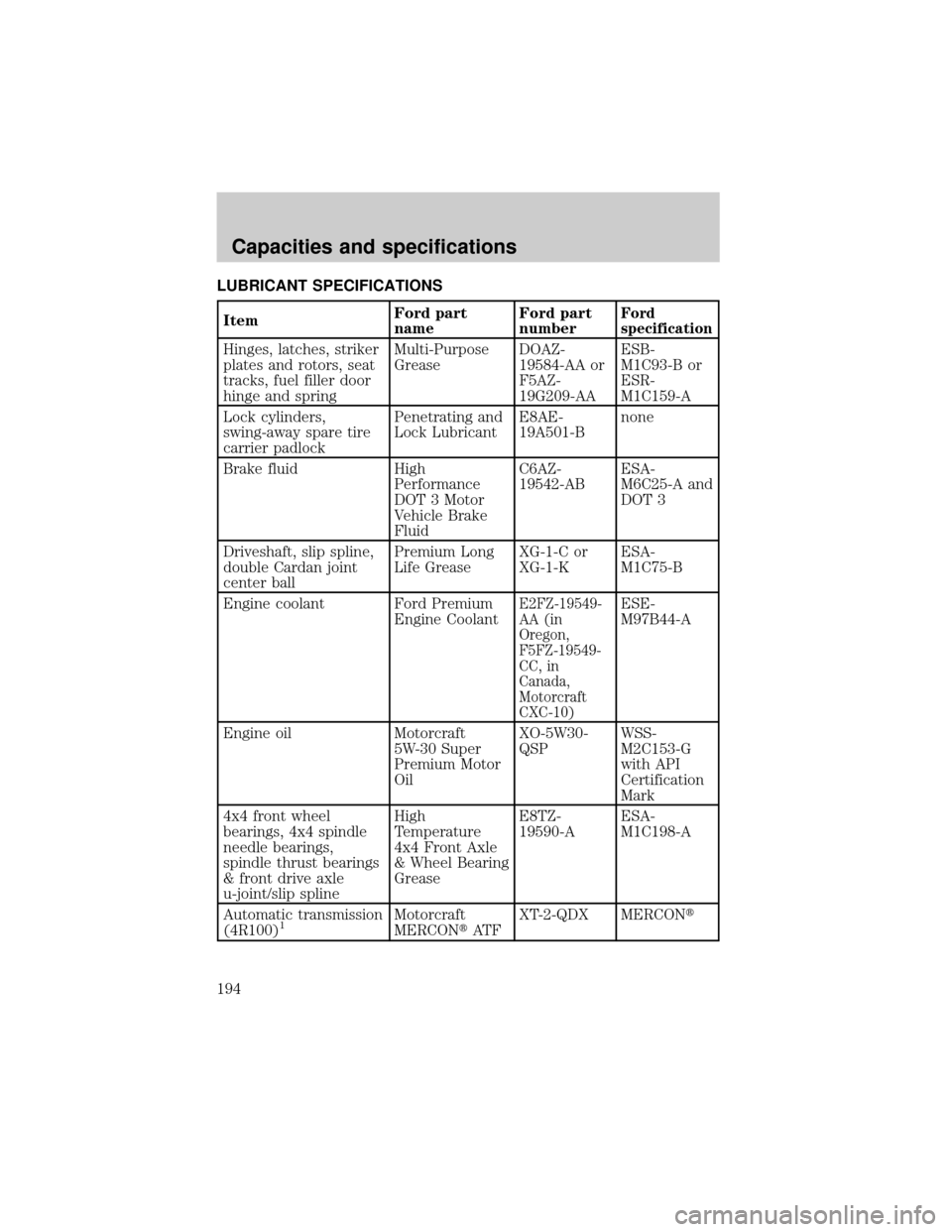
LUBRICANT SPECIFICATIONS
ItemFord part
nameFord part
numberFord
specification
Hinges, latches, striker
plates and rotors, seat
tracks, fuel filler door
hinge and springMulti-Purpose
GreaseDOAZ-
19584-AA or
F5AZ-
19G209-AAESB-
M1C93-B or
ESR-
M1C159-A
Lock cylinders,
swing-away spare tire
carrier padlockPenetrating and
Lock LubricantE8AE-
19A501-Bnone
Brake fluid High
Performance
DOT 3 Motor
Vehicle Brake
FluidC6AZ-
19542-ABESA-
M6C25-A and
DOT 3
Driveshaft, slip spline,
double Cardan joint
center ballPremium Long
Life GreaseXG-1-C or
XG-1-KESA-
M1C75-B
Engine coolant Ford Premium
Engine Coolant
E2FZ-19549-
AA (in
Oregon,
F5FZ-19549-
CC, in
Canada,
Motorcraft
CXC-10)ESE-
M97B44-A
Engine oil Motorcraft
5W-30 Super
Premium Motor
OilXO-5W30-
QSPWSS-
M2C153-G
with API
Certification
Mark
4x4 front wheel
bearings, 4x4 spindle
needle bearings,
spindle thrust bearings
& front drive axle
u-joint/slip splineHigh
Temperature
4x4 Front Axle
& Wheel Bearing
GreaseE8TZ-
19590-AESA-
M1C198-A
Automatic transmission
(4R100)
1Motorcraft
MERCONtAT FXT-2-QDX MERCONt
Capacities and specifications
194
Page 196 of 216
ENGINE DATA
Engine 4.6L V8 engine 5.4L V8 engine
Cubic inches 281 330
Horsepower 215 @ 4500 rpm 235 @ 4250 rpm
Torque 290 lb.-ft. @ 3250 rpm 325 lb.-ft. @ 3000 rpm
Recommended fuel 87 octane 87 octane
Firing order 1-3-7-2-6-5-4-8 1-3-7-2-6-5-4-8
Spark plug gap 1.3-1.4 mm
(0.052-0.056 inch)1.3-1.4 mm
(0.052-0.056 inch)
Ignition system EDIS Coil on plug
Compression ratio 9.0:1 9.0:1
VEHICLE DIMENSIONS
Vehicle dimensions 4x2 mm (in) 4x4 mm (in)
(1) Overall length 5 196.0
(204.6)5 196.0
(204.6)
(2) Vehicle width 2 000.0
(78.7)
12 000.0
(78.7)1
*width including
mirrors2 293
(90.3)2 293
(90.3)
*with optional running
boards2 071
(81.5)2 071
(81.5)
(3) Overall height
21 943.0
(76.5)1 992.0
(78.4)
(4) Wheelbase 3 023.0
(119.0)3 023.0
(119.0)
(5) Track - Front 1 661.0
(65.4)1 661.0
(65.4)
(5) Track - Rear 1 663.0
(65.5)1 663.0
(65.5)
1Vehicle width, including mirrors: 2 293.0 mm (90.3 in)
2Vehicle equipped with 16º tires and base suspension
Capacities and specifications
196