Page 12 of 200
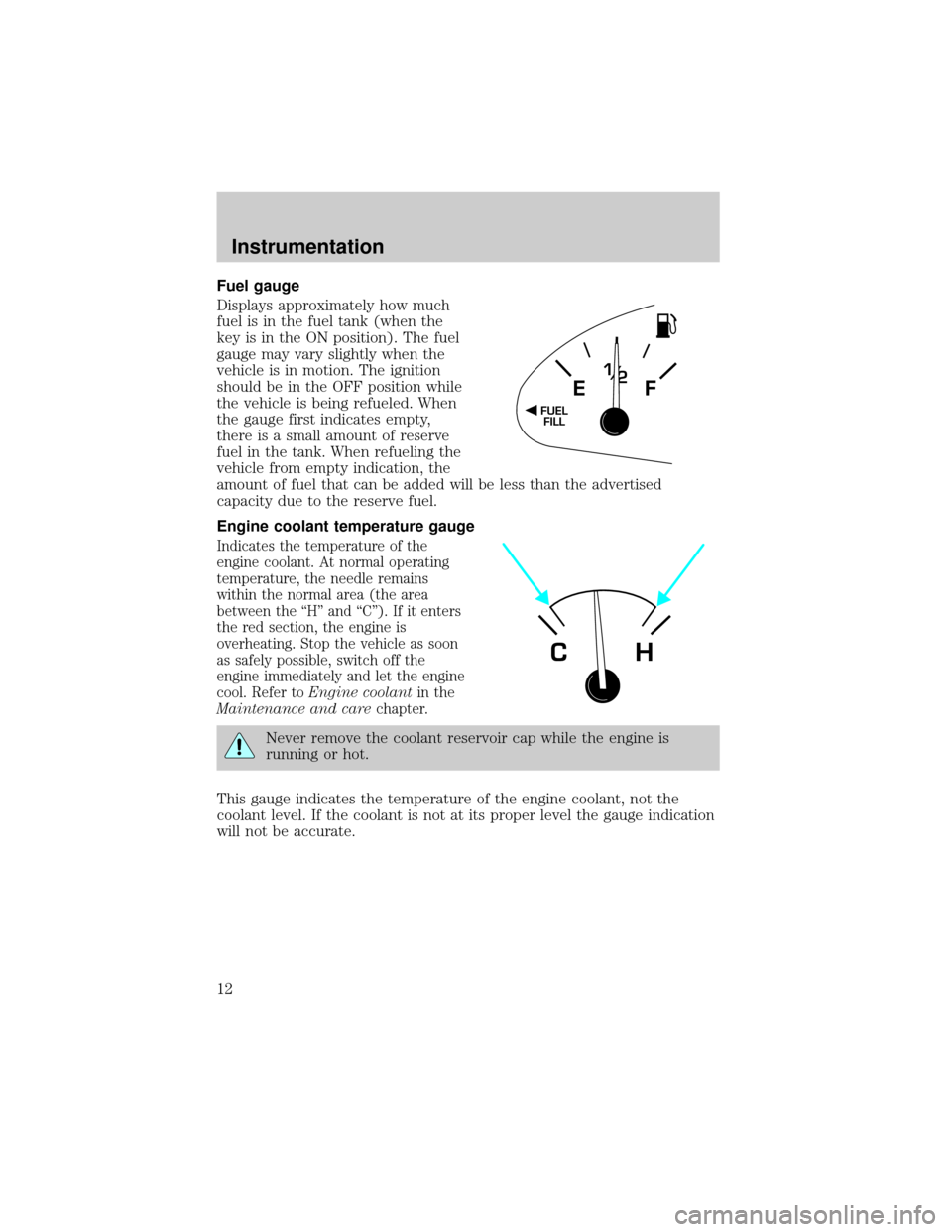
Fuel gauge
Displays approximately how much
fuel is in the fuel tank (when the
key is in the ON position). The fuel
gauge may vary slightly when the
vehicle is in motion. The ignition
should be in the OFF position while
the vehicle is being refueled. When
the gauge first indicates empty,
there is a small amount of reserve
fuel in the tank. When refueling the
vehicle from empty indication, the
amount of fuel that can be added will be less than the advertised
capacity due to the reserve fuel.
Engine coolant temperature gauge
Indicates the temperature of the
engine coolant. At normal operating
temperature, the needle remains
within the normal area (the area
between the ªHº and ªCº). If it enters
the red section, the engine is
overheating. Stop the vehicle as soon
as safely possible, switch off the
engine immediately and let the engine
cool. Refer toEngine coolantin the
Maintenance and carechapter.
Never remove the coolant reservoir cap while the engine is
running or hot.
This gauge indicates the temperature of the engine coolant, not the
coolant level. If the coolant is not at its proper level the gauge indication
will not be accurate.
FUEL
FILL
EF
1
2 /
CH
Instrumentation
12
Page 87 of 200
depress the accelerator and start the engine while holding the
accelerator down to the floor. Release the accelerator when the engine
starts.
4. After idling for a few seconds, apply the brake and release the parking
brake.
Using the engine block heater (if equipped)
An engine block heater warms the engine coolant, which improves
starting, warms up the engine faster and allows the heater-defroster
system to respond quickly. Use of an engine block heater is strongly
recommended if you live in a region where temperatures reach -23ÉC
(-10ÉF) or below.
For best results, plug the heater in at least three hours before starting
the vehicle. Using the heater for longer than three hours will not harm
the engine, so the heater can be plugged in the night before starting the
vehicle.
To prevent electrical shock, do not use your heater with
ungrounded electrical systems or two-pronged (cheater)
adapters.
Guarding against exhaust fumes
Although odorless and colorless, carbon monoxide is present in exhaust
fumes. Take precautions to avoid its dangerous effects.
If you ever smell exhaust fumes of any kind inside your vehicle,
have your dealer inspect and fix your vehicle immediately. Do
not drive if you smell exhaust fumes. These fumes are harmful and
could kill you.
Have the exhaust and body ventilation systems checked whenever:
²the vehicle is raised for service.
²the sound of the exhaust system changes.
²the vehicle has been damaged in a collision.
Starting
87
Page 108 of 200
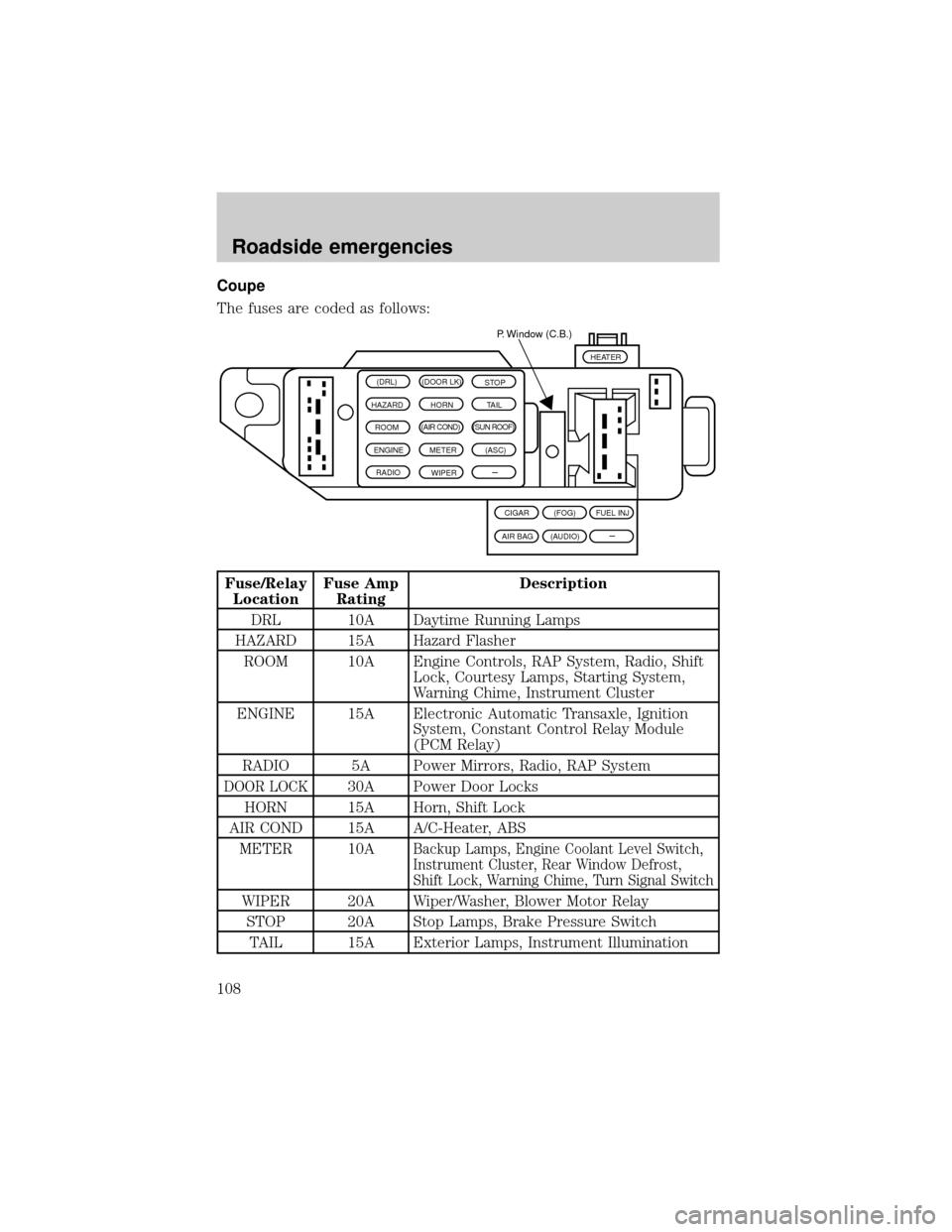
Coupe
The fuses are coded as follows:
Fuse/Relay
LocationFuse Amp
RatingDescription
DRL 10A Daytime Running Lamps
HAZARD 15A Hazard Flasher
ROOM 10A Engine Controls, RAP System, Radio, Shift
Lock, Courtesy Lamps, Starting System,
Warning Chime, Instrument Cluster
ENGINE 15A Electronic Automatic Transaxle, Ignition
System, Constant Control Relay Module
(PCM Relay)
RADIO 5A Power Mirrors, Radio, RAP System
DOOR LOCK30A Power Door Locks
HORN 15A Horn, Shift Lock
AIR COND 15A A/C-Heater, ABS
METER 10A
Backup Lamps, Engine Coolant Level Switch,
Instrument Cluster, Rear Window Defrost,
Shift Lock, Warning Chime, Turn Signal Switch
WIPER 20A Wiper/Washer, Blower Motor Relay
STOP 20A Stop Lamps, Brake Pressure Switch
TAIL 15A Exterior Lamps, Instrument Illumination
(DRL) (DOOR LK)
STOP
HAZARD HORN
TAIL
ROOM(AIR COND) (SUN ROOF)
ENGINE METER(ASC)
RADIO
WIPER
–P. Window (C.B.)
(FOG) CIGAR
(AUDIO)
AIR BAGFUEL INJ
HEATER
–
Roadside emergencies
108
Page 129 of 200
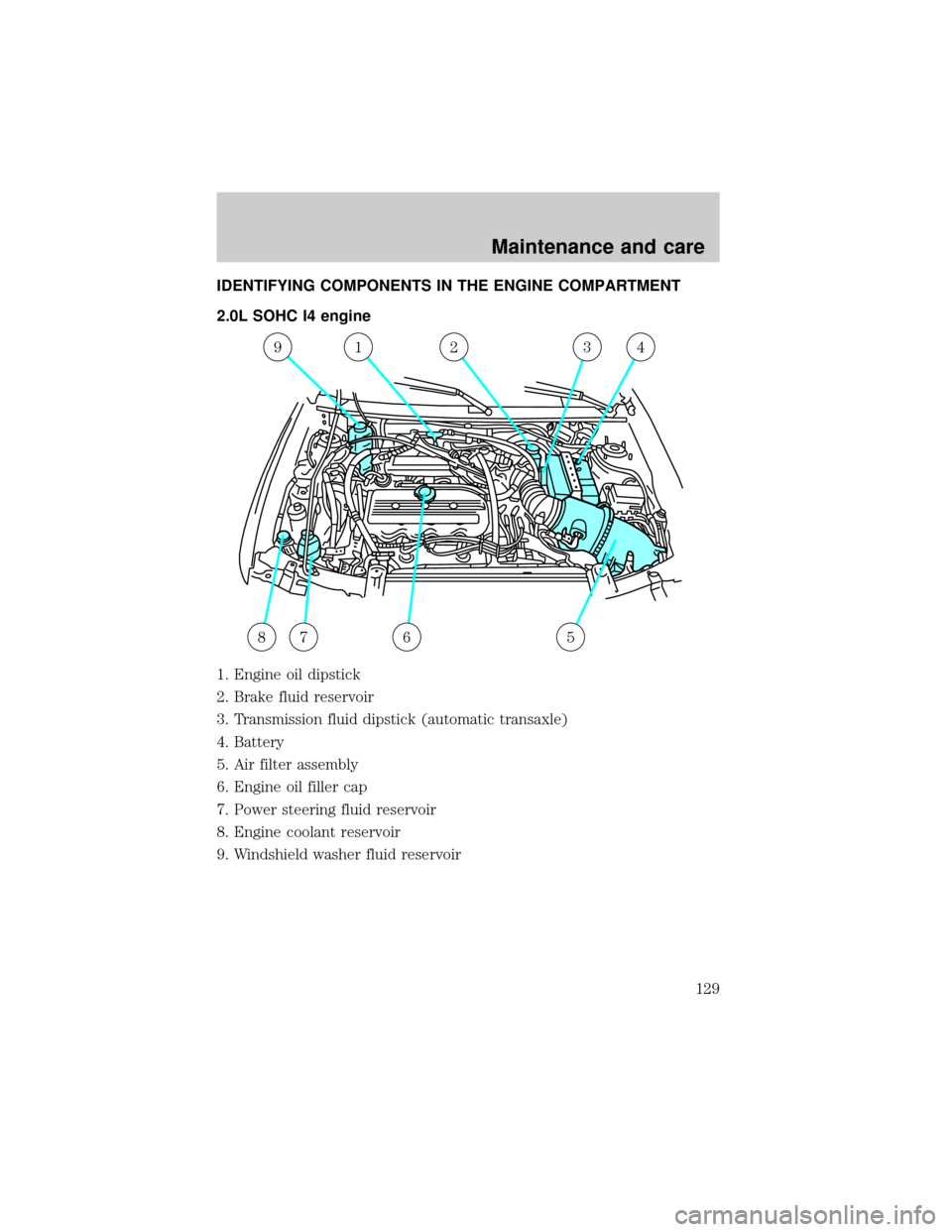
IDENTIFYING COMPONENTS IN THE ENGINE COMPARTMENT
2.0L SOHC I4 engine
1. Engine oil dipstick
2. Brake fluid reservoir
3. Transmission fluid dipstick (automatic transaxle)
4. Battery
5. Air filter assembly
6. Engine oil filler cap
7. Power steering fluid reservoir
8. Engine coolant reservoir
9. Windshield washer fluid reservoir
91234
8756
Maintenance and care
129
Page 130 of 200
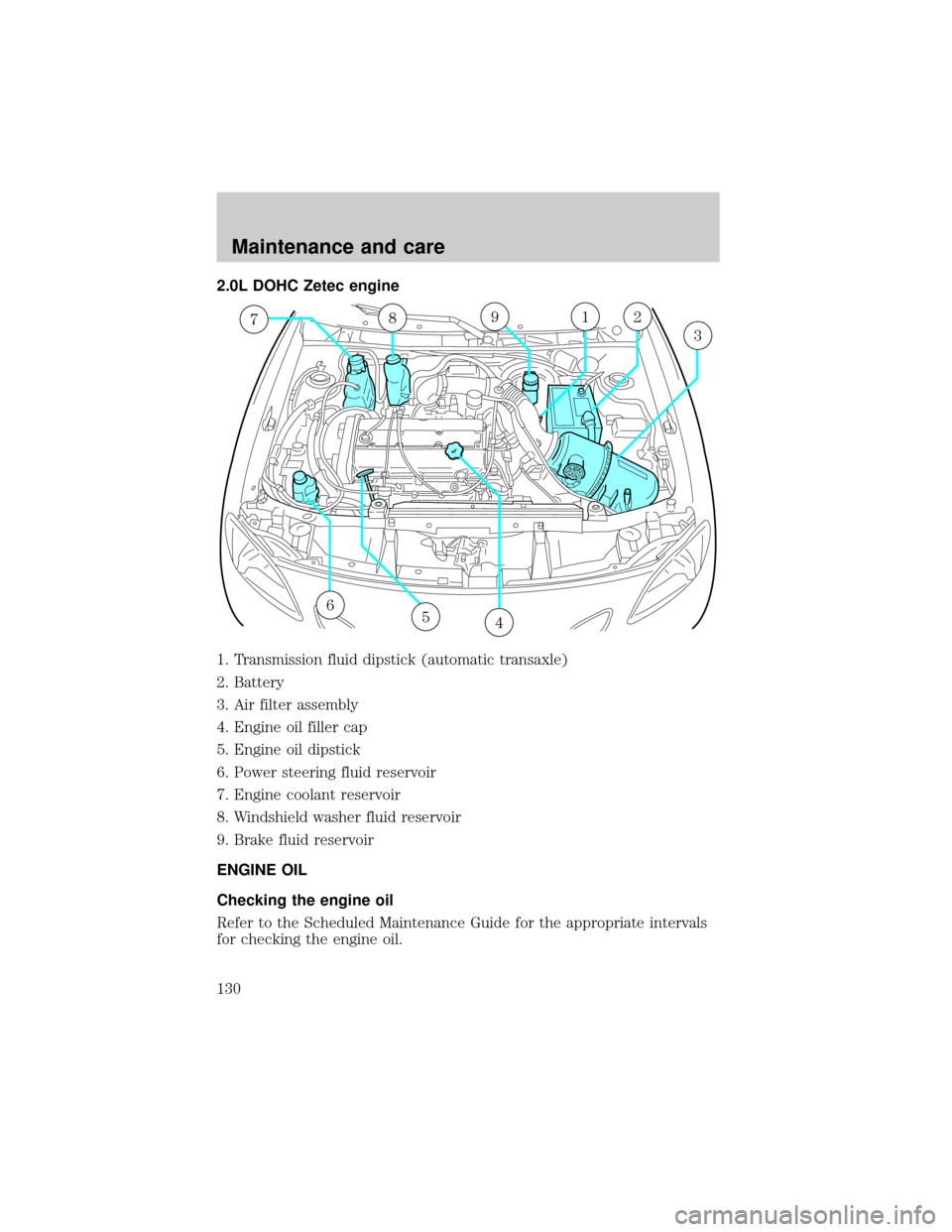
2.0L DOHC Zetec engine
1. Transmission fluid dipstick (automatic transaxle)
2. Battery
3. Air filter assembly
4. Engine oil filler cap
5. Engine oil dipstick
6. Power steering fluid reservoir
7. Engine coolant reservoir
8. Windshield washer fluid reservoir
9. Brake fluid reservoir
ENGINE OIL
Checking the engine oil
Refer to the Scheduled Maintenance Guide for the appropriate intervals
for checking the engine oil.
98712
3
4
65
Maintenance and care
130
Page 136 of 200
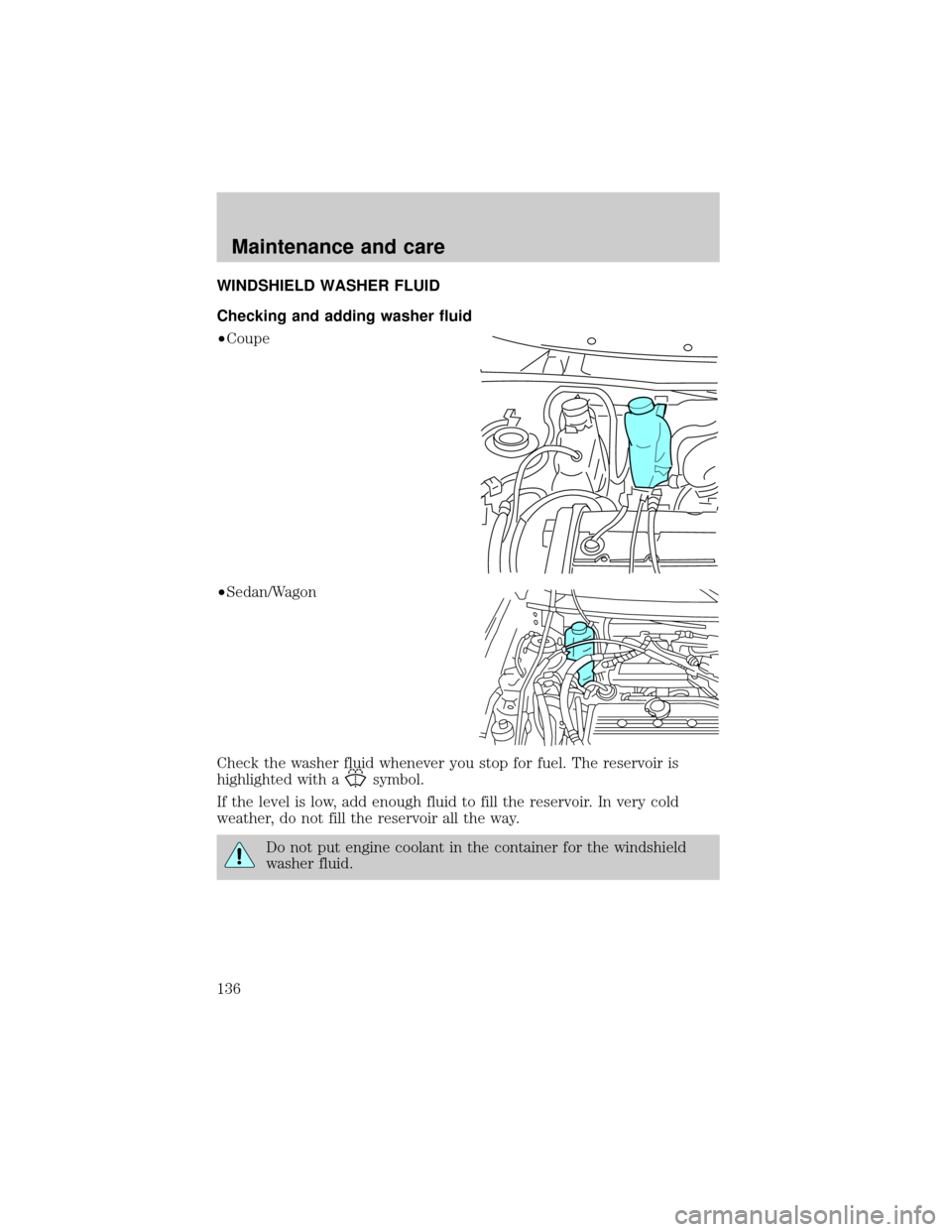
WINDSHIELD WASHER FLUID
Checking and adding washer fluid
²Coupe
²Sedan/Wagon
Check the washer fluid whenever you stop for fuel. The reservoir is
highlighted with a
symbol.
If the level is low, add enough fluid to fill the reservoir. In very cold
weather, do not fill the reservoir all the way.
Do not put engine coolant in the container for the windshield
washer fluid.
Maintenance and care
136
Page 137 of 200
Checking and adding washer fluid for the liftgate (if equipped)
The rear reservoir is located on the passenger side of the storage
compartment behind the access cover. Refill this reservoir with the same
fluid you use for your windshield.
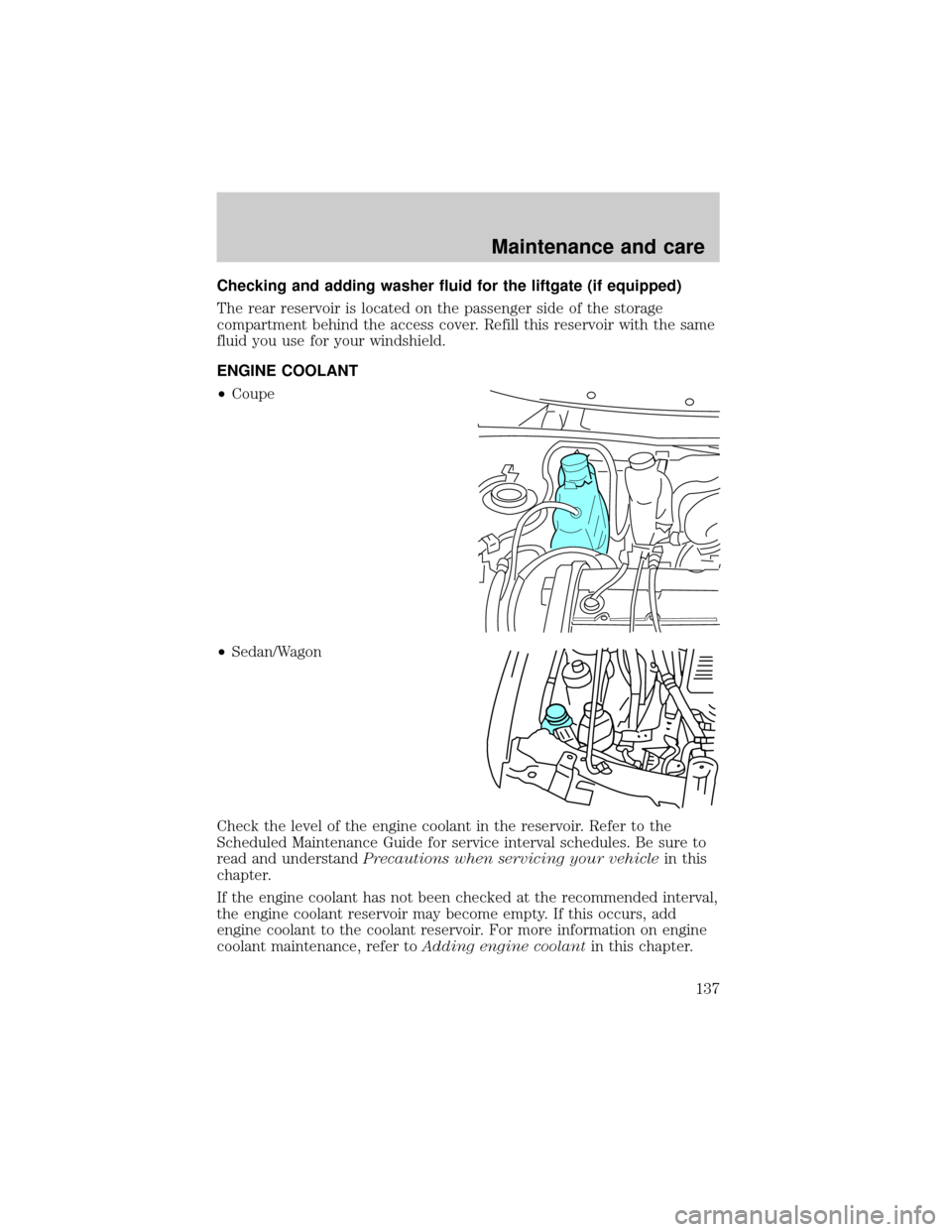
ENGINE COOLANT
²Coupe
²Sedan/Wagon
Check the level of the engine coolant in the reservoir. Refer to the
Scheduled Maintenance Guide for service interval schedules. Be sure to
read and understandPrecautions when servicing your vehiclein this
chapter.
If the engine coolant has not been checked at the recommended interval,
the engine coolant reservoir may become empty. If this occurs, add
engine coolant to the coolant reservoir. For more information on engine
coolant maintenance, refer toAdding engine coolantin this chapter.
Maintenance and care
137
Page 138 of 200
Automotive fluids are not interchangeable;do notuse engine coolant,
antifreeze or windshield washer fluid outside of its specified function and
vehicle location.
Adding engine coolant
Use only Ford Premium Engine Coolant E2FZ-19549±AA (in
Oregon, F5FZ-19549±CC, in Canada, Motorcraft CXC-10) or a
premium engine coolant that meets Ford specification
ESE-M97B44±A.
²DO NOT USE Ford Extended Life Engine Coolant
F6AZ-19544±AA (orange in color).
²DO NOT USE a DEX-COOLtengine coolant or an equivalent
engine coolant that meets Ford specification WSS-M97B44±D.
²DO NOT USE alcohol or methanol antifreeze or any engine
coolants mixed with alcohol or methanol antifreeze.
²DO NOT USE supplemental coolant additives in your vehicle.
These additives may harm your engine's cooling system.
²DO NOT MIX recycled coolant and conventional coolant
together in your vehicle. Mixing of engine coolants may harm
your engine's cooling system.
²The use of an improper coolant may harm engine and cooling
system components and may void the warranty of your vehicle's
engine cooling system.
²Use only the type of coolant with which your vehicle was
originally equipped. If you are unsure which type of coolant
your vehicle requires, contact your local dealer.
Do not put engine coolant in the container for the windshield
washer fluid.
If sprayed on the windshield, engine coolant could make it difficult to see
through the windshield.
When the engine is cool, add a 50/50 mixture of engine coolant and
distilled water to the engine coolant reservoir.
Plain water may be added in an emergency, but youmustreplace it with
a 50/50 mixture of coolant and distilled water as soon as possible.
Maintenance and care
138