1999 FORD ESCORT ABS
[x] Cancel search: ABSPage 110 of 200

Fuse/Relay
LocationFuse Amp
RatingDescription
ROOM 10A Engine Controls, Remote Anti-Theft
Personality (RAP) Module, Radio, Shift
Lock, Courtesy Lamps, Starting System,
Warning Chime
ENGINE 15A Air Bag, Engine Controls, TR Sensor
MIRROR 5A Power Mirrors, Radio, Remote Keyless
Entry (RKE)
DOOR
LOCK30A Power Door Locks
HORN 15A Horn
AIR COND 15A A/C-Heater, ABS
METER 10A Backup Lamps, Engine Controls,
Instrument Cluster, Rear Window Defrost,
Shift Lock, Warning Chime, Turn Signal
Switch
WIPER 20A Wiper/Washer, Blower Relay
STOP 15A Stop Lamps
TAIL 15A Exterior Lamps, Instrument Illumination
SUN ROOF 15A Power Moonroof
ASC 10A Speed Control
CIGAR 20A Cigar Lighter
AIR BAG 10A Joint Connector, Air Bag Diagnostic
Monitor
FOG 10A Fog Lamps, Daytime Running Lamps (DRL)
AUDIO 15A Radio
FUEL
INJECTOR10A HO2S, Evaporative Emission Purge Flow
Sensor
P. WINDOW 30A CB Power Windows
BLOWER 30A CB A/C-Heater
Power distribution box
The power distribution box is located in the engine compartment. The
power distribution box contains high-current fuses that protect your
vehicle's main electrical systems from overloads.
Roadside emergencies
110
Page 111 of 200
Always disconnect the battery before servicing high current
fuses.
Always replace the cover to the Power Distribution Box before
reconnecting the battery or refilling fluid reservoirs.
If the battery has been disconnected and reconnected, refer to the
Batterysection of theMaintenance and Carechapter.
Coupe
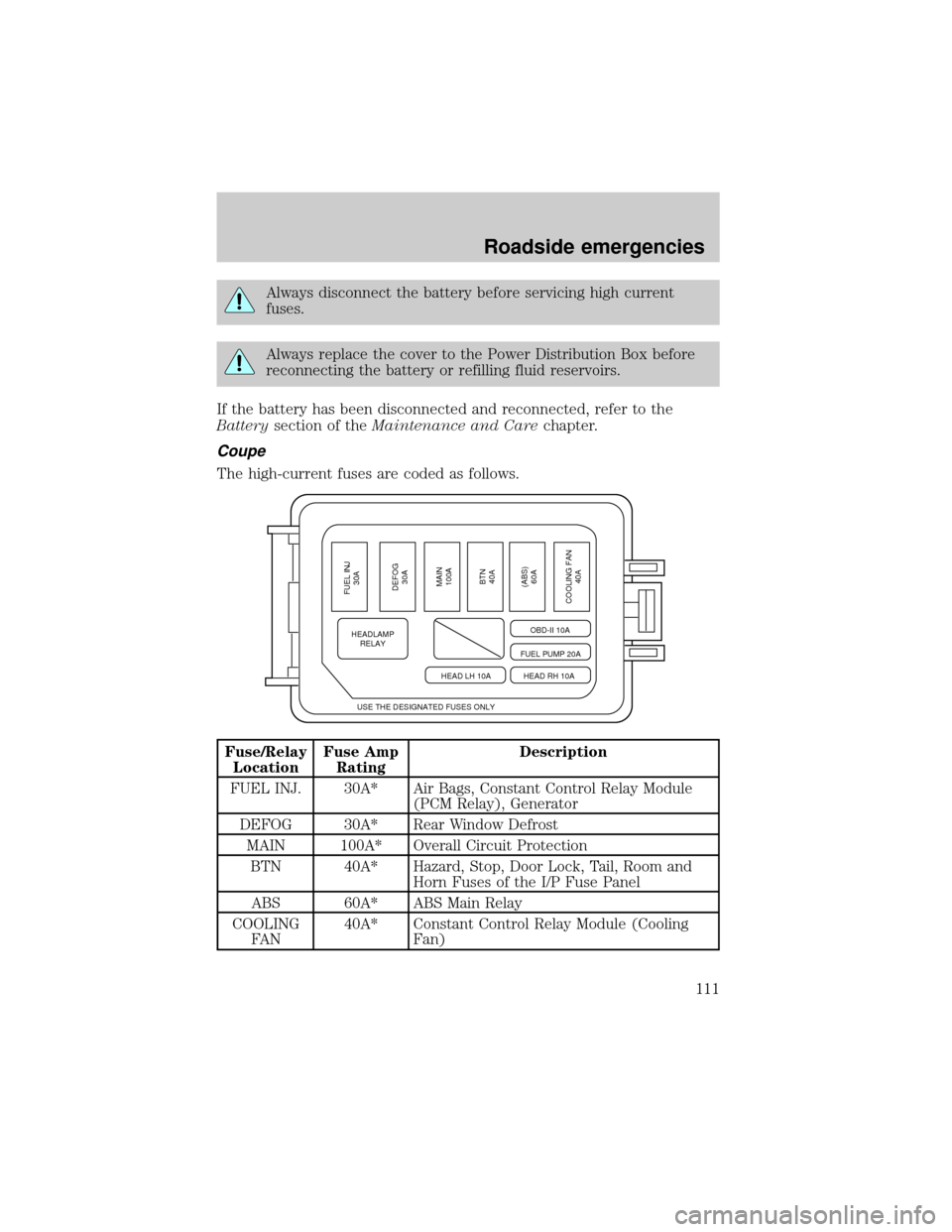
The high-current fuses are coded as follows.
Fuse/Relay
LocationFuse Amp
RatingDescription
FUEL INJ. 30A* Air Bags, Constant Control Relay Module
(PCM Relay), Generator
DEFOG 30A* Rear Window Defrost
MAIN 100A* Overall Circuit Protection
BTN 40A* Hazard, Stop, Door Lock, Tail, Room and
Horn Fuses of the I/P Fuse Panel
ABS 60A* ABS Main Relay
COOLING
FA N40A* Constant Control Relay Module (Cooling
Fan)
USE THE DESIGNATED FUSES ONLY
FUEL INJ
30A
DEFOG
30A
MAIN
100A
COOLING FAN
40A (ABS)
60A BTN
40A
HEADLAMP
RELAY
FUEL PUMP 20AOBD-II 10A
HEAD RH 10A HEAD LH 10A
Roadside emergencies
111
Page 112 of 200
Fuse/Relay
LocationFuse Amp
RatingDescription
OBD-II 10A* Data Link Connector (DLC), Instrument
Cluster
FUEL
PUMP20A** Constant Control Relay Module (Fuel
Pump)
HEAD RH 10A** Headlamps
HEAD LH 10A** Headlamps
* Fuse Link Cartridge **Fuse
Sedan/Wagon
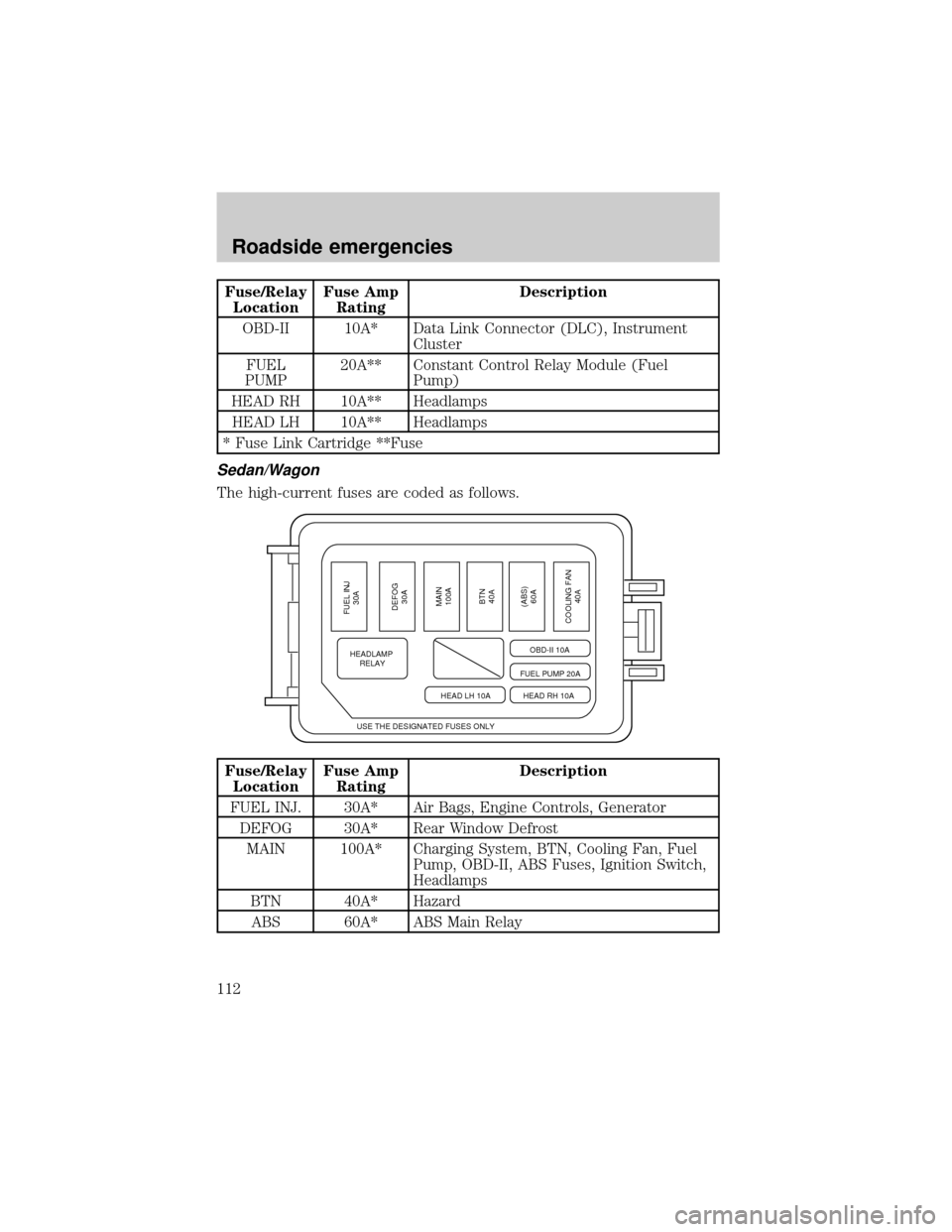
The high-current fuses are coded as follows.
Fuse/Relay
LocationFuse Amp
RatingDescription
FUEL INJ. 30A* Air Bags, Engine Controls, Generator
DEFOG 30A* Rear Window Defrost
MAIN 100A* Charging System, BTN, Cooling Fan, Fuel
Pump, OBD-II, ABS Fuses, Ignition Switch,
Headlamps
BTN 40A* Hazard
ABS 60A* ABS Main Relay
USE THE DESIGNATED FUSES ONLY
FUEL INJ
30A
DEFOG
30A
MAIN
100A
COOLING FAN
40A (ABS)
60A BTN
40A
HEADLAMP
RELAY
FUEL PUMP 20AOBD-II 10A
HEAD RH 10A HEAD LH 10A
Roadside emergencies
112
Page 153 of 200
²Avoid getting fuel liquid in your eyes. If fuel is splashed in the eyes,
remove contact lenses (if worn), flush with water for 15 minutes and
seek medical attention. Failure to seek proper medical attention could
lead to permanent injury.
²Fuels can also be harmful if absorbed through the skin. If fuel is
splashed on the skin and/or clothing, promptly remove contaminated
clothing and wash skin thoroughly with soap and water. Repeated or
prolonged skin contact with fuel liquid or vapor causes skin irritation.
²Be particularly careful if you are taking ªAntabuseº or other forms of
disulfiram for the treatment of alcoholism. Breathing gasoline vapors,
or skin contact could cause an adverse reaction. In sensitive
individuals, serious personal injury or sickness may result. If fuel is
splashed on the skin, promptly wash skin thoroughly with soap and
water. Consult a physician immediately if you experience an adverse
reaction.
When refueling always shut the engine off and never allow
sparks or open flames near the filler neck. Never smoke while
refueling. Fuel vapor is extremely hazardous under certain conditions.
Care should be taken to avoid inhaling excess fumes.
The flow of fuel through a fuel pump nozzle can produce static
electricity, which can cause a fire if fuel is pumped into an
ungrounded fuel container.
Use the following guidelines to avoid static build-up when filling an
ungrounded fuel container:
²Place approved fuel container on the ground.
²DO NOT fill a fuel container while it is in the vehicle.
²Keep the fuel pump nozzle in contact with the fuel container while
filling.
²DO NOT use a device that would hold the fuel pump handle in the fill
position.
Maintenance and care
153
Page 154 of 200
Fuel Filler Cap
Your fuel tank filler cap has an indexed design with a 1/8 turn on/off
feature.
When fueling your vehicle:
1. Turn the engine off.
2. Carefully turn the filler cap counterclockwise 1/8 of a turn until it
stops.
3. Pull to remove the cap from the fuel filler pipe.
4. To install the cap, align the tabs on the cap with the notches on the
filler pipe.
5. Turn the filler cap clockwise 1/8 of a turn until it stops.
If the ªService Engine Soon/Check Engineº indicator comes on and stays
on when you start the engine, the fuel filler cap may not be properly
installed. Turn off the engine, remove the fuel filler cap, align the cap
properly and reinstall it.
If you must replace the fuel filler cap, replace it with a fuel filler
cap that is designed for your vehicle. The customer warranty may
be void for any damage to the fuel tank or fuel system if the
correct genuine Ford or Motorcraft fuel filler cap is not used.
The fuel system may be under pressure. If the fuel filler cap is
venting vapor or if you hear a hissing sound, wait until it stops
before completely removing the fuel filler cap. Otherwise, fuel may
spray out and injure you or others.
If you do not use the proper fuel filler cap, excessive pressure or
vacuum in the fuel tank may damage the fuel system or cause
the fuel system to work improperly in a collision, which may result in
possible personal injury.
Choosing the right fuel
Use only UNLEADED FUEL. The use of leaded fuel is prohibited by law
and could damage your vehicle.
Do not use fuel containing methanol. It can damage critical fuel system
components.
Maintenance and care
154
Page 163 of 200
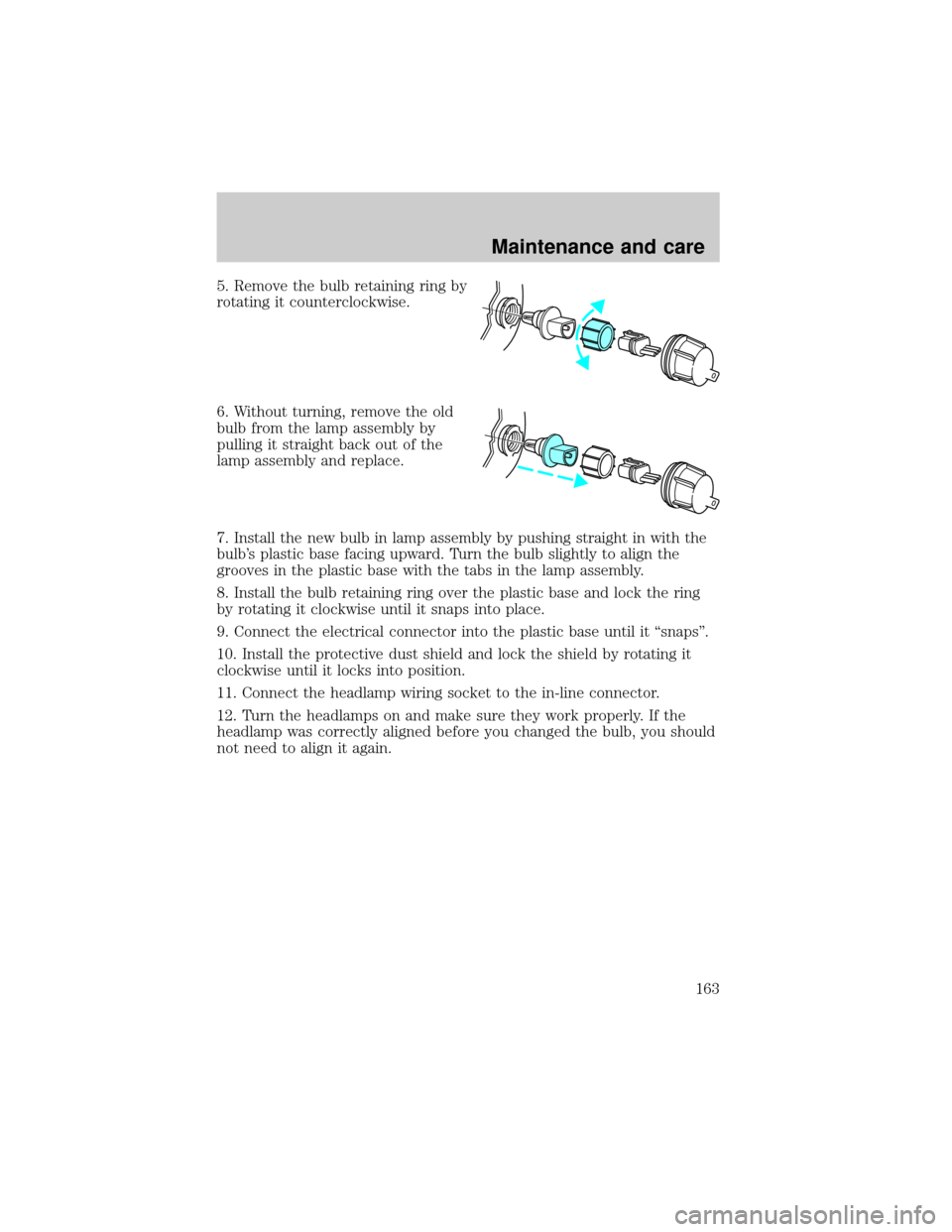
5. Remove the bulb retaining ring by
rotating it counterclockwise.
6. Without turning, remove the old
bulb from the lamp assembly by
pulling it straight back out of the
lamp assembly and replace.
7. Install the new bulb in lamp assembly by pushing straight in with the
bulb's plastic base facing upward. Turn the bulb slightly to align the
grooves in the plastic base with the tabs in the lamp assembly.
8. Install the bulb retaining ring over the plastic base and lock the ring
by rotating it clockwise until it snaps into place.
9. Connect the electrical connector into the plastic base until it ªsnapsº.
10. Install the protective dust shield and lock the shield by rotating it
clockwise until it locks into position.
11. Connect the headlamp wiring socket to the in-line connector.
12. Turn the headlamps on and make sure they work properly. If the
headlamp was correctly aligned before you changed the bulb, you should
not need to align it again.
Maintenance and care
163
Page 167 of 200
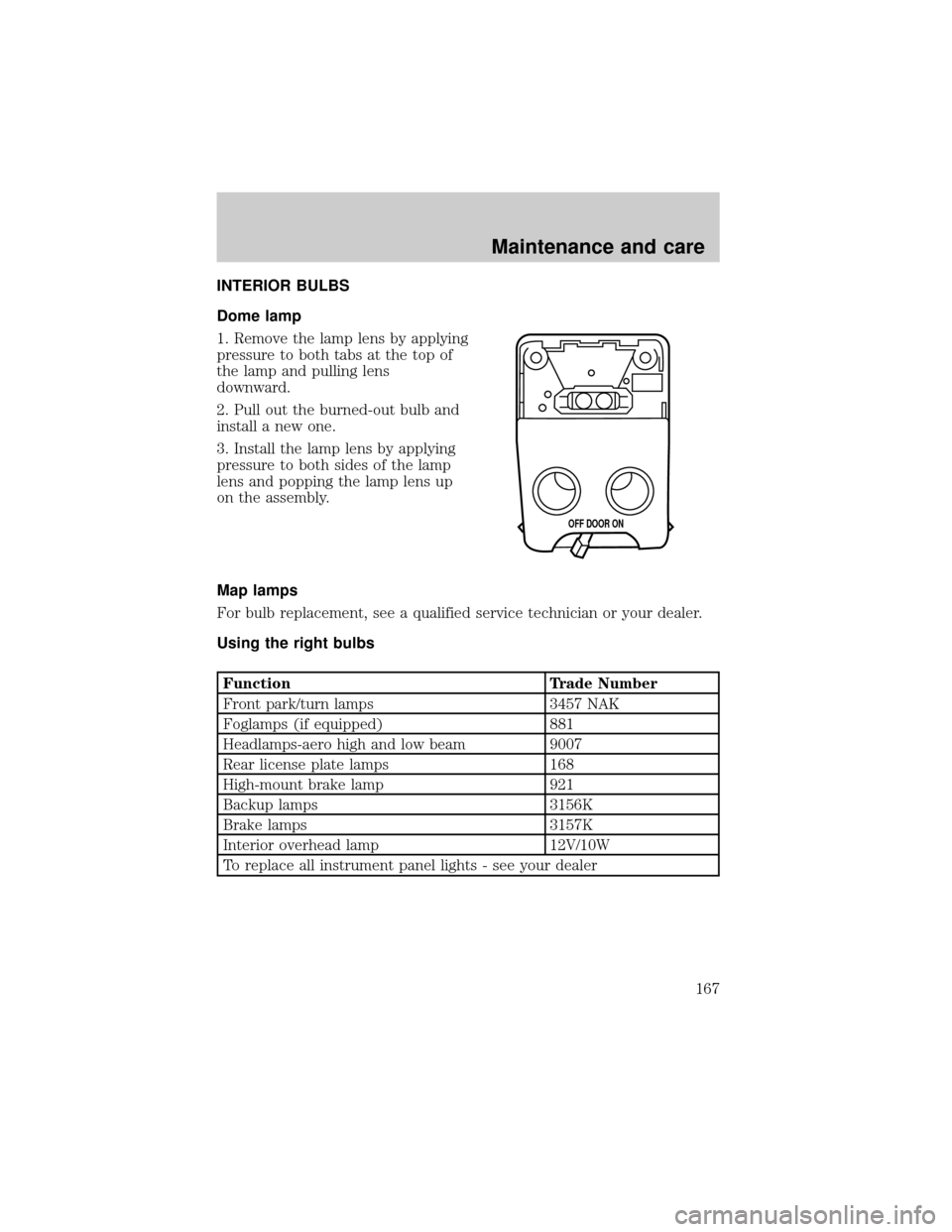
INTERIOR BULBS
Dome lamp
1. Remove the lamp lens by applying
pressure to both tabs at the top of
the lamp and pulling lens
downward.
2. Pull out the burned-out bulb and
install a new one.
3. Install the lamp lens by applying
pressure to both sides of the lamp
lens and popping the lamp lens up
on the assembly.
Map lamps
For bulb replacement, see a qualified service technician or your dealer.
Using the right bulbs
Function Trade Number
Front park/turn lamps 3457 NAK
Foglamps (if equipped) 881
Headlamps-aero high and low beam 9007
Rear license plate lamps 168
High-mount brake lamp 921
Backup lamps 3156K
Brake lamps 3157K
Interior overhead lamp 12V/10W
To replace all instrument panel lights - see your dealer
OFF DOOR ON
Maintenance and care
167
Page 194 of 200

Air bag supplemental
restraint system ..........................71
and child safety seats ..............73
description ................................71
disposal ......................................75
driver air bag ............................73
indicator light ........................8,75
operation ...................................73
passenger air bag .....................73
Air cleaner filter ................146,174
Air conditioning ..........................37
Anti-theft system ...................58,59
arming the system ....................59
disarming a
triggered system ..................59,60
disarming an untriggered
system .......................................59
warning light ...............................9
Automatic transaxle ...................95
driving with ...............................97
fluid, refill capacities ..............174
fluid, specification ..................176
Battery .......................................144
acid, treating emergencies .....144
charging system
warning light .............................10
jumping a disabled battery ....117
maintenance-free ....................144
replacement, specifications ...174
servicing ..................................144
Brakes ..........................................89
anti-lock ................................89,90
anti-lock brake system
(ABS) warning light ..............9,89
brake warning light ....................8
fluid, checking and adding ....134
fluid, refill capacities ..............174
fluid, specifications ..........175,176
lubricant specifications ...175,176
parking ......................................90
shift interlock ............................95
Break-in period .............................2Capacities for refilling fluids ....174
Cargo cover .................................54
Child safety restraints ................76
child safety belts ......................76
child safety seats ......................77
Child safety seats ........................77
attaching with tether straps ....80
built-in child seat .....................77
in front seat ..............................78
in rear seat ................................78
tether anchorage
hardware ..............................80,81
Cleaning your vehicle ...............169
engine compartment ..............171
exterior ....................................170
exterior lamps .........................172
instrument panel ....................172
interior .....................................173
plastic parts ............................172
safety belts ..............................173
washing ....................................170
waxing .....................................170
wheels ......................................171
wiper blades ............................172
Clock ..................................19,25,33
Clutch
fluid ..........................................135
operation while driving ............92
recommended shift speeds ......94
Coolant ........................137,139,140
checking and adding ..............138
refill capacities .................139,174
specifications ...................175,176
Customer Assistance ................181
Ford accessories
for your vehicle ......................188
Ford Extended
Service Plan ............................182
Getting assistance outside the
U.S. and Canada .....................187
Getting roadside assistance ...181
Index
194