Replacing the tires
Replace the tires when the wear
band is visible through the tire
treads.
When replacing full size tires, never mix radial bias-belted, or
bias-type tires. Use only the tire sizes that are listed on the
Certification Label. Make sure that all tires are the same size, speed
rating, and load-carrying capacity. Use only the tire combinations
recommended on the label. If you do not follow these precautions,
your vehicle may not drive properly and safely.
Make sure that all replacement tires are of the same size, type,
load-carrying capacity and tread design (e.g., ªAll Terrainº, etc.),
as originally offered by Ford.
Failure to follow these precautions may adversely affect the
handling of the vehicle and make it easier for the driver to lose
control and roll over.
Tires that are larger or smaller than your vehicle's original tires may also
affect the accuracy of your speedometer.
Maintenance and care
168
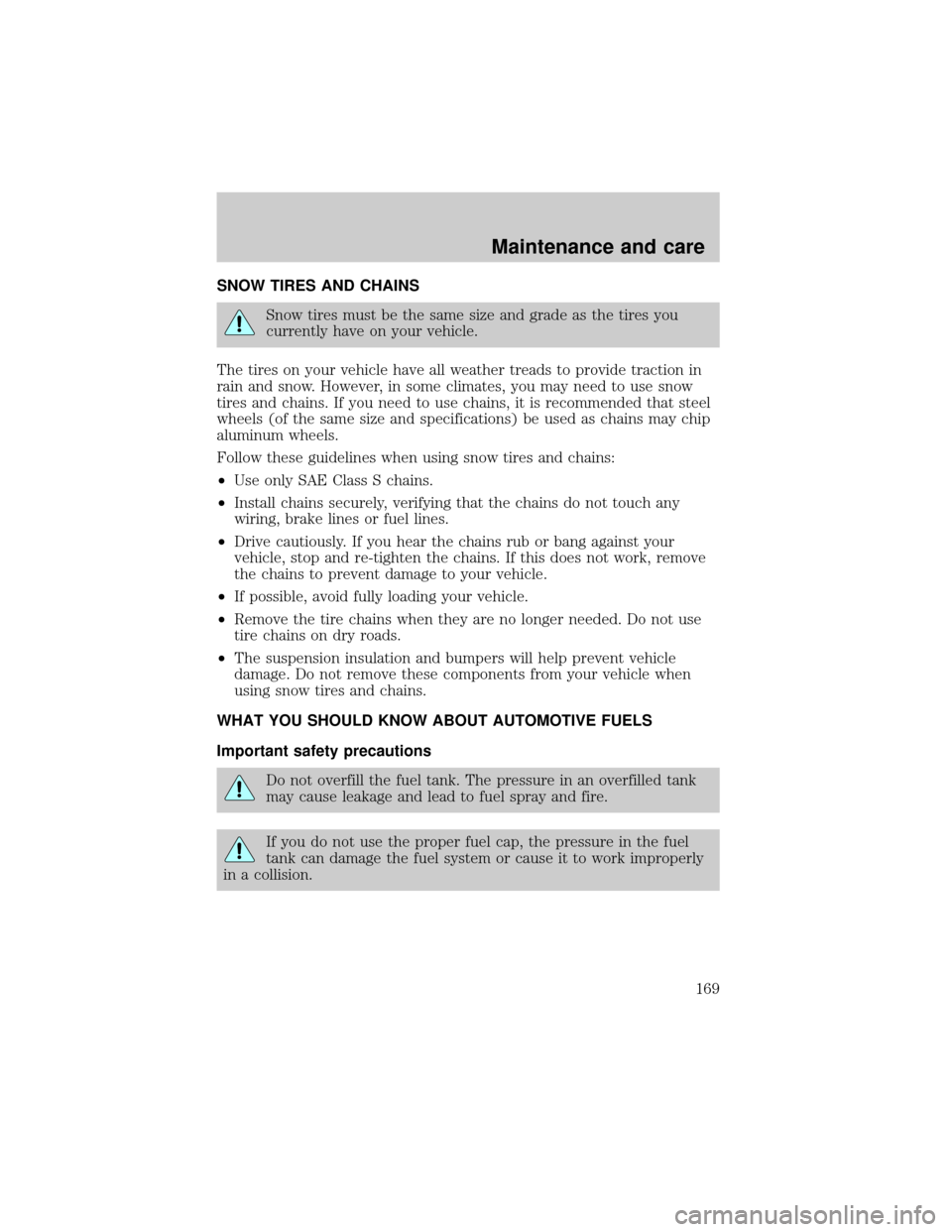
SNOW TIRES AND CHAINS
Snow tires must be the same size and grade as the tires you
currently have on your vehicle.
The tires on your vehicle have all weather treads to provide traction in
rain and snow. However, in some climates, you may need to use snow
tires and chains. If you need to use chains, it is recommended that steel
wheels (of the same size and specifications) be used as chains may chip
aluminum wheels.
Follow these guidelines when using snow tires and chains:
²Use only SAE Class S chains.
²Install chains securely, verifying that the chains do not touch any
wiring, brake lines or fuel lines.
²Drive cautiously. If you hear the chains rub or bang against your
vehicle, stop and re-tighten the chains. If this does not work, remove
the chains to prevent damage to your vehicle.
²If possible, avoid fully loading your vehicle.
²Remove the tire chains when they are no longer needed. Do not use
tire chains on dry roads.
²The suspension insulation and bumpers will help prevent vehicle
damage. Do not remove these components from your vehicle when
using snow tires and chains.
WHAT YOU SHOULD KNOW ABOUT AUTOMOTIVE FUELS
Important safety precautions
Do not overfill the fuel tank. The pressure in an overfilled tank
may cause leakage and lead to fuel spray and fire.
If you do not use the proper fuel cap, the pressure in the fuel
tank can damage the fuel system or cause it to work improperly
in a collision.
Maintenance and care
169
economy. Additionally, keeping records during summer and winter will
show how temperature impacts fuel economy. In general, lower
temperatures give lower fuel economy.
Driving style Ð good driving and fuel economy habits
Give consideration to the lists that follow and you may be able to change
a number of variables and improve your fuel economy.
Habits
²Smooth, moderate operation can yield up to 10% savings in fuel.
²Steady speeds without stopping will usually give the best fuel
economy.
²Idling for long periods of time (greater than one minute) may waste
fuel.
²Anticipate stopping; slowing down may eliminate the need to stop.
²Sudden or hard accelerations may reduce fuel economy.
²Slow down gradually.
²Drive at reasonable speeds (traveling at 105 km /h [65 mph] uses 15%
more fuel than traveling at 88 km/h [55 mph]).
²Revving the engine before turning it off may reduce fuel economy.
²Use of the air conditioner or defroster may reduce fuel economy.
²Use of speed control (if equipped) may improve fuel economy. Speed
control can help maintain a constant speed and reduce speed changes.
You may want to turn off the speed control in hilly terrain as
unnecessary shifting between third and fourth gears may occur and
could result in reduced fuel economy.
²Warming up a vehicle on cold mornings is not required and may
reduce fuel economy.
²Resting your foot on the brake pedal while driving may reduce fuel
economy.
²Combine errands and minimize stop-and-go driving.
Maintenance
²Keep tires properly inflated and use only recommended size.
²Operating a vehicle with the wheels out of alignment will reduce fuel
economy.
Maintenance and care
175
Radio ....34,35,36,37,38,39,40,41,42
43,44,45,46,47,48,49,50,51
52,53,54,55,56,57,58,59,60
Relays .................................133,138
Remote entry system ............81,84
illuminated entry ......................85
locking/unlocking doors ...........82
replacement/additional
transmitters ...............................86
replacing the batteries .............85
Safety Compliance
Certification Label ....................191
Safety defects, reporting ..........204
Safety restraints ...........95,96,97,98
cleaning the safety belts .100,186
extension assembly ..................99
for children .............................105
lap belt ......................................98
warning light and chime ...99,100
Seat belts
(see Safety restraints) ...............95
Seats ............................................91
child safety seats .............106,107
cleaning ...................................186
Servicing your vehicle ..............148
Spark plugs, specifications .......187
Special notice ................................3
Specification chart, lubricants .188
Speed control ..............................68
Starting your vehicle .........112,114
jump starting ............142,143,145
preparing to start your
vehicle .......................................86
Steering wheel
tilting .........................................67Tires ....................................165,166
changing ...........................138,139
checking the pressure ............166
replacing ..................................168
rotating ....................................166
snow tires and chains ............169
tire grades ...............................166
treadwear ................................165
Towing .........................128,129,130
wrecker ....................................147
Traction control ........................120
Traction-lok rear axle ...............126
Transmission .............................123
fluid, checking and adding
(automatic) ...............159,160,161
Trunk ...........................................84
remote release ..........................78
Vehicle dimensions ...................189
Vehicle Identification Number
(VIN) ..........................................191
Vehicle loading ..........................126
Ventilating your vehicle ...........116
Warning chimes ......................11,21
Washer fluid ..............................154
Water, Driving through .............130
Wheels
anti-theft lug nuts ...........141,142
Windows .................................78,79
Windshield washer fluid and
wipers
checking and cleaning ............164
operation ...................................66
replacing wiper blades ...........164
Index
207