1999 DODGE RAM fuel cap release
[x] Cancel search: fuel cap releasePage 983 of 1691
line on fuel rail using proper procedure. Go to step 5).
4) Release fuel pressure from fuel system. See FUEL SYSTEM
PRESSURE RELEASE. Ensure negative battery cable is disconnected.
Remove fuel tank cap to release any residual fuel tank pressure.
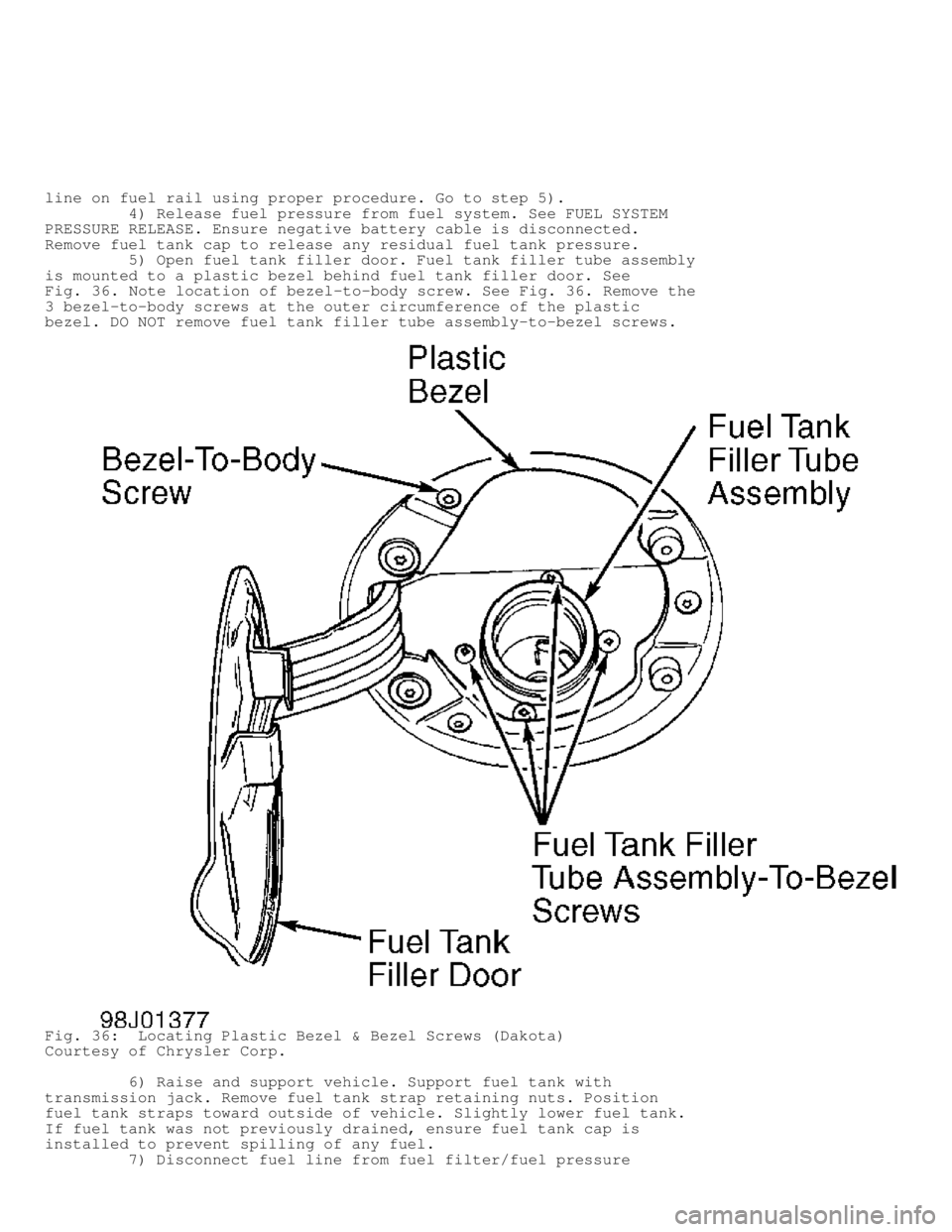
5) Open fuel tank filler door. Fuel tank filler tube assembly
is mounted to a plastic bezel behind fuel tank filler door. See
Fig. 36. Note location of bezel-to-body screw. See Fig. 36. Remove the
3 bezel-to-body screws at the outer circumference of the plastic
bezel. DO NOT remove fuel tank filler tube assembly-to-bezel screws.
Fig. 36: Locating Plastic Bezel & Bezel Screws (Dakota)
Courtesy of Chrysler Corp.
6) Raise and support vehicle. Support fuel tank with
transmission jack. Remove fuel tank strap retaining nuts. Position
fuel tank straps toward outside of vehicle. Slightly lower fuel tank.
If fuel tank was not previously drained, ensure fuel tank cap is
installed to prevent spilling of any fuel.
7) Disconnect fuel line from fuel filter/fuel pressure
Page 985 of 1691

1) To install, reverse removal procedure. If installing small
vent tube and large fill tube on fuel tank, ensure fuel tank fittings
are clean.
2) Install disconnect fitting on fuel tank fitting until
disconnect fitting snaps onto fuel tank fitting. Pull on small vent
tube or and large fill tube to ensure disconnect fitting is locked on
fuel tank fitting. To verify proper installation of disconnect
fitting, ensure the distance between release sleeve and top of fuel
tank fitting is .50" (12.7 mm) on small vent tube or .25" (6.4 mm) o\
n
large fill tube. See Fig. 37.
3) Install fuel lines on fuel filter/fuel pressure regulator
on fuel pump module using proper procedure. See FUEL LINE DISCONNECT
FITTINGS under FUEL SYSTEM.
CAUTION: DO NOT overtighten fuel tank strap retaining nuts during
installation.
4) Tighten fuel tank strap retaining nuts to specification.
See TORQUE SPECIFICATIONS. To install remaining components, reverse
removal procedure. Start engine and check for fuel leaks.
Removal (Durango)
1) Fuel tank may be drained by removing vent hose from rear
of fuel tank, or by pumping fuel from fuel tank using the fuel pump if
fuel pump is operating. If removing vent hose from fuel tank to drain
the fuel, go to step 4). If using fuel pump to drain the fuel tank, go
to next step.
2) Disconnect fuel line from fuel rail. See FUEL LINE AT FUEL
RAIL under FUEL SYSTEM. Connect Fuel Hose (6541, 6539, 6631 or 6923)
for proper engine application at fuel line fitting on fuel rail. Place
remaining end of fuel hose in an approved gasoline container.
3) Connect scan tool to Data Link Connector (DLC). DLC is a
16-pin connector attached to bottom of driver's side of the instrument
panel, just to the right of the brake pedal. Using scan tool
manufacturer's instructions, activate the fuel pump and pump fuel from
fuel tank. Once fuel tank is empty, remove scan tool. Reinstall fuel
line on fuel rail using proper procedure. Go to step 5).
4) Release fuel pressure from fuel system. See FUEL SYSTEM
PRESSURE RELEASE. Ensure negative battery cable is disconnected.
Remove fuel tank cap to release any residual fuel tank pressure.
5) Raise and support vehicle. Remove necessary skid plates
for access to fuel tank. Disconnect vent and filler hose from rear of
fuel tank. If fuel tank was not previously drained, place drain hose
in vent hose fitting at rear of fuel tank. Drain fuel from fuel tank
into an approved gasoline container.
6) Support fuel tank with transmission jack. Remove fuel tank
strap retaining nuts. Position fuel tank straps toward outside of
vehicle. Slightly lower fuel tank. Ensure rear of fuel tank is higher
than front of fuel tank to prevent any spilling any remaining fuel in
fuel tank.
7) Disconnect fuel line from fuel filter/fuel pressure
regulator on fuel pump module using proper procedure for fuel line
disconnect fitting. See FUEL LINE DISCONNECT FITTINGS. Fuel pump
module is located on top of fuel tank. See Fig. 28. Disconnect
electrical connector at fuel pump module. Disconnect vapor line from
rollover valves on top of fuel tank and EVAP line from fuel pump
module. Lower fuel tank from vehicle.
CAUTION: DO NOT overtighten fuel tank strap retaining nuts during
installation.
Installation
1) To install, reverse removal procedure. Install fuel lines
Page 986 of 1691

on fuel filter/fuel pressure regulator on fuel pump module using
proper procedure. See FUEL LINE DISCONNECT FITTINGS.
2) Tighten fuel tank strap retaining nuts to specification.
See TORQUE SPECIFICATIONS. Start engine and check for fuel leaks.
Removal (Ram Pickup)
1) Fuel tank may be drained by lowering fuel tank, or by
pumping fuel from fuel tank using the fuel pump if fuel pump is
operating. If lowering fuel tank to drain the fuel, go to step 4). If
using fuel pump to drain the fuel tank, go to next step.
2) Disconnect fuel line from fuel rail. See FUEL LINE AT FUEL
RAIL. Connect Fuel Hose (6541, 6539, 6631 or 6923) for proper engine
application at fuel line fitting on fuel rail. Place remaining end of
fuel hose in an approved gasoline container.
3) Connect scan tool to Data Link Connector (DLC). DLC is a
16-pin connector attached to bottom of driver's side of the instrument
panel, just straight above the accelerator pedal. Using scan tool
manufacturer's instructions, activate the fuel pump and pump fuel from
fuel tank. Once fuel tank is empty, remove scan tool. Reinstall fuel
line on fuel rail using proper procedure. Go to step 5).
4) Release fuel pressure from fuel system. See FUEL SYSTEM
PRESSURE RELEASE. Ensure negative battery cable is disconnected.
Remove fuel tank cap to release any residual fuel tank pressure.
5) Raise and support vehicle. Open fuel tank filler door.
Remove fuel tank filler tube assembly-to-body screws. Support fuel
tank with transmission jack. Remove fuel tank strap retaining nuts.
6) Slightly lower fuel tank. If fuel tank was not previously
drained, slightly rotate fuel tank so vent hose and filler hose on
fuel tank are above the fuel level in the fuel tank to prevent fuel
leakage when hoses are disconnected. Vent hose and filler hose attach
to fitting on the fuel tank. See Fig. 29.
7) Disconnect vent hose from vent hose fitting on fuel tank.
If fuel tank was previously drained, go to next step. If fuel tank was
not previously drained, place drain hose in vent hose fitting on fuel
tank. Drain fuel from fuel tank into an approved gasoline container.
Go to next step.
8) Disconnect filler hose from filler hose fitting on fuel
tank. Disconnect electrical connector at fuel pump module. Fuel pump
module is located on top of fuel tank. See Fig. 29.
9) Disconnect fuel line from fuel filter/fuel pressure
regulator on fuel pump module using proper procedure for fuel line
disconnect fitting. See FUEL LINE DISCONNECT FITTINGS under FUEL
SYSTEM.
10) Disconnect necessary vapor hoses from rollover valves on
top of fuel tank or fuel pump module. See Fig. 29. Lower fuel tank
from vehicle.
CAUTION: DO NOT overtighten fuel tank strap retaining nuts during
installation.
Installation
1) To install, reverse removal procedure. Install fuel lines
on fuel filter/fuel pressure regulator on fuel pump module using
proper procedure. See FUEL LINE DISCONNECT FITTINGS.
2) Tighten fuel tank strap retaining nuts to specification.
See TORQUE SPECIFICATIONS. Start engine and check for fuel leaks.
Removal (Ram Van & Ram Wagon)
1) Fuel tank may be drained by siphoning fuel out through
small vent hose on fuel and vent hose fitting assembly on fuel tank,
or by pumping fuel from fuel tank using the fuel pump if fuel pump is
operating. If siphoning fuel out through small vent hose on fuel and
vent hose fitting assembly on fuel tank, go to step 4). If using fuel
Page 987 of 1691
pump to drain the fuel tank, go to next step.
2) Disconnect fuel line from fuel rail. See FUEL LINE AT FUEL
RAIL. Connect Fuel Hose (6541, 6539, 6631 or 6923) for proper engine
application at fuel line fitting on fuel rail. Place remaining end of
fuel hose in an approved gasoline container.
3) Connect scan tool to Data Link Connector (DLC). DLC is a
16-pin connector attached to bottom of driver's side of the instrument
panel, just straight above the accelerator pedal. Using scan tool
manufacturer's instructions, activate the fuel pump and pump fuel from
fuel tank. Once fuel tank is empty, remove scan tool. Reinstall fuel
line on fuel rail using proper procedure. Go to step 5).
4) Release fuel pressure from fuel system. See FUEL SYSTEM
PRESSURE RELEASE. Ensure negative battery cable is disconnected.
Remove fuel tank cap to release any residual fuel tank pressure.
5) Raise and support vehicle. Disconnect the small vent hose
from fill and vent hose fitting assembly at driver's side frame rail.
Fill and vent hose fitting assembly is permanently attached on fuel
tank. See Fig. 30.
6) If fuel tank was previously drained, go to next step. If
fuel tank was not previously drained, siphon fuel from fuel tank into
an approved gasoline container by installing siphon hose in small vent
hose fitting on fill and vent hose fitting assembly. Go to next step.
7) Disconnect large fill hose from fill and vent hose fitting
assembly at driver's side frame rail. Fill and vent hose fitting
assembly is permanently attached on fuel tank. See Fig. 30.
8) Support fuel tank with transmission jack. Remove fuel tank
strap retaining nuts from L-shaped bolts securing fuel tank straps on
frame rail. Remove fuel tank straps.
CAUTION: Fill and vent hose fitting assembly must be released from
plastic shield before lowering fuel tank. Use care when
lowering fuel tank as not to damage fill and vent hose
fitting assembly or the fuel tank.
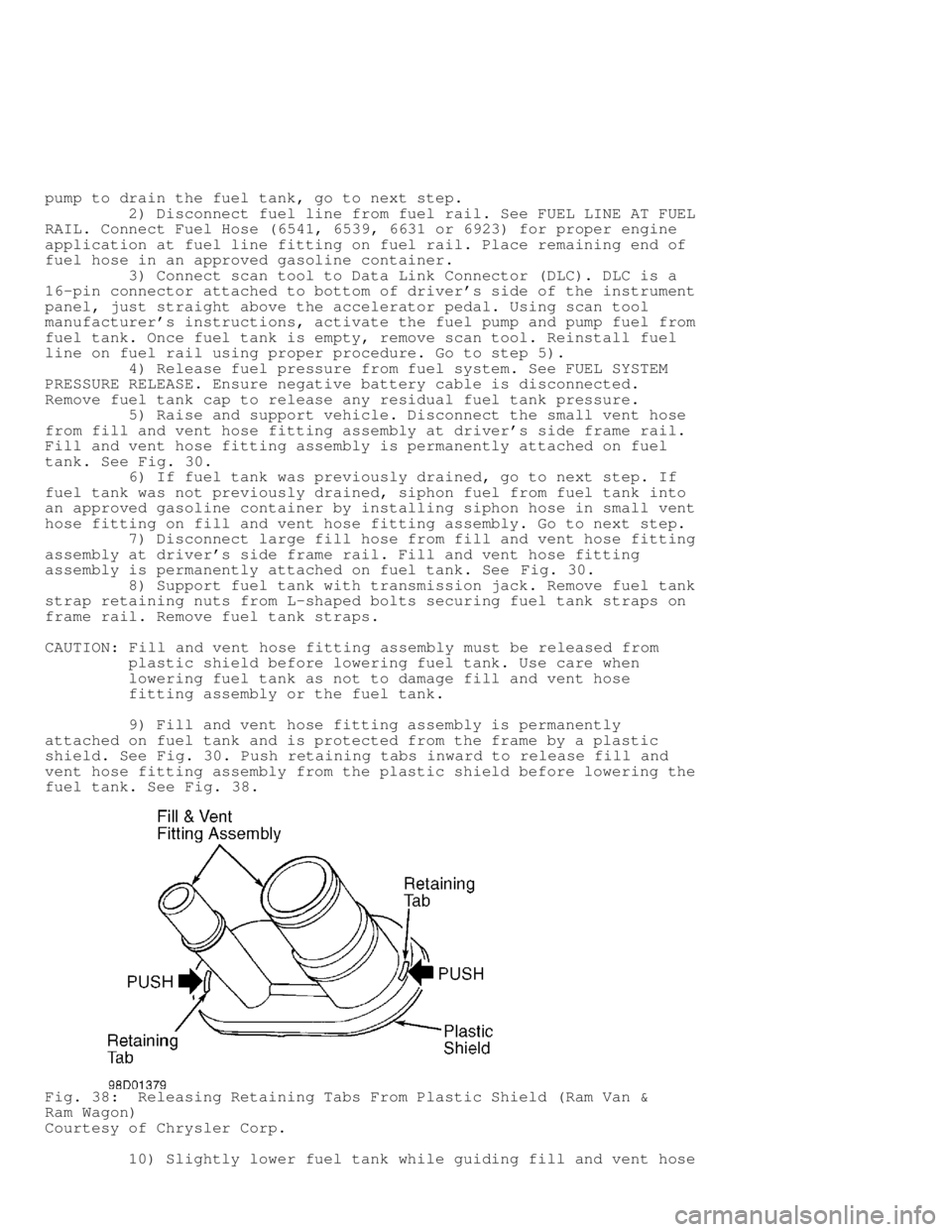
9) Fill and vent hose fitting assembly is permanently
attached on fuel tank and is protected from the frame by a plastic
shield. See Fig. 30. Push retaining tabs inward to release fill and
vent hose fitting assembly from the plastic shield before lowering the
fuel tank. See Fig. 38.
Fig. 38: Releasing Retaining Tabs From Plastic Shield (Ram Van &
Ram Wagon)
Courtesy of Chrysler Corp.
10) Slightly lower fuel tank while guiding fill and vent hose