Page 275 of 440
yellowblue
4-39 Parking on Hills
CAUTION:
You really should not park your vehicle, with a
trailer attached, on a hill. If something goes
wrong, your rig could start to move. People can
be injured, and both your vehicle and the trailer
can be damaged.
But if you ever have to park your rig on a hill, here's
how to do it:
1. Apply your regular brakes, but don't shift into
PARK (P) yet.
2. Have someone place chocks under the trailer wheels.
3. When the wheel chocks are in place, release the
regular brakes until the chocks absorb the load.
4. Reapply the regular brakes. Then apply your parking
brake, and then shift to PARK (P).
5. Release the regular brakes.
When You Are Ready to Leave After
Parking on a Hill
1. Apply your regular brakes and hold the pedal down
while you:
�Start your engine;
�Shift into a gear; and
�Release the parking brake.
2. Let up on the brake pedal.
3. Drive slowly until the trailer is clear of the chocks.
4. Stop and have someone pick up and store the chocks.
Maintenance When Trailer Towing
Your vehicle will need service more often when you're
pulling a trailer. See the Maintenance Schedule for more
on this. Things that are especially important in trailer
operation are automatic transaxle fluid (don't overfill),
engine oil, belts, cooling system and brake system. Each
of these is covered in this manual, and the Index will
help you find them quickly. If you're trailering, it's a
good idea to review these sections before you start
your trip.
Check periodically to see that all hitch nuts and bolts
are tight.
Page 281 of 440
yellowblue
5-5
3. Turn off the ignition on both vehicles. Unplug
unnecessary accessories plugged into the cigarette
lighter or the accessory power outlet. Turn off all
lamps that aren't needed, as well as radios. This will
avoid sparks and help save both batteries. In
addition, it could save your radio!
NOTICE:
If you leave your radio on, it could be badly
damaged. The repairs wouldn't be covered by
your warranty.
4. Open the hoods and locate the batteries. Find the
positive (+) and negative (
-) terminals on
each battery.
CAUTION:
An electric fan can start up even when the engine
is not running and can injure you. Keep hands,
clothing and tools away from any underhood
electric fan.
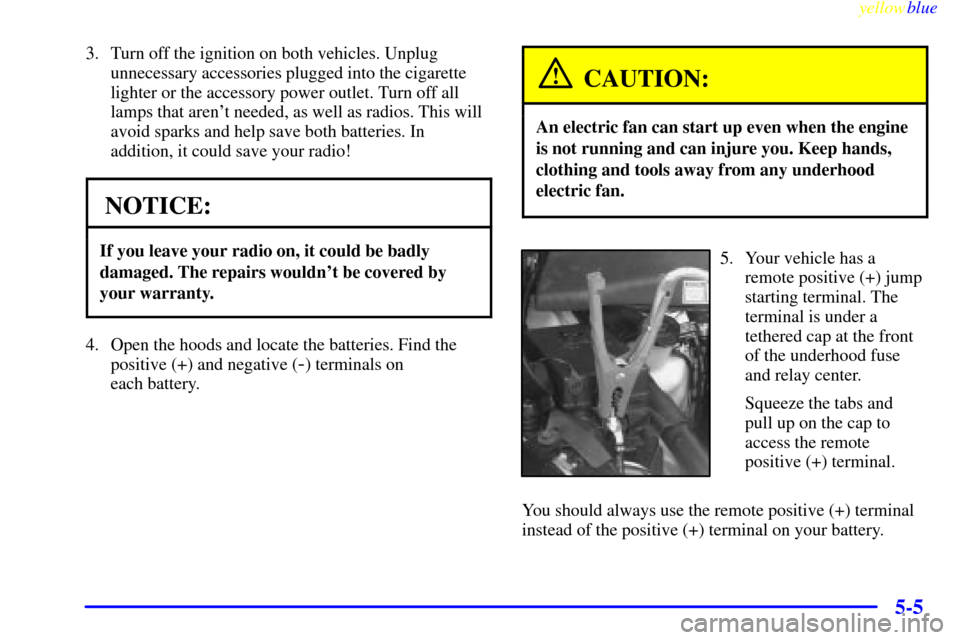
5. Your vehicle has a
remote positive (+) jump
starting terminal. The
terminal is under a
tethered cap at the front
of the underhood fuse
and relay center.
Squeeze the tabs and
pull up on the cap to
access the remote
positive (+) terminal.
You should always use the remote positive (+) terminal
instead of the positive (+) terminal on your battery.
Page 306 of 440
yellowblue
5-30 Storing a Flat or Spare Tire and Tools
CAUTION:
Storing a jack, a tire or other equipment in the
passenger compartment of the vehicle could
cause injury. In a sudden stop or collision, loose
equipment could strike someone. Store all these
in the proper place.
1. Lay the tire near the rear of the vehicle with the
valve stem down.
2. Remove the small center cap by tapping the back of
the cap with the extension of the shaft.
3. Slide the cable retainer through the center of the
wheel and start to raise the tire.
Make sure the retainer is fully seated across the
underside of the wheel.4. When the tire is almost in the stored position,
turn the tire so the valve is towards the rear of
the vehicle.
This will help when you check and maintain tire
pressure in the spare.
5. Keep raising the wheel until you hear the hoist
mechanism click twice.
This means the wheel is firmly stored against the
underside of the vehicle.
6. Push against the wheel to be sure it does not move
and is stored securely.
7. Replace all jacking tools as they were stored in the
jack storage compartment and replace the
compartment cover.
To replace the cover, line up the tabs on the right of
the cover with the slots in the cover opening. Push
the cover in place and push down the tab so that it
rests in the groove. This secures the cover in place.
Page 326 of 440
yellowblue
6-16
Checking or Replacing the Air Cleaner/Filter
1. Unlatch the two hooks on top of the air
cleaner housing.
2. Turn back the air inlet panel and rest it on top of the
housing. The air intake tube is designed to flex back;
you do not need to disconnect it.
3. After replacing the air cleaner filter, seat the tabs on
the bottom of the panel into the slots at the bottom.
4. Latch the hooks to secure the panel in place. If the
panel moves easily, check that the tabs are seated
correctly in the slots.
CAUTION:
Operating the engine with the air cleaner/filter
off can cause you or others to be burned. The air
cleaner not only cleans the air, it stops flame if
the engine backfires. If it isn't there, and the
engine backfires, you could be burned. Don't
drive with it off, and be careful working on the
engine with the air cleaner/filter off.
NOTICE:
If the air cleaner/filter is off, a backfire can cause
a damaging engine fire. And, dirt can easily get
into your engine, which will damage it. Always
have the air cleaner/filter in place when
you're driving.
Passenger Compartment
Air Filter Replacement
Passenger compartment air, both outside air and
recirculated air, is routed through a passenger
compartment filter, which is part of a two
-piece filter
system. The filter removes certain contaminants from
the air, including pollen and dust particles, as well as
odors such as exhaust fumes. Reductions in airflow,
which may occur more quickly in dusty areas, indicate
that the filter needs to be replaced early. For how often
to change the air filter, see ªMaintenance Scheduleº in
the Index.
The access panel for the passenger compartment air
filter is located in the back of the glove box.
Page 342 of 440
yellowblue
6-32
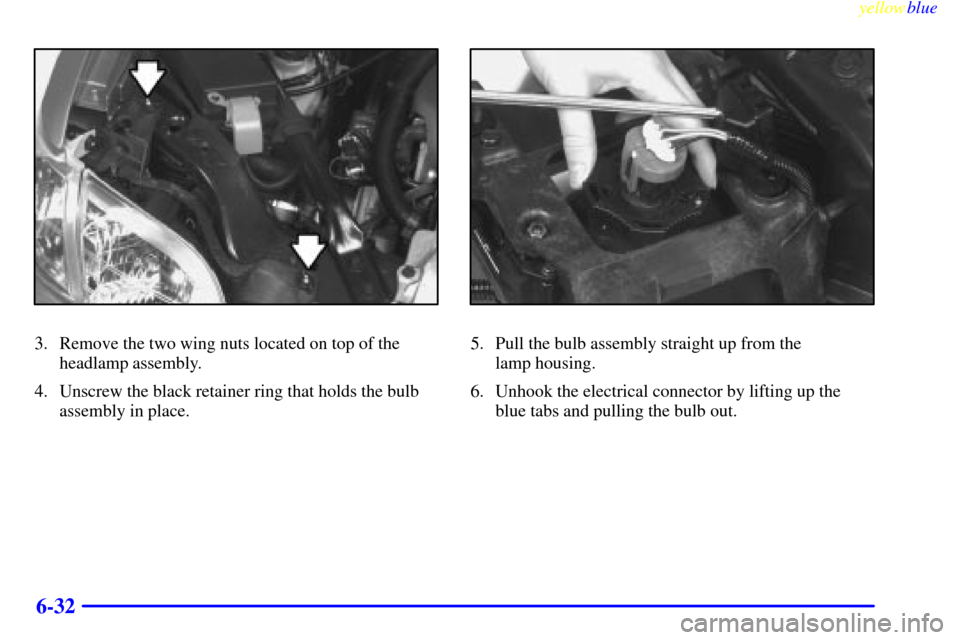
3. Remove the two wing nuts located on top of the
headlamp assembly.
4. Unscrew the black retainer ring that holds the bulb
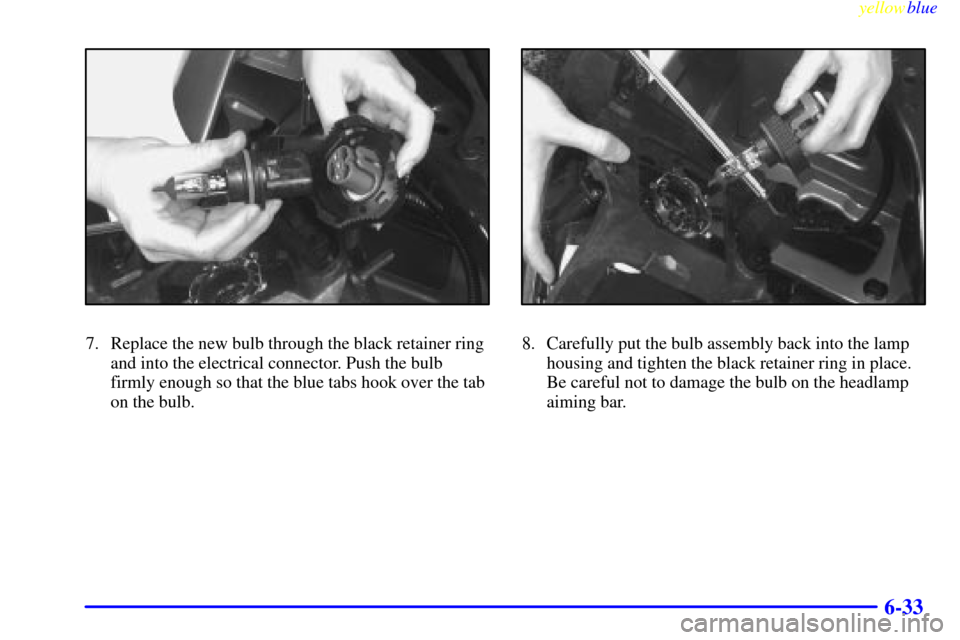
assembly in place.5. Pull the bulb assembly straight up from the
lamp housing.
6. Unhook the electrical connector by lifting up the
blue tabs and pulling the bulb out.
Page 343 of 440
yellowblue
6-33
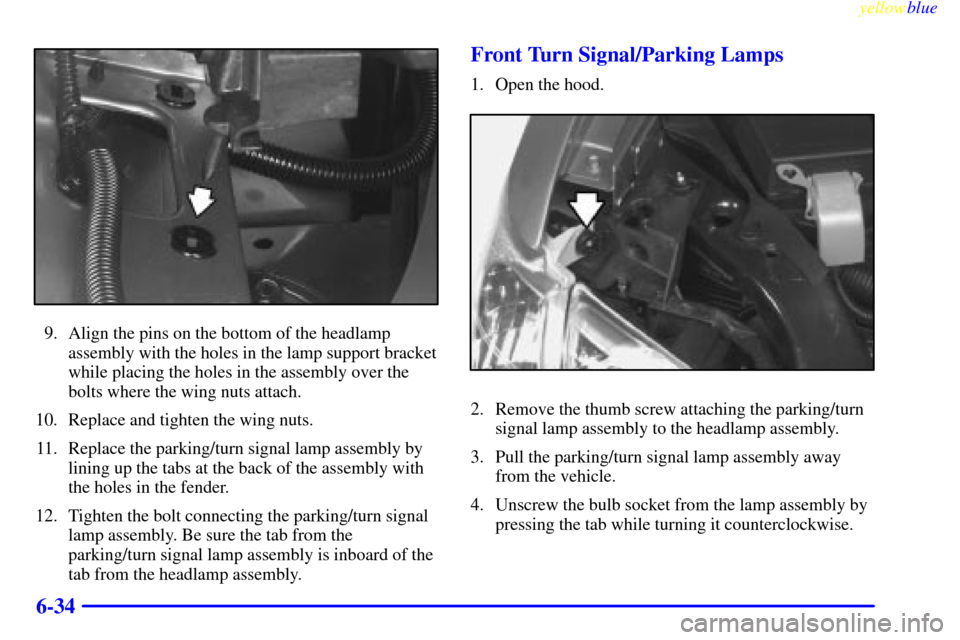
7. Replace the new bulb through the black retainer ring
and into the electrical connector. Push the bulb
firmly enough so that the blue tabs hook over the tab
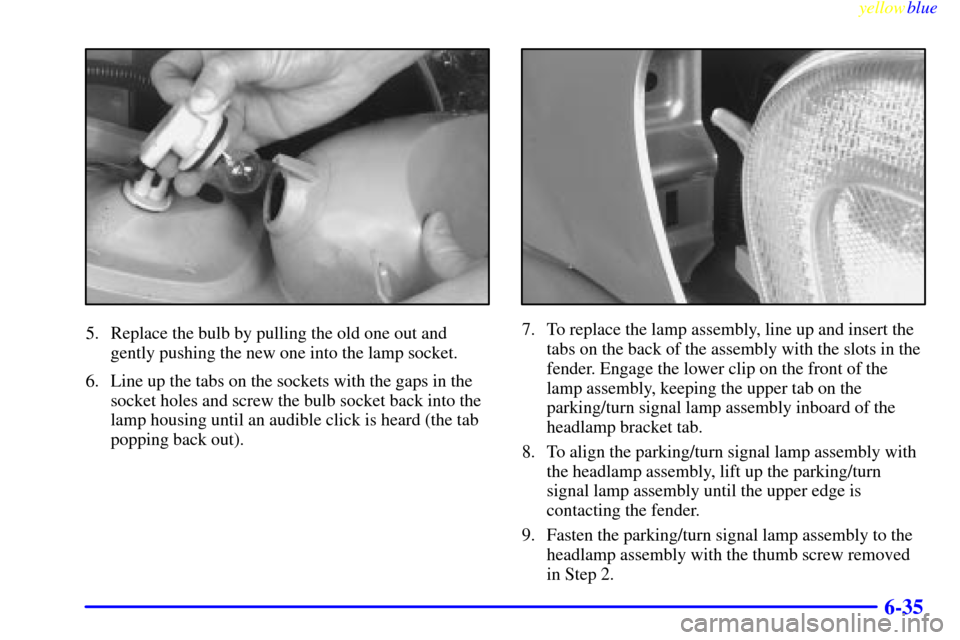
on the bulb.8. Carefully put the bulb assembly back into the lamp
housing and tighten the black retainer ring in place.
Be careful not to damage the bulb on the headlamp
aiming bar.
Page 344 of 440
yellowblue
6-34
9. Align the pins on the bottom of the headlamp
assembly with the holes in the lamp support bracket
while placing the holes in the assembly over the
bolts where the wing nuts attach.
10. Replace and tighten the wing nuts.
11. Replace the parking/turn signal lamp assembly by
lining up the tabs at the back of the assembly with
the holes in the fender.
12. Tighten the bolt connecting the parking/turn signal
lamp assembly. Be sure the tab from the
parking/turn signal lamp assembly is inboard of the
tab from the headlamp assembly.
Front Turn Signal/Parking Lamps
1. Open the hood.
2. Remove the thumb screw attaching the parking/turn
signal lamp assembly to the headlamp assembly.
3. Pull the parking/turn signal lamp assembly away
from the vehicle.
4. Unscrew the bulb socket from the lamp assembly by
pressing the tab while turning it counterclockwise.
Page 345 of 440
yellowblue
6-35
5. Replace the bulb by pulling the old one out and
gently pushing the new one into the lamp socket.
6. Line up the tabs on the sockets with the gaps in the
socket holes and screw the bulb socket back into the
lamp housing until an audible click is heard (the tab
popping back out).7. To replace the lamp assembly, line up and insert the
tabs on the back of the assembly with the slots in the
fender. Engage the lower clip on the front of the
lamp assembly, keeping the upper tab on the
parking/turn signal lamp assembly inboard of the
headlamp bracket tab.
8. To align the parking/turn signal lamp assembly with
the headlamp assembly, lift up the parking/turn
signal lamp assembly until the upper edge is
contacting the fender.
9. Fasten the parking/turn signal lamp assembly to the
headlamp assembly with the thumb screw removed
in Step 2.