Page 334 of 440
yellowblue
6-24
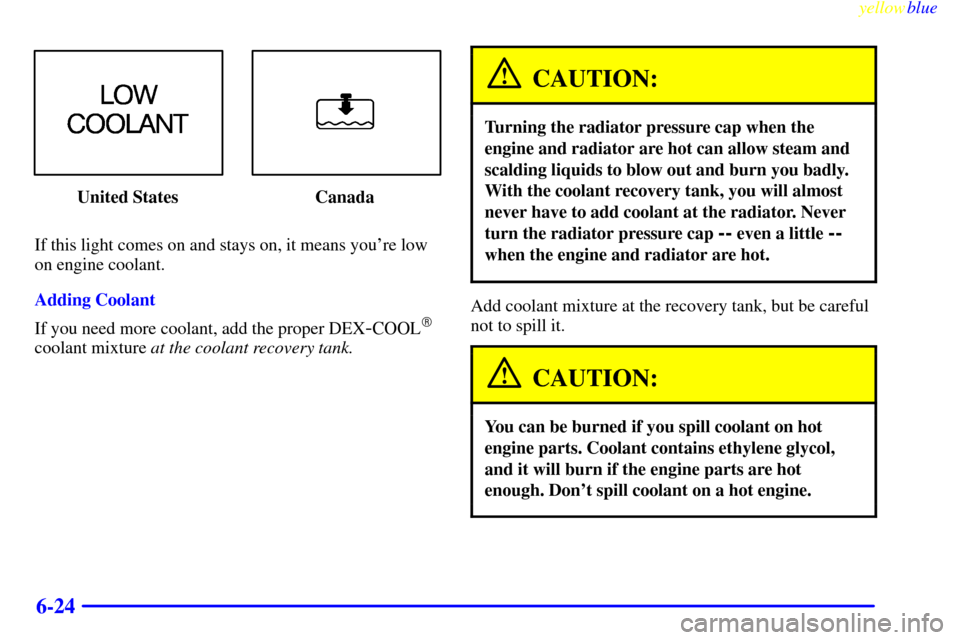
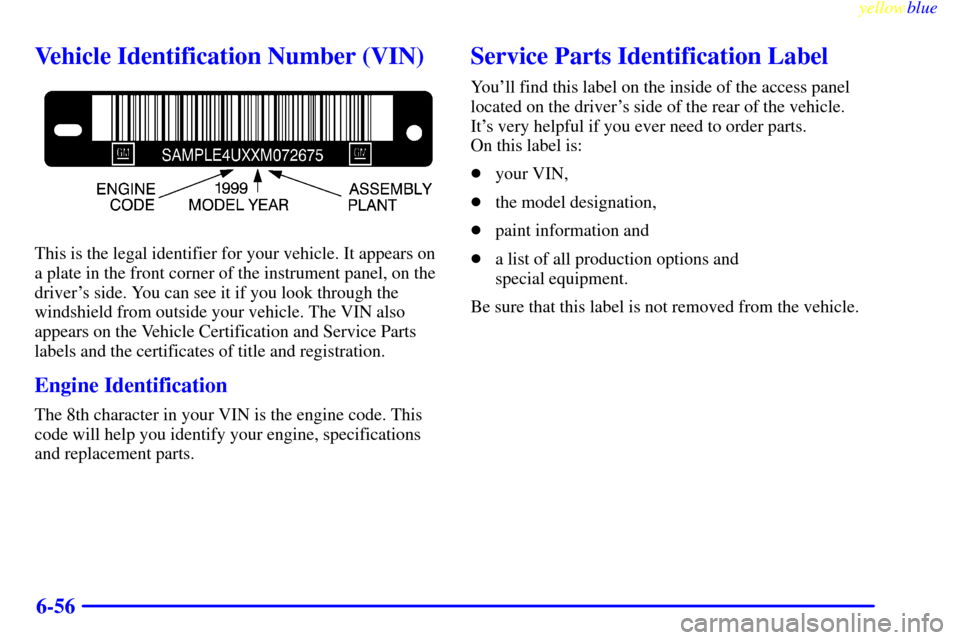
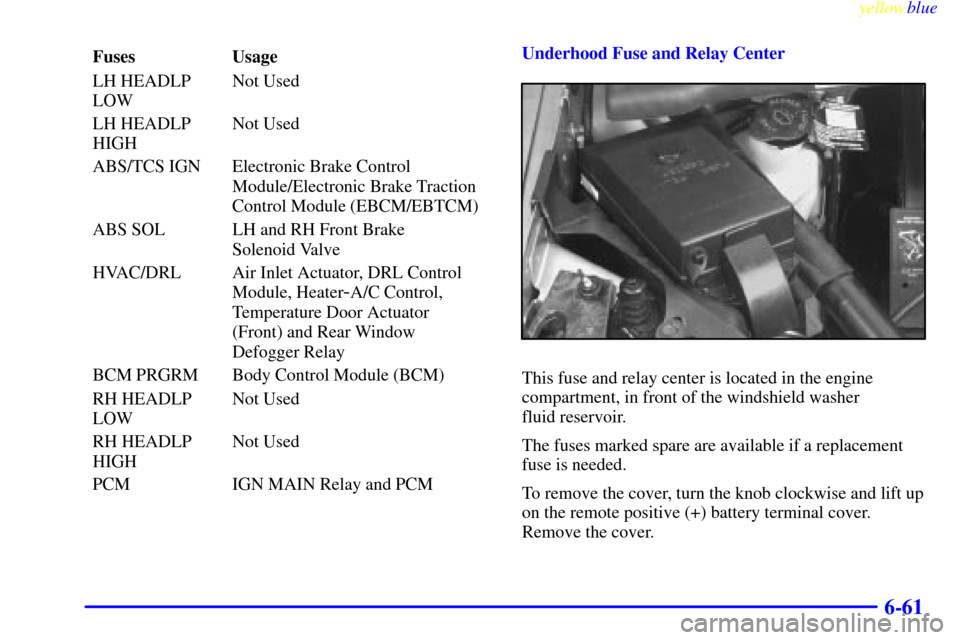
United States Canada
If this light comes on and stays on, it means you're low
on engine coolant.
Adding Coolant
If you need more coolant, add the proper DEX
-COOL�
coolant mixture at the coolant recovery tank.
CAUTION:
Turning the radiator pressure cap when the
engine and radiator are hot can allow steam and
scalding liquids to blow out and burn you badly.
With the coolant recovery tank, you will almost
never have to add coolant at the radiator. Never
turn the radiator pressure cap
-- even a little --
when the engine and radiator are hot.
Add coolant mixture at the recovery tank, but be careful
not to spill it.
CAUTION:
You can be burned if you spill coolant on hot
engine parts. Coolant contains ethylene glycol,
and it will burn if the engine parts are hot
enough. Don't spill coolant on a hot engine.
Page 335 of 440
yellowblue
6-25
Power Steering Fluid
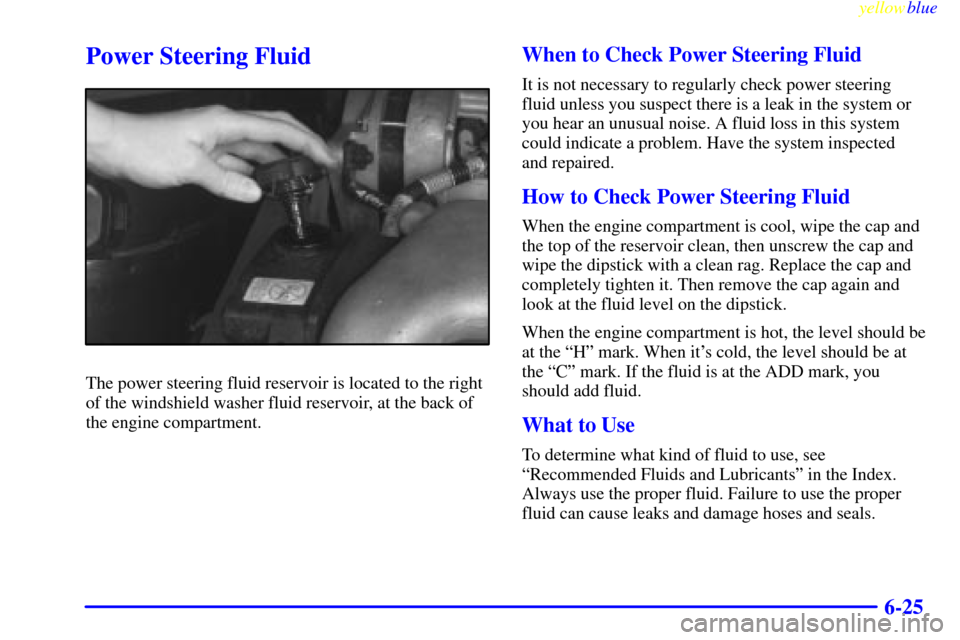
The power steering fluid reservoir is located to the right
of the windshield washer fluid reservoir, at the back of
the engine compartment.
When to Check Power Steering Fluid
It is not necessary to regularly check power steering
fluid unless you suspect there is a leak in the system or
you hear an unusual noise. A fluid loss in this system
could indicate a problem. Have the system inspected
and repaired.
How to Check Power Steering Fluid
When the engine compartment is cool, wipe the cap and
the top of the reservoir clean, then unscrew the cap and
wipe the dipstick with a clean rag. Replace the cap and
completely tighten it. Then remove the cap again and
look at the fluid level on the dipstick.
When the engine compartment is hot, the level should be
at the ªHº mark. When it's cold, the level should be at
the ªCº mark. If the fluid is at the ADD mark, you
should add fluid.
What to Use
To determine what kind of fluid to use, see
ªRecommended Fluids and Lubricantsº in the Index.
Always use the proper fluid. Failure to use the proper
fluid can cause leaks and damage hoses and seals.
Page 336 of 440
yellowblue
6-26
Windshield Washer Fluid
What to Use
When you need windshield washer fluid, be sure to read
the manufacturer's instructions before use. If you will be
operating your vehicle in an area where the temperature
may fall below freezing, use a fluid that has sufficient
protection against freezing.
Adding Washer Fluid
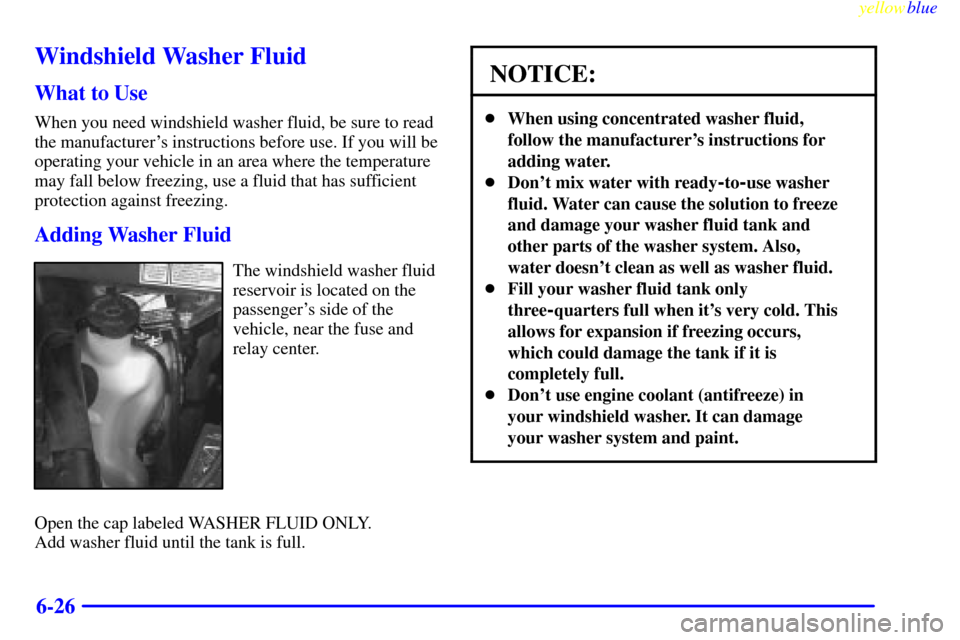
The windshield washer fluid
reservoir is located on the
passenger's side of the
vehicle, near the fuse and
relay center.
Open the cap labeled WASHER FLUID ONLY.
Add washer fluid until the tank is full.
NOTICE:
�When using concentrated washer fluid,
follow the manufacturer's instructions for
adding water.
�Don't mix water with ready
-to-use washer
fluid. Water can cause the solution to freeze
and damage your washer fluid tank and
other parts of the washer system. Also,
water doesn't clean as well as washer fluid.
�Fill your washer fluid tank only
three
-quarters full when it's very cold. This
allows for expansion if freezing occurs,
which could damage the tank if it is
completely full.
�Don't use engine coolant (antifreeze) in
your windshield washer. It can damage
your washer system and paint.
Page 338 of 440
yellowblue
6-28
CAUTION:
If you have too much brake fluid, it can spill on
the engine. The fluid will burn if the engine is
hot enough. You or others could be burned, and
your vehicle could be damaged. Add brake
fluid only when work is done on the brake
hydraulic system.
United States Canada
When your brake fluid falls to a low level, your brake
warning light will come on. See ªBrake System Warning
Lightº in the Index.What to Add
When you do need brake fluid, use only DOT
-3 brake
fluid. Refer to ªRecommended Fluids and Lubricantsº
in the Index. Use new brake fluid from a sealed
container only.
Always clean the brake fluid reservoir cap and the area
around the cap before removing it. This will help keep
dirt from entering the reservoir.
CAUTION:
With the wrong kind of fluid in your brake
system, your brakes may not work well, or they
may not even work at all. This could cause a
crash. Always use the proper brake fluid.
Page 339 of 440
yellowblue
6-29
NOTICE:
�Using the wrong fluid can badly damage
brake system parts. For example, just a few
drops of mineral
-based oil, such as engine
oil, in your brake system can damage brake
system parts so badly that they'll have to be
replaced. Don't let someone put in the
wrong kind of fluid.
�If you spill brake fluid on your vehicle's
painted surfaces, the paint finish can be
damaged. Be careful not to spill brake fluid
on your vehicle. If you do, wash it off
immediately. See ªAppearance Careº in
the Index.
Brake Wear
Your vehicle has front disc brakes and rear drum brakes.
Disc brake pads have built
-in wear indicators that make a
high
-pitched warning sound when the brake pads are worn
and new pads are needed. The sound may come and go or
be heard all the time your vehicle is moving (except when
you are pushing on the brake pedal firmly).
CAUTION:
The brake wear warning sound means that soon
your brakes won't work well. That could lead to
an accident. When you hear the brake wear
warning sound, have your vehicle serviced.
NOTICE:
Continuing to drive with worn-out brake pads
could result in costly brake repair.
Some driving conditions or climates may cause a brake
squeal when the brakes are first applied or lightly
applied. This does not mean something is wrong with
your brakes.
Properly torqued wheel nuts are necessary to help
prevent brake pulsation. When tires are rotated, inspect
brake pads for wear and evenly torque wheel nuts in the
proper sequence to GM specifications.
Page 366 of 440
yellowblue
6-56
Vehicle Identification Number (VIN)
This is the legal identifier for your vehicle. It appears on
a plate in the front corner of the instrument panel, on the
driver's side. You can see it if you look through the
windshield from outside your vehicle. The VIN also
appears on the Vehicle Certification and Service Parts
labels and the certificates of title and registration.
Engine Identification
The 8th character in your VIN is the engine code. This
code will help you identify your engine, specifications
and replacement parts.
Service Parts Identification Label
You'll find this label on the inside of the access panel
located on the driver's side of the rear of the vehicle.
It's very helpful if you ever need to order parts.
On this label is:
�your VIN,
�the model designation,
�paint information and
�a list of all production options and
special equipment.
Be sure that this label is not removed from the vehicle.
Page 371 of 440
yellowblue
6-61
Fuses Usage
LH HEADLP
LOWNot Used
LH HEADLP
HIGHNot Used
ABS/TCS IGN Electronic Brake Control
Module/Electronic Brake Traction
Control Module (EBCM/EBTCM)
ABS SOL LH and RH Front Brake
Solenoid Valve
HVAC/DRL Air Inlet Actuator, DRL Control
Module, Heater
-A/C Control,
Temperature Door Actuator
(Front) and Rear Window
Defogger Relay
BCM PRGRM Body Control Module (BCM)
RH HEADLP
LOWNot Used
RH HEADLP
HIGHNot Used
PCM IGN MAIN Relay and PCMUnderhood Fuse and Relay Center
This fuse and relay center is located in the engine
compartment, in front of the windshield washer
fluid reservoir.
The fuses marked spare are available if a replacement
fuse is needed.
To remove the cover, turn the knob clockwise and lift up
on the remote positive (+) battery terminal cover.
Remove the cover.
Page 375 of 440
yellowblue
6-65
Engine Crankcase - Oil
and Filter Change4.5 quarts (4.3 L) . . . . . . . . . . .
Fuel Capacity
Standard/Regular 19.8 gallons (75.0 L). . . . . . . . . . .
Optional/Extended 24.3 gallons (92.0 L). . . . . . . . .
Refrigerant,
Air Conditioning*See Refrigerant . . . . . . . . . . . .
Label under the hood.
Tire Pressures, SizesSee Tire
-Loading . . . . . . . . . . .
Information label on driver's door.
Wheel Nut Torque100 lb
-ft (140 N´m) . . . . . . . . . .
Windshield Washer Fluid1 gallon (0.37 L) . . . . . . .
*See Air Conditioning Refrigerants later in
this section.
NOTE: All capacities are approximate. When adding, be
sure to fill to the appropriate level, as recommended in
this manual.
Engine Specifications
Engine VIN Code E. . . . . . . . . . . . . . . . . . . . . . . . . . .
Engine Type V6. . . . . . . . . . . . . . . . . . . . . . . . . . . . . .
Firing Order 1
-2-3-4-5-6 . . . . . . . . . . . . . . . . . . . . . .
Horsepower 185. . . . . . . . . . . . . . . . . . . . . . . . . . . . .
Thermostat Temperature
Specification 195�F (91�C) . . . . . . . . . . . . . . . . . . .
Air Conditioning Refrigerants
Not all air conditioning refrigerants are the same.
If the air conditioning system in your vehicle needs
refrigerant, be sure the proper refrigerant is used.
If you're not sure, ask your dealer.
Normal Maintenance
Replacement Parts
Air Cleaner Filter AC Type A-1028C . . . . . . . . . . . . .
Passenger Compartment Air Filter (2) 52482929. . . .
Engine Oil Filter PF47. . . . . . . . . . . . . . . . . . . . . . . .
Spark Plugs AC Type 41
-940 . . . . . . . . . . . . . . . . . . .
Gap: 0.060 inches (1.5 mm)
Windshield Wiper Blades
Length 24.0 inches (60.0 cm). . . . . . . . . . . . . . . . . .
Type Sheperd's Hook. . . . . . . . . . . . . . . . . . . . . . . . .
Backglass Wiper Blade
Length 16 inches (40.6 cm). . . . . . . . . . . . . . . . . . . .
Type Sheperd's Hook. . . . . . . . . . . . . . . . . . . . . . . . .