Page 313 of 440
yellowblue
6-3
CAUTION:
You can be injured and your vehicle could be
damaged if you try to do service work on a
vehicle without knowing enough about it.
�Be sure you have sufficient knowledge,
experience, the proper replacement parts
and tools before you attempt any vehicle
maintenance task.
�Be sure to use the proper nuts, bolts and
other fasteners. ªEnglishº and ªmetricº
fasteners can be easily confused. If you use
the wrong fasteners, parts can later break
or fall off. You could be hurt.
Adding Equipment to the Outside of
Your Vehicle
Things you might add to the outside of your vehicle can
affect the airflow around it. This may cause wind noise
and affect windshield washer performance. Check with
your dealer before adding equipment to the outside of
your vehicle.
Fuel
Use regular unleaded gasoline rated at 87 octane or
higher. It is recommended that the gasoline meet
specifications which have been developed by the
American Automobile Manufacturers Association
(AAMA) and endorsed by the Canadian Motor Vehicle
Manufacturers Association for better vehicle
performance and engine protection. Gasolines meeting
the AAMA specification could provide improved
driveability and emission control system performance
compared to other gasolines. For more information,
write to: American Automobile Manufacturer's
Association, 7430 Second Ave, Suite 300,
Detroit MI 48202.
Be sure the posted octane is at least 87. If the octane is
less than 87, you may get a heavy knocking noise when
you drive. If it's bad enough, it can damage your engine.
If you're using fuel rated at 87 octane or higher and you
hear heavy knocking, your engine needs service. But
don't worry if you hear a little pinging noise when
you're accelerating or driving up a hill. That's normal,
and you don't have to buy a higher octane fuel to get rid
of pinging. It's the heavy, constant knock that means
you have a problem.
Page 314 of 440
yellowblue
6-4
If your vehicle is certified to meet California Emission
Standards (indicated on the underhood emission control
label), it is designed to operate on fuels that meet
California specifications. If such fuels are not available
in states adopting California emissions standards, your
vehicle will operate satisfactorily on fuels meeting
federal specifications, but emission control system
performance may be affected. The malfunction indicator
lamp on your instrument panel may turn on and/or your
vehicle may fail a smog
-check test. (See ªMalfunction
Indicator Lampº in the Index.) If this occurs, return to
your authorized Chevrolet dealer for diagnosis to
determine the cause of failure. In the event it is
determined that the cause of the condition is the type of
fuels used, repairs may not be covered by your warranty.
Some gasolines that are not reformulated for low
emissions may contain an octane
-enhancing additive
called methylcyclopentadienyl manganese tricarbonyl
(MMT); ask your service station operator whether or not
the fuel contains MMT. General Motors does not
recommend the use of such gasolines. If fuels containing
MMT are used, spark plug life may be reduced and your
emission control system performance may be affected.
The malfunction indicator lamp on your instrument
panel may turn on. If this occurs, return to your
authorized Chevrolet dealer for service.To provide cleaner air, all gasolines in the United States
are now required to contain additives that will help
prevent deposits from forming in your engine and fuel
system, allowing your emission control system to
function properly. Therefore, you should not have to add
anything to the fuel. In addition, gasolines containing
oxygenates, such as ethers and ethanol, and
reformulated gasolines may be available in your area to
contribute to clean air. General Motors recommends that
you use these gasolines, particularly if they comply with
the specifications described earlier.
NOTICE:
Your vehicle was not designed for fuel that
contains methanol. Don't use it. It can corrode
metal parts in your fuel system and also damage
plastic and rubber parts. That damage wouldn't
be covered under your warranty.
Page 318 of 440
yellowblue
6-8
Checking Things Under the Hood
CAUTION:
An electric fan under the hood can start up and
injure you even when the engine is not running.
Keep hands, clothing and tools away from any
underhood electric fan.
CAUTION:
Things that burn can get on hot engine parts and
start a fire. These include liquids like gasoline,
oil, coolant, brake fluid, windshield washer and
other fluids, and plastic or rubber. You or others
could be burned. Be careful not to drop or spill
things that will burn onto a hot engine.
Hood Release
To open the hood, first pull the hood release handle
inside the vehicle.
Page 319 of 440
yellowblue
6-9
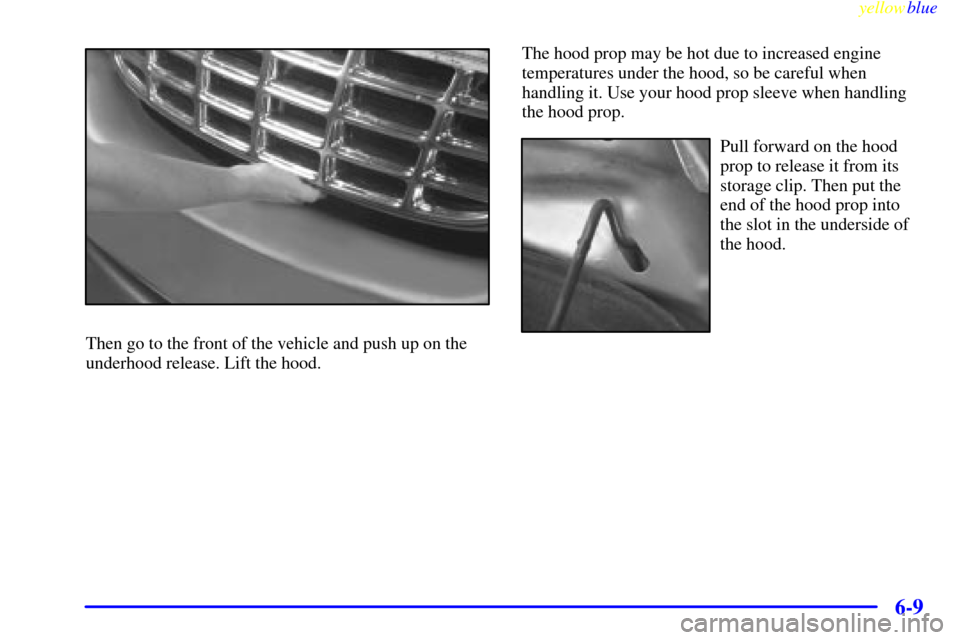
Then go to the front of the vehicle and push up on the
underhood release. Lift the hood.The hood prop may be hot due to increased engine
temperatures under the hood, so be careful when
handling it. Use your hood prop sleeve when handling
the hood prop.
Pull forward on the hood
prop to release it from its
storage clip. Then put the
end of the hood prop into
the slot in the underside of
the hood.
Page 320 of 440
yellowblue
6-10
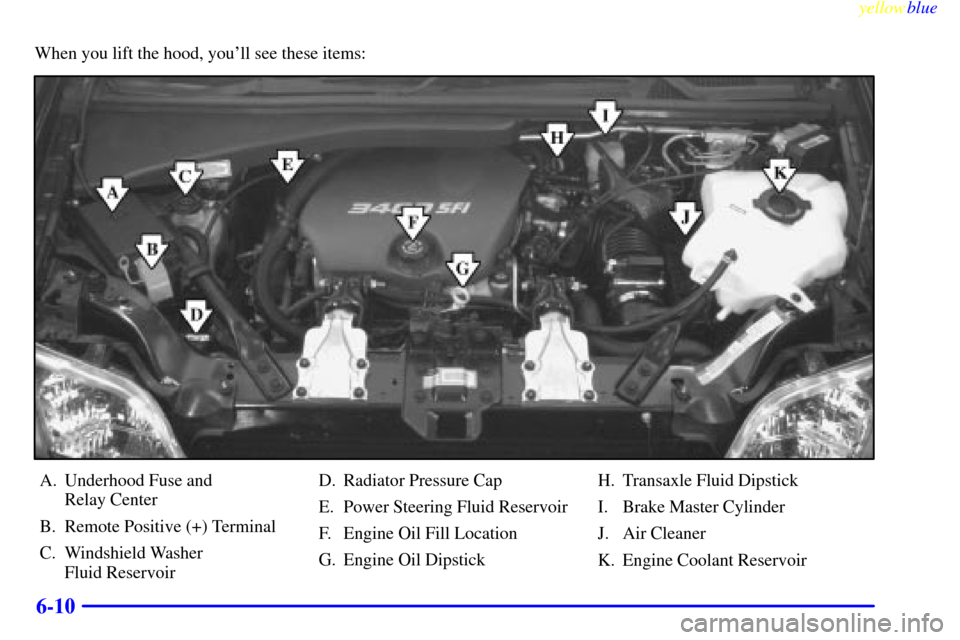
When you lift the hood, you'll see these items:
A. Underhood Fuse and
Relay Center
B. Remote Positive (+) Terminal
C. Windshield Washer
Fluid ReservoirD. Radiator Pressure Cap
E. Power Steering Fluid Reservoir
F. Engine Oil Fill Location
G. Engine Oil DipstickH. Transaxle Fluid Dipstick
I. Brake Master Cylinder
J. Air Cleaner
K. Engine Coolant Reservoir
Page 321 of 440
yellowblue
6-11
Before closing the hood, be sure all the filler caps are on
properly. Then lift the hood to relieve pressure on the
hood prop. Remove the hood prop from the slot in the
hood and return the prop to its retainer. Then just let the
hood down and close it firmly.
Engine Oil
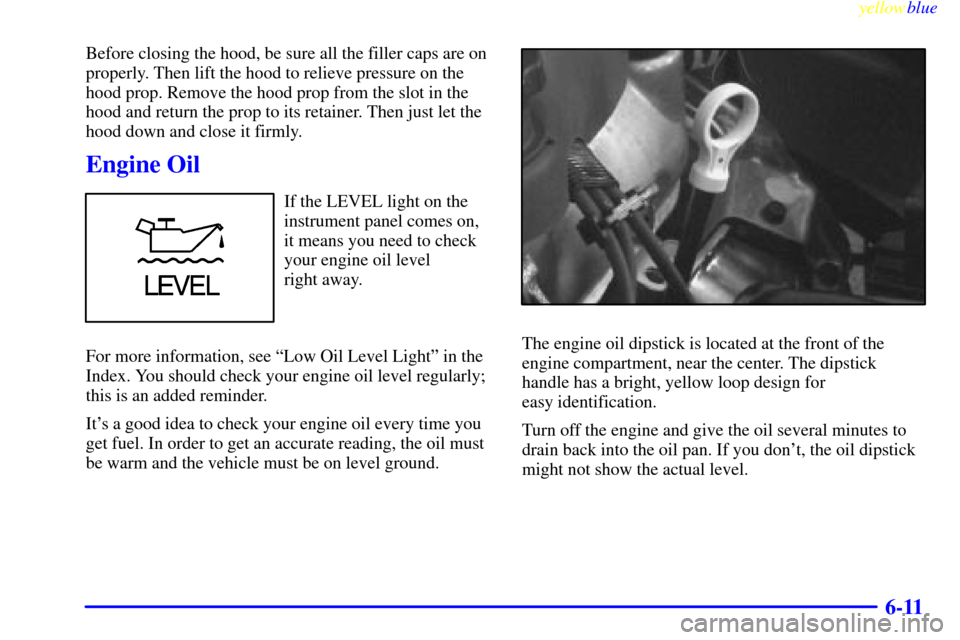
If the LEVEL light on the
instrument panel comes on,
it means you need to check
your engine oil level
right away.
For more information, see ªLow Oil Level Lightº in the
Index. You should check your engine oil level regularly;
this is an added reminder.
It's a good idea to check your engine oil every time you
get fuel. In order to get an accurate reading, the oil must
be warm and the vehicle must be on level ground.
The engine oil dipstick is located at the front of the
engine compartment, near the center. The dipstick
handle has a bright, yellow loop design for
easy identification.
Turn off the engine and give the oil several minutes to
drain back into the oil pan. If you don't, the oil dipstick
might not show the actual level.
Page 322 of 440
yellowblue
6-12 Checking Engine Oil
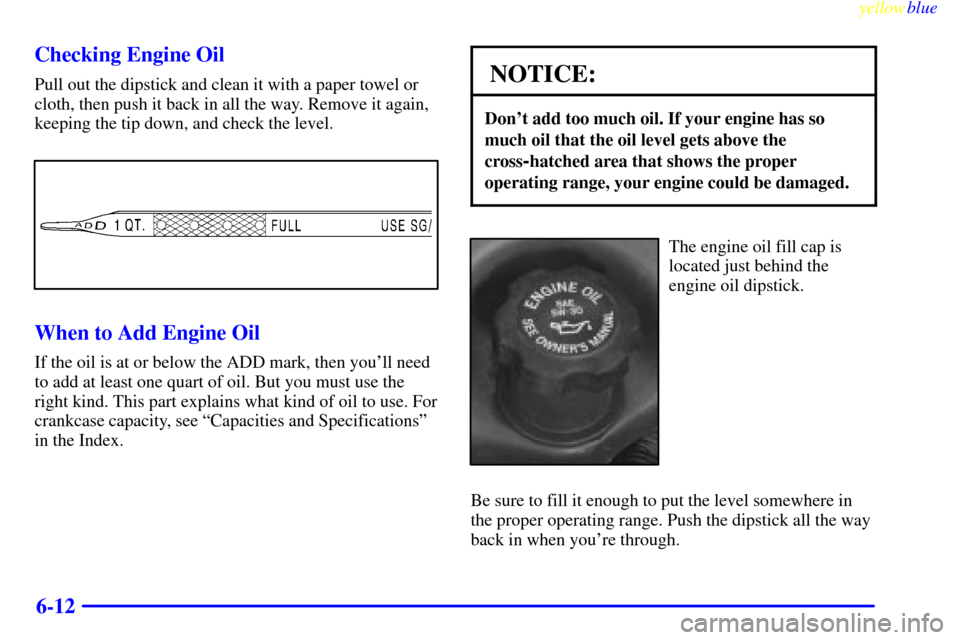
Pull out the dipstick and clean it with a paper towel or
cloth, then push it back in all the way. Remove it again,
keeping the tip down, and check the level.
When to Add Engine Oil
If the oil is at or below the ADD mark, then you'll need
to add at least one quart of oil. But you must use the
right kind. This part explains what kind of oil to use. For
crankcase capacity, see ªCapacities and Specificationsº
in the Index.
NOTICE:
Don't add too much oil. If your engine has so
much oil that the oil level gets above the
cross
-hatched area that shows the proper
operating range, your engine could be damaged.
The engine oil fill cap is
located just behind the
engine oil dipstick.
Be sure to fill it enough to put the level somewhere in
the proper operating range. Push the dipstick all the way
back in when you're through.
Page 323 of 440
yellowblue
6-13 What Kind of Engine Oil to Use
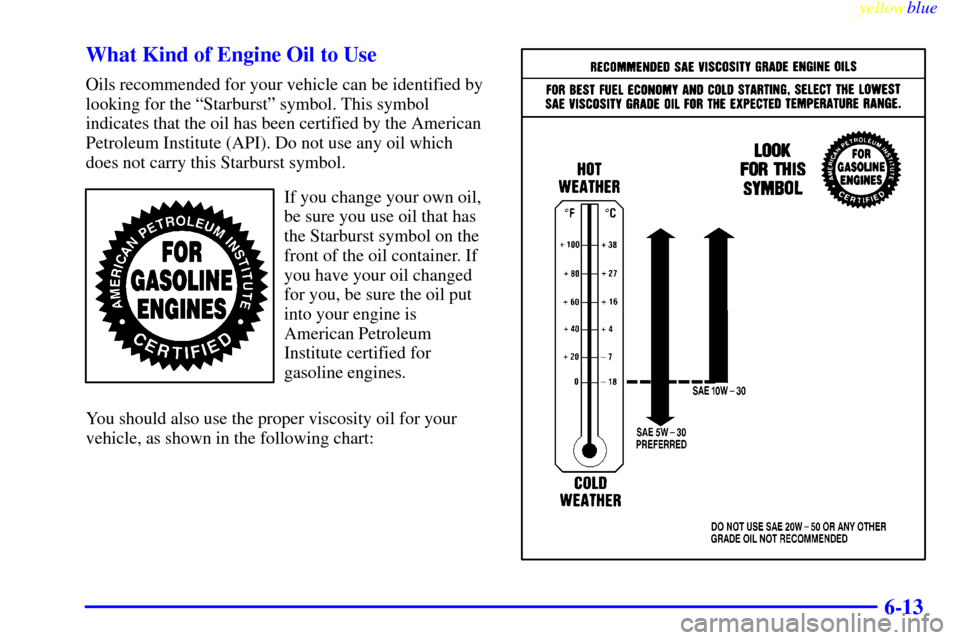
Oils recommended for your vehicle can be identified by
looking for the ªStarburstº symbol. This symbol
indicates that the oil has been certified by the American
Petroleum Institute (API). Do not use any oil which
does not carry this Starburst symbol.
If you change your own oil,
be sure you use oil that has
the Starburst symbol on the
front of the oil container. If
you have your oil changed
for you, be sure the oil put
into your engine is
American Petroleum
Institute certified for
gasoline engines.
You should also use the proper viscosity oil for your
vehicle, as shown in the following chart: