Page 239 of 376
Second Printing for Chevrolet Tracker Owner's Manual ± 1999
yellowblue
6-9
Checking Things Under the Hood
CAUTION:
An electric fan under the hood can start up and
injure you even when the engine is not running.
Keep hands, clothing and tools away from any
underhood electric fan. Don't reach through the
grille to release the underhood lever.
CAUTION:
Things that burn can get on hot engine parts and
start a fire. These include liquids like gasoline,
oil, coolant, brake fluid, windshield washer and
other fluids, and plastic or rubber. You or others
could be burned. Be careful not to drop or spill
things that will burn onto a hot engine.
JE±16±0003±X
To open the hood, first pull
the release handle located
on the driver's side of the
vehicle on the lower portion
of the instrument panel.
Page 241 of 376
Second Printing for Chevrolet Tracker Owner's Manual ± 1999
yellowblue
6-11 1.6L Engine
When you open the hood, you'll see the following:
JE±16±0006±X
A. Main Fuse Box
B. Engine Air Cleaner/Filter
C. Battery
D. Engine Oil DipstickE. Radiator Pressure Cap
F. Engine Oil Fill Cap
G. Power Steering Fluid ReservoirH. Brake Fluid Reservoir
I. Engine Coolant Reservoir
J. Windshield Washer Reservoir
Page 242 of 376
Second Printing for Chevrolet Tracker Owner's Manual ± 1999
yellowblue
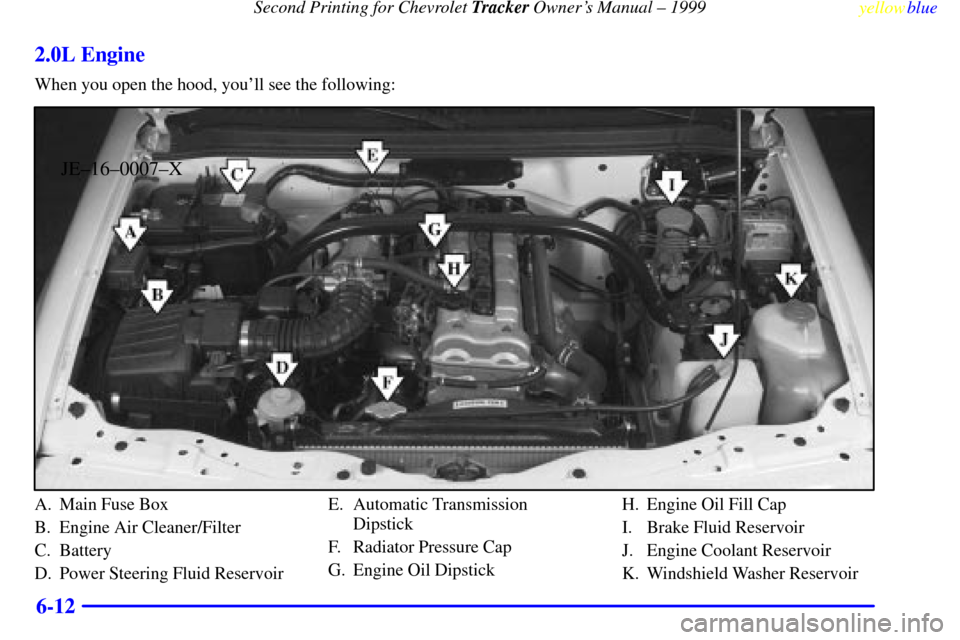
6-12 2.0L Engine
When you open the hood, you'll see the following:
JE±16±0007±X
A. Main Fuse Box
B. Engine Air Cleaner/Filter
C. Battery
D. Power Steering Fluid ReservoirE. Automatic Transmission
Dipstick
F. Radiator Pressure Cap
G. Engine Oil DipstickH. Engine Oil Fill Cap
I. Brake Fluid Reservoir
J. Engine Coolant Reservoir
K. Windshield Washer Reservoir
Page 251 of 376

Second Printing for Chevrolet Tracker Owner's Manual ± 1999
yellowblue
6-21
Wait at least 30 minutes before checking the
transmission fluid level if you have been driving:
�When outside temperatures are above 90�F (32�C).
�At high speed for quite a while.
�In heavy traffic
-- especially in hot weather.
�While pulling a trailer.
To get the right reading, the fluid should be at normal
operating temperature, which is 180�F to
200�F (82�C to 93�C).
Get the vehicle warmed up by driving about
15 miles (24 km) when outside temperatures are above
50�F (10�C). If it's colder than 50�F (10�C),
drive the vehicle in DRIVE (D) until the engine
temperature gage moves and then remains steady for
10 minutes. Then follow the hot check procedures.Checking Transmission Fluid Cold
A cold check is made after the vehicle has been sitting
for eight hours or more with the engine off and is used
only as a reference. Let the engine run at idle for five
minutes if outside temperatures are 50�F (10�C) or
more. If it's colder than 50�F (10�C), you may have to
idle the engine longer. Should the fluid level be low
during a cold check, you must perform a hot check
before adding fluid. This will give you a more accurate
reading of the fluid level.
Checking the Fluid Level
�Park your vehicle on a level place. Keep the
engine running.
�With the parking brake applied, place the shift lever
in PARK (P).
�With your foot on the brake pedal, move the shift
lever through each gear range, pausing for about
three seconds in each range. Then, position the shift
lever in PARK (P).
�Let the engine run at idle for three minutes or more.
Page 263 of 376
Second Printing for Chevrolet Tracker Owner's Manual ± 1999
yellowblue
6-33
NOTICE:
�When using concentrated washer fluid,
follow the manufacturer's instructions for
adding water.
�Don't mix water with ready
-to-use washer
fluid. Water can cause the solution to freeze
and damage your washer fluid tank and
other parts of the washer system. Also,
water doesn't clean as well as washer fluid.
�Fill your washer fluid tank only
three
-quarters full when it's very cold. This
allows for expansion if freezing occurs,
which could damage the tank if it is
completely full.
�Don't use engine coolant (antifreeze) in
your windshield washer. It can damage
your washer system and paint.
Brakes
Brake Fluid
JE±16±0017±X
Your brake master cylinder reservoir is here. It is filled
with DOT
-3 brake fluid.
Page 264 of 376

Second Printing for Chevrolet Tracker Owner's Manual ± 1999
yellowblue
6-34
There are only two reasons why the brake fluid level in
the reservoir might go down. The first is that the brake
fluid goes down to an acceptable level during normal
brake lining wear. When new linings are put in, the fluid
level goes back up. The other reason is that fluid is
leaking out of the brake system. If it is, you should have
your brake system fixed, since a leak means that sooner
or later your brakes won't work well, or won't work
at all.
So, it isn't a good idea to ªtop offº your brake fluid.
Adding brake fluid won't correct a leak. If you add fluid
when your linings are worn, then you'll have too much
fluid when you get new brake linings. You should add
(or remove) brake fluid, as necessary, only when work is
done on the brake hydraulic system.
CAUTION:
If you have too much brake fluid, it can spill on
the engine. The fluid will burn if the engine is
hot enough. You or others could be burned, and
your vehicle could be damaged. Add brake
fluid only when work is done on the brake
hydraulic system.
Refer to the Maintenance Schedule to determine when to
check your brake fluid. See ªPeriodic Maintenance
Inspectionsº in the Index.
Checking Brake Fluid
JE±16±0018±X
You can check the brake
fluid without taking off
the cap.
Just look at the brake fluid reservoir. The fluid level
should be above MIN. If it isn't, have your brake system
checked to see if there is a leak.
After work is done on the brake hydraulic system,
make sure the level is above the MIN but not over the
MAX mark.
Page 265 of 376
Second Printing for Chevrolet Tracker Owner's Manual ± 1999
yellowblue
6-35
What to Add
When you do need brake fluid, use only DOT
-3 brake
fluid. Refer to ªRecommended Fluids and Lubricantsº
in the Index. Use new brake fluid from a sealed
container only.
Always clean the brake fluid reservoir cap and the area
around the cap before removing it. This will help keep
dirt from entering the reservoir.
CAUTION:
With the wrong kind of fluid in your brake
system, your brakes may not work well, or they
may not even work at all. This could cause a
crash. Always use the proper brake fluid.
NOTICE:
�Using the wrong fluid can badly damage
brake system parts. For example, just a few
drops of mineral
-based oil, such as engine
oil, in your brake system can damage brake
system parts so badly that they'll have to be
replaced. Don't let someone put in the
wrong kind of fluid.
�If you spill brake fluid on your vehicle's
painted surfaces, the paint finish can be
damaged. Be careful not to spill brake fluid
on your vehicle. If you do, wash it off
immediately. See ªAppearance Careº in
the Index.
Brake Wear
Your vehicle has front disc brakes and rear drum brakes.
Disc brake pads have built
-in wear indicators that make a
high
-pitched warning sound when the brake pads are
worn and new pads are needed. The sound may come and
go or be heard all the time your vehicle is moving (except
when you are pushing on the brake pedal firmly).
Page 266 of 376

Second Printing for Chevrolet Tracker Owner's Manual ± 1999
yellowblue
6-36
CAUTION:
The brake wear warning sound means that soon
your brakes won't work well. That could lead to
an accident. When you hear the brake wear
warning sound, have your vehicle serviced.
NOTICE:
Continuing to drive with worn-out brake pads
could result in costly brake repair.
Some driving conditions or climates may cause a brake
squeal when the brakes are first applied or lightly
applied. This does not mean something is wrong with
your brakes.
Properly torqued wheel nuts are necessary to help
prevent brake pulsation. When tires are rotated, inspect
brake pads for wear and evenly torque wheel nuts in the
proper sequence to GM specifications.Your rear drum brakes don't have wear indicators, but if
you ever hear a rear brake rubbing noise, have the rear
brake linings inspected immediately. Also, the rear
brake drums should be removed and inspected each time
the tires are removed for rotation or changing. When
you have the front brake pads replaced, have the rear
brakes inspected, too.
Brake linings should always be replaced as complete
axle sets.
See ªBrake System Inspectionº in Section 7
of this manual under Part C ªPeriodic
Maintenance Inspections.º
Brake Pedal Travel
See your dealer if the brake pedal does not return to
normal height, or if there is a rapid increase in pedal
travel. This could be a sign of brake trouble.
Brake Adjustment
Every time you make a brake stop, your disc brakes
adjust for wear.