Page 52 of 424
yellowblue
1-46
Child Restraints
Every time infants and young children ride in
vehicles, they should have protection provided by
appropriate restraints.
Q:What are the different types of add-on
child restraints?
A:Add-on child restraints are available in four basic
types. When selecting a child restraint, take into
consideration not only the child's weight and size,
but also whether or not the restraint will be
compatible with the motor vehicle in which it will
be used.
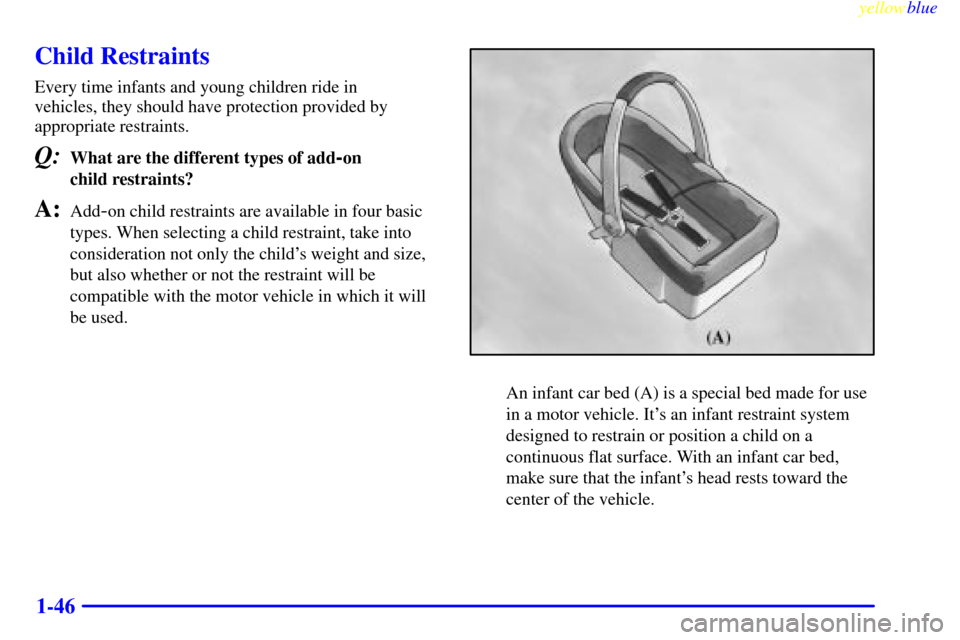
An infant car bed (A) is a special bed made for use
in a motor vehicle. It's an infant restraint system
designed to restrain or position a child on a
continuous flat surface. With an infant car bed,
make sure that the infant's head rests toward the
center of the vehicle.
Page 67 of 424
yellowblue
1-61
Accident statistics show that children are safer if they
are restrained in the rear seat. But they need to use the
safety belts properly.
�Children who aren't buckled up can be thrown out in
a crash.
�Children who aren't buckled up can strike other
people who are.
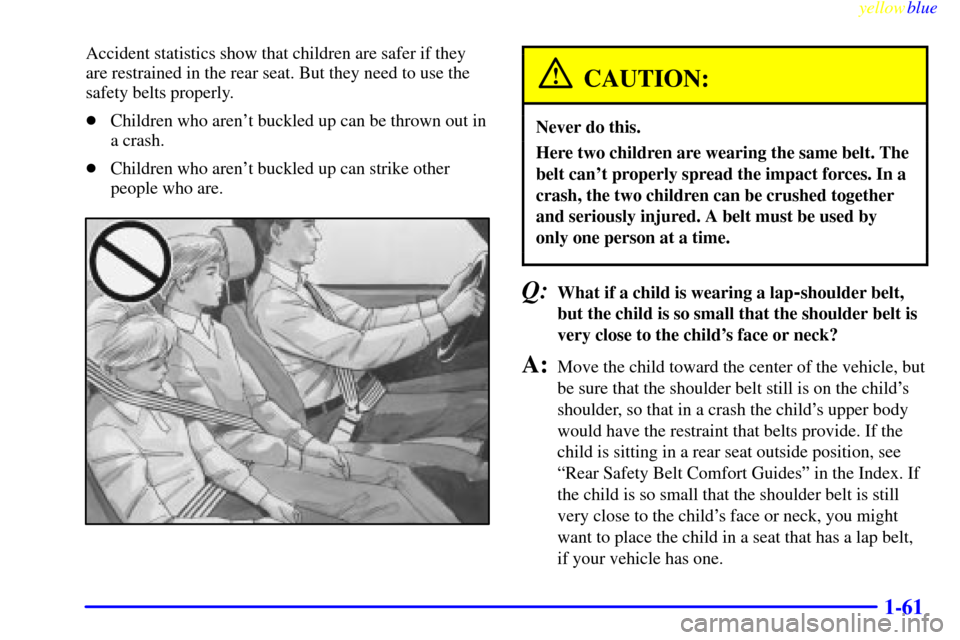
CAUTION:
Never do this.
Here two children are wearing the same belt. The
belt can't properly spread the impact forces. In a
crash, the two children can be crushed together
and seriously injured. A belt must be used by
only one person at a time.
Q:What if a child is wearing a lap-shoulder belt,
but the child is so small that the shoulder belt is
very close to the child's face or neck?
A:Move the child toward the center of the vehicle, but
be sure that the shoulder belt still is on the child's
shoulder, so that in a crash the child's upper body
would have the restraint that belts provide. If the
child is sitting in a rear seat outside position, see
ªRear Safety Belt Comfort Guidesº in the Index. If
the child is so small that the shoulder belt is still
very close to the child's face or neck, you might
want to place the child in a seat that has a lap belt,
if your vehicle has one.
Page 78 of 424
yellowblue
2-8
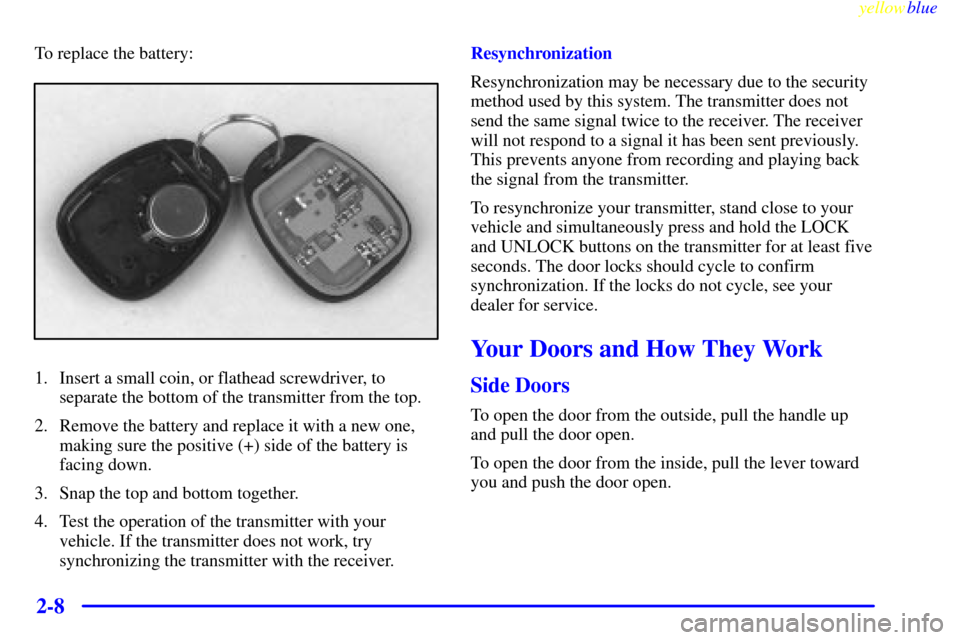
To replace the battery:
1. Insert a small coin, or flathead screwdriver, to
separate the bottom of the transmitter from the top.
2. Remove the battery and replace it with a new one,
making sure the positive (+) side of the battery is
facing down.
3. Snap the top and bottom together.
4. Test the operation of the transmitter with your
vehicle. If the transmitter does not work, try
synchronizing the transmitter with the receiver.Resynchronization
Resynchronization may be necessary due to the security
method used by this system. The transmitter does not
send the same signal twice to the receiver. The receiver
will not respond to a signal it has been sent previously.
This prevents anyone from recording and playing back
the signal from the transmitter.
To resynchronize your transmitter, stand close to your
vehicle and simultaneously press and hold the LOCK
and UNLOCK buttons on the transmitter for at least five
seconds. The door locks should cycle to confirm
synchronization. If the locks do not cycle, see your
dealer for service.
Your Doors and How They Work
Side Doors
To open the door from the outside, pull the handle up
and pull the door open.
To open the door from the inside, pull the lever toward
you and push the door open.
Page 79 of 424

yellowblue
2-9
CAUTION:
It can be dangerous to drive with the tailgate
glass, tailgate or rear doors open because carbon
monoxide (CO) gas can come into your vehicle.
You can't see or smell CO. It can cause
unconsciousness and even death.
If you must drive with the tailgate glass, tailgate
or rear doors open or if electrical wiring or other
cable connections must pass through the seal
between the body and the tailgate glass, tailgate
or rear doors:
�Make sure all other windows are shut.
�Turn the fan on your heating or cooling
system to its highest speed with the setting
on VENT. That will force outside air into
your vehicle. See ªComfort Controlsº in
the Index.
�If you have air outlets on or under the
instrument panel, open them all the way.
See ªEngine Exhaustº in the Index.
Tailgate Glass and Tailgate
If your vehicle has a tailgate, you must raise the rear
glass before lowering the tailgate.
To open the glass from the outside, use your key. With
the key in the lock, turn the key clockwise to release the
glass, then lift it up.
To release the glass from the inside, use the electric
tailgate glass release switch on the instrument panel. For
more information, see ªTailgate
-- Electric Glass
Releaseº in the Index.
To open the tailgate, lift up on the handle while pulling
the tailgate toward you.
Close the tailgate before closing the rear glass. After
closing the tailgate, make sure the tailgate is securely
latched by pulling it toward you. After closing the rear
glass, pull up on its handle to make sure it is locked.
Panel Doors
To open the rear panel doors, you must open the
passenger's side panel door first. If the door is locked,
insert your door key in the lock and turn it
counterclockwise to unlock it.
To open the passenger's side panel door, pull up on the
handle and pull the door open.
Page 80 of 424
yellowblue
2-10
To open the driver's side panel door, first open the
passenger's side door. Then, pull the handle on the left
door edge out and pull the door open.
The rear doors have a check assembly to keep them
from fully opening during normal use.
To fully open either rear door, you must release the
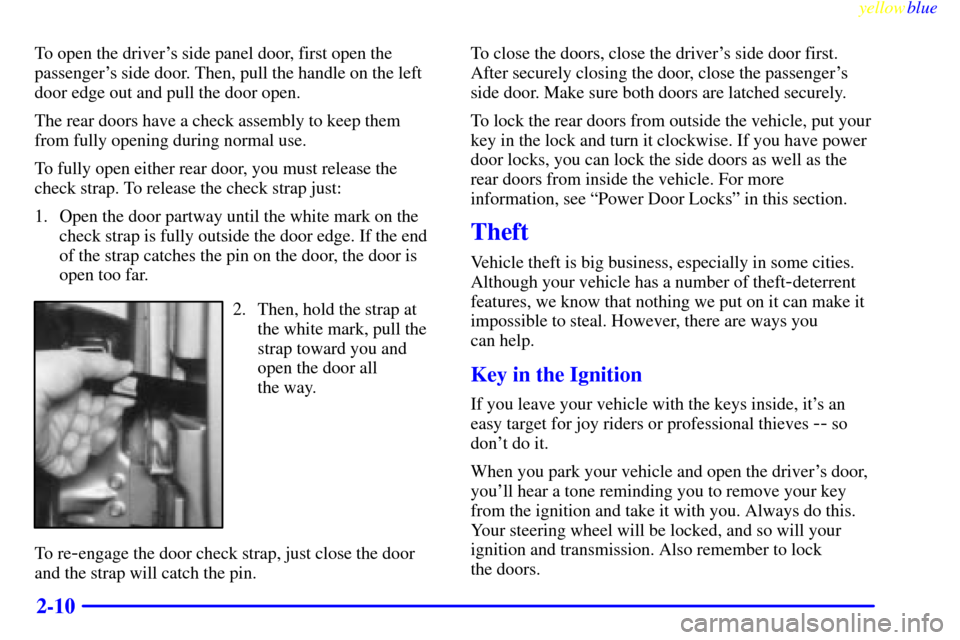
check strap. To release the check strap just:
1. Open the door partway until the white mark on the
check strap is fully outside the door edge. If the end
of the strap catches the pin on the door, the door is
open too far.
2. Then, hold the strap at
the white mark, pull the
strap toward you and
open the door all
the way.
To r e
-engage the door check strap, just close the door
and the strap will catch the pin.To close the doors, close the driver's side door first.
After securely closing the door, close the passenger's
side door. Make sure both doors are latched securely.
To lock the rear doors from outside the vehicle, put your
key in the lock and turn it clockwise. If you have power
door locks, you can lock the side doors as well as the
rear doors from inside the vehicle. For more
information, see ªPower Door Locksº in this section.
Theft
Vehicle theft is big business, especially in some cities.
Although your vehicle has a number of theft
-deterrent
features, we know that nothing we put on it can make it
impossible to steal. However, there are ways you
can help.
Key in the Ignition
If you leave your vehicle with the keys inside, it's an
easy target for joy riders or professional thieves
-- so
don't do it.
When you park your vehicle and open the driver's door,
you'll hear a tone reminding you to remove your key
from the ignition and take it with you. Always do this.
Your steering wheel will be locked, and so will your
ignition and transmission. Also remember to lock
the doors.
Page 82 of 424
yellowblue
2-12
New Vehicle ªBreak-Inº
NOTICE:
Your vehicle doesn't need an elaborate
ªbreak
-in.º But it will perform better in the long
run if you follow these guidelines:
�Keep your speed at 55 mph (88 km/h) or
less for the first 500 miles (805 km).
�Don't drive at any one speed
-- fast or
slow
-- for the first 500 miles (805 km).
Don't make full
-throttle starts.
�Avoid making hard stops for the first
200 miles (322 km) or so. During this time
your new brake linings aren't yet broken
in. Hard stops with new linings can mean
premature wear and earlier replacement.
Follow this breaking
-in guideline every
time you get new brake linings.
�Don't tow a trailer during break
-in.
See ªTowing a Trailerº in the Index for
more information.
Ignition Positions
CAUTION:
Leaving children in a vehicle with the ignition
key is dangerous for many reasons. A child or
others could be injured or even killed. They could
operate power windows or other controls or even
make the vehicle move. Don't leave the keys in
the vehicle with children.
Use your key to start your vehicle. The key lets you turn
the ignition switch to five different positions.
Page 83 of 424
yellowblue
2-13
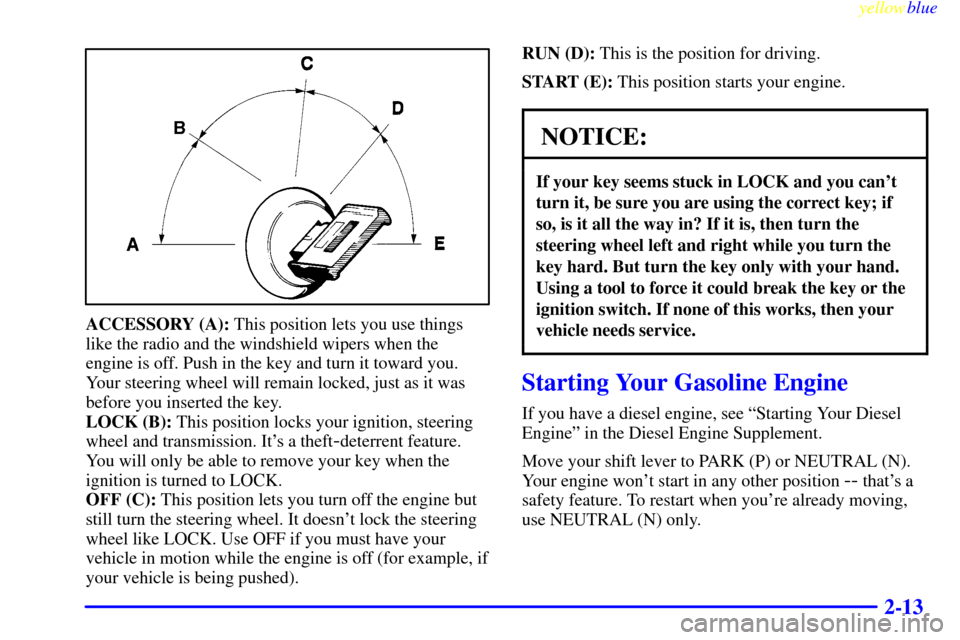
ACCESSORY (A): This position lets you use things
like the radio and the windshield wipers when the
engine is off. Push in the key and turn it toward you.
Your steering wheel will remain locked, just as it was
before you inserted the key.
LOCK (B): This position locks your ignition, steering
wheel and transmission. It's a theft
-deterrent feature.
You will only be able to remove your key when the
ignition is turned to LOCK.
OFF (C): This position lets you turn off the engine but
still turn the steering wheel. It doesn't lock the steering
wheel like LOCK. Use OFF if you must have your
vehicle in motion while the engine is off (for example, if
your vehicle is being pushed).RUN (D): This is the position for driving.
START (E): This position starts your engine.
NOTICE:
If your key seems stuck in LOCK and you can't
turn it, be sure you are using the correct key; if
so, is it all the way in? If it is, then turn the
steering wheel left and right while you turn the
key hard. But turn the key only with your hand.
Using a tool to force it could break the key or the
ignition switch. If none of this works, then your
vehicle needs service.
Starting Your Gasoline Engine
If you have a diesel engine, see ªStarting Your Diesel
Engineº in the Diesel Engine Supplement.
Move your shift lever to PARK (P) or NEUTRAL (N).
Your engine won't start in any other position
-- that's a
safety feature. To restart when you're already moving,
use NEUTRAL (N) only.
Page 84 of 424
yellowblue
2-14
NOTICE:
Don't try to shift to PARK (P) if your vehicle is
moving. If you do, you could damage the
transmission. Shift to PARK (P) only when your
vehicle is stopped.
How to Start the Engine
1. Without pushing the accelerator pedal, turn your
ignition key to START. When the engine starts, let
go of the key. The idle speed will go down as your
engine gets warm.
NOTICE:
Holding your key in START for longer than
15 seconds at a time will cause your battery
to be drained much sooner. And the excessive
heat can damage your starter motor. Wait about
15 seconds between each try to help avoid
draining your battery or damaging your starter.
2. If it doesn't start right away, hold your key in
START. If it doesn't start in 10 seconds, push the
accelerator pedal all the way down for five more
seconds, unless it starts sooner.
3. If your engine still won't start (or starts but then
stops), wait 15 seconds and start over.
When the engine starts, let go of the key and the
accelerator pedal.
NOTICE:
Your engine is designed to work with the
electronics in your vehicle. If you add electrical
parts or accessories, you could change the way
the engine operates. Before adding electrical
equipment, check with your dealer. If you don't,
your engine might not perform properly.
If you ever have to have your vehicle towed, see
the part of this manual that tells how to do it
without damaging your vehicle. See ªTowing
Your Vehicleº in the Index.