Page 281 of 432

yellowblue
5-21
You'll use the jack handle and the wheel wrench to
remove the underbody
-mounted spare tire.
A. Hoist Assembly
B. Wheel Wrench
C. Extensions
D. Hoist Shaft
E. Valve Stem,
Pointed Down
F. Spare TireG. Tire Retainer
H. Hoist Cable
I. Hoist Lock
J. Hoist Shaft
Access Hole
K. Hoist EndFollow these instructions to lower the spare tire:
1. If the vehicle is equipped with a hoist lock, open the
spare tire lock cover on the bumper and use the
ignition key to remove the lock.
2. Assemble the wheel wrench and the two jack handle
extensions as shown. Insert the hoist end of the
extension through the hole in the rear bumper. Be
sure the hoist end of the extension connects into the
hoist shaft.
3. Turn the wheel wrench counterclockwise to lower
the spare tire to the ground. Continue to turn the
wheel wrench until the spare tire can be pulled out
from under the vehicle. The wheel wrench has a
hook feature that allows you to pull the hoist cable
towards you, to assist you in reaching the spare tire.
4. When the tire has been lowered, tilt the retainer at
the end of the cable so it can be pulled up through
the wheel opening.
5. Put the spare tire near the flat tire.
Page 287 of 432
yellowblue
5-27
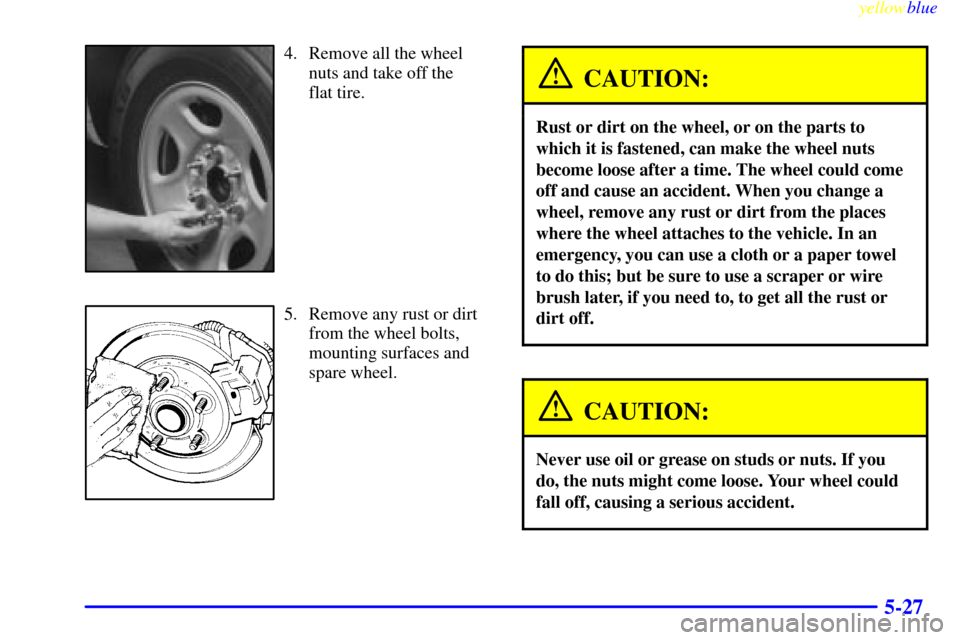
4. Remove all the wheel
nuts and take off the
flat tire.
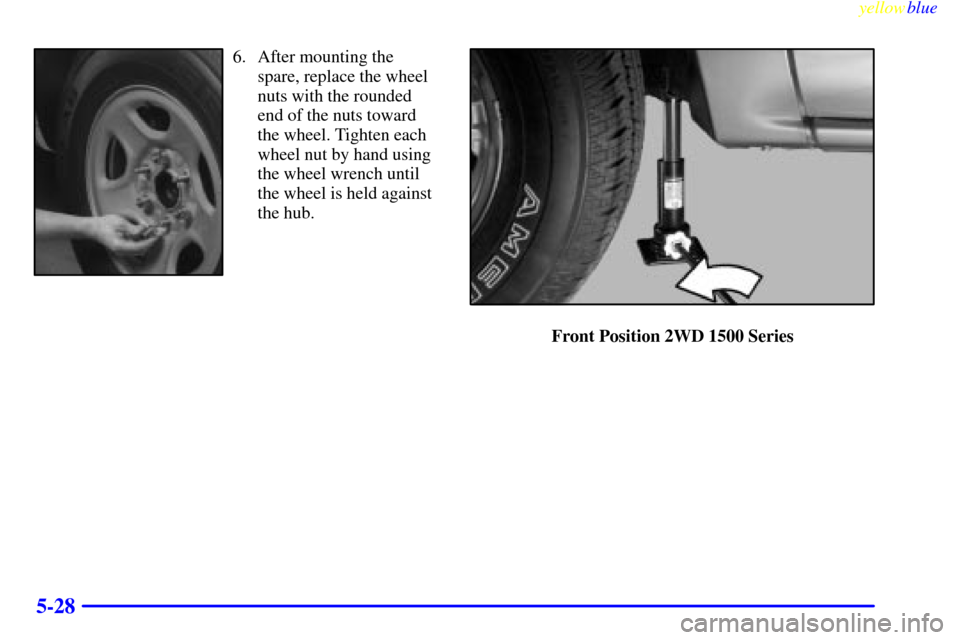
5. Remove any rust or dirt
from the wheel bolts,
mounting surfaces and
spare wheel.
CAUTION:
Rust or dirt on the wheel, or on the parts to
which it is fastened, can make the wheel nuts
become loose after a time. The wheel could come
off and cause an accident. When you change a
wheel, remove any rust or dirt from the places
where the wheel attaches to the vehicle. In an
emergency, you can use a cloth or a paper towel
to do this; but be sure to use a scraper or wire
brush later, if you need to, to get all the rust or
dirt off.
CAUTION:
Never use oil or grease on studs or nuts. If you
do, the nuts might come loose. Your wheel could
fall off, causing a serious accident.
Page 288 of 432
yellowblue
5-28
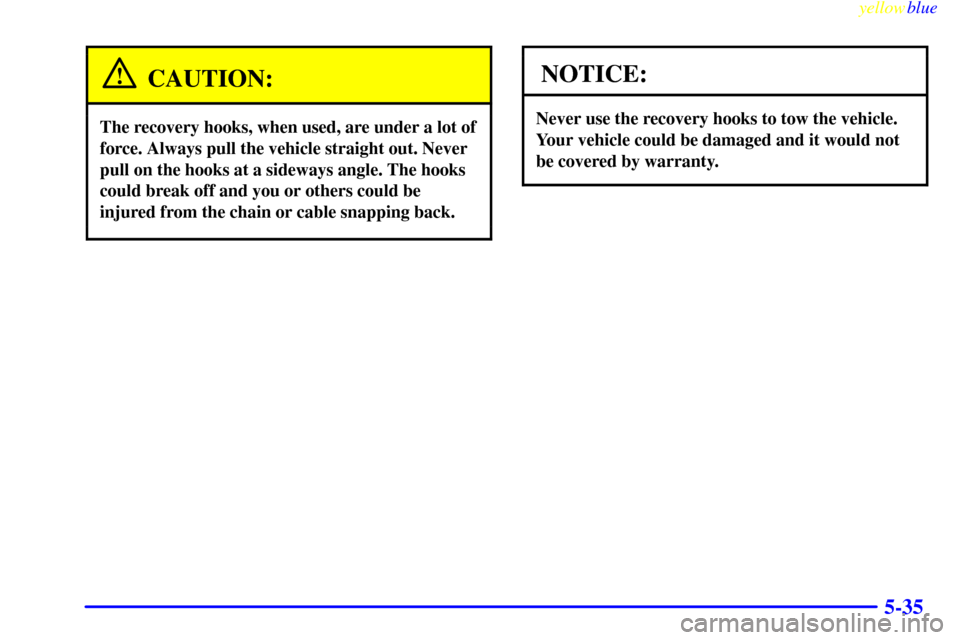
6. After mounting the
spare, replace the wheel
nuts with the rounded
end of the nuts toward
the wheel. Tighten each
wheel nut by hand using
the wheel wrench until
the wheel is held against
the hub.
Front Position 2WD 1500 Series
Page 291 of 432
yellowblue
5-31 Storing a Flat or Spare Tire and Tools
CAUTION:
Storing a jack, a tire or other equipment in the
passenger compartment of the vehicle could
cause injury. In a sudden stop or collision, loose
equipment could strike someone. Store all these
in the proper place.
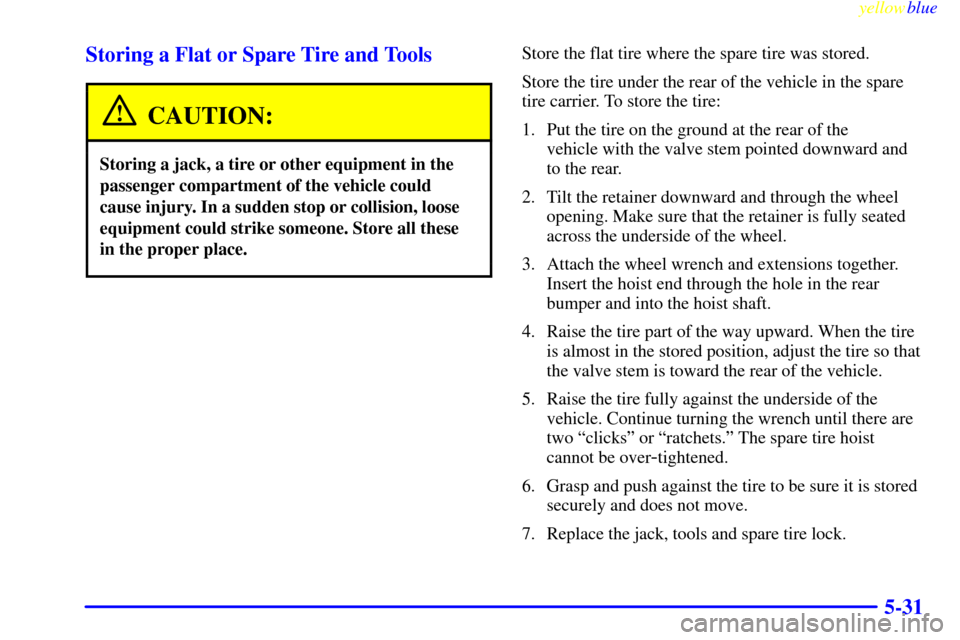
Store the flat tire where the spare tire was stored.
Store the tire under the rear of the vehicle in the spare
tire carrier. To store the tire:
1. Put the tire on the ground at the rear of the
vehicle with the valve stem pointed downward and
to the rear.
2. Tilt the retainer downward and through the wheel
opening. Make sure that the retainer is fully seated
across the underside of the wheel.
3. Attach the wheel wrench and extensions together.
Insert the hoist end through the hole in the rear
bumper and into the hoist shaft.
4. Raise the tire part of the way upward. When the tire
is almost in the stored position, adjust the tire so that
the valve stem is toward the rear of the vehicle.
5. Raise the tire fully against the underside of the
vehicle. Continue turning the wrench until there are
two ªclicksº or ªratchets.º The spare tire hoist
cannot be over
-tightened.
6. Grasp and push against the tire to be sure it is stored
securely and does not move.
7. Replace the jack, tools and spare tire lock.
Page 293 of 432
yellowblue
5-33
If You're Stuck: In Sand, Mud,
Ice or Snow
In order to free your vehicle when it is stuck, you will
need to spin the wheels, but you don't want to spin your
wheels too fast. The method known as ªrockingº can
help you get out when you're stuck, but you must
use caution.
CAUTION:
If you let your tires spin at high speed, they can
explode, and you or others could be injured. And,
the transmission or other parts of the vehicle can
overheat. That could cause an engine
compartment fire or other damage. When you're
stuck, spin the wheels as little as possible. Don't
spin the wheels above 35 mph (55 km/h) as shown
on the speedometer.
NOTICE:
Spinning your wheels can destroy parts of your
vehicle as well as the tires. If you spin the wheels
too fast while shifting your transmission back
and forth, you can destroy your transmission.
For information about using tire chains on your vehicle,
see ªTire Chainsº in the Index.
Rocking Your Vehicle To Get It Out
First, turn your steering wheel left and right. That will clear
the area around your front wheels. If you have a four
-wheel
drive vehicle, shift into 4HI. Then shift back and forth
between REVERSE (R) and a forward gear (or with a
manual transmission, between FIRST (1) or SECOND (2)
and REVERSE (R)), spinning the wheels as little as possible.
Release the accelerator pedal while you shift, and press
lightly on the accelerator pedal when the transmission is in
gear. By slowly spinning your wheels in the forward and
reverse directions, you will cause a rocking motion that may
free your vehicle. If that doesn't get you out after a few tries,
you may need to be towed out. Or, you can use your recovery
hooks if your vehicle has them. If you do need to be towed
out, see ªTowing Your Vehicleº in the Index.
Page 295 of 432
yellowblue
5-35
CAUTION:
The recovery hooks, when used, are under a lot of
force. Always pull the vehicle straight out. Never
pull on the hooks at a sideways angle. The hooks
could break off and you or others could be
injured from the chain or cable snapping back.
NOTICE:
Never use the recovery hooks to tow the vehicle.
Your vehicle could be damaged and it would not
be covered by warranty.
Page 311 of 432
yellowblue
6-13 Checking Engine Oil
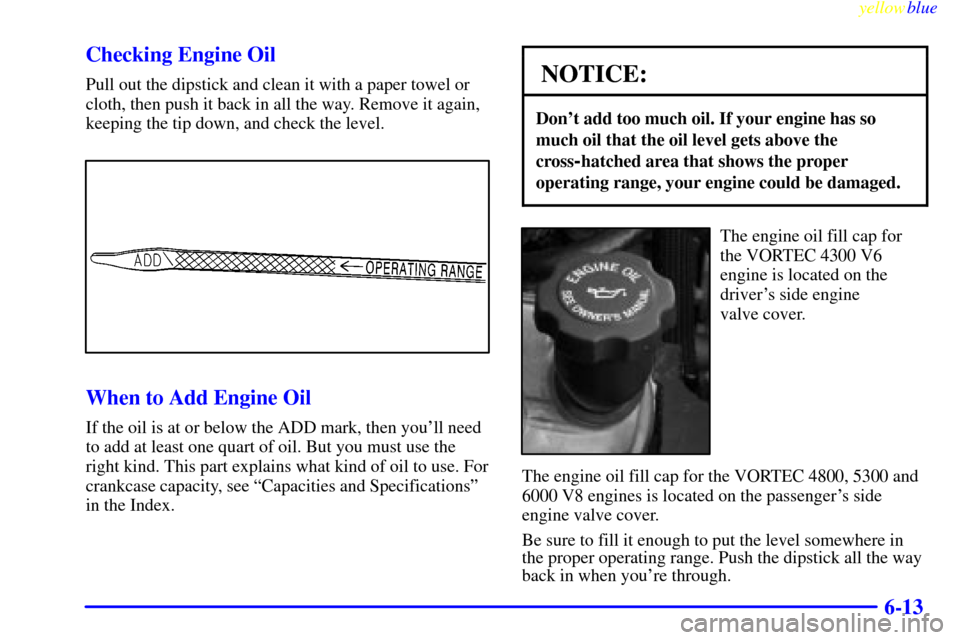
Pull out the dipstick and clean it with a paper towel or
cloth, then push it back in all the way. Remove it again,
keeping the tip down, and check the level.
When to Add Engine Oil
If the oil is at or below the ADD mark, then you'll need
to add at least one quart of oil. But you must use the
right kind. This part explains what kind of oil to use. For
crankcase capacity, see ªCapacities and Specificationsº
in the Index.
NOTICE:
Don't add too much oil. If your engine has so
much oil that the oil level gets above the
cross
-hatched area that shows the proper
operating range, your engine could be damaged.
The engine oil fill cap for
the VORTEC 4300 V6
engine is located on the
driver's side engine
valve cover.
The engine oil fill cap for the VORTEC 4800, 5300 and
6000 V8 engines is located on the passenger's side
engine valve cover.
Be sure to fill it enough to put the level somewhere in
the proper operating range. Push the dipstick all the way
back in when you're through.
Page 316 of 432
yellowblue
6-18
CAUTION:
Operating the engine with the air cleaner/filter
off can cause you or others to be burned. The air
cleaner not only cleans the air, it stops flame if
the engine backfires. If it isn't there, and the
engine backfires, you could be burned. Don't
drive with it off, and be careful working on the
engine with the air cleaner/filter off.
NOTICE:
If the air cleaner/filter is off, a backfire can
cause a damaging engine fire. And, dirt can easily
get into your engine, which will damage it.
Always have the air cleaner/filter in place when
you're driving.
Passenger Compartment Air Filter
(If Equipped)
Your vehicle may be equipped with a passenger
compartment air filter. The filter is located under the
instrument panel below the glove compartment.
To replace the passenger compartment air filter:
1. If your vehicle is equipped with a panel under the
center of the instrument panel, remove the bolts on it
to remove the panel. Because this operation can be a
little difficult, you may choose to have it done at
your dealer service department.
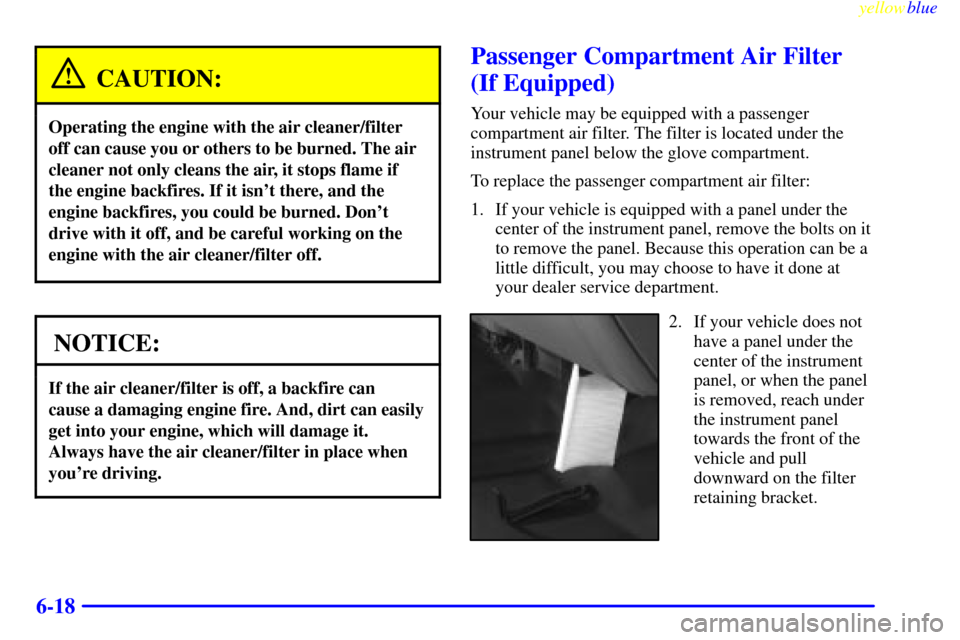
2. If your vehicle does not
have a panel under the
center of the instrument
panel, or when the panel
is removed, reach under
the instrument panel
towards the front of the
vehicle and pull
downward on the filter
retaining bracket.