Page 320 of 432
yellowblue
6-22 How to Add Fluid
Refer to the Maintenance Schedule to determine what
kind of transmission fluid to use. See ªRecommended
Fluids and Lubricantsº in the Index.
Add fluid only after checking the transmission fluid
while it is hot. (A cold check is used only as a
reference.) If the fluid level is low, add only enough of
the proper fluid to bring the level up to the HOT area for
a hot check. It doesn't take much fluid, generally less
than one pint (0.5 L). Don't overfill.
NOTICE:
We recommend you use only fluid labeled
DEXRON�-III, because fluid with that label is
made especially for your automatic transmission.
Damage caused by fluid other than
DEXRON
�-III is not covered by your new
vehicle warranty.
�After adding fluid, recheck the fluid level as
described under ªHow to Check.º
�When the correct fluid level is obtained, push the
dipstick back in all the way; then flip the handle
down to lock the dipstick in place.
Manual Transmission Fluid
When to Check
A good time to have it checked is when the engine oil is
changed. See your maintenance schedule to find out
when to change your transmission fluid.
Page 321 of 432
yellowblue
6-23 How to Check
Because this operation can be a little difficult, you may
choose to have this done at your GM dealership Service
Department.
If you do it yourself, be sure to follow all the
instructions here, or you could get a false reading.
NOTICE:
Too much or too little fluid can damage your
transmission. Too much can mean that some of
the fluid could come out and fall on hot engine
parts or exhaust system parts, starting a fire. Be
sure to get an accurate reading if you check your
transmission fluid.
Check the fluid level only when your engine is off, the
vehicle is parked on a level place and the transmission is
cool enough for you to rest your fingers on the
transmission case.Then, follow these steps:
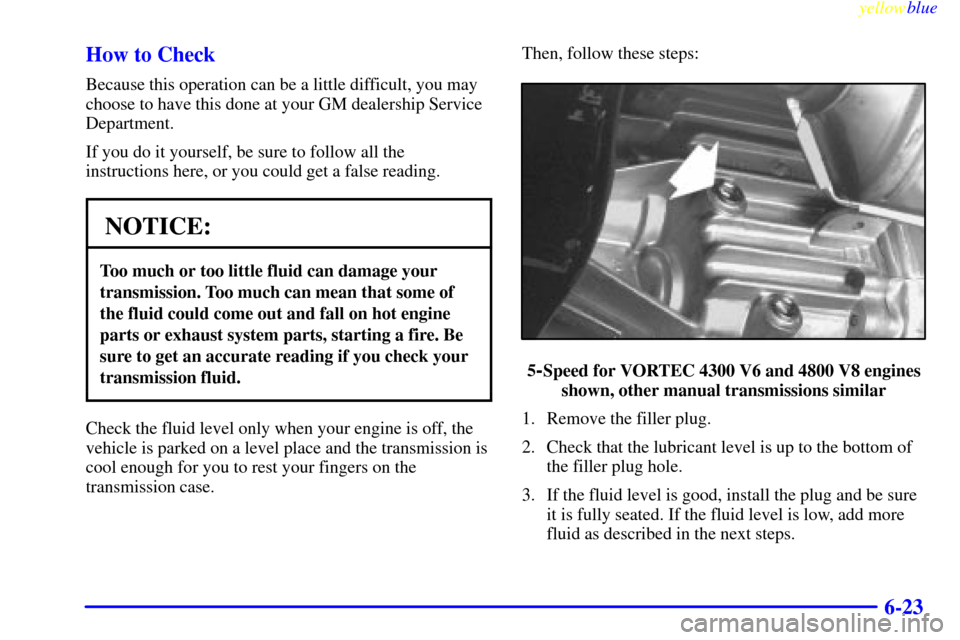
5-Speed for VORTEC 4300 V6 and 4800 V8 engines
shown, other manual transmissions similar
1. Remove the filler plug.
2. Check that the lubricant level is up to the bottom of
the filler plug hole.
3. If the fluid level is good, install the plug and be sure
it is fully seated. If the fluid level is low, add more
fluid as described in the next steps.
Page 328 of 432
yellowblue
6-30 What to Use
Use a mixture of one-half clean, drinkable water and
one
-half DEX-COOL� coolant which won't damage
aluminum parts. If you use this coolant mixture, you
don't need to add anything else.
CAUTION:
Adding only plain water to your cooling system
can be dangerous. Plain water, or some other
liquid like alcohol, can boil before the proper
coolant mixture will. Your vehicle's coolant
warning system is set for the proper coolant
mixture. With plain water or the wrong mixture,
your engine could get too hot but you wouldn't
get the overheat warning. Your engine could
catch fire and you or others could be burned. Use
a 50/50 mixture of clean, drinkable water and
DEX
-COOL� coolant.
NOTICE:
If you use an improper coolant mixture, your
engine could overheat and be badly damaged.
The repair cost wouldn't be covered by your
warranty. Too much water in the mixture can
freeze and crack the engine, radiator, heater core
and other parts.
If you have to add coolant more than four times a year,
have your dealer check your cooling system.
NOTICE:
If you use the proper coolant, you don't have to
add extra inhibitors or additives which claim to
improve the system. These can be harmful.
Page 329 of 432
yellowblue
6-31 Checking Coolant (Gasoline Engine)
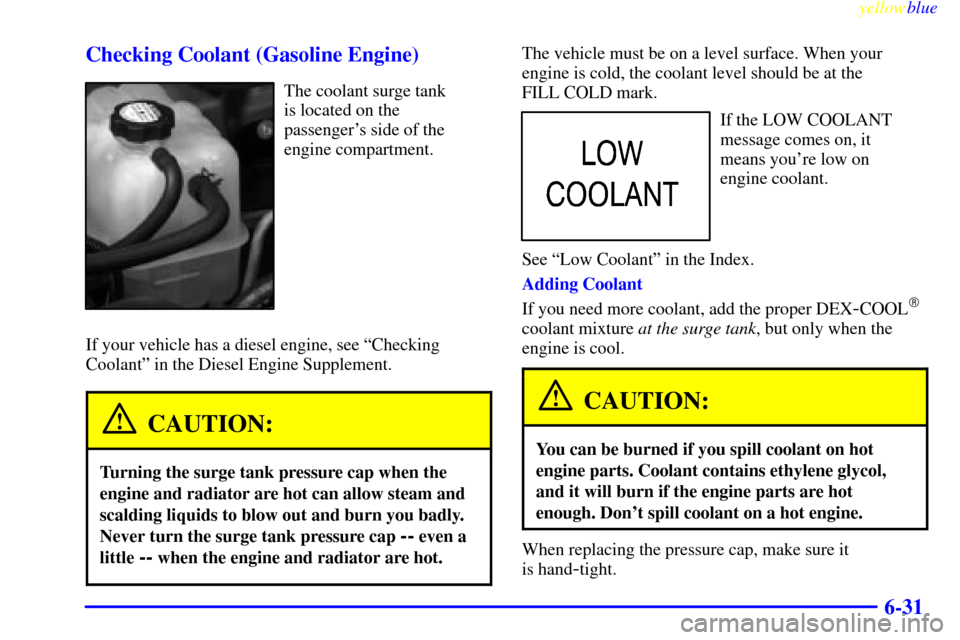
The coolant surge tank
is located on the
passenger's side of the
engine compartment.
If your vehicle has a diesel engine, see ªChecking
Coolantº in the Diesel Engine Supplement.
CAUTION:
Turning the surge tank pressure cap when the
engine and radiator are hot can allow steam and
scalding liquids to blow out and burn you badly.
Never turn the surge tank pressure cap
-- even a
little
-- when the engine and radiator are hot.
The vehicle must be on a level surface. When your
engine is cold, the coolant level should be at the
FILL COLD mark.
If the LOW COOLANT
message comes on, it
means you're low on
engine coolant.
See ªLow Coolantº in the Index.
Adding Coolant
If you need more coolant, add the proper DEX
-COOL�
coolant mixture at the surge tank, but only when the
engine is cool.
CAUTION:
You can be burned if you spill coolant on hot
engine parts. Coolant contains ethylene glycol,
and it will burn if the engine parts are hot
enough. Don't spill coolant on a hot engine.
When replacing the pressure cap, make sure it
is hand
-tight.
Page 330 of 432
yellowblue
6-32
Power Steering Fluid
When to Check Power Steering Fluid
It is not necessary to regularly check power steering
fluid unless you suspect there is a leak in the system or
you hear an unusual noise. A fluid loss in this system
could indicate a problem. Have the system inspected
and repaired.
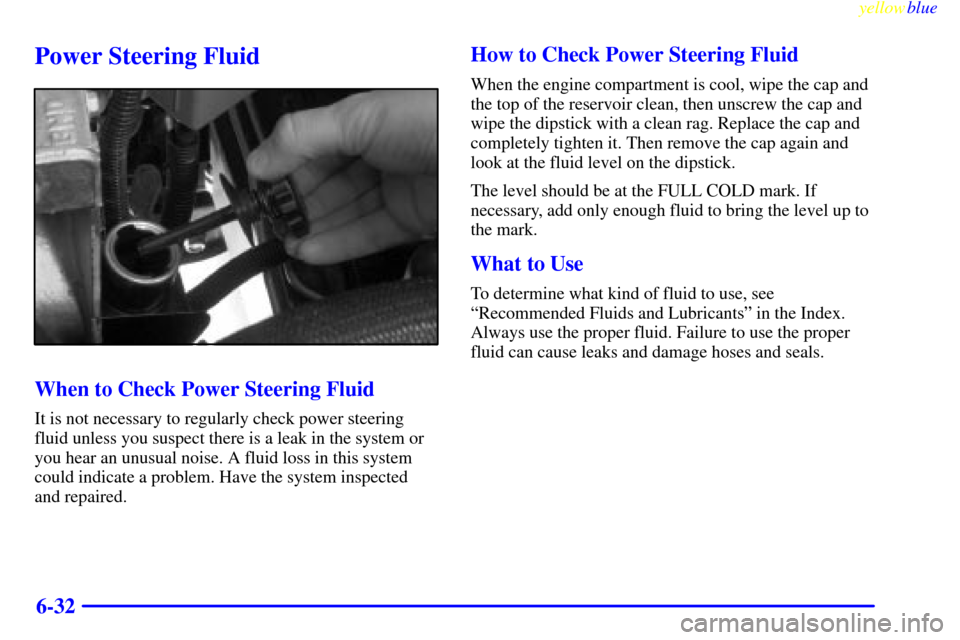
How to Check Power Steering Fluid
When the engine compartment is cool, wipe the cap and
the top of the reservoir clean, then unscrew the cap and
wipe the dipstick with a clean rag. Replace the cap and
completely tighten it. Then remove the cap again and
look at the fluid level on the dipstick.
The level should be at the FULL COLD mark. If
necessary, add only enough fluid to bring the level up to
the mark.
What to Use
To determine what kind of fluid to use, see
ªRecommended Fluids and Lubricantsº in the Index.
Always use the proper fluid. Failure to use the proper
fluid can cause leaks and damage hoses and seals.
Page 332 of 432
yellowblue
6-34
Brakes
Brake Fluid
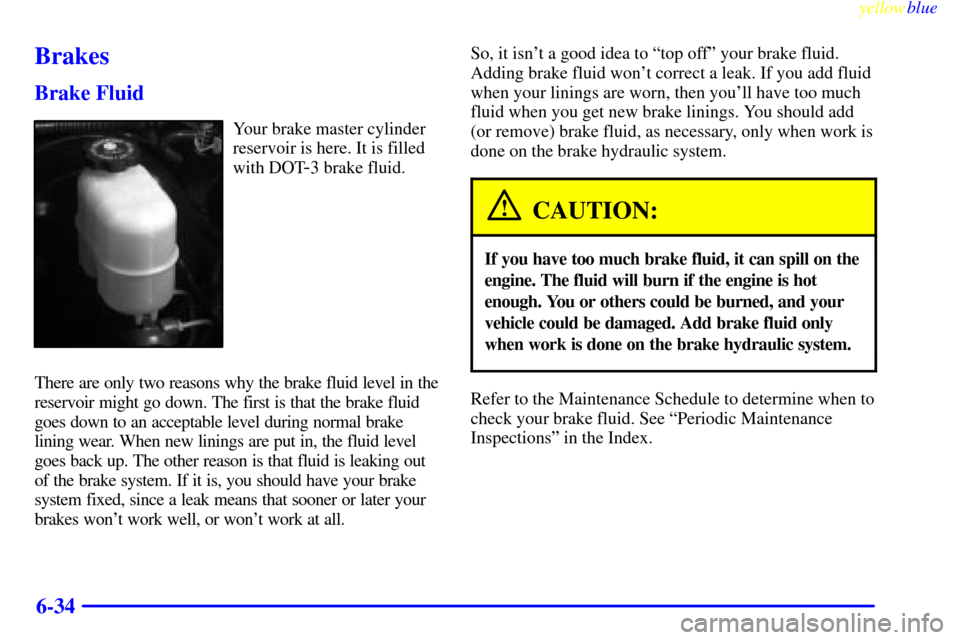
Your brake master cylinder
reservoir is here. It is filled
with DOT
-3 brake fluid.
There are only two reasons why the brake fluid level in the
reservoir might go down. The first is that the brake fluid
goes down to an acceptable level during normal brake
lining wear. When new linings are put in, the fluid level
goes back up. The other reason is that fluid is leaking out
of the brake system. If it is, you should have your brake
system fixed, since a leak means that sooner or later your
brakes won't work well, or won't work at all.So, it isn't a good idea to ªtop offº your brake fluid.
Adding brake fluid won't correct a leak. If you add fluid
when your linings are worn, then you'll have too much
fluid when you get new brake linings. You should add
(or remove) brake fluid, as necessary, only when work is
done on the brake hydraulic system.
CAUTION:
If you have too much brake fluid, it can spill on the
engine. The fluid will burn if the engine is hot
enough. You or others could be burned, and your
vehicle could be damaged. Add brake fluid only
when work is done on the brake hydraulic system.
Refer to the Maintenance Schedule to determine when to
check your brake fluid. See ªPeriodic Maintenance
Inspectionsº in the Index.
Page 373 of 432
yellowblue
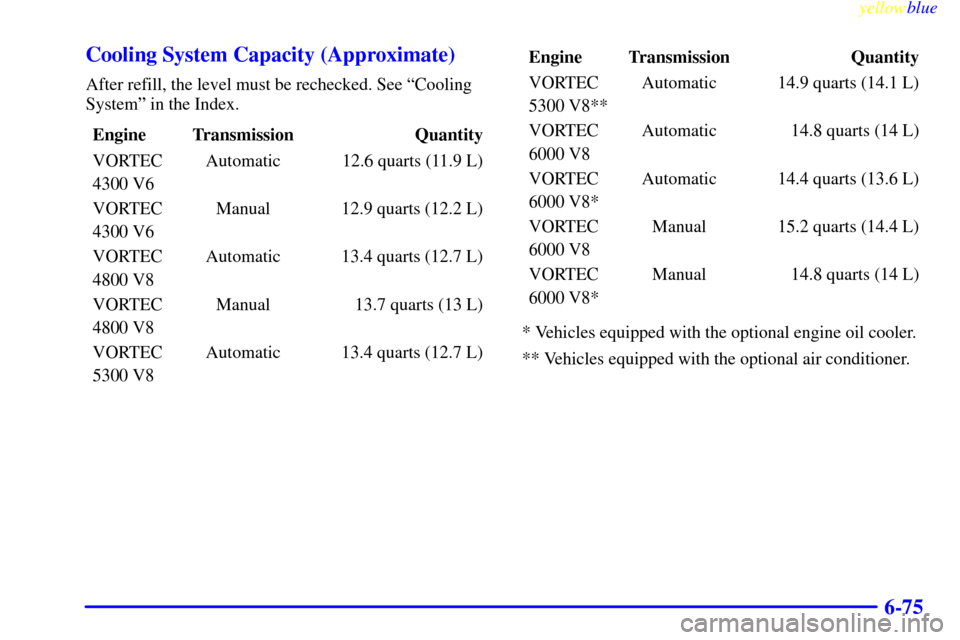
6-75 Cooling System Capacity (Approximate)
After refill, the level must be rechecked. See ªCooling
Systemº in the Index.
Engine Transmission Quantity
VORTEC
4300 V6Automatic 12.6 quarts (11.9 L)
VORTEC
4300 V6Manual 12.9 quarts (12.2 L)
VORTEC
4800 V8Automatic 13.4 quarts (12.7 L)
VORTEC
4800 V8Manual 13.7 quarts (13 L)
VORTEC
5300 V8Automatic 13.4 quarts (12.7 L)Engine Transmission Quantity
VORTEC
5300 V8**Automatic 14.9 quarts (14.1 L)
VORTEC
6000 V8Automatic 14.8 quarts (14 L)
VORTEC
6000 V8*Automatic 14.4 quarts (13.6 L)
VORTEC
6000 V8Manual 15.2 quarts (14.4 L)
VORTEC
6000 V8*Manual 14.8 quarts (14 L)
* Vehicles equipped with the optional engine oil cooler.
** Vehicles equipped with the optional air conditioner.
Page 374 of 432
yellowblue
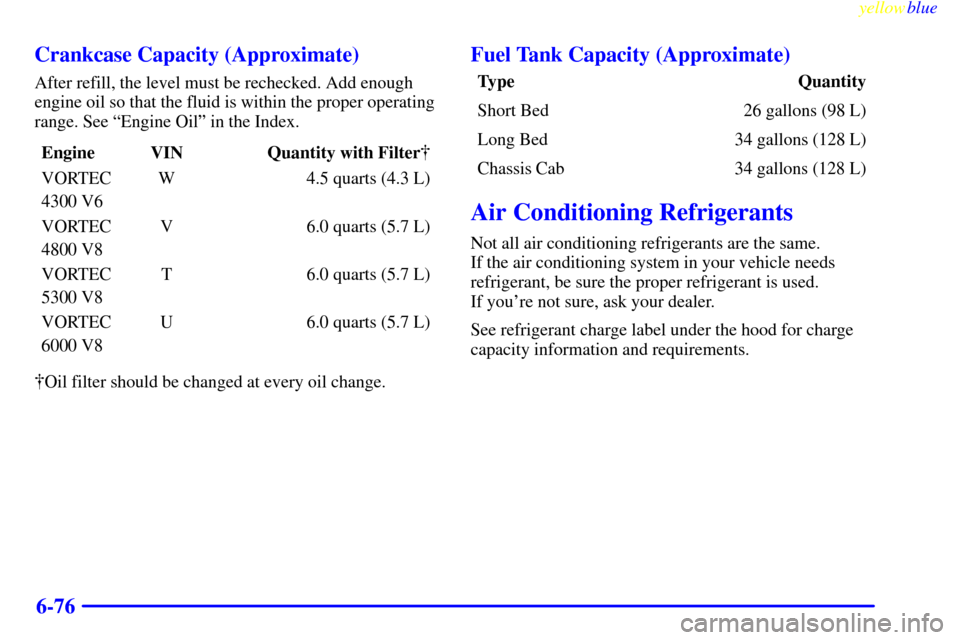
6-76 Crankcase Capacity (Approximate)
After refill, the level must be rechecked. Add enough
engine oil so that the fluid is within the proper operating
range. See ªEngine Oilº in the Index.
Engine VIN
Quantity with Filter�
VORTEC
4300 V6W 4.5 quarts (4.3 L)
VORTEC
4800 V8V 6.0 quarts (5.7 L)
VORTEC
5300 V8T 6.0 quarts (5.7 L)
VORTEC
6000 V8U 6.0 quarts (5.7 L)
�Oil filter should be changed at every oil change.
Fuel Tank Capacity (Approximate)
Type Quantity
Short Bed 26 gallons (98 L)
Long Bed 34 gallons (128 L)
Chassis Cab 34 gallons (128 L)
Air Conditioning Refrigerants
Not all air conditioning refrigerants are the same.
If the air conditioning system in your vehicle needs
refrigerant, be sure the proper refrigerant is used.
If you're not sure, ask your dealer.
See refrigerant charge label under the hood for charge
capacity information and requirements.