Page 306 of 432
yellowblue
6-8
Filling a Portable Fuel Container
CAUTION:
Never fill a portable fuel container while it is in
your vehicle. Static electricity discharge from the
container can ignite the gasoline vapor. You can
be badly burned and your vehicle damaged if this
occurs. To help avoid injury to you and others:
�Dispense gasoline only into
approved containers.
�Do not fill a container while it is inside a
vehicle, in a vehicle's trunk, pickup bed or
on any surface other than the ground.
�Bring the fill nozzle in contact with the
inside of the fill opening before operating
the nozzle. Contact should be maintained
until the filling is complete.
�Don't smoke while pumping gasoline.
Checking Things Under the Hood
CAUTION:
Things that burn can get on hot engine parts and
start a fire. These include liquids like gasoline or
diesel fuel, oil, coolant, brake fluid, windshield
washer and other fluids, and plastic or rubber.
You or others could be burned. Be careful not
to drop or spill things that will burn onto a
hot engine.
Page 310 of 432
yellowblue
6-12
Engine Oil (Gasoline Engine)
If your vehicle has a diesel engine, see ªEngine Oil
(Diesel Engine)º in the Diesel Engine Supplement.
If the CHECK ENG OIL
LEVEL light on the
instrument panel comes on,
it means you need to check
your engine oil level
right away.
For more information, see ªCHECK ENG OIL LEVELº
in the Index. You should check your engine oil level
regularly; this is an added reminder.
It's a good idea to check your engine oil every time you
get fuel. In order to get an accurate reading, the oil must
be warm and the vehicle must be on level ground.
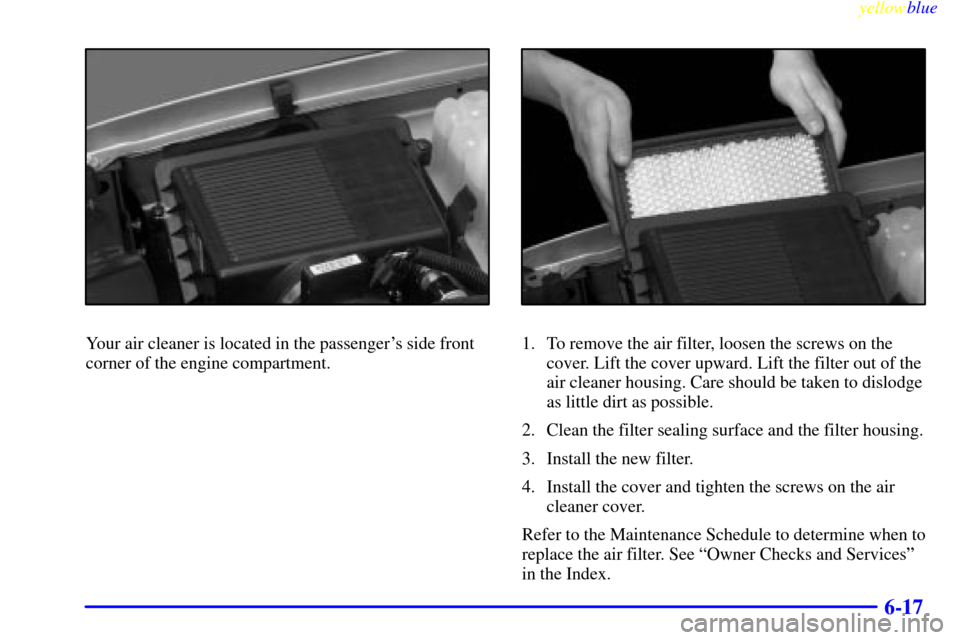
The engine oil dipstick has
a yellow ring handle and is
located on the passenger's
side of the engine.
Turn off the engine and give the oil several minutes to
drain back into the oil pan. If you don't, the oil dipstick
might not show the actual level.
Page 311 of 432
yellowblue
6-13 Checking Engine Oil
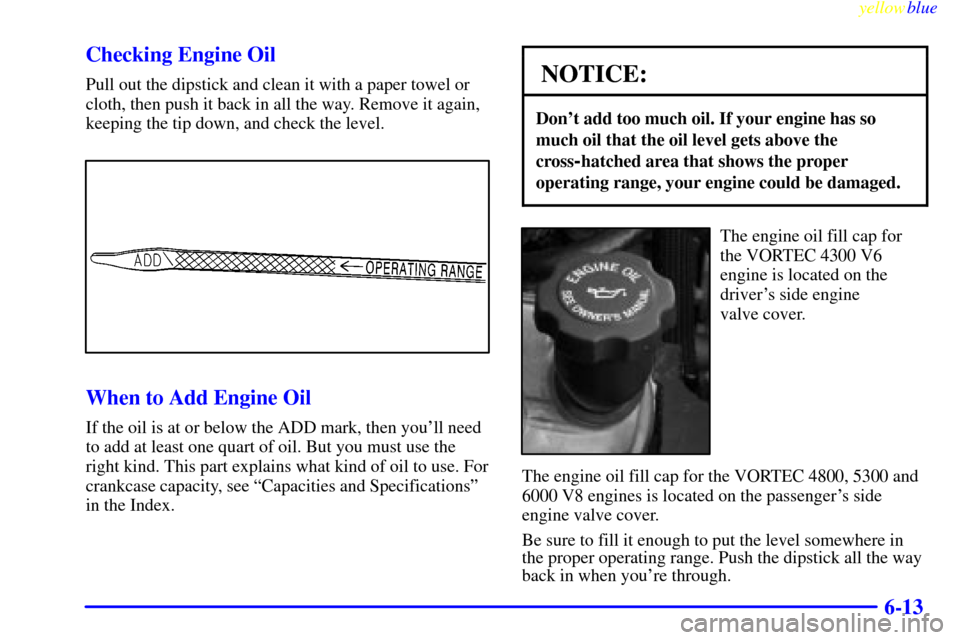
Pull out the dipstick and clean it with a paper towel or
cloth, then push it back in all the way. Remove it again,
keeping the tip down, and check the level.
When to Add Engine Oil
If the oil is at or below the ADD mark, then you'll need
to add at least one quart of oil. But you must use the
right kind. This part explains what kind of oil to use. For
crankcase capacity, see ªCapacities and Specificationsº
in the Index.
NOTICE:
Don't add too much oil. If your engine has so
much oil that the oil level gets above the
cross
-hatched area that shows the proper
operating range, your engine could be damaged.
The engine oil fill cap for
the VORTEC 4300 V6
engine is located on the
driver's side engine
valve cover.
The engine oil fill cap for the VORTEC 4800, 5300 and
6000 V8 engines is located on the passenger's side
engine valve cover.
Be sure to fill it enough to put the level somewhere in
the proper operating range. Push the dipstick all the way
back in when you're through.
Page 314 of 432
yellowblue
6-16
How to Reset the CHANGE ENGINE OIL Message
To reset the CHANGE ENGINE OIL message, turn the
ignition key to RUN with the engine off. Fully press and
release the accelerator pedal three times within five
seconds. If the CHANGE ENGINE OIL message flashes
for five seconds, the system is reset.
What to Do with Used Oil
Did you know that used engine oil contains certain
elements that may be unhealthy for your skin and could
even cause cancer? Don't let used oil stay on your skin
for very long. Clean your skin and nails with soap and
water, or a good hand cleaner. Wash or properly throw
away clothing or rags containing used engine oil. (See
the manufacturer's warnings about the use and disposal
of oil products.)
Used oil can be a real threat to the environment. If you
change your own oil, be sure to drain all free
-flowing oil
from the filter before disposal. Don't ever dispose of oil
by putting it in the trash, pouring it on the ground, into
sewers, or into streams or bodies of water. Instead,
recycle it by taking it to a place that collects used oil. If
you have a problem properly disposing of your used oil,
ask your dealer, a service station or a local recycling
center for help.
Engine Air Cleaner/Filter
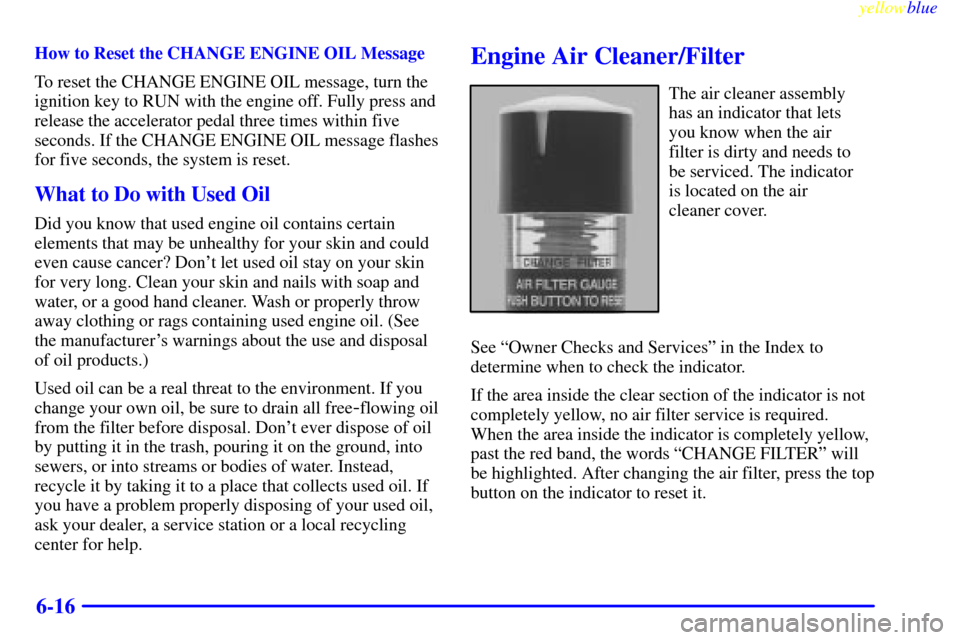
The air cleaner assembly
has an indicator that lets
you know when the air
filter is dirty and needs to
be serviced. The indicator
is located on the air
cleaner cover.
See ªOwner Checks and Servicesº in the Index to
determine when to check the indicator.
If the area inside the clear section of the indicator is not
completely yellow, no air filter service is required.
When the area inside the indicator is completely yellow,
past the red band, the words ªCHANGE FILTERº will
be highlighted. After changing the air filter, press the top
button on the indicator to reset it.
Page 315 of 432
yellowblue
6-17
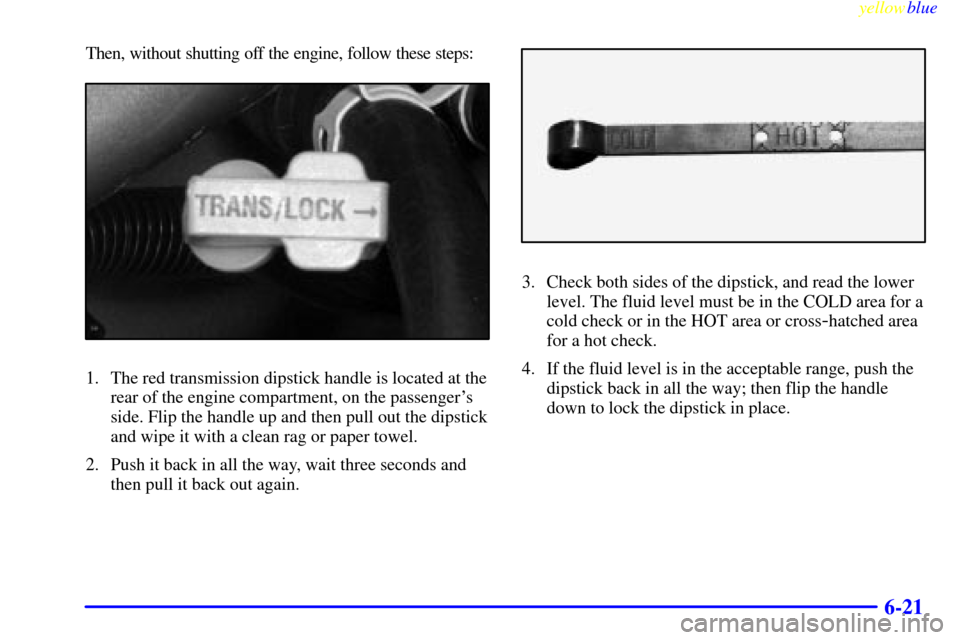
Your air cleaner is located in the passenger's side front
corner of the engine compartment.1. To remove the air filter, loosen the screws on the
cover. Lift the cover upward. Lift the filter out of the
air cleaner housing. Care should be taken to dislodge
as little dirt as possible.
2. Clean the filter sealing surface and the filter housing.
3. Install the new filter.
4. Install the cover and tighten the screws on the air
cleaner cover.
Refer to the Maintenance Schedule to determine when to
replace the air filter. See ªOwner Checks and Servicesº
in the Index.
Page 317 of 432
yellowblue
6-19
3. Remove the air filter by pulling downward on the
element. Remove the second portion of the air filter
by sliding it towards the rear of the vehicle and then
pulling downward.
4. Install the new filter by reversing the steps listed
previously. Be sure to follow any instructions that
may be included in the replacement filter package.
Refer to the Maintenance Schedule to determine when to
replace the passenger compartment air filter. See
ªScheduled Maintenanceº in the Index.
Automatic Transmission Fluid
If your vehicle has a diesel engine, see ªAutomatic
Transmission Fluidº in the Diesel Supplement.
When to Check and Change
A good time to check your automatic transmission fluid
level is when the engine oil is changed.
Change both the fluid and filter every 50,000 miles
(83 000 km) if the vehicle is mainly driven under one or
more of these conditions:
�In heavy city traffic where the outside temperature
regularly reaches 90�F (32�C) or higher.
�In hilly or mountainous terrain.�When doing frequent trailer towing.
�Uses such as found in taxi, police or delivery service.
If you do not use your vehicle under any of these
conditions, change the fluid and filter every
100,000 miles (166 000 km).
See ªScheduled Maintenance Servicesº in the Index.
How to Check
Because this operation can be a little difficult, you may
choose to have this done at the dealership service
department.
If you do it yourself, be sure to follow all the
instructions here, or you could get a false reading on
the dipstick.
NOTICE:
Too much or too little fluid can damage your
transmission. Too much can mean that some of
the fluid could come out and fall on hot engine
parts or exhaust system parts, starting a fire.
Be sure to get an accurate reading if you check
your transmission fluid.
Page 318 of 432
yellowblue
6-20
Wait at least 30 minutes before checking the
transmission fluid level if you have been driving:
�When outside temperatures are above 90�F (32�C).
�At high speed for quite a while.
�In heavy traffic
-- especially in hot weather.
�While pulling a trailer.
To get the right reading, the fluid should be at normal
operating temperature, which is 180�F to 200�F
(82�C to 93�C).
Get the vehicle warmed up by driving about 15 miles
(24 km) when outside temperatures are above 50�F
(10�C). If it's colder than 50�F (10�C), drive the
vehicle in THIRD (3) until the engine temperature gage
moves and then remains steady for 10 minutes. Then
follow the hot check procedures.Checking Transmission Fluid Cold
A cold check is made after the vehicle has been sitting
for eight hours or more with the engine off and is used
only as a reference. Let the engine run at idle for five
minutes if outside temperatures are 50�F (10�C) or
more. If it's colder than 50�F (10�C), you may have to
idle the engine longer. Should the fluid level be low
during a cold check, you must perform a hot check
before adding fluid. This will give you a more accurate
reading of the fluid level.
Checking the Fluid Level
�Park your vehicle on a level place. Keep the
engine running.
�With the parking brake applied, place the shift lever
in PARK (P).
�With your foot on the brake pedal, move the shift
lever through each gear range, pausing for about
three seconds in each range. Then, position the shift
lever in PARK (P).
�Let the engine run at idle for three minutes or more.
Page 319 of 432
yellowblue
6-21
Then, without shutting off the engine, follow these steps:
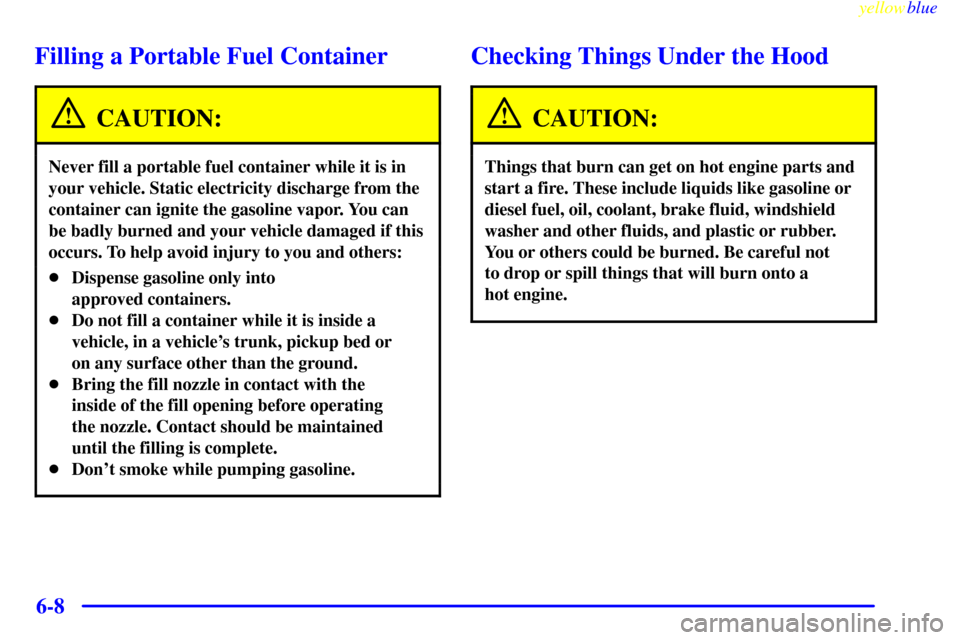
1. The red transmission dipstick handle is located at the
rear of the engine compartment, on the passenger's
side. Flip the handle up and then pull out the dipstick
and wipe it with a clean rag or paper towel.
2. Push it back in all the way, wait three seconds and
then pull it back out again.
3. Check both sides of the dipstick, and read the lower
level. The fluid level must be in the COLD area for a
cold check or in the HOT area or cross
-hatched area
for a hot check.
4. If the fluid level is in the acceptable range, push the
dipstick back in all the way; then flip the handle
down to lock the dipstick in place.