Page 118 of 432

yellowblue
2-46 Headlamp High/Low Beam Changer
To change the headlamps from low to high beam or high
to low beam, pull the multifunction lever all the way
toward you. Then release it.
When the high beams
are on, this light on the
instrument panel also
will be on.
Flash-To-Pass Feature
This feature allows you to use your high-beam
headlamps to signal a driver in front of you that you
want to pass. It works even if your headlamps are off.
To use it, pull the turn signal lever toward you, but not
so far that you hear it click.
If your headlamps are off or on low
-beam, your
high
-beam headlamps will turn on. They'll stay on as
long as you hold the lever toward you and the high
-beam
indicator on the instrument cluster will come on. Release
the lever to turn the high
-beam headlamps off.
Windshield Wipers
You control the windshield wipers by turning the band
with the wiper symbol on it.
For a single wiping cycle, turn the band to MIST. Hold
it there until the wipers start, then let go. The wipers will
stop after one wipe. If you want more wipes, hold the
band on MIST longer.
Page 128 of 432
yellowblue
2-56 Battery Run-Down Protection
This feature shuts off the dome, reading, glove box,
cargo and underhood lamps if they are left on for more
than 40 minutes when the ignition is off. This will keep
your battery from running down.
Mirrors
Inside Day/Night Rearview Mirror
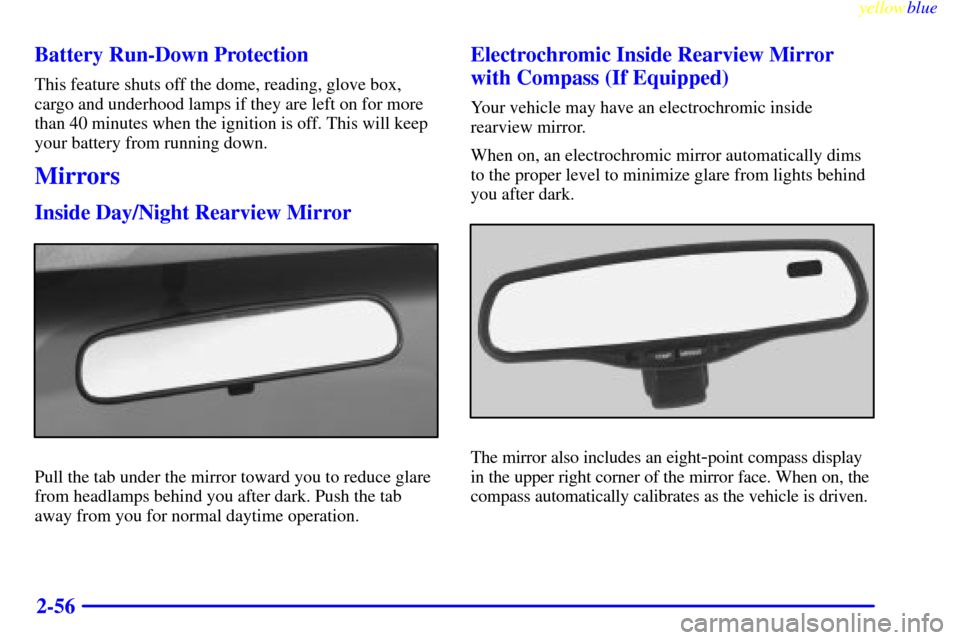
Pull the tab under the mirror toward you to reduce glare
from headlamps behind you after dark. Push the tab
away from you for normal daytime operation.
Electrochromic Inside Rearview Mirror
with Compass (If Equipped)
Your vehicle may have an electrochromic inside
rearview mirror.
When on, an electrochromic mirror automatically dims
to the proper level to minimize glare from lights behind
you after dark.
The mirror also includes an eight-point compass display
in the upper right corner of the mirror face. When on, the
compass automatically calibrates as the vehicle is driven.
Page 129 of 432
yellowblue
2-57
Mirror Operation
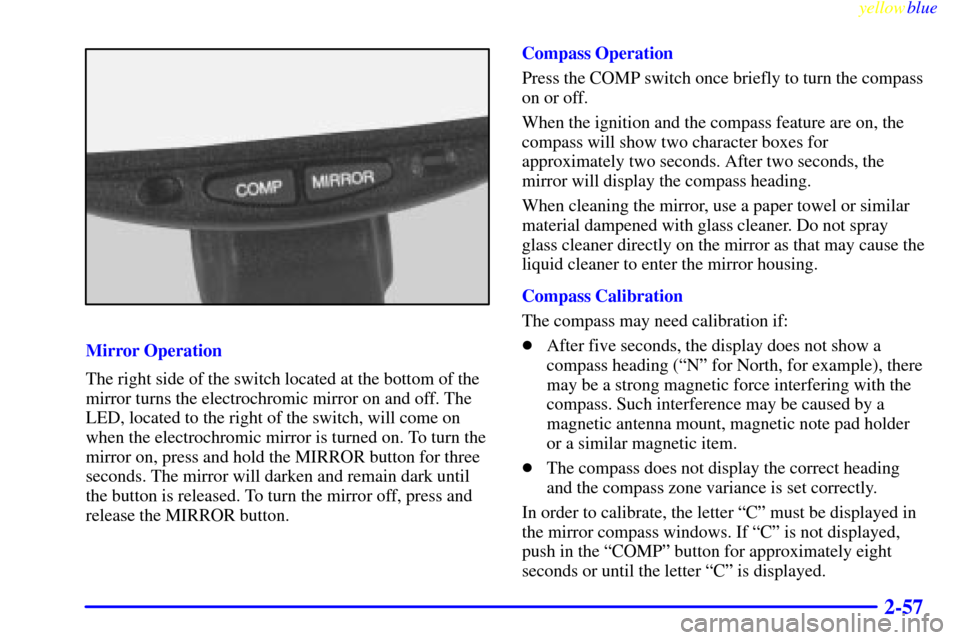
The right side of the switch located at the bottom of the
mirror turns the electrochromic mirror on and off. The
LED, located to the right of the switch, will come on
when the electrochromic mirror is turned on. To turn the
mirror on, press and hold the MIRROR button for three
seconds. The mirror will darken and remain dark until
the button is released. To turn the mirror off, press and
release the MIRROR button.Compass Operation
Press the COMP switch once briefly to turn the compass
on or off.
When the ignition and the compass feature are on, the
compass will show two character boxes for
approximately two seconds. After two seconds, the
mirror will display the compass heading.
When cleaning the mirror, use a paper towel or similar
material dampened with glass cleaner. Do not spray
glass cleaner directly on the mirror as that may cause the
liquid cleaner to enter the mirror housing.
Compass Calibration
The compass may need calibration if:
�After five seconds, the display does not show a
compass heading (ªNº for North, for example), there
may be a strong magnetic force interfering with the
compass. Such interference may be caused by a
magnetic antenna mount, magnetic note pad holder
or a similar magnetic item.
�The compass does not display the correct heading
and the compass zone variance is set correctly.
In order to calibrate, the letter ªCº must be displayed in
the mirror compass windows. If ªCº is not displayed,
push in the ªCOMPº button for approximately eight
seconds or until the letter ªCº is displayed.
Page 131 of 432
yellowblue
2-59 Outside Manual Adjust Mirrors
Adjust your outside mirrors so you can just see the side of
your vehicle and have a clear view of objects behind you.
Some mirrors can be folded in, to enter narrow doorways.
The use of hood
-mounted air deflectors and add-on
convex mirror attachments may adversely affect
mirror performance.
Camper Type Outside Mirrors
(If Equipped)
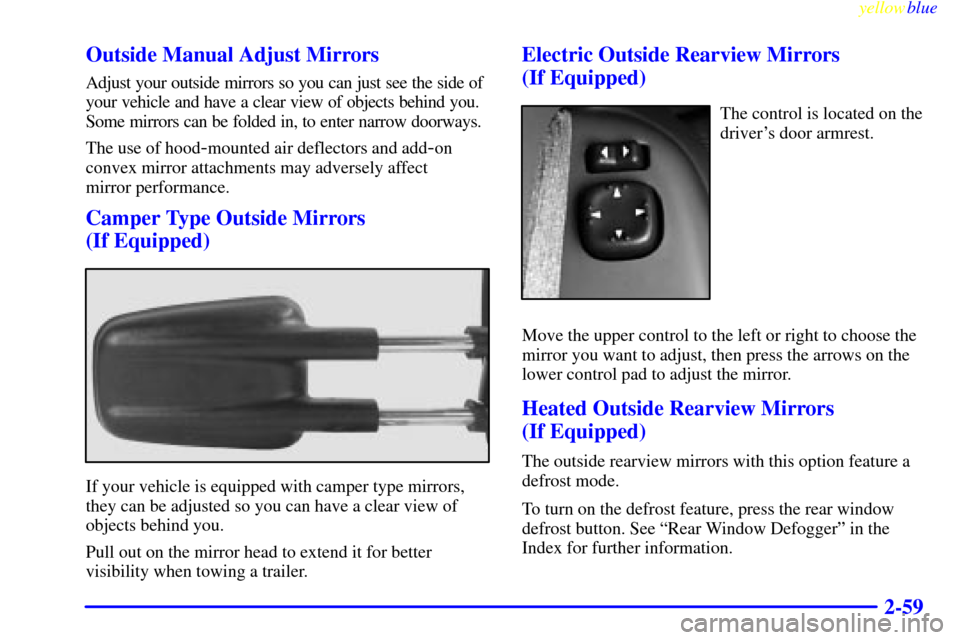
If your vehicle is equipped with camper type mirrors,
they can be adjusted so you can have a clear view of
objects behind you.
Pull out on the mirror head to extend it for better
visibility when towing a trailer.
Electric Outside Rearview Mirrors
(If Equipped)
The control is located on the
driver's door armrest.
Move the upper control to the left or right to choose the
mirror you want to adjust, then press the arrows on the
lower control pad to adjust the mirror.
Heated Outside Rearview Mirrors
(If Equipped)
The outside rearview mirrors with this option feature a
defrost mode.
To turn on the defrost feature, press the rear window
defrost button. See ªRear Window Defoggerº in the
Index for further information.
Page 136 of 432
yellowblue
2-64 Armrest Storage Compartment
(If Equipped)
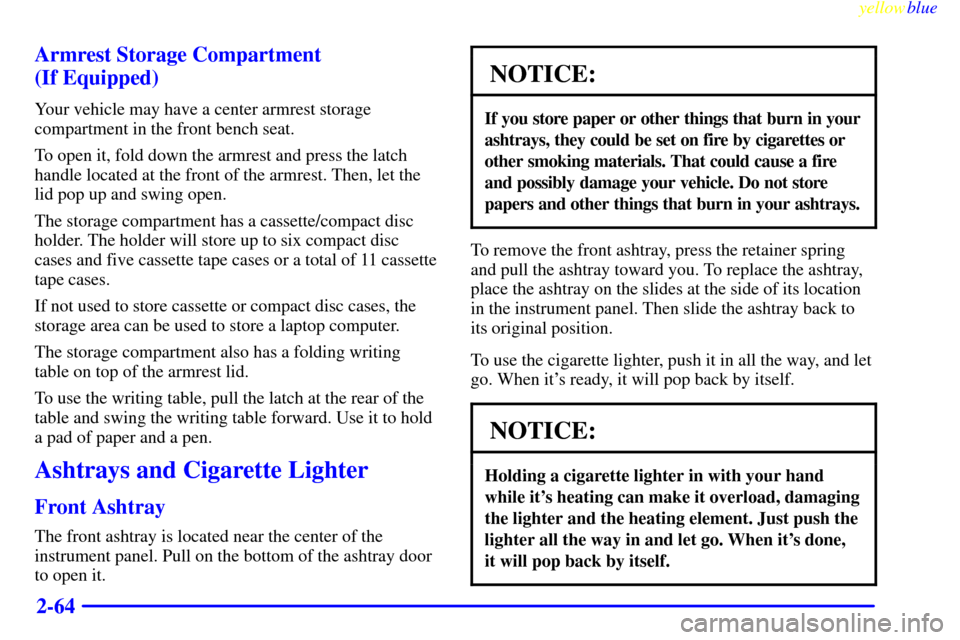
Your vehicle may have a center armrest storage
compartment in the front bench seat.
To open it, fold down the armrest and press the latch
handle located at the front of the armrest. Then, let the
lid pop up and swing open.
The storage compartment has a cassette/compact disc
holder. The holder will store up to six compact disc
cases and five cassette tape cases or a total of 11 cassette
tape cases.
If not used to store cassette or compact disc cases, the
storage area can be used to store a laptop computer.
The storage compartment also has a folding writing
table on top of the armrest lid.
To use the writing table, pull the latch at the rear of the
table and swing the writing table forward. Use it to hold
a pad of paper and a pen.
Ashtrays and Cigarette Lighter
Front Ashtray
The front ashtray is located near the center of the
instrument panel. Pull on the bottom of the ashtray door
to open it.
NOTICE:
If you store paper or other things that burn in your
ashtrays, they could be set on fire by cigarettes or
other smoking materials. That could cause a fire
and possibly damage your vehicle. Do not store
papers and other things that burn in your ashtrays.
To remove the front ashtray, press the retainer spring
and pull the ashtray toward you. To replace the ashtray,
place the ashtray on the slides at the side of its location
in the instrument panel. Then slide the ashtray back to
its original position.
To use the cigarette lighter, push it in all the way, and let
go. When it's ready, it will pop back by itself.
NOTICE:
Holding a cigarette lighter in with your hand
while it's heating can make it overload, damaging
the lighter and the heating element. Just push the
lighter all the way in and let go. When it's done,
it will pop back by itself.
Page 139 of 432
yellowblue
2-67
A. Dome Lamp Switch
B. Lamp Controls
C. Air Outlets
D. Automatic Transfer Case (If Equipped)
E. Multifunction Lever
F. Instrument Cluster
G. Gearshift Lever (Automatic Transmission)
H. Tow/Haul Selector Switch
I. Audio System
J. Comfort Control System
K. Glove BoxL. Passenger Air Bag Off Switch
M. Manual Selectable Ride Control (If Equipped)
N. Ashtray
O. Storage Area or Compact Disc Player (If Equipped)
P. Rear Window Defogger Switch (If Equipped)
Q. Lighter and Auxiliary Power Outlets
R. Parking Brake Release
S. Tilt Lever (If Equipped)
T. Center Instrument Panel Utility Block
U. Hood Release
V. Instrument Panel Fuse Block
Page 146 of 432
yellowblue
2-74 Brake System Warning Light
With the ignition on, the brake system warning light will
flash when you set the parking brake. The light will flash
if the parking brake doesn't release fully. If you try to
drive with the parking brake engaged, a chime will sound
when the vehicle speed is greater than 3 mph (5 km/h).
Your vehicle's hydraulic brake system is divided into
two parts. If one part isn't working, the other part can
still work and stop you. For good braking, though, you
need both parts working well.
If the warning light comes on, there could be a brake
problem. Have your brake system inspected right away.
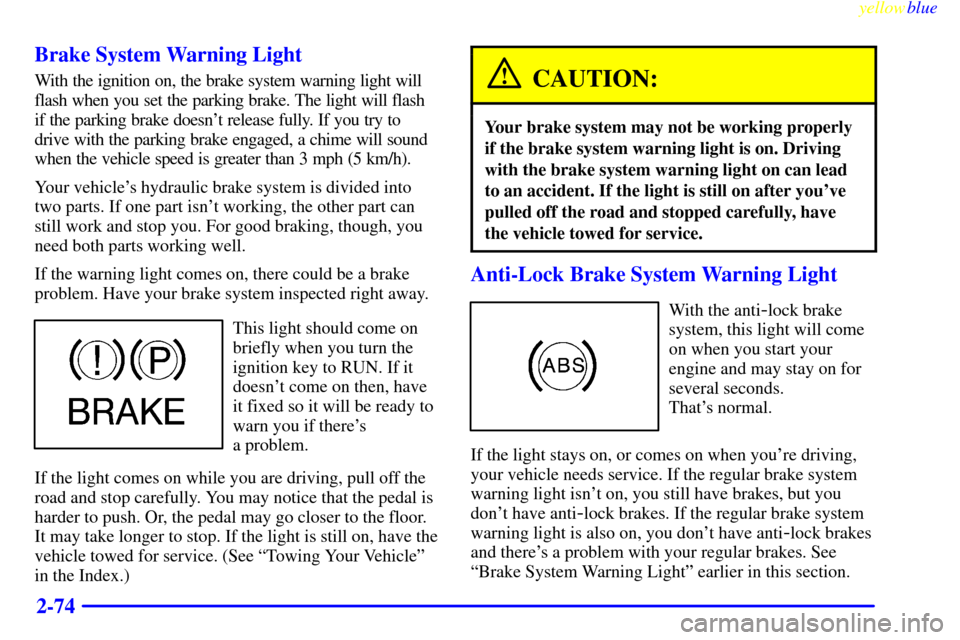
This light should come on
briefly when you turn the
ignition key to RUN. If it
doesn't come on then, have
it fixed so it will be ready to
warn you if there's
a problem.
If the light comes on while you are driving, pull off the
road and stop carefully. You may notice that the pedal is
harder to push. Or, the pedal may go closer to the floor.
It may take longer to stop. If the light is still on, have the
vehicle towed for service. (See ªTowing Your Vehicleº
in the Index.)
CAUTION:
Your brake system may not be working properly
if the brake system warning light is on. Driving
with the brake system warning light on can lead
to an accident. If the light is still on after you've
pulled off the road and stopped carefully, have
the vehicle towed for service.
Anti-Lock Brake System Warning Light
With the anti-lock brake
system, this light will come
on when you start your
engine and may stay on for
several seconds.
That's normal.
If the light stays on, or comes on when you're driving,
your vehicle needs service. If the regular brake system
warning light isn't on, you still have brakes, but you
don't have anti
-lock brakes. If the regular brake system
warning light is also on, you don't have anti
-lock brakes
and there's a problem with your regular brakes. See
ªBrake System Warning Lightº earlier in this section.
Page 148 of 432
yellowblue
2-76
At approximately 265�F (130�C), the message center
will display a TRANS FLUID HOT message and the
transmission will enter a transmission protection mode.
When the transmission enters the protection mode, you
may notice a change in the transmission shifting
patterns. The transmission will return to normal shifting
patterns when the transmission fluid temperature falls
below 260�F (127�C).
See ªMessage Centerº in the Index for
further information.
If the transmission fluid reaches temperatures of
approximately 275�F (135�C) or greater, the message
center will display a TRANS HOT...IDLE ENG warning
message. Pull the vehicle off the roadway when it is safe
to do so. Set the parking brake, place the transmission in
PARK (P) and allow the engine to idle until the
transmission temperature falls below 260�F (127�C).
If the transmission continues to operate above 265�F
(130�C), please contact your nearest dealer or the
GM Roadside Assistance Center.
NOTICE:
If you keep driving your vehicle with the
transmission temperature gage above the normal
operating range, you can damage the
transmission. This could lead to costly repairs
that may not be covered under your warranty.
The following situations can cause the transmission to
operate at higher temperatures:
�Towing a trailer
�Hot outside air temperatures
�Hauling a large or heavy load
�Low transmission fluid level
�High transmission fluid level
�Restricted air flow to the radiator and the auxiliary
transmission oil cooler (if equipped).
A temporary solution to hotter transmission operating
temperatures may be to let the transmission cool down.
If the transmission is operated at higher temperatures on
a frequent basis, see ªScheduled Maintenanceº in the
Index for the proper transmission maintenance intervals.