Page 84 of 432

yellowblue
2-12 Testing the Alarm
The alarm can be tested by following these steps:
1. From inside the vehicle, lower the driver's window
and open the driver's door.
2. Activate the system by locking the doors with the
power door lock switch while the door is open, or
with the remote keyless entry transmitter.
3. Get out of the vehicle, close the door and wait for the
SECURITY message to go out.
4. Then reach in through the window, unlock the door
with the manual door lock and open the door. This
should set off the alarm.
If the alarm does not sound when it should but the
vehicle's headlamps flash, check to see if the horn
works. The horn fuse may be blown. To replace the fuse,
see ªFuses and Circuit Breakersº in the Index.
If the alarm does not sound or the vehicle's headlamps
do not flash, the vehicle should be serviced by an
authorized service center.
Passlock�
Your vehicle is equipped with the Passlock
theft
-deterrent system.
Passlock is a passive theft
-deterrent system. Passlock
enables fuel if the ignition lock cylinder is turned with a
valid key. If a correct key is not used or the ignition lock
cylinder is tampered with, fuel is disabled.
If the engine stalls and the SECURITY message flashes,
wait until the light stops flashing before trying to restart
the engine. Remember to release the key from START
as soon as the engine starts.
If the engine is running and the SECURITY message
comes on, you will be able to restart the engine if you turn
the engine off. However, your Passlock system is not
working properly and must be serviced by your dealer.
Your vehicle is not protected by Passlock at this time. You
may also want to check the fuse (see ªFuses and Circuit
Breakersº in the Index). See your dealer for service.
In an emergency, call the GM Roadside Assistance
Center. See ªRoadside Assistanceº in the Index.
Page 86 of 432
yellowblue
2-14
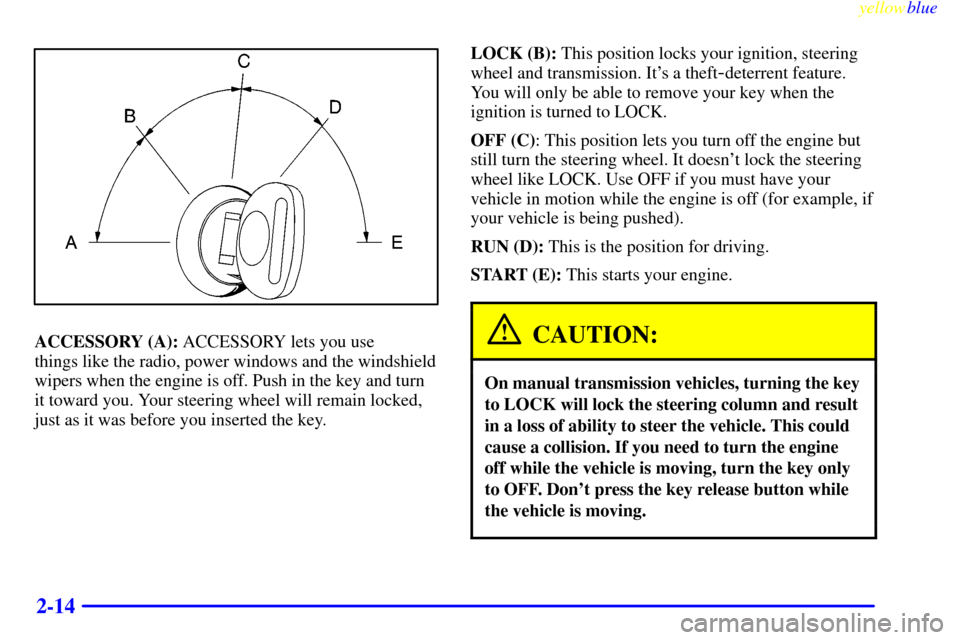
ACCESSORY (A): ACCESSORY lets you use
things like the radio, power windows and the windshield
wipers when the engine is off. Push in the key and turn
it toward you. Your steering wheel will remain locked,
just as it was before you inserted the key.LOCK (B): This position locks your ignition, steering
wheel and transmission. It's a theft
-deterrent feature.
You will only be able to remove your key when the
ignition is turned to LOCK.
OFF (C): This position lets you turn off the engine but
still turn the steering wheel. It doesn't lock the steering
wheel like LOCK. Use OFF if you must have your
vehicle in motion while the engine is off (for example, if
your vehicle is being pushed).
RUN (D): This is the position for driving.
START (E): This starts your engine.
CAUTION:
On manual transmission vehicles, turning the key
to LOCK will lock the steering column and result
in a loss of ability to steer the vehicle. This could
cause a collision. If you need to turn the engine
off while the vehicle is moving, turn the key only
to OFF. Don't press the key release button while
the vehicle is moving.
Page 87 of 432
yellowblue
2-15
NOTICE:
If your key seems stuck in LOCK and you can't
turn it, be sure you are using the correct key; if
so, is it all the way in? If it is, then turn the
steering wheel left and right while you turn the
key hard. But turn the key only with your hand.
Using a tool to force it could break the key or the
ignition switch. If none of this works, then your
vehicle needs service.
Key Release Button (Manual Transmission)
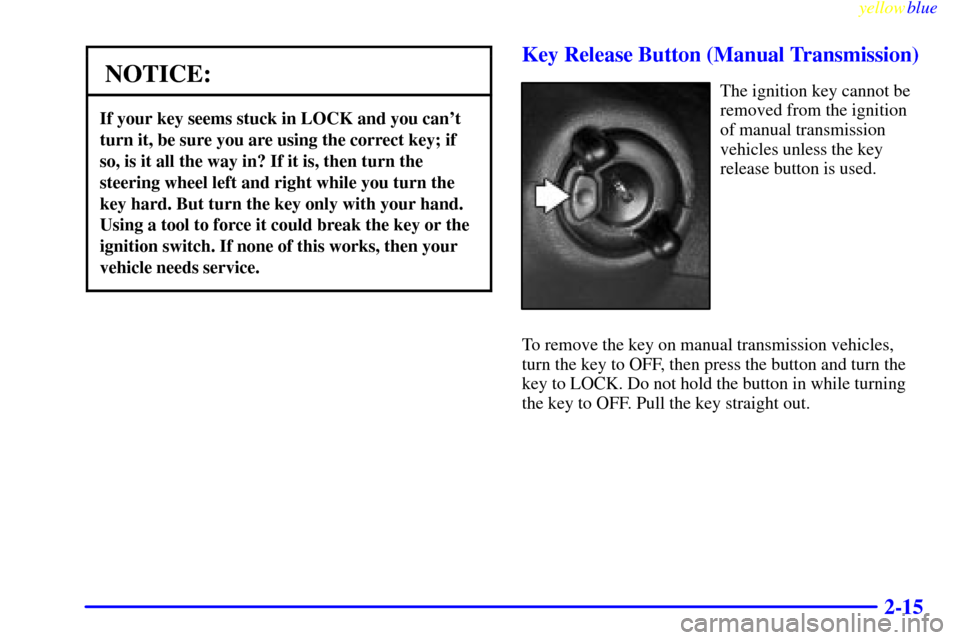
The ignition key cannot be
removed from the ignition
of manual transmission
vehicles unless the key
release button is used.
To remove the key on manual transmission vehicles,
turn the key to OFF, then press the button and turn the
key to LOCK. Do not hold the button in while turning
the key to OFF. Pull the key straight out.
Page 92 of 432
yellowblue
2-20
Automatic Transmission Operation
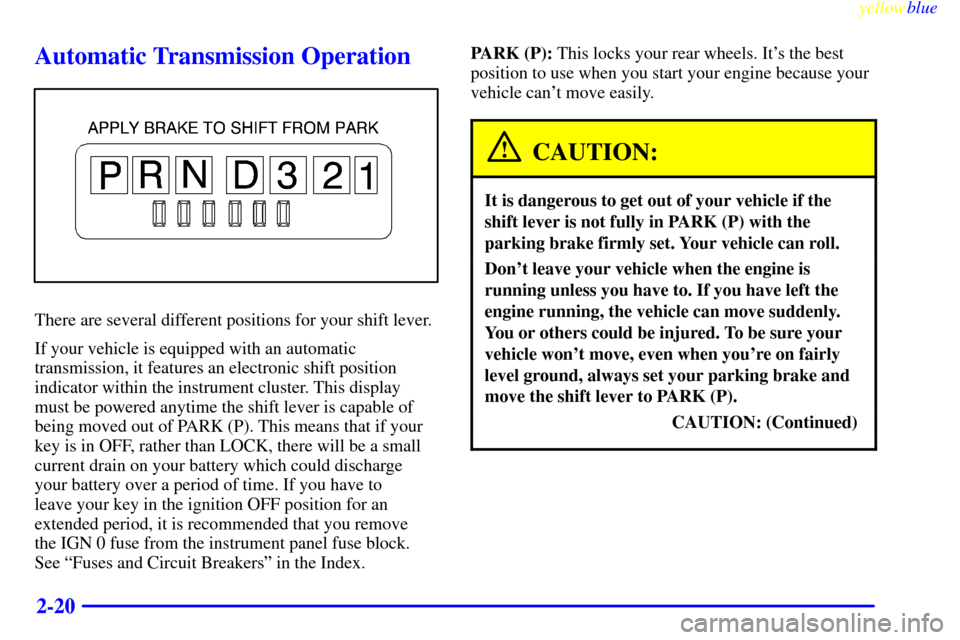
There are several different positions for your shift lever.
If your vehicle is equipped with an automatic
transmission, it features an electronic shift position
indicator within the instrument cluster. This display
must be powered anytime the shift lever is capable of
being moved out of PARK (P). This means that if your
key is in OFF, rather than LOCK, there will be a small
current drain on your battery which could discharge
your battery over a period of time. If you have to
leave your key in the ignition OFF position for an
extended period, it is recommended that you remove
the IGN 0 fuse from the instrument panel fuse block.
See ªFuses and Circuit Breakersº in the Index.PARK (P): This locks your rear wheels. It's the best
position to use when you start your engine because your
vehicle can't move easily.
CAUTION:
It is dangerous to get out of your vehicle if the
shift lever is not fully in PARK (P) with the
parking brake firmly set. Your vehicle can roll.
Don't leave your vehicle when the engine is
running unless you have to. If you have left the
engine running, the vehicle can move suddenly.
You or others could be injured. To be sure your
vehicle won't move, even when you're on fairly
level ground, always set your parking brake and
move the shift lever to PARK (P).
CAUTION: (Continued)
Page 99 of 432
yellowblue
2-27
Shift Light
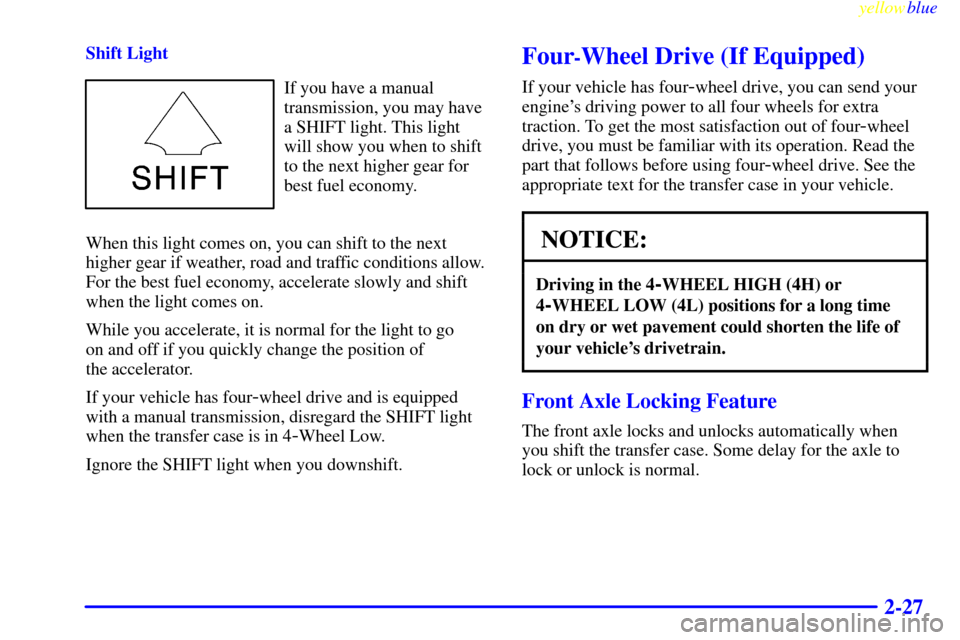
If you have a manual
transmission, you may have
a SHIFT light. This light
will show you when to shift
to the next higher gear for
best fuel economy.
When this light comes on, you can shift to the next
higher gear if weather, road and traffic conditions allow.
For the best fuel economy, accelerate slowly and shift
when the light comes on.
While you accelerate, it is normal for the light to go
on and off if you quickly change the position of
the accelerator.
If your vehicle has four
-wheel drive and is equipped
with a manual transmission, disregard the SHIFT light
when the transfer case is in 4
-Wheel Low.
Ignore the SHIFT light when you downshift.
Four-Wheel Drive (If Equipped)
If your vehicle has four-wheel drive, you can send your
engine's driving power to all four wheels for extra
traction. To get the most satisfaction out of four
-wheel
drive, you must be familiar with its operation. Read the
part that follows before using four
-wheel drive. See the
appropriate text for the transfer case in your vehicle.
NOTICE:
Driving in the 4-WHEEL HIGH (4H) or
4
-WHEEL LOW (4L) positions for a long time
on dry or wet pavement could shorten the life of
your vehicle's drivetrain.
Front Axle Locking Feature
The front axle locks and unlocks automatically when
you shift the transfer case. Some delay for the axle to
lock or unlock is normal.
Page 108 of 432
yellowblue
2-36
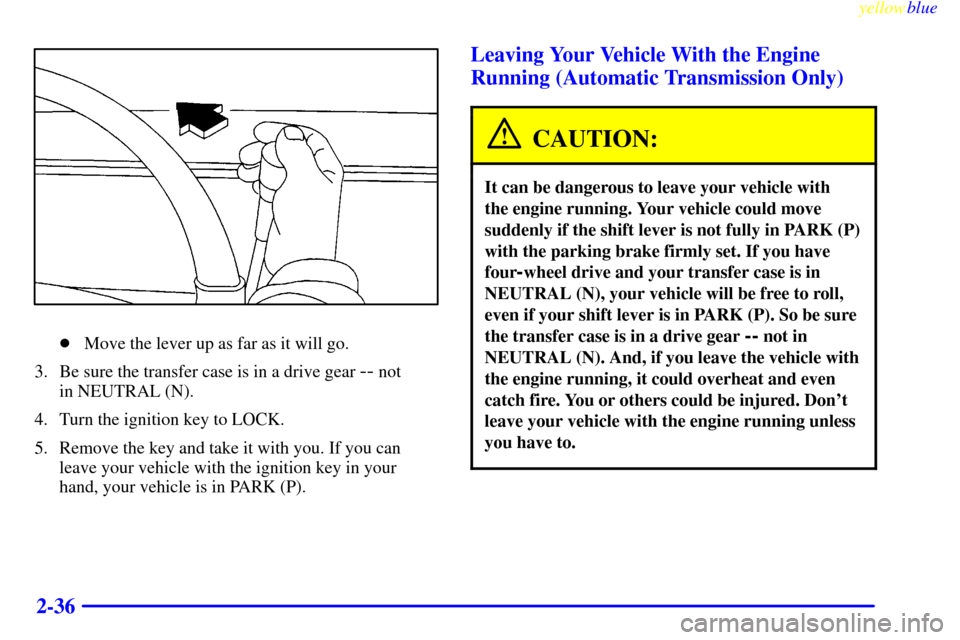
�Move the lever up as far as it will go.
3. Be sure the transfer case is in a drive gear
-- not
in NEUTRAL (N).
4. Turn the ignition key to LOCK.
5. Remove the key and take it with you. If you can
leave your vehicle with the ignition key in your
hand, your vehicle is in PARK (P).
Leaving Your Vehicle With the Engine
Running (Automatic Transmission Only)
CAUTION:
It can be dangerous to leave your vehicle with
the engine running. Your vehicle could move
suddenly if the shift lever is not fully in PARK (P)
with the parking brake firmly set. If you have
four
-wheel drive and your transfer case is in
NEUTRAL (N), your vehicle will be free to roll,
even if your shift lever is in PARK (P). So be sure
the transfer case is in a drive gear
-- not in
NEUTRAL (N). And, if you leave the vehicle with
the engine running, it could overheat and even
catch fire. You or others could be injured. Don't
leave your vehicle with the engine running unless
you have to.
Page 109 of 432
yellowblue
2-37
If you have to leave your vehicle with the engine
running, be sure your vehicle is in PARK (P) and the
parking brake is firmly set before you leave it. After you
move the shift lever into PARK (P), hold the regular
brake pedal down. Then, see if you can move the shift
lever away from PARK (P) without first pulling it
toward you. If you can, it means that the shift lever
wasn't fully locked into PARK (P).
Torque Lock (Automatic Transmission)
If you are parking on a hill and you don't shift your
transmission into PARK (P) properly, the weight of the
vehicle may put too much force on the parking pawl in
the transmission. You may find it difficult to pull the
shift lever out of PARK (P). This is called ªtorque lock.º
To prevent torque lock, set the parking brake and then
shift into PARK (P) properly before you leave the
driver's seat. To find out how, see ªShifting Into
PARK (P)º in the Index.
When you are ready to drive, move the shift lever out of
PARK (P) before you release the parking brake.
If torque lock does occur, you may need to have another
vehicle push yours a little uphill to take some of the
pressure from the parking pawl in the transmission, so
you can pull the shift lever out of PARK (P).
Shifting Out of PARK (P)
(Automatic Transmission Only)
CAUTION:
Before shifting out of PARK (P) you must fully
apply your regular brakes. Your vehicle can roll.
If you have left the engine running, the vehicle
can move suddenly. You or others could be
injured. If you're pulling a trailer, see ªTowing a
Trailerº in the Index.
Your vehicle has a brake-transmission shift interlock
system. You have to fully apply your regular brakes
before you can shift from PARK (P) when the ignition is
in RUN. See ªAutomatic Transmissionº in the Index.
If you cannot shift out of PARK (P), ease pressure on
the shift lever and push the shift lever all the way up
into PARK (P) as you maintain brake application. Then,
move the shift lever into the gear you want.
Page 110 of 432
yellowblue
2-38
If you ever hold the brake pedal down but still can't
shift out of PARK (P), try this:
1. Turn the key to the OFF ignition position.
2. Apply and hold the brake until the end of Step 4.
3. Shift the vehicle to NEUTRAL (N).
4. Start the vehicle and then shift to the drive gear
you want.
5. Have the brake
-transmission shift interlock system
fixed as soon as you can.
Parking Your Vehicle (Manual
Transmission Models Only)
CAUTION:
Shifting the transfer case to NEUTRAL (N) can
cause your vehicle to roll even if the manual
transmission is in gear. You or someone else could
be seriously injured. Be sure to set the parking
brake before placing the transfer case in
NEUTRAL (N). See ªParking Brakeº in the Index.
Before you get out of your vehicle, put your manual
transmission in REVERSE (R), turn off the engine, and
firmly apply the parking brake.
If you are parking on a hill, or if you are pulling a
trailer, see ªTowing a Trailerº in the Index.
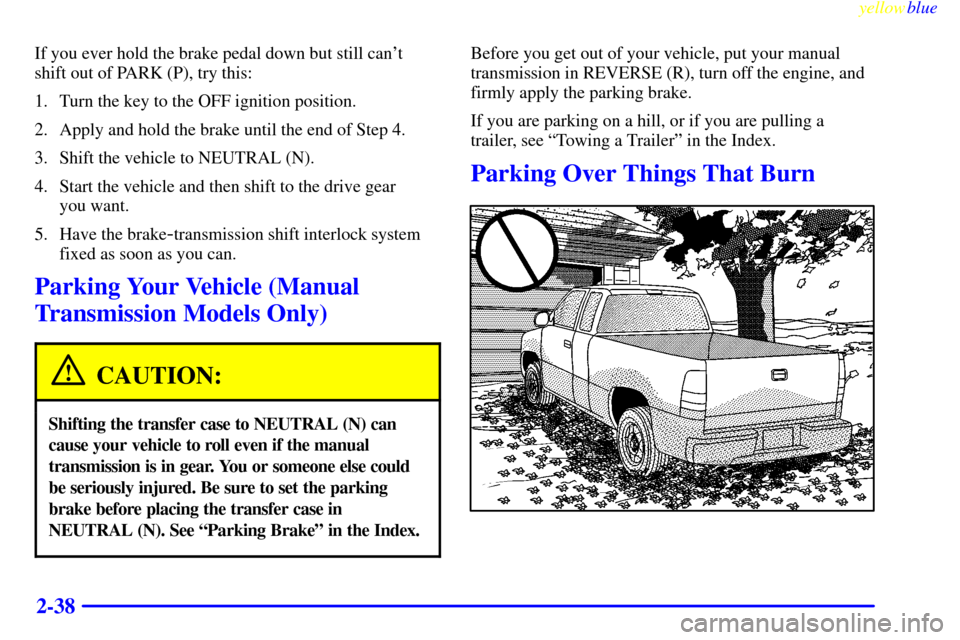
Parking Over Things That Burn