Page 215 of 432
yellowblue
4-25 Driving Downhill
When off-roading takes you downhill, you'll want to
consider a number of things:
�How steep is the downhill? Will I be able to maintain
vehicle control?
�What's the surface like? Smooth? Rough?
Slippery? Hard
-packed dirt? Gravel?
�Are there hidden surface obstacles? Ruts?
Logs? Boulders?
�What's at the bottom of the hill? Is there a hidden
creek bank or even a river bottom with large rocks?
If you decide you can go down a hill safely, then try to
keep your vehicle headed straight down, and use a low
gear. This way, engine drag can help your brakes and
they won't have to do all the work. Descend slowly,
keeping your vehicle under control at all times.
CAUTION:
Heavy braking when going down a hill can cause
your brakes to overheat and fade. This could
cause loss of control and a serious accident. Apply
the brakes lightly when descending a hill and use
a low gear to keep vehicle speed under control.
Q:Are there some things I should not do when
driving down a hill?
A:Yes! These are important because if you
ignore them you could lose control and have a
serious accident.
�When driving downhill, avoid turns that take you
across the incline of the hill. A hill that's not too
steep to drive down may be too steep to drive across.
You could roll over if you don't drive straight down.
�Never go downhill with the transmission in
NEUTRAL (N), or with the clutch pedal depressed
in a manual shift. This is called ªfree
-wheeling.º
Your brakes will have to do all the work and could
overheat and fade.
Page 253 of 432
yellowblue
4-63
When towing at high altitude on steep uphill grades,
consider the following: Engine coolant will boil at a
lower temperature than at normal altitudes. If you turn
your engine off immediately after towing at high altitude
on steep uphill grades, your vehicle may show signs
similar to engine overheating. To avoid this, let the
engine run while parked (preferably on level ground)
with the automatic transmission in PARK (P) (or the
manual transmission out of gear and the parking brake
applied) for a few minutes before turning the engine off.
If you do get the overheat warning, see ªEngine
Overheatingº in the Index.
Parking on Hills
CAUTION:
You really should not park your vehicle, with a
trailer attached, on a hill. If something goes
wrong, your rig could start to move. People can
be injured, and both your vehicle and the trailer
can be damaged.
But if you ever have to park your rig on a hill, here's
how to do it:
1. Apply your regular brakes, but don't shift into
PARK (P) yet for an automatic transmission, or into
gear for a manual transmission.
2. Have someone place chocks under the trailer wheels.
3. When the wheel chocks are in place, release the
regular brakes until the chocks absorb the load.
4. Reapply the regular brakes. Then apply your
parking brake and shift into PARK (P) for an
automatic transmission, or REVERSE (R) for a
manual transmission.
5. If you have a four
-wheel-drive vehicle, be sure
the transfer case is in a drive gear and not in
NEUTRAL (N).
6. Release the regular brakes.
Page 261 of 432
5-
yellowblue
5-1
Section 5 Problems on the Road
Here you'll find what to do about some problems that can occur on the road.
5
-2 Hazard Warning Flashers
5
-3 Other Warning Devices
5
-3 Jump Starting
5
-8 Towing Your Vehicle
5
-9 Engine Overheating (Gasoline Engine)5
-12 Cooling System (Gasoline Engine)
5
-18 Engine Fan Noise
5
-18 If a Tire Goes Flat
5
-18 Changing a Flat Tire
5
-33 If You're Stuck: In Sand, Mud, Ice or Snow
Page 269 of 432
yellowblue
5-9
Engine Overheating
(Gasoline Engine)
You will find a coolant temperature gage on your
vehicle's instrument panel. See ªEngine Coolant
Temperature Gageº in the Index. In addition, you will
find a LOW COOLANT, CHECK COOLANT TEMP,
ENGINE OVERHEATED and a REDUCED ENGINE
POWER message in the message center on the
instrument panel. See ªMessage Centerº in the Index.
If your vehicle has a diesel engine, see ªEngine
Overheatingº in the Diesel Engine Supplement.
Overheated Engine Protection Operating
Mode (V8 Gasoline Engines Only)
Should an overheated engine condition exist and the
REDUCED ENGINE POWER message is displayed, an
overheat protection mode which alternates firing groups
of cylinders helps prevent engine damage. In this mode,
you will notice a loss in power and engine performance.
This operating mode allows your vehicle to be driven to
a safe place in an emergency. Towing a trailer in the
overheat protection mode should be avoided.
NOTICE:
After driving in the overheated engine protection
operating mode, to avoid engine damage, allow the
engine to cool before attempting any repair. The
engine oil will be severely degraded. Repair the
cause of coolant loss, change the oil and reset the
oil life monitor. See ªEngine Oilº in the Index.
Page 270 of 432
yellowblue
5-10 If Steam Is Coming From Your Engine
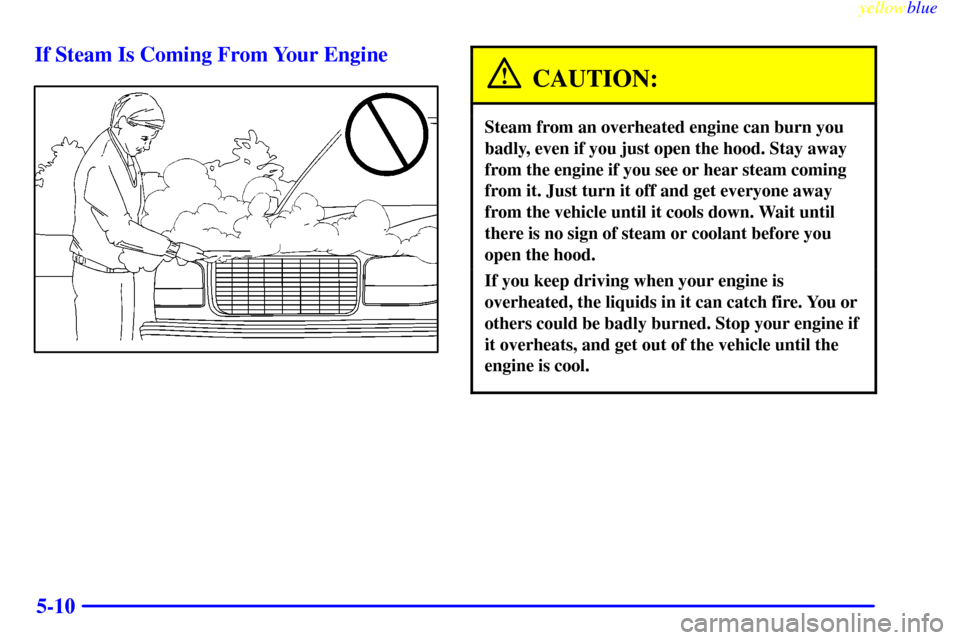
CAUTION:
Steam from an overheated engine can burn you
badly, even if you just open the hood. Stay away
from the engine if you see or hear steam coming
from it. Just turn it off and get everyone away
from the vehicle until it cools down. Wait until
there is no sign of steam or coolant before you
open the hood.
If you keep driving when your engine is
overheated, the liquids in it can catch fire. You or
others could be badly burned. Stop your engine if
it overheats, and get out of the vehicle until the
engine is cool.
Page 271 of 432
yellowblue
5-11
NOTICE:
If your engine catches fire because you keep
driving with no coolant, your vehicle can be
badly damaged. The costly repairs would not be
covered by your warranty. See ªOverheated
Engine Protection Operating Modeº in the Index.
If No Steam Is Coming From Your Engine
If you get an engine overheat warning but see or hear no
steam, the problem may not be too serious. Sometimes
the engine can get a little too hot when you:
�Climb a long hill on a hot day.
�Stop after high
-speed driving.
�Idle for long periods in traffic.
�Tow a trailer. See ªDriving on Gradesº in the Index.If you get the overheat warning with no sign of steam,
try this for a minute or so:
1. If you have an air conditioner and it's on, turn it off.
2. Turn on your heater to full hot at the highest fan
speed and open the window as necessary.
3. If you're in a traffic jam, shift to NEUTRAL (N);
otherwise, shift to the highest gear while
driving
-- DRIVE (D) for automatic transmissions.
If you no longer have the overheat warning, you can
drive. Just to be safe, drive slower for about 10 minutes.
If the warning doesn't come back on, you can
drive normally.
If the warning continues, pull over, stop, and park your
vehicle right away.
If there's still no sign of steam, push down the
accelerator until the engine speed is about twice as fast
as normal idle speed for at least three minutes while
you're parked. If you still have the warning, turn off the
engine and get everyone out of the vehicle until it cools
down. Also, see ªOverheated Engine Protection
Operating Modeº listed previously in this section.
You may decide not to lift the hood but to get service
help right away.
Page 273 of 432
yellowblue
5-13
CAUTION:
Heater and radiator hoses, and other engine
parts, can be very hot. Don't touch them. If you
do, you can be burned.
Don't run the engine if there is a leak. If you run
the engine, it could lose all coolant. That could
cause an engine fire, and you could be burned.
Get any leak fixed before you drive the vehicle.
NOTICE:
Engine damage from running your engine
without coolant isn't covered by your warranty.
See ªOverheated Engine Protection Operating
Modeº in the Index.
NOTICE:
When adding coolant, it is important that you use
only DEX
-COOL� (silicate-free) coolant.
If coolant other than DEX-COOL is added to the
system, premature engine, heater core or
radiator corrosion may result. In addition, the
engine coolant will require change sooner
-- at
30,000 miles (50 000 km) or 24 months,
whichever occurs first. Damage caused by the use
of coolant other than DEX
-COOL� is not
covered by your new vehicle warranty.
If there seems to be no leak, start the engine again.
See if the engine cooling fan speed increases when idle
speed is doubled by pushing the accelerator pedal down.
If it doesn't, your vehicle needs service. Turn off
the engine.
Page 275 of 432
yellowblue
5-15
CAUTION:
Adding only plain water to your cooling system
can be dangerous. Plain water, or some other
liquid like alcohol, can boil before the proper
coolant mixture will. Your vehicle's coolant
warning system is set for the proper coolant
mixture. With plain water or the wrong mixture,
your engine could get too hot but you wouldn't
get the overheat warning. Your engine could
catch fire and you or others could be burned. Use
a 50/50 mixture of clean, drinkable water and
DEX
-COOL� coolant.
NOTICE:
In cold weather, water can freeze and crack the
engine, radiator, heater core and other parts. So
use the recommended coolant.
CAUTION:
You can be burned if you spill coolant on hot
engine parts. Coolant contains ethylene glycol
and it will burn if the engine parts are hot
enough. Don't spill coolant on a hot engine.