Page 170 of 384

yellowblue
4-20
Q:What should I do if my vehicle stalls, or is about
to stall, and I can't make it up the hill?
A:If this happens, there are some things you should
do, and there are some things you must not do.
First, here's what you should do:
�Push the brake pedal to stop the vehicle and keep it
from rolling backwards. Also, apply the parking brake.
�If your engine is still running, shift the transmission
to REVERSE (R), release the parking brake, and
slowly back down the hill in REVERSE (R).
�If your engine has stopped running, you'll need to
restart it. With the brake pedal pressed and the
parking brake still applied, shift the transmission to
PARK (P) (or, shift to NEUTRAL (N) if your
vehicle has a manual transmission) and restart the
engine. Then, shift to REVERSE (R), release the
parking brake, and slowly back down the hill as
straight as possible in REVERSE (R).
�As you are backing down the hill, put your left hand
on the steering wheel at the 12 o'clock position. This
way, you'll be able to tell if your wheels are straight
and maneuver as you back down. It's best that youback down the hill with your wheels straight rather
than in the left or right direction. Turning the wheel
too far to the left or right will increase the possibility
of a rollover.
Here are some things you must not do if you stall, or are
about to stall, when going up a hill.
�Never attempt to prevent a stall by shifting into
NEUTRAL (N) (or depressing the clutch, if you
have a manual transmission) to ªrev
-upº the engine
and regain forward momentum. This won't work.
Your vehicle will roll backwards very quickly and
you could go out of control.
Instead, apply the regular brake to stop the
vehicle. Then apply the parking brake. Shift to
REVERSE (R), release the parking brake, and
slowly back straight down.
�Never attempt to turn around if you are about to stall
when going up a hill. If the hill is steep enough to
stall your vehicle, it's steep enough to cause you to
roll over if you turn around. If you can't make it up
the hill, you must back straight down the hill.
Page 220 of 384
yellowblue
5-16 How to Add Coolant to the Radiator
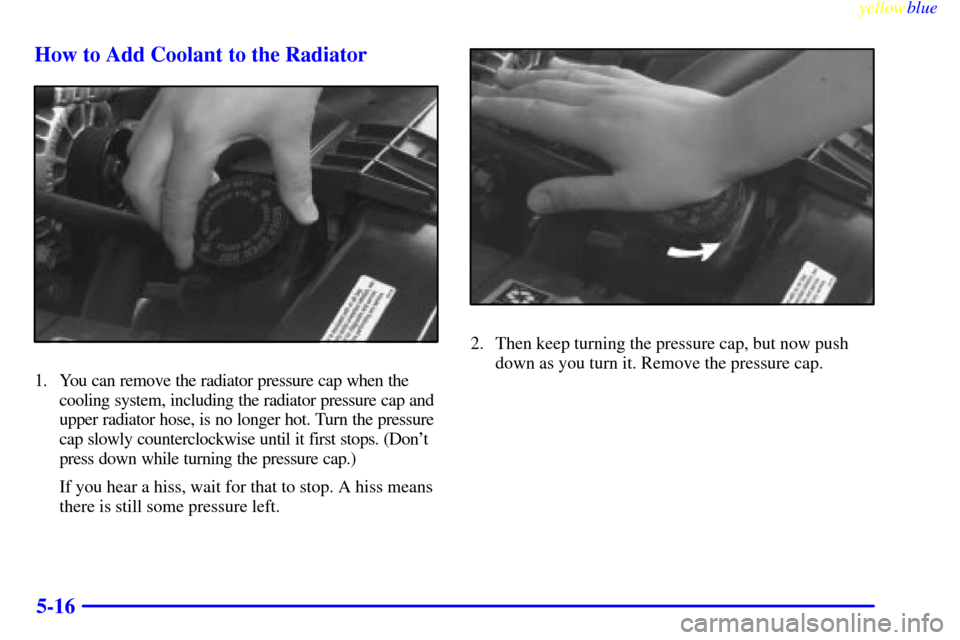
1. You can remove the radiator pressure cap when the
cooling system, including the radiator pressure cap and
upper radiator hose, is no longer hot. Turn the pressure
cap slowly counterclockwise until it first stops. (Don't
press down while turning the pressure cap.)
If you hear a hiss, wait for that to stop. A hiss means
there is still some pressure left.
2. Then keep turning the pressure cap, but now push
down as you turn it. Remove the pressure cap.
Page 225 of 384
yellowblue
5-21
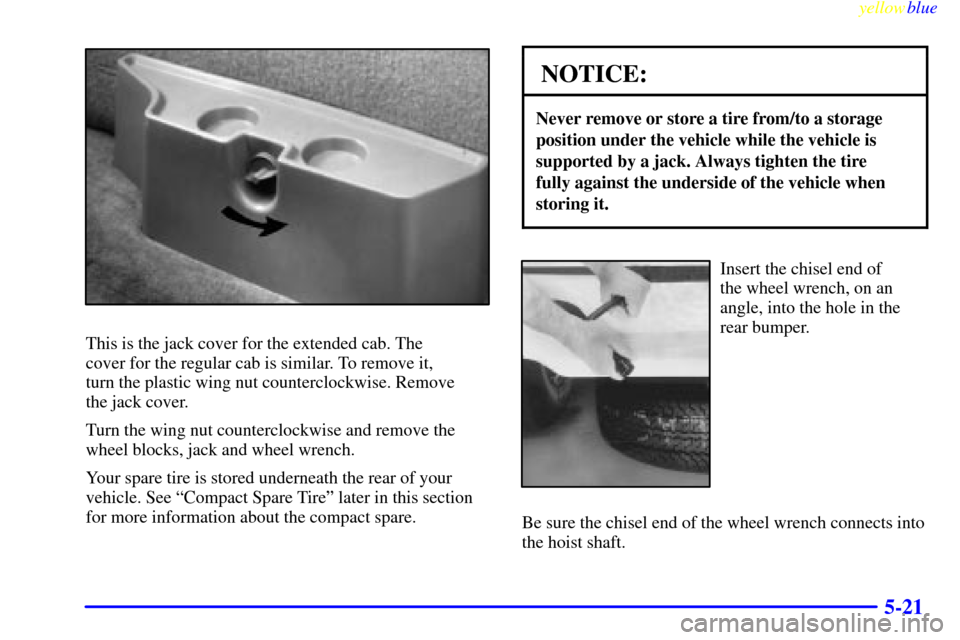
This is the jack cover for the extended cab. The
cover for the regular cab is similar. To remove it,
turn the plastic wing nut counterclockwise. Remove
the jack cover.
Turn the wing nut counterclockwise and remove the
wheel blocks, jack and wheel wrench.
Your spare tire is stored underneath the rear of your
vehicle. See ªCompact Spare Tireº later in this section
for more information about the compact spare.
NOTICE:
Never remove or store a tire from/to a storage
position under the vehicle while the vehicle is
supported by a jack. Always tighten the tire
fully against the underside of the vehicle when
storing it.
Insert the chisel end of
the wheel wrench, on an
angle, into the hole in the
rear bumper.
Be sure the chisel end of the wheel wrench connects into
the hoist shaft.
Page 226 of 384
yellowblue
5-22
Turn the wheel wrench counterclockwise to lower the
spare tire. Keep turning the wheel wrench until the spare
tire can be pulled out from under the vehicle.
When the tire has been completely lowered, tilt the
retainer at the end of the cable and pull it through the
wheel opening. Pull the tire out from under the vehicle.
NOTICE:
To help avoid vehicle damage, do not drive the
vehicle before the cable is restored.
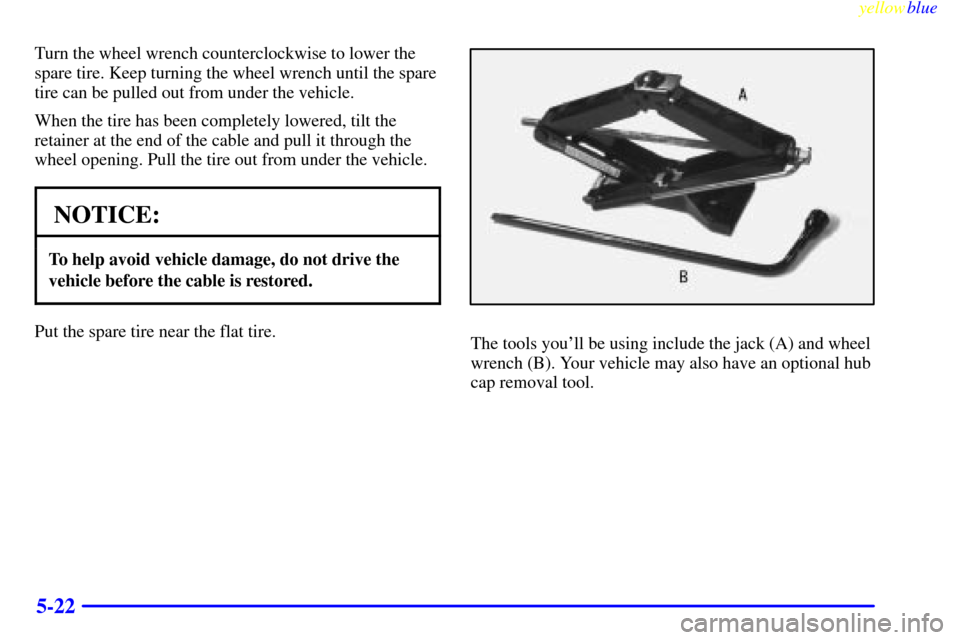
Put the spare tire near the flat tire.The tools you'll be using include the jack (A) and wheel
wrench (B). Your vehicle may also have an optional hub
cap removal tool.
Page 228 of 384
yellowblue
5-24 Removing the Flat Tire and Installing
the Spare Tire
1. Using the wheel wrench, loosen all the wheel nuts.
Don't remove them yet.
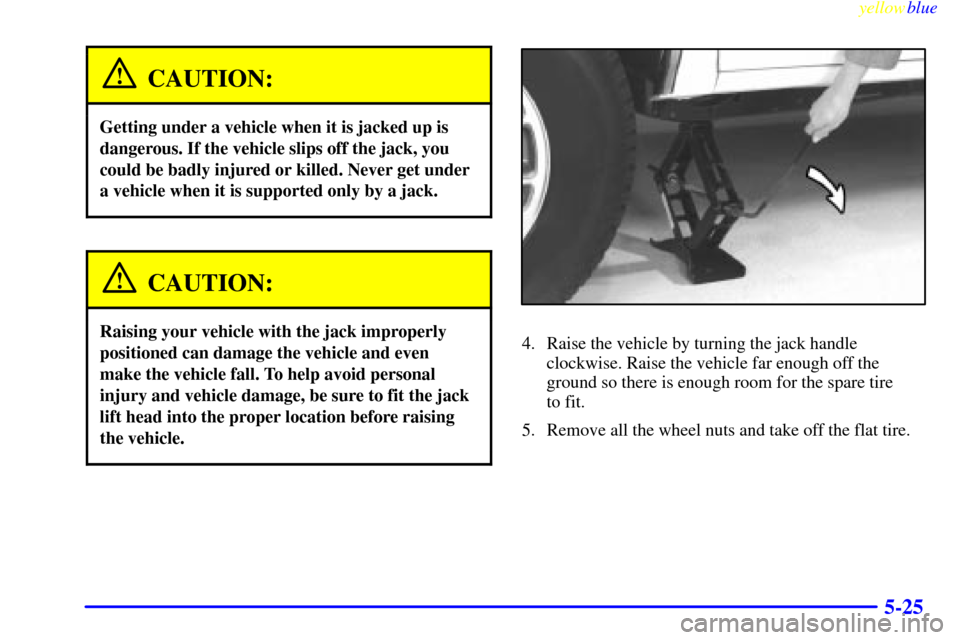
2. Turn the jack handle clockwise slightly to raise the
jack lift head.
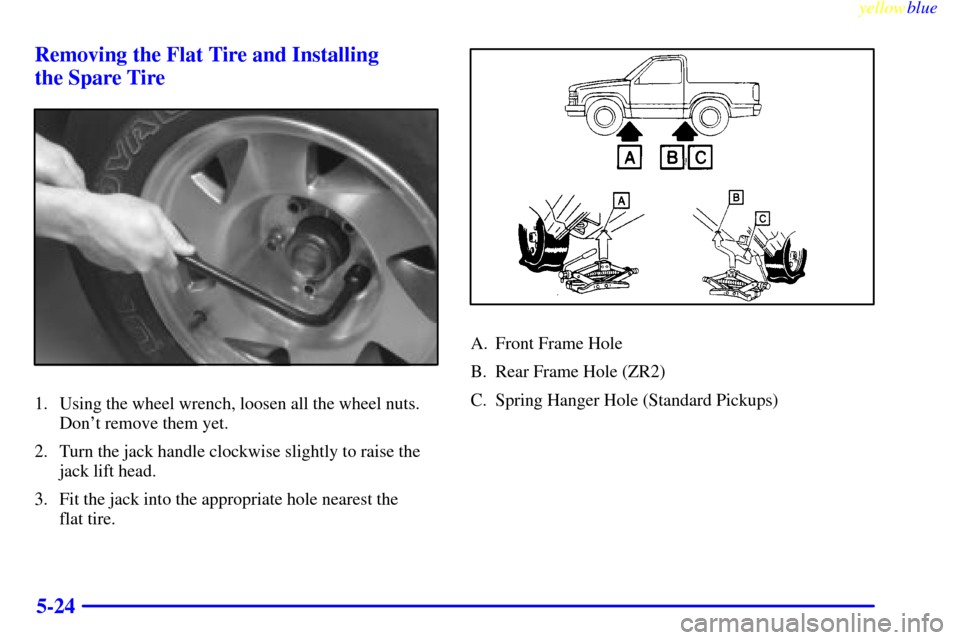
3. Fit the jack into the appropriate hole nearest the
flat tire.
A. Front Frame Hole
B. Rear Frame Hole (ZR2)
C. Spring Hanger Hole (Standard Pickups)
Page 229 of 384
yellowblue
5-25
CAUTION:
Getting under a vehicle when it is jacked up is
dangerous. If the vehicle slips off the jack, you
could be badly injured or killed. Never get under
a vehicle when it is supported only by a jack.
CAUTION:
Raising your vehicle with the jack improperly
positioned can damage the vehicle and even
make the vehicle fall. To help avoid personal
injury and vehicle damage, be sure to fit the jack
lift head into the proper location before raising
the vehicle.4. Raise the vehicle by turning the jack handle
clockwise. Raise the vehicle far enough off the
ground so there is enough room for the spare tire
to fit.
5. Remove all the wheel nuts and take off the flat tire.
Page 231 of 384
yellowblue
5-27
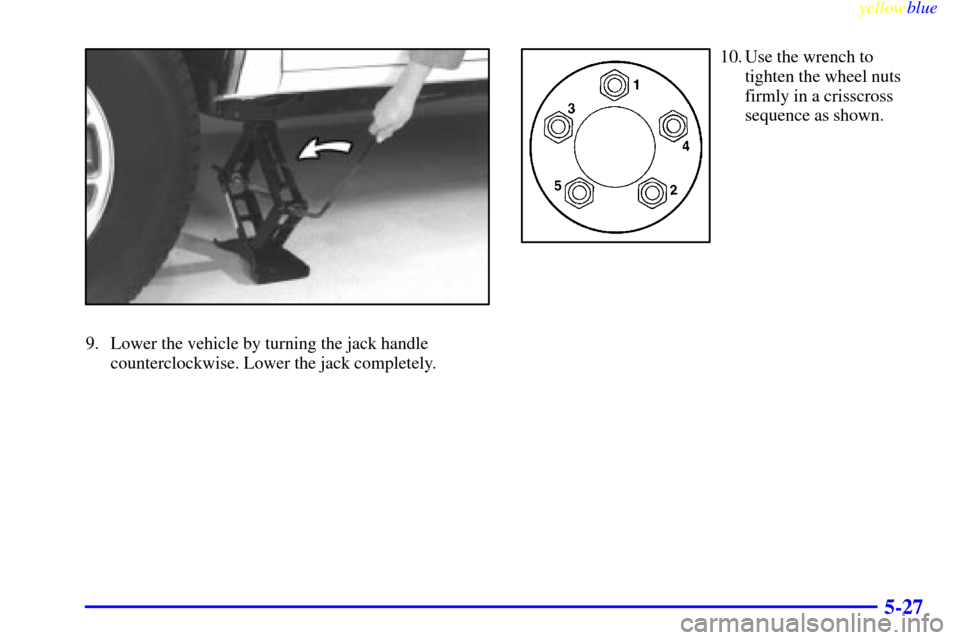
9. Lower the vehicle by turning the jack handle
counterclockwise. Lower the jack completely.
10. Use the wrench to
tighten the wheel nuts
firmly in a crisscross
sequence as shown.
Page 233 of 384
yellowblue
5-29
Follow this diagram to store the underbody-mounted spare.
A. Wheel Wrench
B. Hoist Assembly
C. Retainer
D. Spring
E. TireF. Valve Stem
(Pointed Down)
G. Lower
H. Raise1. Put the tire on the ground at the rear of the vehicle,
with the valve stem pointed down and to the rear.
2. Pull the retainer through the wheel.
Note that with the ZR2 option, the spring and
retainer must be separated to insert through the
wheel opening.
3. Put the chisel end of the wheel wrench on an angle,
through the hole in the rear bumper and into the hoist
shaft. Turn the wheel wrench clockwise until the tire
is raised against the underside of the vehicle.
You will hear two ªclicksº when the tire is secure,
but pull on the tire to make sure.