Page 167 of 344
yellowblue
4-17
The heavier the rain, the harder it is to see. Even if your
windshield wiper blades are in good shape, a heavy rain
can make it harder to see road signs and traffic signals,
pavement markings, the edge of the road and even
people walking.
It's wise to keep your windshield wiping equipment in
good shape and keep your windshield washer tank filled
with washer fluid. Replace your windshield wiper
inserts when they show signs of streaking or missing
areas on the windshield, or when strips of rubber start to
separate from the inserts.
Driving too fast through large water puddles or even
going through some car washes can cause problems, too.
The water may affect your brakes. Try to avoid puddles.
But if you can't, try to slow down before you hit them.
Page 173 of 344
yellowblue
4-23
Hill and Mountain Roads
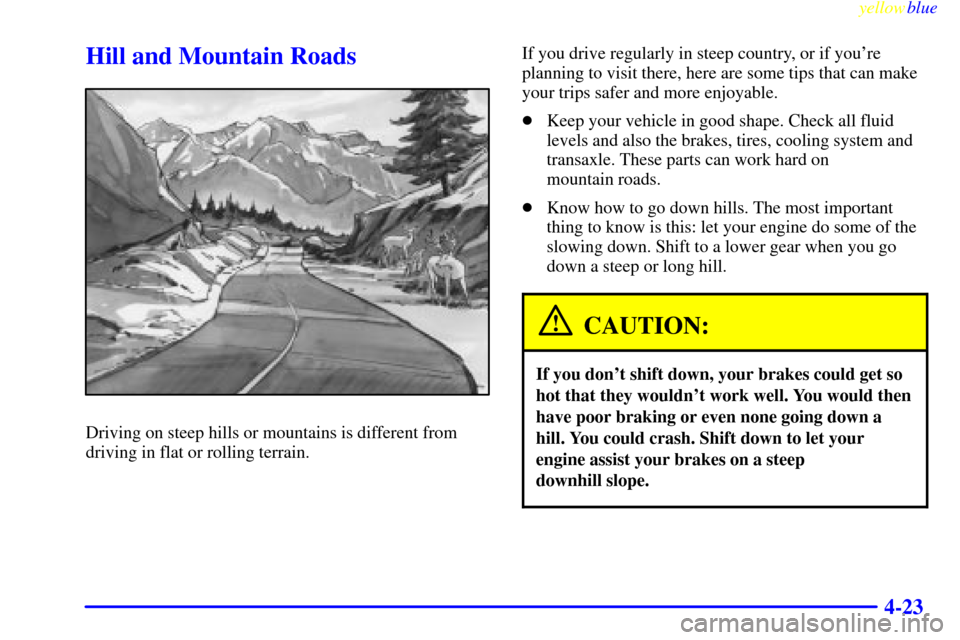
Driving on steep hills or mountains is different from
driving in flat or rolling terrain.If you drive regularly in steep country, or if you're
planning to visit there, here are some tips that can make
your trips safer and more enjoyable.
�Keep your vehicle in good shape. Check all fluid
levels and also the brakes, tires, cooling system and
transaxle. These parts can work hard on
mountain roads.
�Know how to go down hills. The most important
thing to know is this: let your engine do some of the
slowing down. Shift to a lower gear when you go
down a steep or long hill.
CAUTION:
If you don't shift down, your brakes could get so
hot that they wouldn't work well. You would then
have poor braking or even none going down a
hill. You could crash. Shift down to let your
engine assist your brakes on a steep
downhill slope.
Page 190 of 344
yellowblue
4-40 Maintenance When Trailer Towing
Your vehicle will need service more often when you're
pulling a trailer. See the Maintenance Schedule for more
on this. Things that are especially important in trailer
operation are automatic transaxle fluid (don't overfill),
engine oil, drive belt, cooling system and brake system.
Each of these is covered in this manual, and the Index
will help you find them quickly. If you're trailering, it's
a good idea to review this information before you start
your trip.
Check periodically to see that all hitch nuts and bolts
are tight.
Engine Cooling When Trailer Towing
Your cooling system may temporarily overheat during
severe operating conditions. See ªEngine Overheatingº
in the Index.
Towing A Trailer
(Except 3100 V6 Engine)
If your vehicle is equipped with the 2.4L L4 engine, it is
neither designed nor intended to tow a trailer.
Page 221 of 344
6-
yellowblue
6-1
Section 6 Service and Appearance Care
Here you will find information about the care of your vehicle. This section begins with service and fuel information,
and then it shows how to check important fluid and lubricant levels. There is also technical information about your
vehicle, and a part devoted to its appearance care.
6
-2 Service
6
-3 Fuel
6
-5 Fuels in Foreign Countries
6
-5 Filling Your Tank
6
-7 Filling a Portable Fuel Container
6
-8 Checking Things Under the Hood
6
-13 Engine Oil
6
-18 Engine Air Cleaner/Filter
6
-19 Automatic Transaxle Fluid
6
-20 Surge Tank Pressure Cap
6
-20 Thermostat
6
-20 Engine Coolant
6
-24 Power Steering Fluid
6
-25 Windshield Washer Fluid
6
-26 Brakes
6
-29 Battery6
-30 Bulb Replacement
6
-38 Windshield Wiper Blade Replacement
6
-38 Tires
6
-46 Appearance Care
6
-47 Cleaning the Inside of Your Vehicle
6
-49 Care of Safety Belts
6
-50 Cleaning the Outside of Your Vehicle
6
-51 Cleaning Aluminum Wheels (If Equipped)
6
-52 Finish Damage
6
-53 GM Vehicle Care/Appearance Materials
6
-54 Vehicle Identification Number (VIN)
6
-55 Electrical System
6
-60 Replacement Bulbs
6
-61 Capacities and Specifications
6
-62 Air Conditioning Refrigerants
6
-62 Normal Maintenance Replacement Parts
Page 228 of 344
yellowblue
6-8
Checking Things Under the Hood
CAUTION:
An electric fan under the hood can start up and
injure you even when the engine is not running.
Keep hands, clothing and tools away from any
underhood electric fan.
CAUTION:
Things that burn can get on hot engine parts and
start a fire. These include liquids like gasoline,
oil, coolant, brake fluid, windshield washer and
other fluids, and plastic or rubber. You or others
could be burned. Be careful not to drop or spill
things that will burn onto a hot engine.
The following sections tell you how to check fluids,
lubricants and important parts under the hood.
Hood Release
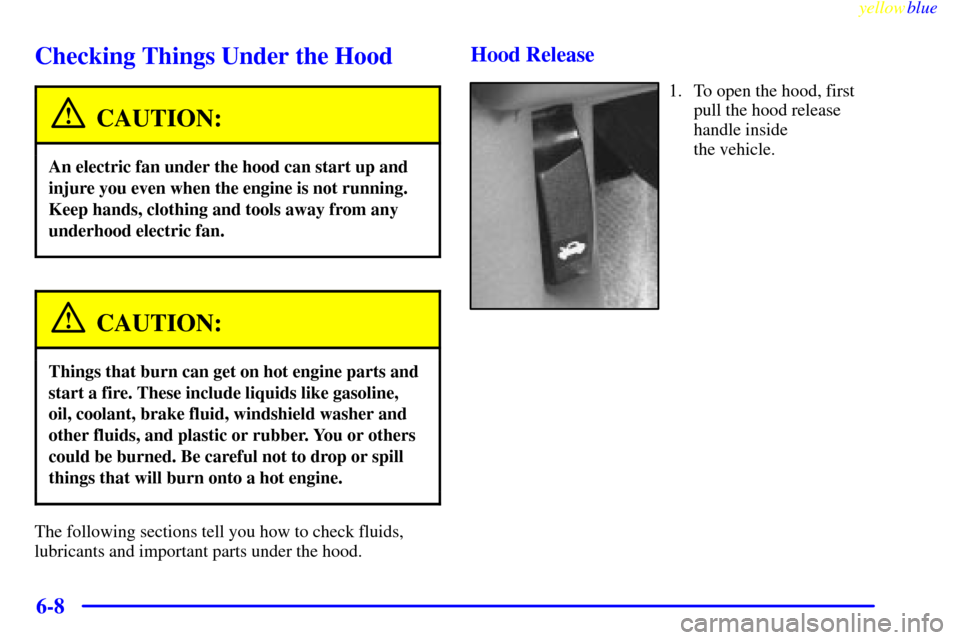
1. To open the hood, first
pull the hood release
handle inside
the vehicle.
Page 230 of 344
yellowblue
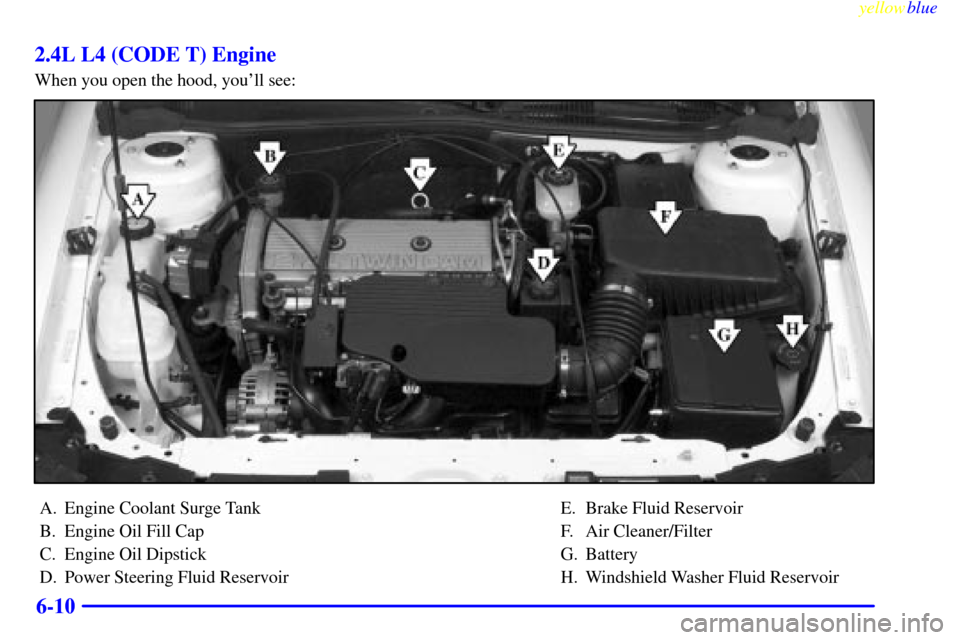
6-10 2.4L L4 (CODE T) Engine
When you open the hood, you'll see:
A. Engine Coolant Surge Tank
B. Engine Oil Fill Cap
C. Engine Oil Dipstick
D. Power Steering Fluid ReservoirE. Brake Fluid Reservoir
F. Air Cleaner/Filter
G. Battery
H. Windshield Washer Fluid Reservoir
Page 231 of 344
yellowblue
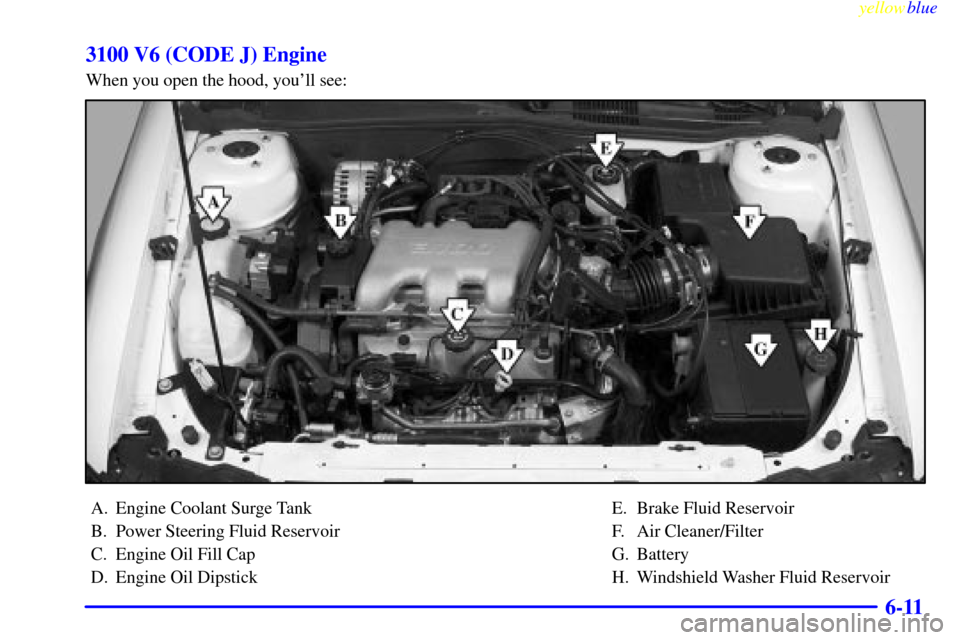
6-11 3100 V6 (CODE J) Engine
When you open the hood, you'll see:
A. Engine Coolant Surge Tank
B. Power Steering Fluid Reservoir
C. Engine Oil Fill Cap
D. Engine Oil DipstickE. Brake Fluid Reservoir
F. Air Cleaner/Filter
G. Battery
H. Windshield Washer Fluid Reservoir
Page 232 of 344
yellowblue
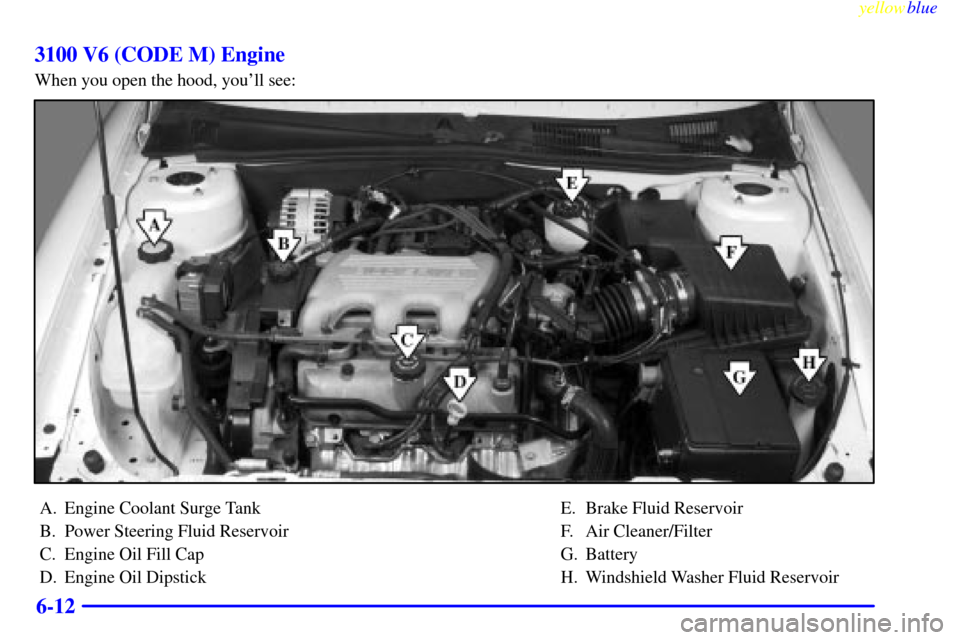
6-12 3100 V6 (CODE M) Engine
When you open the hood, you'll see:
A. Engine Coolant Surge Tank
B. Power Steering Fluid Reservoir
C. Engine Oil Fill Cap
D. Engine Oil DipstickE. Brake Fluid Reservoir
F. Air Cleaner/Filter
G. Battery
H. Windshield Washer Fluid Reservoir