Page 105 of 376
yellowblue
2-53
Interior Lamps
Instrument Panel Brightness Control
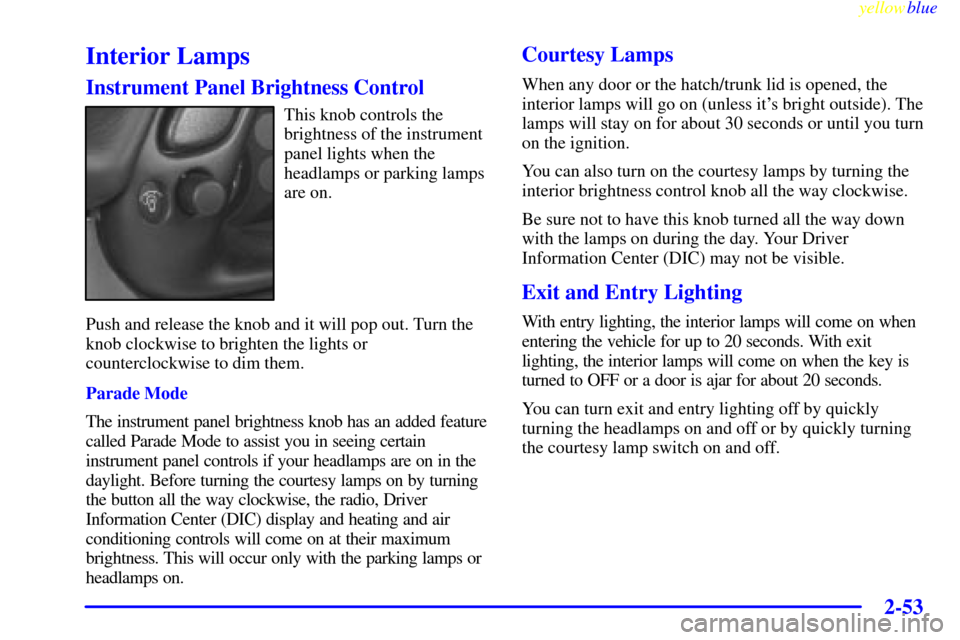
This knob controls the
brightness of the instrument
panel lights when the
headlamps or parking lamps
are on.
Push and release the knob and it will pop out. Turn the
knob clockwise to brighten the lights or
counterclockwise to dim them.
Parade Mode
The instrument panel brightness knob has an added feature
called Parade Mode to assist you in seeing certain
instrument panel controls if your headlamps are on in the
daylight. Before turning the courtesy lamps on by turning
the button all the way clockwise, the radio, Driver
Information Center (DIC) display and heating and air
conditioning controls will come on at their maximum
brightness. This will occur only with the parking lamps or
headlamps on.
Courtesy Lamps
When any door or the hatch/trunk lid is opened, the
interior lamps will go on (unless it's bright outside). The
lamps will stay on for about 30 seconds or until you turn
on the ignition.
You can also turn on the courtesy lamps by turning the
interior brightness control knob all the way clockwise.
Be sure not to have this knob turned all the way down
with the lamps on during the day. Your Driver
Information Center (DIC) may not be visible.
Exit and Entry Lighting
With entry lighting, the interior lamps will come on when
entering the vehicle for up to 20 seconds. With exit
lighting, the interior lamps will come on when the key is
turned to OFF or a door is ajar for about 20 seconds.
You can turn exit and entry lighting off by quickly
turning the headlamps on and off or by quickly turning
the courtesy lamp switch on and off.
Page 106 of 376

yellowblue
2-54
Reading Lamps
Your inside rearview mirror includes two reading lamps.
The lamps will go on when a door is opened. When the
doors are closed, each lamp can be turned on
individually by pressing the switch (each lamp has its
own switch).
There is also an interior console flood lamp located
underneath the rearview mirror which comes on with the
headlamps or parking lamps.
Inadvertent Load Control
Your vehicle has a feature to help prevent you from
draining the battery in case the underhood lamp, vanity
mirror lamps, cargo lamps, reading lamps, console or
glove box lamps are accidentally left on. If you leave
any of these lamps on, they will automatically time out
after 15 minutes. To reset it, all of the above lamps must
be turned off or the ignition key must be in ON.
Mirrors
Inside Day/Night Rearview Mirror
An inside rearview mirror is attached above the
windshield. The mirror has pivots so that you can
adjust it.
You can adjust the mirror for day or night driving. Pull
the tab for night driving to reduce glare. Push the tab for
daytime driving.
Page 213 of 376

yellowblue
4-17
Driving at Night
Night driving is more dangerous than day driving. One
reason is that some drivers are likely to be impaired
-- by
alcohol or drugs, with night vision problems, or by fatigue.
Here are some tips on night driving.
�Drive defensively.
�Don't drink and drive.�Adjust your inside rearview mirror to reduce the
glare from headlamps behind you.
�Since you can't see as well, you may need to
slow down and keep more space between you and
other vehicles.
�Slow down, especially on higher speed roads. Your
headlamps can light up only so much road ahead.
�In remote areas, watch for animals.
�If you're tired, pull off the road in a safe place
and rest.
Night Vision
No one can see as well at night as in the daytime. But as
we get older these differences increase. A 50
-year-old
driver may require at least twice as much light to see the
same thing at night as a 20
-year-old.
What you do in the daytime can also affect your night
vision. For example, if you spend the day in bright
sunshine you are wise to wear sunglasses. Your eyes will
have less trouble adjusting to night. But if you're
driving, don't wear sunglasses at night. They may cut
down on glare from headlamps, but they also make a lot
of things invisible.
Page 214 of 376

yellowblue
4-18
You can be temporarily blinded by approaching
headlamps. It can take a second or two, or even several
seconds, for your eyes to readjust to the dark. When you
are faced with severe glare (as from a driver who
doesn't lower the high beams, or a vehicle with
misaimed headlamps), slow down a little. Avoid staring
directly into the approaching headlamps.
Keep your windshield and all the glass on your vehicle
clean
-- inside and out. Glare at night is made much
worse by dirt on the glass. Even the inside of the glass
can build up a film caused by dust. Dirty glass makes
lights dazzle and flash more than clean glass would,
making the pupils of your eyes contract repeatedly.
Remember that your headlamps light up far less of a
roadway when you are in a turn or curve. Keep your
eyes moving; that way, it's easier to pick out dimly
lighted objects. Just as your headlamps should be
checked regularly for proper aim, so should your eyes
be examined regularly. Some drivers suffer from night
blindness
-- the inability to see in dim light -- and
aren't even aware of it.
Driving in Rain and on Wet Roads
Page 226 of 376

yellowblue
4-30
CAUTION:
Snow can trap exhaust gases under your vehicle.
This can cause deadly CO (carbon monoxide) gas
to get inside. CO could overcome you and kill
you. You can't see it or smell it, so you might not
know it is in your vehicle. Clear away snow from
around the base of your vehicle, especially any
that is blocking your exhaust pipe. And check
around again from time to time to be sure snow
doesn't collect there.
Open a window just a little on the side of the
vehicle that's away from the wind. This will help
keep CO out.
Run your engine only as long as you must. This saves
fuel. When you run the engine, make it go a little faster
than just idle. That is, push the accelerator slightly. This
uses less fuel for the heat that you get and it keeps the
battery charged. You will need a well
-charged battery to
restart the vehicle, and possibly for signaling later on
with your headlamps. Let the heater run for a while.Then, shut the engine off and close the window almost
all the way to preserve the heat. Start the engine again
and repeat this only when you feel really uncomfortable
from the cold. But do it as little as possible. Preserve the
fuel as long as you can. To help keep warm, you can get
out of the vehicle and do some fairly vigorous exercises
every half hour or so until help comes.
Recreational Vehicle Towing
Your vehicle was not designed to be towed with all four
wheels on the ground. If your vehicle must be towed,
see ªTowing Your Vehicleº in the Index.
NOTICE:
Towing your vehicle with all four wheels on the
ground will damage drivetrain components.
Page 260 of 376
yellowblue
6-10 Hood Release
NOTICE:
In order to avoid possible contact of the hood to
the headlamp doors, care should be taken in
raising the hood with the headlamps up, or shut
off the headlamps prior to opening the hood.
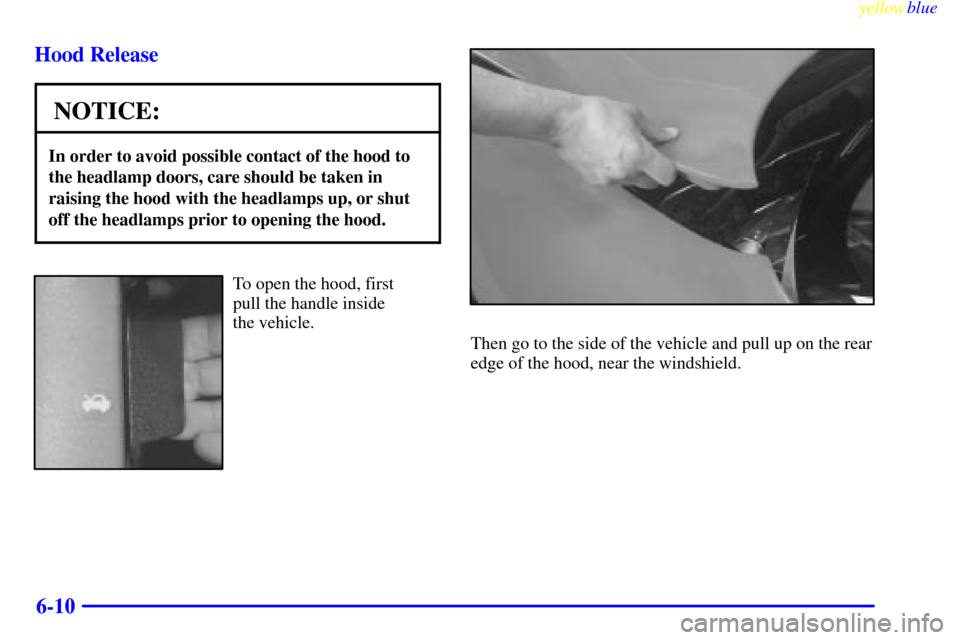
To open the hood, first
pull the handle inside
the vehicle.
Then go to the side of the vehicle and pull up on the rear
edge of the hood, near the windshield.
Page 275 of 376
yellowblue
6-25 Checking Coolant
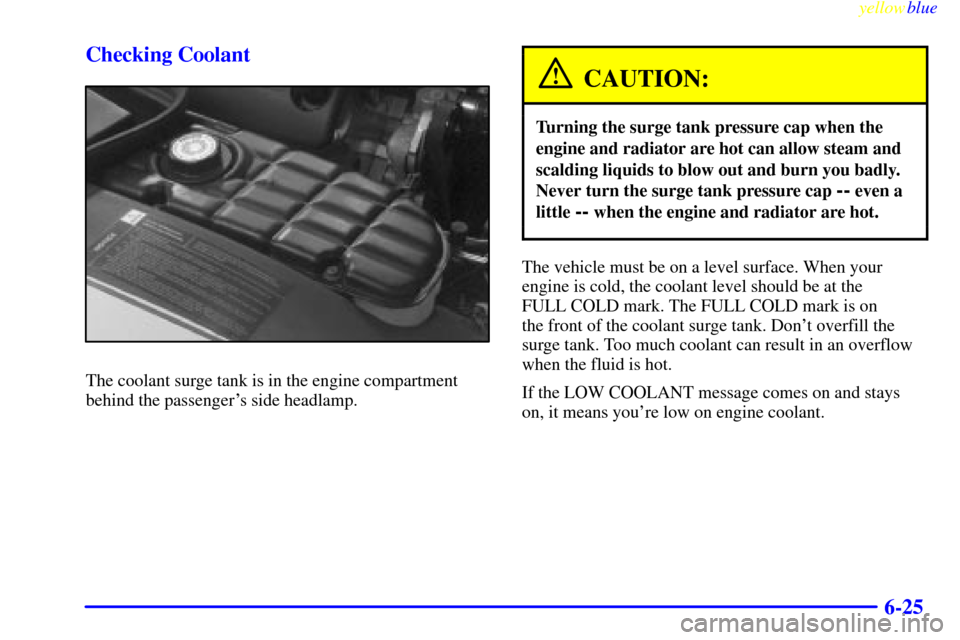
The coolant surge tank is in the engine compartment
behind the passenger's side headlamp.
CAUTION:
Turning the surge tank pressure cap when the
engine and radiator are hot can allow steam and
scalding liquids to blow out and burn you badly.
Never turn the surge tank pressure cap
-- even a
little
-- when the engine and radiator are hot.
The vehicle must be on a level surface. When your
engine is cold, the coolant level should be at the
FULL COLD mark. The FULL COLD mark is on
the front of the coolant surge tank. Don't overfill the
surge tank. Too much coolant can result in an overflow
when the fluid is hot.
If the LOW COOLANT message comes on and stays
on, it means you're low on engine coolant.
Page 283 of 376
yellowblue
6-33
Bulb Replacement
For the proper type of replacement bulb, see
ªReplacement Bulbsº in the Index.
For any bulb changing procedure not listed in this
section, contact your Chevrolet dealer's
service department.
Halogen Bulbs
CAUTION:
Halogen bulbs have pressurized gas inside and
can burst if you drop or scratch the bulb. You or
others could be injured. Be sure to read and
follow the instructions on the bulb package.
Headlamps
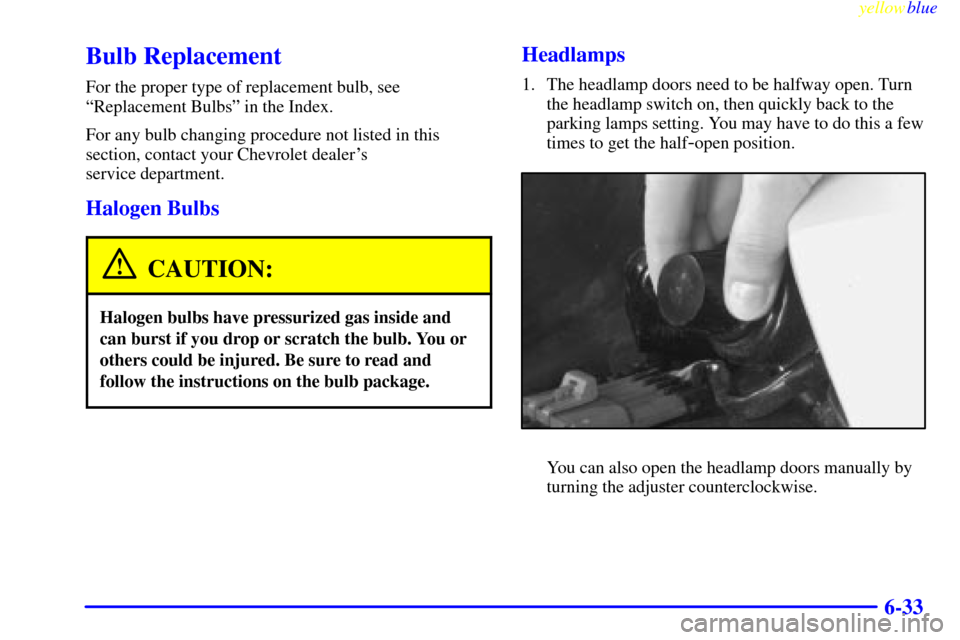
1. The headlamp doors need to be halfway open. Turn
the headlamp switch on, then quickly back to the
parking lamps setting. You may have to do this a few
times to get the half
-open position.
You can also open the headlamp doors manually by
turning the adjuster counterclockwise.