Page 79 of 376
yellowblue
2-23
Ignition Positions
CAUTION:
Leaving children in a vehicle with the ignition
key is dangerous for many reasons. A child or
others could be badly injured or even killed.
They could operate power windows or other
controls or even make the vehicle move. Don't
leave the keys in the vehicle with children.
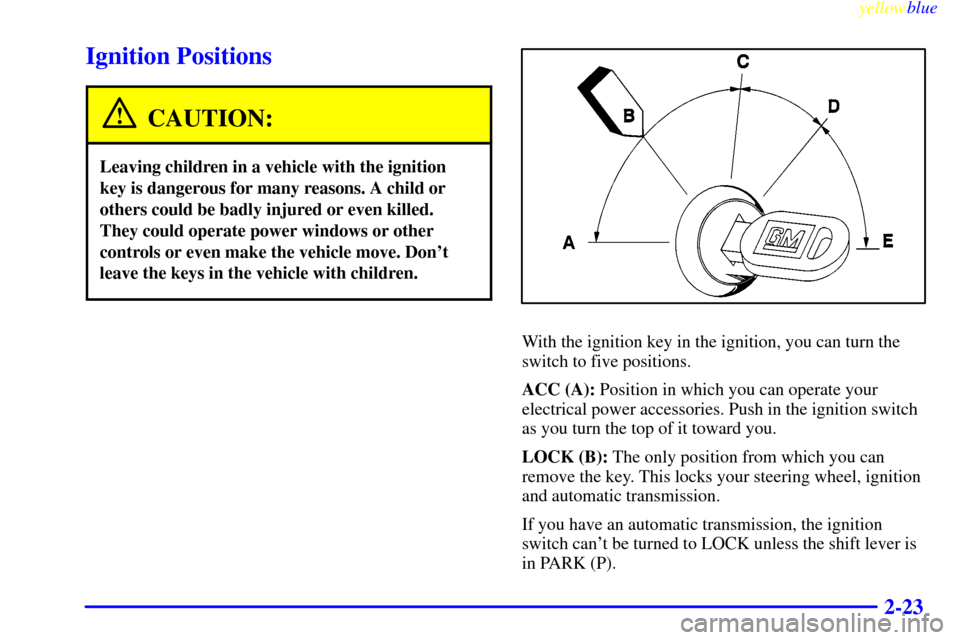
With the ignition key in the ignition, you can turn the
switch to five positions.
ACC (A): Position in which you can operate your
electrical power accessories. Push in the ignition switch
as you turn the top of it toward you.
LOCK (B): The only position from which you can
remove the key. This locks your steering wheel, ignition
and automatic transmission.
If you have an automatic transmission, the ignition
switch can't be turned to LOCK unless the shift lever is
in PARK (P).
Page 80 of 376

yellowblue
2-24
OFF (C): Unlocks the steering wheel, ignition and
automatic transmission, but does not send electrical
power to any accessories. Use this position if your
vehicle must be pushed or towed. A warning tone will
sound if you open the driver's door when the ignition is
in OFF and the key is in the ignition.
RUN (D): Position to which the switch returns after you
start your engine and release the switch. The switch
stays in RUN when the engine is running. But even
when the engine is not running, you can use RUN to
operate your electrical power accessories and to display
some instrument panel warning and indicator lights.
START (E): Starts the engine. When the engine starts,
release the key. The ignition will return to RUN for
normal driving.
Even if the engine is not running, ACC and RUN allows
you to operate your electrical accessories, such as the
radio and ventilation fan.
CAUTION:
On manual transmission vehicles, turning the key
to LOCK will lock the steering column and result
in a loss of ability to steer the vehicle. This could
cause a collision. If you need to turn the engine
off while the vehicle is moving, turn the key only
to OFF. Don't press the key release button while
the vehicle is moving.
NOTICE:
If your key seems stuck in LOCK and you can't
turn it, be sure you are using the correct key; if
so, is it all the way in? If it is, then turn the
steering wheel left and right while you turn the
key hard. But turn the key only with your hand.
Using a tool to force it could break the key or the
ignition switch. If none of this works, then your
vehicle needs service.
Page 81 of 376
yellowblue
2-25 Key Release Button
If you have a manual
transmission, your ignition
lock has a key release
button. You must press the
key release button to turn
the ignition key to LOCK
before you can take your
key out.
Starting Your Engine
Automatic Transmission
Move your shift lever to PARK (P) or NEUTRAL (N).
Your engine won't start in any other position
-- that's a
safety feature. To restart when you're already moving,
use NEUTRAL (N) only.
NOTICE:
Don't try to shift to PARK (P) if your Chevrolet
is moving. If you do, you could damage the
transmission. Shift to PARK (P) only when your
vehicle is stopped.
Manual Transmission
The gear selector should be in NEUTRAL and the
parking brake engaged. Hold the clutch pedal to the
floor and start the engine. Your vehicle won't start if the
clutch pedal is not all the way down
-- that's a
safety feature.
Page 86 of 376

yellowblue
2-30
PARK (P): This locks your rear wheels. It's the best
position to use when you start your engine because your
vehicle can't move easily.
CAUTION:
It is dangerous to get out of your vehicle if the
shift lever is not fully in PARK (P) with the
parking brake firmly set. Your vehicle can roll.
Don't leave your vehicle when the engine is
running unless you have to. If you have left the
engine running, the vehicle can move suddenly.
You or others could be injured. To be sure your
vehicle won't move, even when you're on fairly
level ground, always set your parking brake and
move the shift lever to PARK (P).
See ªShifting Into PARK (P)º in the Index. If
you're pulling a trailer, see ªTowing a Trailerº in
the Index.
Ensure the shift lever is fully in PARK (P) before
starting the engine. Your vehicle has a
Brake
-Transmission Shift Interlock (BTSI). You have to
fully apply your regular brakes before you can shift
from PARK (P) when the ignition key is in RUN. If you
cannot shift out of PARK (P), ease pressure on the shift
lever
--push the shift lever all the way into PARK (P)
and also release the shift lever button on floor shift
console models as you maintain brake application. Then
move the shift lever into the gear you wish. (Press the
shift lever button before moving the shift lever on floor
shift console models.) See ªShifting Out of PARK (P)º
in the Index.
REVERSE (R): Use this gear to back up.
NOTICE:
Shifting to REVERSE (R) while your vehicle is
moving forward could damage your
transmission. Shift to REVERSE (R) only after
your vehicle is stopped.
To rock your vehicle back and forth to get out of snow,
ice or sand without damaging your transmission, see
ªStuck: In Sand, Mud, Ice or Snowº in the Index.
Page 94 of 376
yellowblue
2-38
If you are towing a trailer and are parking on any hill,
see ªTowing a Trailerº in the Index. That section shows
what to do first to keep the trailer from moving.
Shifting Into PARK (P)
(Automatic Transmission Only)
CAUTION:
It can be dangerous to get out of your vehicle if
the shift lever is not fully in PARK (P) with the
parking brake firmly set. Your vehicle can roll. If
you have left the engine running, the vehicle can
move suddenly. You or others could be injured.
To be sure your vehicle won't move, even when
you're on fairly level ground, use the steps that
follow. If you're pulling a trailer, see ªTowing a
Trailerº in the Index.
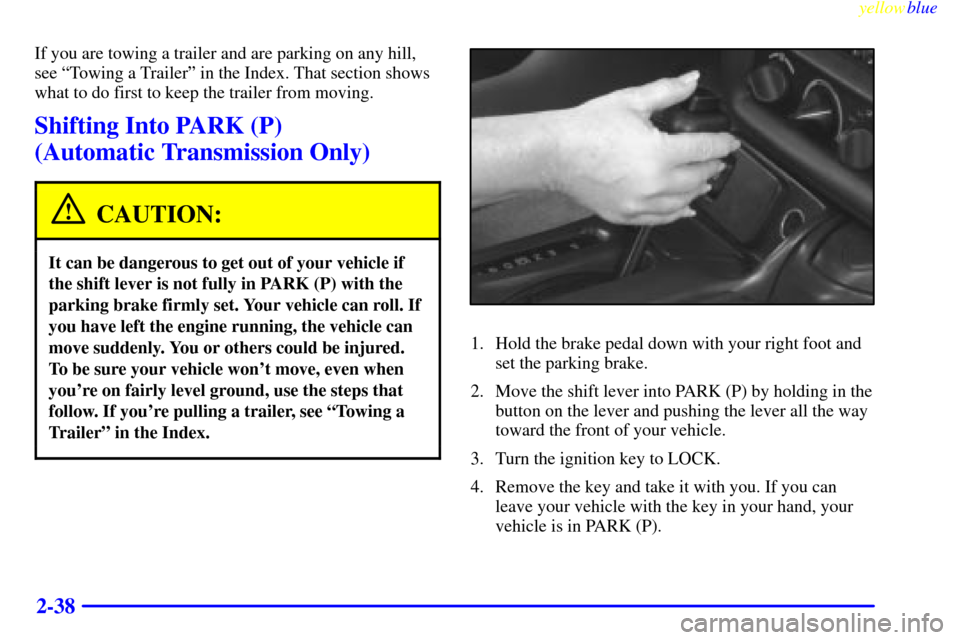
1. Hold the brake pedal down with your right foot and
set the parking brake.
2. Move the shift lever into PARK (P) by holding in the
button on the lever and pushing the lever all the way
toward the front of your vehicle.
3. Turn the ignition key to LOCK.
4. Remove the key and take it with you. If you can
leave your vehicle with the key in your hand, your
vehicle is in PARK (P).
Page 95 of 376
yellowblue
2-39 Leaving Your Vehicle With the Engine
Running (Automatic Transmission Only)
CAUTION:
It can be dangerous to leave your vehicle with the
engine running. Your vehicle could move
suddenly if the shift lever is not fully in PARK (P)
with the parking brake firmly set. And, if you
leave the vehicle with the engine running, it could
overheat and even catch fire. You or others could
be injured. Don't leave your vehicle with the
engine running unless you have to.
Torque Lock (Automatic Transmission)
If you are parking on a hill and you don't shift your
transmission into PARK (P) properly, the weight of the
vehicle may put too much force on the parking pawl in
the transmission. You may find it difficult to pull the
shift lever out of PARK (P). This is called ªtorque lock.º
To prevent torque lock, set the parking brake and then
shift into PARK (P) properly before you leave the
driver's seat. To find out how, see ªShifting Into
PARK (P)º in the Index.When you are ready to drive, move the shift lever out of
PARK (P) before you release the parking brake.
If torque lock does occur, you may need to have another
vehicle push yours a little uphill to take some of the
pressure from the parking pawl in the transmission, so
you can pull the shift lever out of PARK (P).
Shifting Out of PARK (P)
(Automatic Transmission)
CAUTION:
Before shifting out of PARK (P) you must fully
apply your regular brakes. Your vehicle can roll.
If you have left the engine running, the vehicle
can move suddenly. You or others could be
injured. If you're pulling a trailer, see ªTowing a
Trailerº in the Index.
Your vehicle has a Brake-Transmission Shift Interlock
(BTSI). You have to fully apply your regular brake
before you can shift from PARK (P) when the ignition is
in RUN. See ªAutomatic Transmission Operationº in
the Index.
Page 99 of 376

yellowblue
2-43 Power Windows (If Equipped)
Switches on the driver's door control each window
when the ignition is on or when RAP is present. (See
ªRetained Accessory Powerº in the Index.)You can open the passenger's window any amount by
pressing the switch and releasing it when the window
has lowered to the position you want.
The switch for the driver's window has an express
-down
feature. This switch is labeled AUTO. Quickly press and
release the bottom of the switch for the driver's window
and the window will lower completely. You can also
open the driver's window any amount by pressing the
switch again while the window is in the express
-down
mode when it has lowered to the position you want.
To stop the window while it is lowering, press the front
of the switch. To raise the window, press and hold the
front of the switch.
Horn
To sound the horn, press either horn symbol on your
steering wheel.
If your horn sounds two or three chirps when unlocking
your vehicle with the remote keyless entry transmitter
(if equipped), the alarm was triggered while you were
away. Check the vehicle before entering.
Page 100 of 376
yellowblue
2-44
Tilt Wheel
A tilt wheel allows you to adjust the steering wheel
before you drive.
You can also raise it to the highest level to give your
legs more room when you exit and enter the vehicle.
To tilt the wheel, hold the steering wheel and pull the
lever. Move the steering wheel to a comfortable level,
then release the lever to lock the wheel in place.
Turn Signal/Multifunction Lever
The lever on the left side of the steering column
includes your:
�Turn Signal and Lane Change Indicator
�Headlamp High/Low
-Beam Changer and
Passing Signal
�Windshield Wipers
�Windshield Washer
�Cruise Control (Option)