Page 250 of 376
yellowblue
5-34
Compact Spare Tire
Although the compact spare tire was fully inflated when
your vehicle was new, it can lose air after a time.
Check the inflation pressure regularly. It should be
60 psi (420 kPa).
After installing the compact spare on your vehicle, you
should stop as soon as possible and make sure your
spare tire is correctly inflated. The compact spare is
made to perform well at speeds up to 65 mph
(105 km/h) for distances up to 3,000 miles (5 000 km),
so you can finish your trip and have your full
-size tire
repaired or replaced where you want. Of course, it's best
to replace your spare with a full
-size tire as soon as you
can. Your spare will last longer and be in good shape in
case you need it again.
NOTICE:
When the compact spare is installed, don't take
your vehicle through an automatic car wash with
guide rails. The compact spare can get caught on
the rails. That can damage the tire and wheel,
and maybe other parts of your vehicle.
Don't use your compact spare on other vehicles.
And don't mix your compact spare tire or wheel with
other wheels or tires. They won't fit. Keep your spare
tire and its wheel together.
NOTICE:
Tire chains won't fit your compact spare. Using
them can damage your vehicle and can damage
the chains too. Don't use tire chains on your
compact spare.
Page 251 of 376

yellowblue
5-35
If You're Stuck: In Sand, Mud, Ice
or Snow
In order to free your vehicle when it is stuck, you will
need to spin the wheels, but you don't want to spin your
wheels too fast. The method known as ªrockingº can
help you get out when you're stuck, but you must
use caution.
CAUTION:
If you let your tires spin at high speed, they can
explode, and you or others could be injured. And,
the transmission or other parts of the vehicle can
overheat. That could cause an engine
compartment fire or other damage. When you're
stuck, spin the wheels as little as possible. Don't
spin the wheels above 35 mph (55 km/h) as shown
on the speedometer.
NOTICE:
Spinning your wheels can destroy parts of your
vehicle as well as the tires. If you spin the wheels
too fast while shifting your transmission back
and forth, you can destroy your transmission.
For information about using tire chains on your vehicle,
see ªTire Chainsº in the Index.
Rocking Your Vehicle To Get It Out
First, turn your steering wheel left and right. That will clear
the area around your front wheels. If your vehicle has ASR,
you should turn the system off. (See ªASR Systemº in the
Index.) Then shift back and forth between REVERSE (R)
and a forward gear (or with a manual transmission, between
FIRST (1) or SECOND (2) and REVERSE (R)), spinning
the wheels as little as possible. Release the accelerator pedal
while you shift, and press lightly on the accelerator pedal
when the transmission is in gear. By slowly spinning your
wheels in the forward and reverse directions, you will cause a
rocking motion that may free your vehicle. If that doesn't get
you out after a few tries, you may need to be towed out. If you
do need to be towed out, see ªTowing Your Vehicleº in
the Index.
Page 253 of 376

6-
yellowblue
6-1
Section 6 Service and Appearance Care
Here you will find information about the care of your vehicle. This section begins with service and fuel information,
and then it shows how to check important fluid and lubricant levels. There is also technical information about your
vehicle, and a part devoted to its appearance care.
6
-2 Service
6
-3 Fuel
6
-5 Fuels in Foreign Countries
6
-6 Filling Your Tank
6
-8 Filling a Portable Fuel Container
6
-8 Checking Things Under the Hood
6
-12 Engine Oil
6
-18 Engine Air Cleaner/Filter
6
-20 Automatic Transmission Fluid
6
-24 Manual Transmission Fluid
6
-26 Hydraulic Clutch
6
-27 Rear Axle
6
-28 Thermostat
6
-28 Engine Coolant
6
-31 Power Steering Fluid
6
-33 Windshield Washer Fluid
6
-34 Brakes
6
-38 Battery6
-38 Bulb Replacement
6
-44 Tires
6
-53 Appearance Care
6
-53 Cleaning the Inside of Your Vehicle
6
-56 Care of Safety Belts
6
-57 Cleaning the Outside of Your Vehicle
6
-59 Cleaning Aluminum or Chrome-Plated
Wheels (If Equipped)
6
-60 Underbody Maintenance
6
-61 GM Vehicle Care/Appearance Materials
6
-62 Vehicle Identification Number (VIN)
6
-62 Service Parts Identification Label
6
-63 Electrical System
6
-69 Replacement Bulbs
6
-70 Capacities and Specifications
6
-71 Air Conditioning Refrigerants
6
-71 Normal Maintenance Replacement Parts
Page 296 of 376
yellowblue
6-44
Tires
Your new vehicle comes with high-quality tires made by
a leading tire manufacturer. If you ever have questions
about your tire warranty and where to obtain service, see
your Chevrolet Warranty booklet for details.
CAUTION:
Poorly maintained and improperly used tires
are dangerous.
�Overloading your tires can cause overheating
as a result of too much friction. You could
have an air
-out and a serious accident. See
ªLoading Your Vehicleº in the Index.
�Underinflated tires pose the same danger as
overloaded tires. The resulting accident
could cause serious injury. Check all tires
frequently to maintain the recommended
pressure. Tire pressure should be checked
when your tires are cold.
CAUTION: (Continued)
CAUTION: (Continued)
�Overinflated tires are more likely to be cut,
punctured or broken by a sudden impact
--
such as when you hit a pothole. Keep tires
at the recommended pressure.
�Worn, old tires can cause accidents. If your
tread is badly worn, or if your tires have
been damaged, replace them.
See ªInflation -- Tire Pressureº in this section
for inflation pressure adjustment for higher
speed driving.
Page 297 of 376
yellowblue
6-45 Inflation -- Tire Pressure
The Tire-Loading Information label, which is on the
driver's door, shows the correct inflation pressures for
your tires when they're cold. ªColdº means your vehicle
has been sitting for at least three hours or driven no
more than 1 mile (1.6 km).
If you'll be driving at high speeds (e.g., speeds of
100 mph (160 km/h) or higher), where it is legal, set the
cold inflation pressure to the maximum inflation
pressure shown on the tire sidewall, or to 38 psi
(265 kPa), whichever is lower. See the example below.
When you end this high
-speed driving, return to the
cold inflation pressure shown on the Tire
-Loading
Information label.
Example:
You'll find maximum load and inflation pressure
molded on the tire's sidewall, in small letters, near the
rim flange. It will read something like this: Maximum
load 690 kg (1521 lbs.) @ 300 kPa (44 psi) Max. Press.
For this example, you would set the inflation pressure
for high
-speed driving at 38 psi (265 kPa).
NOTICE:
Don't let anyone tell you that underinflation or
overinflation is all right. It's not. If your tires
don't have enough air (underinflation), you can
get the following:
�Too much flexing
�Too much heat
�Tire overloading
�Bad wear
�Bad handling
�Bad fuel economy.
If your tires have too much air (overinflation),
you can get the following:
�Unusual wear
�Bad handling
�Rough ride
�Needless damage from road hazards.
Page 298 of 376

yellowblue
6-46
When to Check
Check your tires once a month or more.
Don't forget your compact spare tire. It should be at
60 psi (420 kPa).
How to Check
Use a good quality pocket
-type gage to check tire
pressure. You can't tell if your tires are properly inflated
simply by looking at them. Radial tires may look
properly inflated even when they're underinflated.
Be sure to put the valve caps back on the valve
stems. They help prevent leaks by keeping out dirt
and moisture.
Tire Inspection and Rotation
Tires should be rotated every 6,000 to 8,000 miles
(10 000 to 13 000 km). Any time you notice unusual
wear, rotate your tires as soon as possible and check
wheel alignment. Also check for damaged tires or
wheels. See ªWhen It's Time for New Tiresº and
ªWheel Replacementº later in this section for
more information.The purpose of regular rotation is to achieve more
uniform wear for all tires on the vehicle. The first
rotation is the most important. See ªScheduled
Maintenance Servicesº in the Index for scheduled
rotation intervals.
If you don't have P245/50ZR16 Goodyear Eagle GS-C
tires or P275/40ZR17 Goodyear Eagle F1
-GS tires, use
the rotation pattern shown above for your tires.
Page 299 of 376
yellowblue
6-47
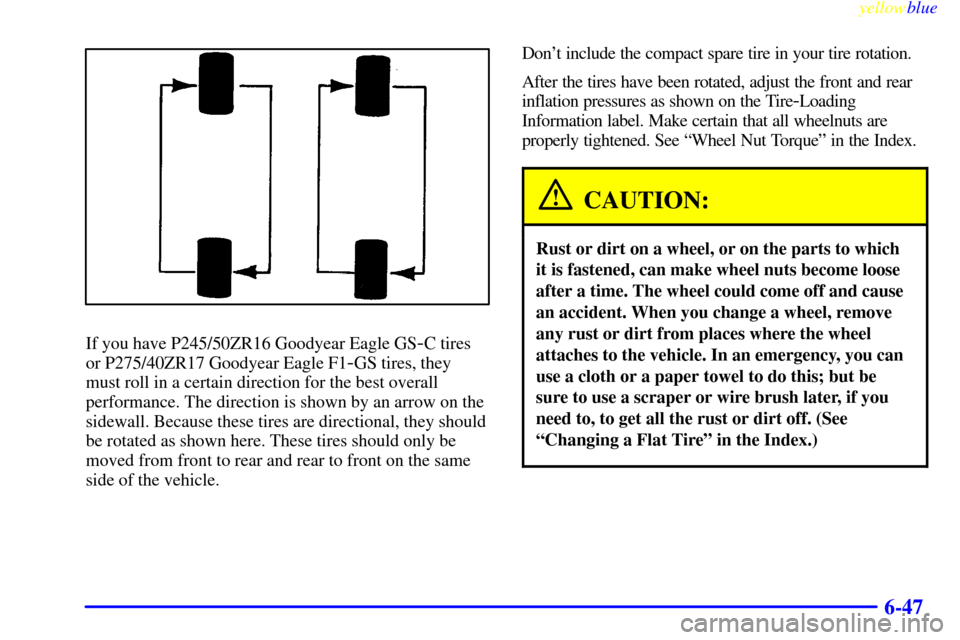
If you have P245/50ZR16 Goodyear Eagle GS-C tires
or P275/40ZR17 Goodyear Eagle F1
-GS tires, they
must roll in a certain direction for the best overall
performance. The direction is shown by an arrow on the
sidewall. Because these tires are directional, they should
be rotated as shown here. These tires should only be
moved from front to rear and rear to front on the same
side of the vehicle.Don't include the compact spare tire in your tire rotation.
After the tires have been rotated, adjust the front and rear
inflation pressures as shown on the Tire
-Loading
Information label. Make certain that all wheelnuts are
properly tightened. See ªWheel Nut Torqueº in the Index.
CAUTION:
Rust or dirt on a wheel, or on the parts to which
it is fastened, can make wheel nuts become loose
after a time. The wheel could come off and cause
an accident. When you change a wheel, remove
any rust or dirt from places where the wheel
attaches to the vehicle. In an emergency, you can
use a cloth or a paper towel to do this; but be
sure to use a scraper or wire brush later, if you
need to, to get all the rust or dirt off. (See
ªChanging a Flat Tireº in the Index.)
Page 300 of 376

yellowblue
6-48
When It's Time for New Tires
One way to tell when it's
time for new tires is to
check the treadwear
indicators, which will
appear when your tires have
only 1/16 inch (1.6 mm) or
less of tread remaining.
You need a new tire if any of the following statements
are true:
�You can see the indicators at three or more places
around the tire.
�You can see cord or fabric showing through the
tire's rubber.
�The tread or sidewall is cracked, cut or snagged deep
enough to show cord or fabric.�The tire has a bump, bulge or split.
�The tire has a puncture, cut or other damage that
can't be repaired well because of the size or location
of the damage.
Buying New Tires
To find out what kind and size of tires you need, look at
the Tire
-Loading Information label.
The tires installed on your vehicle when it was new had
a Tire Performance Criteria Specification (TPC Spec)
number on each tire's sidewall. When you get new tires,
get ones with that same TPC Spec number. That way
your vehicle will continue to have tires that are designed
to give proper endurance, handling, speed rating,
traction, ride and other things during normal service on
your vehicle. If your tires have an all
-season tread
design, the TPC number will be followed by an ªMSº
(for mud and snow).
If you ever replace your tires with those not having a
TPC Spec number, make sure they are the same size,
load range, speed rating and construction type (bias,
bias
-belted or radial) as your original tires.