Page 266 of 352
yellowblue
6-6
CAUTION:
Gasoline vapor is highly flammable. It burns
violently, and that can cause very bad injuries.
Don't smoke if you're near gasoline or refueling
your vehicle. Keep sparks, flames and smoking
materials away from gasoline.
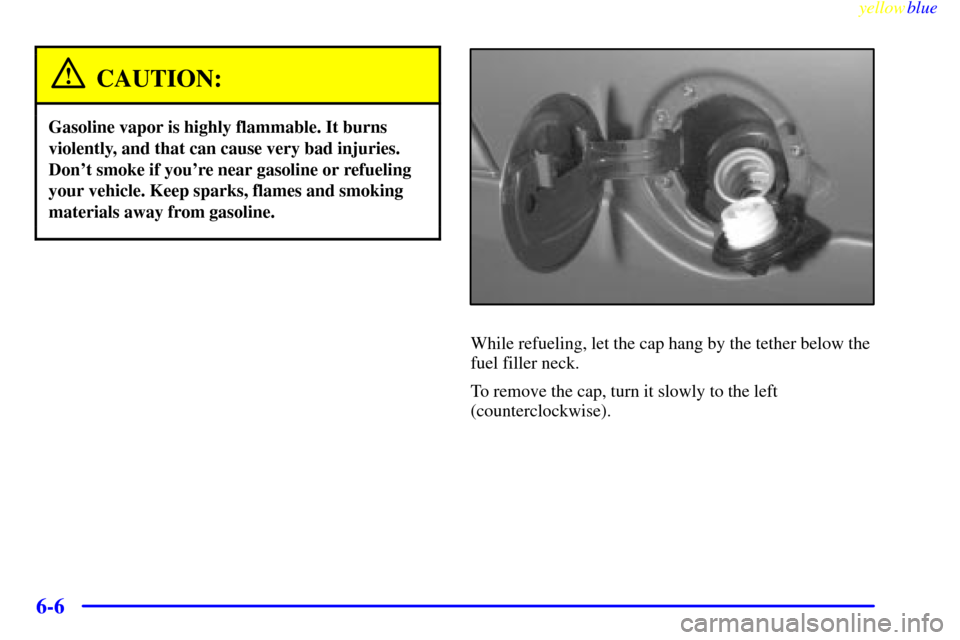
While refueling, let the cap hang by the tether below the
fuel filler neck.
To remove the cap, turn it slowly to the left
(counterclockwise).
Page 267 of 352
yellowblue
6-7
CAUTION:
If you get gasoline on yourself and then
something ignites it, you could be badly burned.
Gasoline can spray out on you if you open the
fuel filler cap too quickly. This spray can happen
if your tank is nearly full, and is more likely in
hot weather. Open the fuel filler cap slowly and
wait for any ªhissº noise to stop. Then unscrew
the cap all the way.
Be careful not to spill gasoline. Clean gasoline from
painted surfaces as soon as possible. See ªCleaning the
Outside of Your Vehicleº in the Index.When you put the cap back on, turn it to the right
(clockwise) until you hear a clicking sound. Make sure
you fully install the cap. The diagnostic system can
determine if the fuel cap has been left off or improperly
installed. This would allow fuel to evaporate into the
atmosphere. See ªMalfunction Indicator Lampº
in the Index.
NOTICE:
If you need a new cap, be sure to get the right
type. Your dealer can get one for you. If you get
the wrong type, it may not fit properly. This may
cause your malfunction indicator lamp to light
and your fuel tank and emissions system may be
damaged. See ªMalfunction Indicator Lampº
in the Index.
Page 279 of 352
yellowblue
6-19
�With your foot on the brake pedal, move the shift
lever through each gear range, pausing for about
three seconds in each range. Then, position the shift
lever in PARK (P).
�Let the engine run at idle for three minutes or more.
Then, without shutting off the engine, follow these steps:
1. The red transmission dipstick is located at the rear of
the engine compartment, on the passenger's side.
Flip the handle up and then pull out the dipstick and
wipe it with a clean rag or paper towel.2. Push it back in all the way, wait three seconds and
then pull it back out again.
3. Check both sides of the dipstick, and read the lower
level. The fluid level must be in the COLD area,
below the cross
-hatched area, for a cold check or in
the HOT area or cross
-hatched area for a hot check.
4. If the fluid level is in the acceptable range, push the
dipstick back in all the way; then flip the handle
down to lock the dipstick in place.
Page 280 of 352

yellowblue
6-20 How to Add Fluid
Refer to the Maintenance Schedule booklet to determine
what kind of transmission fluid to use. See
ªRecommended Fluids and Lubricantsº in the Index.
Add fluid only after checking the transmission fluid
while it is hot. (A cold check is used only as a
reference.) If the fluid level is low, add only enough of
the proper fluid to bring the level up to the HOT area for
a hot check. It doesn't take much fluid, generally less
than one pint (0.5 L). Don't overfill.
NOTICE:
We recommend you use only fluid labeled
DEXRON�-III, because fluid with that label is
made especially for your automatic transmission.
Damage caused by fluid other than DEXRON
�-III
is not covered by your new vehicle warranty.
�After adding fluid, recheck the fluid level as
described under ªHow to Check.º
�When the correct fluid level is obtained, push the
dipstick back in all the way; then flip the handle
down to lock the dipstick in place.
Rear Axle
When to Check and Change Lubricant
Refer to the Maintenance Schedule to determine how
often to check the lubricant and when to change it. See
ªScheduled Maintenance Servicesº in the Maintenance
Schedule booklet.
How to Check Lubricant
Page 294 of 352
yellowblue
6-34 Headlamps
1. Remove the parking/turn signal assembly as
described under ªParking/Turn Signal Lampsº,
following this procedure.
2. Remove the two turn signal bulb sockets and the
sidemarker bulb socket from the parking/turn signal
assembly by turning counterclockwise.
3. Set the parking/turn signal assembly to the side.
4. Remove the two bolts at the top of the radiator
support as shown.5. Pull the headlamp assembly out.
6. Turn the bulb counterclockwise and remove it.
7. Unplug the electrical connector.
8. Put the new bulb into the lens assembly and turn it
clockwise until it is tight.
9. Plug in the electrical connector.
10. Put the headlamp lens assembly back into the
vehicle. Install and tighten the two bolts.
Page 295 of 352
yellowblue
6-35
11. Install the two turn signal bulb sockets and the
sidemarker bulb socket into the parking/turn signal
bulb assembly.
12. Install the parking/turn signal assembly. Install and
tighten the two screws.
Parking/Turn Signal Lamps
1. Remove the two screws on the side of the
parking/turn signal bulb assembly. The parking/turn
signal assembly must be removed to provide
clearance for headlamp removal.2. Pull the parking/turn signal assembly toward the side
of the vehicle until the tabs are out of the grille.
A. Turn Signal Bulb
B. Sidemarker Bulb
3. To remove a bulb, turn the socket counterclockwise
to remove it from the assembly.
4. Install the parking/turn signal lamp assembly by
sliding it from the side of the vehicle toward the
center until the tabs fully engage the grille.
5. Install and tighten the two screws.
Page 296 of 352
yellowblue
6-36 Fog Lamps
The fog lamp bulb assembly is located under the
front bumper.
1. Remove the fog lamp bulb socket by turning it
counterclockwise.
2. Remove the connector from the bulb by lifting the
tabs on the sides of the connector.
3. Insert the new bulb into the connector until the tabs
lock into the connector.
4. Insert the fog lamp bulb socket into the fog lamp
housing and turn it clockwise one
-quarter of a turn.
Page 317 of 352
yellowblue
6-57 Fuses and Circuit Breakers
The wiring circuits in your vehicle are protected from
short circuits by a combination of fuses, circuit breakers
and fusible thermal links in the wiring itself. This greatly
reduces the chance of fires caused by electrical problems.
Look at the silver
-colored band inside the fuse. If the
band is broken or melted, replace the fuse. Be sure you
replace a bad fuse with a new one of the identical size
and rating.
If you ever have a problem on the road and don't have
a spare fuse, you can borrow one that has the same
amperage. Just pick some feature of your vehicle that
you can get along without
-- like the radio or cigarette
lighter
-- and use its fuse, if it is the correct amperage.
Replace it as soon as you can.Instrument Panel Fuse Block
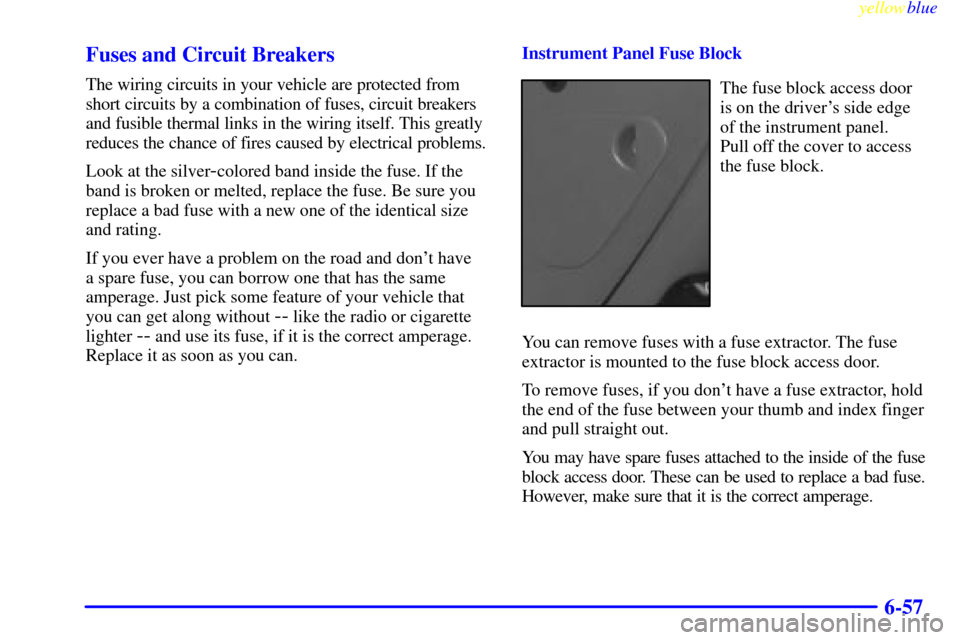
The fuse block access door
is on the driver's side edge
of the instrument panel.
Pull off the cover to access
the fuse block.
You can remove fuses with a fuse extractor. The fuse
extractor is mounted to the fuse block access door.
To remove fuses, if you don't have a fuse extractor, hold
the end of the fuse between your thumb and index finger
and pull straight out.
You may have spare fuses attached to the inside of the fuse
block access door. These can be used to replace a bad fuse.
However, make sure that it is the correct amperage.