Page 128 of 328

yellowblue
2-66
Have it checked right away. Driving with the voltmeter
reading in the lower warning zone could drain or
damage the battery. Driving with the voltmeter reading
in the upper warning zone could cause bulbs to burn out
(especially headlamp bulbs), various vehicle modules to
shut down (due to overload protection) and the
possibility of a battery acid leak.
If you idle the engine for a while, the voltmeter reading
might move into the red zone. If the reading stays in the
red zone while you are driving, you may have a problem
with the electrical charging system. Have it checked.
While the voltmeter reads in the red zone, the battery
may not be able to power certain electrical accessories,
like ABS. (If this happens, the ABS light will come on.
See ªAnti
-Lock Brakes System Warning Lightº in
this section.)
If you must drive a short distance with the voltmeter
reading in a warning zone, turn off all the accessories,
including the comfort controls and the audio system.
Brake System Warning Light
Your vehicle's hydraulic brake system is divided into
two parts. If one part isn't working, the other part can
still work and stop you. For good braking, though, you
need both parts working well.
If the warning light comes on, there is a brake problem.
Have your brake system inspected right away.
United States Canada
This light should come on briefly when you turn the
ignition key to ON. If it doesn't come on then, have it
fixed so it will be ready to warn you if there's
a problem.
If the light comes on while you are driving, pull off the
road and stop carefully. You may notice that the pedal is
harder to push. Or, the pedal may go closer to the floor.
It may take longer to stop. If the light is still on, have the
vehicle towed for service. (See ªTowing Your Vehicleº
in the Index.)
Page 129 of 328
yellowblue
2-67
CAUTION:
Your brake system may not be working properly
if the brake system warning light is on. Driving
with the brake system warning light on can lead
to an accident. If the light is still on after you've
pulled off the road and stopped carefully, have
the vehicle towed for service.
When the ignition is on, the brake system warning light
will also come on when you set your parking brake. The
light will stay on if your parking brake doesn't release
fully. If it stays on after your parking brake is fully
released, it means you have a brake problem.
Anti-Lock Brake System Warning Light
With the anti-lock brake
system, the light(s) will
come on when you start
your engine and may stay
on for several seconds.
That's normal.
If the light stays on, turn the ignition to OFF. Or, if the
light comes on when you're driving, stop as soon as
possible and turn the ignition off. Then start the engine
again to reset the system. If the light still stays on, or
comes on again while you're driving, your vehicle needs
service. If the regular brake system warning light isn't
on, you still have brakes, but you don't have anti
-lock
brakes. If the regular brake system warning light is also
on, you don't have anti
-lock brakes and there's a
problem with your regular brakes. See ªBrake System
Warning Lightº earlier in this section.
The anti
-lock brake system warning light should come
on briefly when you turn the ignition key to ON. If the
light doesn't come on then, have it fixed so it will be
ready to warn you if there is a problem.
Page 130 of 328

yellowblue
2-68 Traction Control System Warning Light
This warning light will flash
when the system senses a
traction change.
If it stays on, or comes on and stays on steady when
you're driving, there may be a problem with your
traction control system and your vehicle may need
service. When this warning light is on, the system will
not limit wheel spin. Adjust your driving accordingly.
The traction control system warning light may come on
for the following reasons:
�If there's a brake system problem that is specifically
related to traction control, the traction control system
will turn off and the warning light will come on.
�If the traction control system is affected by an
engine
-related problem, the system will turn off and
the warning light will come on.
If the traction control system warning light comes on
and stays on for an extended period of time when the
system is turned on, your vehicle needs service.
Engine Coolant Temperature
Warning Light
This light tells you that the
engine has overheated. If
this light comes on, you
should stop the vehicle and
turn the engine off as soon
as possible.
A warning chime should also sound if this light
comes on.
As a check, the light should come on for a few seconds
when you start the engine. See ªEngine Overheatingº in
the Index.
Page 135 of 328

yellowblue
2-73
When the light comes on and stays on, it means that oil
isn't flowing through the engine properly. You could
be low on oil and you might have some other
system problem.
CAUTION:
Don't keep driving if the oil pressure is low. If
you do, your engine can become so hot that it
catches fire. You or others could be burned.
Check your oil as soon as possible and have your
vehicle serviced.
NOTICE:
Damage to your engine from neglected oil
problems can be costly and is not covered by
your warranty.
Check Oil Light
This light will come on for
a few seconds when the
ignition is turned on. If the
light doesn't come on, have
it repaired.
If the light comes on while starting and stays on for
about one minute or comes on while driving, the engine
oil level should be checked. Prior to checking the oil
level, be sure your vehicle has been shut off for several
minutes and is on a level surface. Check the oil level and
bring it to the proper level. See ªEngine Oilº in
the Index.
Brake To Shift Light
This light will come on to
remind you that you must
press the brake pedal to
shift out of PARK (P).
Page 138 of 328
yellowblue
2-76 Automatic Transmission Warning Light
(If Equipped)
This light comes on briefly
when the ignition is turned
on. If the light remains on
or lights up while driving,
there may be a fault in the
automatic transmission.
Have your vehicle serviced.
Leveling Indicator Light
This light comes on steady
when the rear load level in
your vehicle changes.Do not drive your vehicle when this light is on. The rear
of your vehicle is too low and part of the body or the
rear axle may be damaged when driving over bumpy
roads. When the light goes out, leveling is complete.
This procedure is automatic
-- you don't have to
do anything.
If the light comes on flashing, there may be a problem
with the leveling system. You should reduce your
vehicle speed and have your vehicle serviced soon.
Brake Pad Wear Indicator Light
This light comes on when
the brake pads on your
vehicle have significantly
worn. The pads will have to
be replaced, so have your
vehicle serviced soon.
Page 171 of 328
4-
yellowblue
4-1
Section 4 Your Driving and the Road
Here you'll find information about driving on different kinds of roads and in varying weather conditions. We've also
included many other useful tips on driving.
4
-2 Defensive Driving
4
-3 Drunken Driving
4
-6 Control of a Vehicle
4
-6 Braking
4
-7 Anti-Lock Brakes (ABS)
4
-10 Steering
4
-12 Off-Road Recovery
4
-13 Passing
4
-14 Loss of Control
4
-15 Driving at Night4
-17 Driving in Rain and on Wet Roads
4
-19 City Driving
4
-20 Freeway Driving
4
-21 Before Leaving on a Long Trip
4
-22 Highway Hypnosis
4
-23 Hill and Mountain Roads
4
-24 Winter Driving
4
-28 Recreational Vehicle Towing
4
-29 Loading Your Vehicle
4
-31 Towing a Trailer
Page 172 of 328
yellowblue
4-2
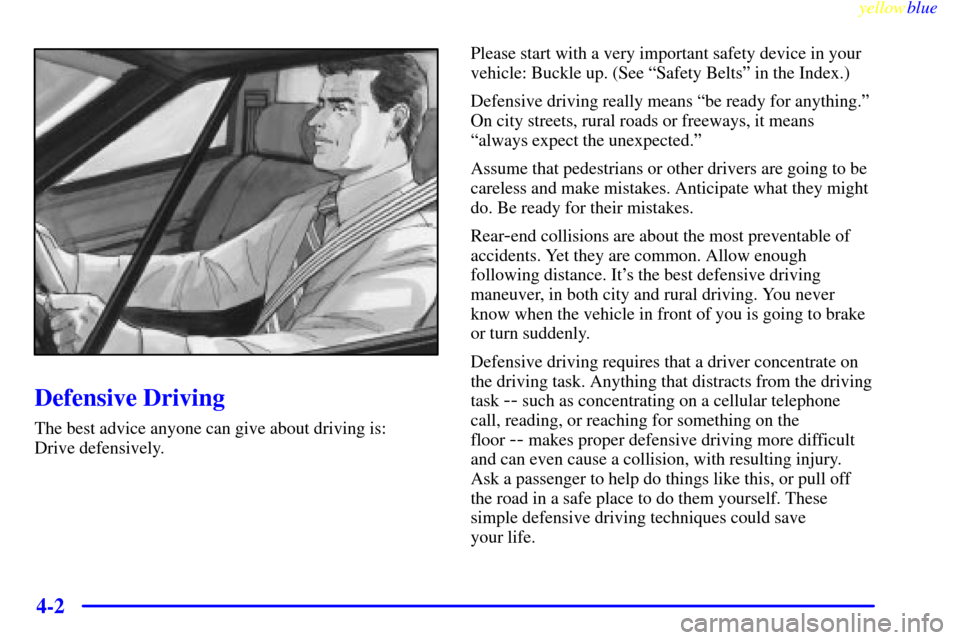
Defensive Driving
The best advice anyone can give about driving is:
Drive defensively.Please start with a very important safety device in your
vehicle: Buckle up. (See ªSafety Beltsº in the Index.)
Defensive driving really means ªbe ready for anything.º
On city streets, rural roads or freeways, it means
ªalways expect the unexpected.º
Assume that pedestrians or other drivers are going to be
careless and make mistakes. Anticipate what they might
do. Be ready for their mistakes.
Rear
-end collisions are about the most preventable of
accidents. Yet they are common. Allow enough
following distance. It's the best defensive driving
maneuver, in both city and rural driving. You never
know when the vehicle in front of you is going to brake
or turn suddenly.
Defensive driving requires that a driver concentrate on
the driving task. Anything that distracts from the driving
task
-- such as concentrating on a cellular telephone
call, reading, or reaching for something on the
floor
-- makes proper defensive driving more difficult
and can even cause a collision, with resulting injury.
Ask a passenger to help do things like this, or pull off
the road in a safe place to do them yourself. These
simple defensive driving techniques could save
your life.
Page 176 of 328

yellowblue
4-6
Control of a Vehicle
You have three systems that make your vehicle go where
you want it to go. They are the brakes, the steering and
the accelerator. All three systems have to do their work
at the places where the tires meet the road.
Sometimes, as when you're driving on snow or ice, it's
easy to ask more of those control systems than the tires
and road can provide. That means you can lose control
of your vehicle.
Braking
Braking action involves perception time and
reaction time.
First, you have to decide to push on the brake pedal.
That's perception time. Then you have to bring up your
foot and do it. That's reaction time.
Average reaction time is about 3/4 of a second. But
that's only an average. It might be less with one driver
and as long as two or three seconds or more with
another. Age, physical condition, alertness, coordination
and eyesight all play a part. So do alcohol, drugs and
frustration. But even in 3/4 of a second, a vehicle
moving at 60 mph (100 km/h) travels 66 feet (20 m).
That could be a lot of distance in an emergency, so
keeping enough space between your vehicle and others
is important.
And, of course, actual stopping distances vary greatly
with the surface of the road (whether it's pavement or
gravel); the condition of the road (wet, dry, icy); tire
tread; the condition of your brakes; the weight of the
vehicle and the amount of brake force applied.