Page 221 of 328
yellowblue
5-13 How to Add Coolant to the Coolant
Surge Tank
If you haven't found a problem yet, but the coolant level
isn't at the KALT/COLD line (seam), add a 50/50
mixture of clean, drinkable water and DEX
-COOL�
coolant at the coolant surge tank, but be sure the cooling
system, including the coolant surge tank pressure cap, is
cool before you do it. (See ªEngine Coolantº in the
Index for more information.)
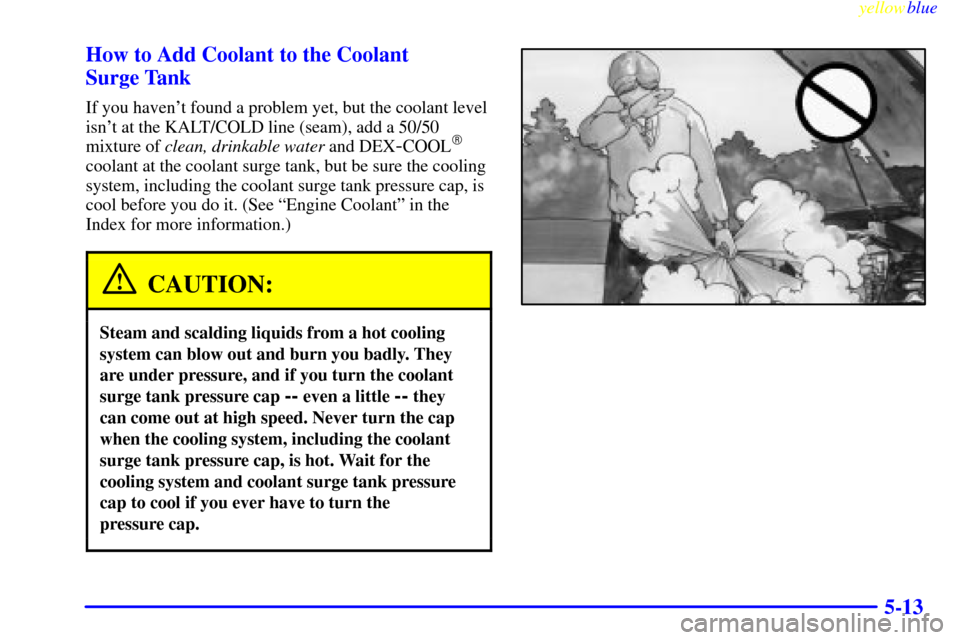
CAUTION:
Steam and scalding liquids from a hot cooling
system can blow out and burn you badly. They
are under pressure, and if you turn the coolant
surge tank pressure cap
-- even a little -- they
can come out at high speed. Never turn the cap
when the cooling system, including the coolant
surge tank pressure cap, is hot. Wait for the
cooling system and coolant surge tank pressure
cap to cool if you ever have to turn the
pressure cap.
Page 222 of 328
yellowblue
5-14
CAUTION:
Adding only plain water to your cooling system
can be dangerous. Plain water, or some other
liquid like alcohol, can boil before the proper
coolant mixture will. Your vehicle's coolant
warning system is set for the proper coolant
mixture. With plain water or the wrong mixture,
your engine could get too hot but you wouldn't
get the overheat warning. Your engine could
catch fire and you or others could be burned. Use
a 50/50 mixture of clean, drinkable water and
DEX
-COOL� coolant.
NOTICE:
In cold weather, water can freeze and crack
the engine, radiator, heater core and other parts.
So use the recommended coolant.
CAUTION:
You can be burned if you spill coolant on hot
engine parts. Coolant contains ethylene glycol
and it will burn if the engine parts are hot
enough. Don't spill coolant on a hot engine.
Page 223 of 328
yellowblue
5-15
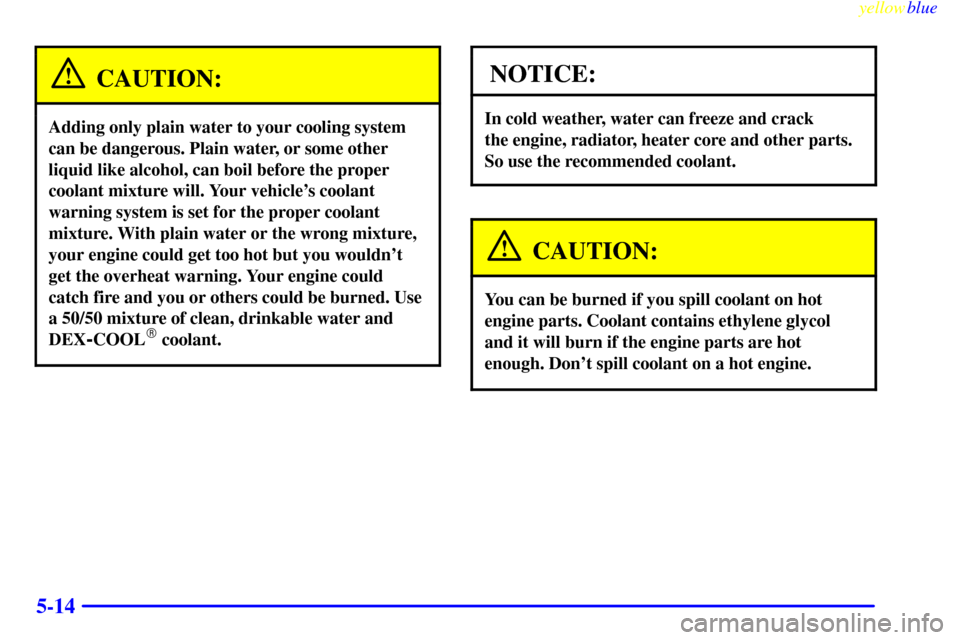
1. You can remove the coolant surge tank pressure cap
when the cooling system, including the coolant surge
tank pressure cap and upper radiator hose, is no
longer hot. Turn the pressure cap slowly
counterclockwise (left) until it first stops. (Don't
press down while turning the pressure cap.)
If you hear a hiss, wait for that to stop. A hiss means
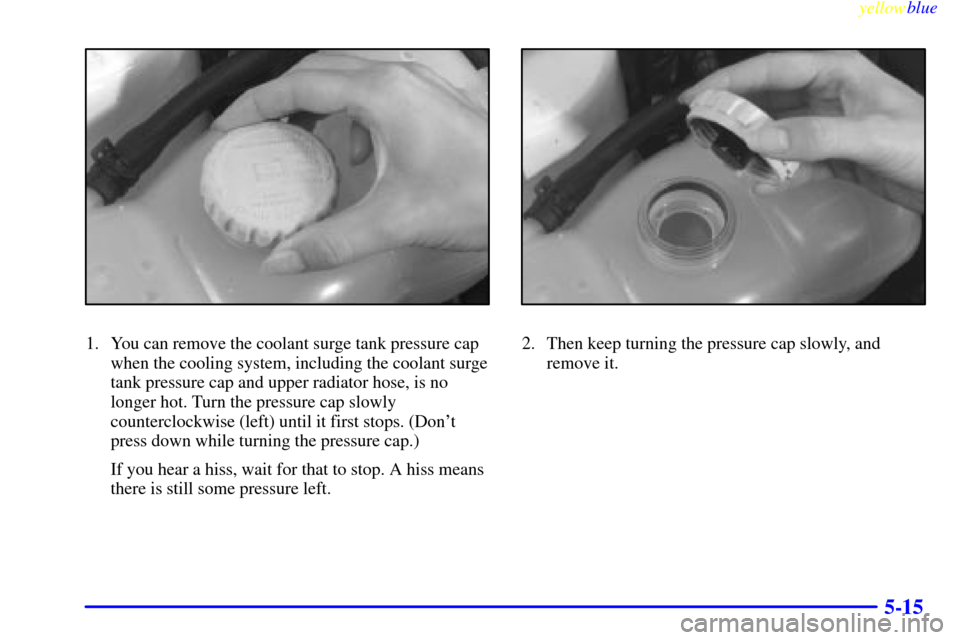
there is still some pressure left.2. Then keep turning the pressure cap slowly, and
remove it.
Page 224 of 328
yellowblue
5-16
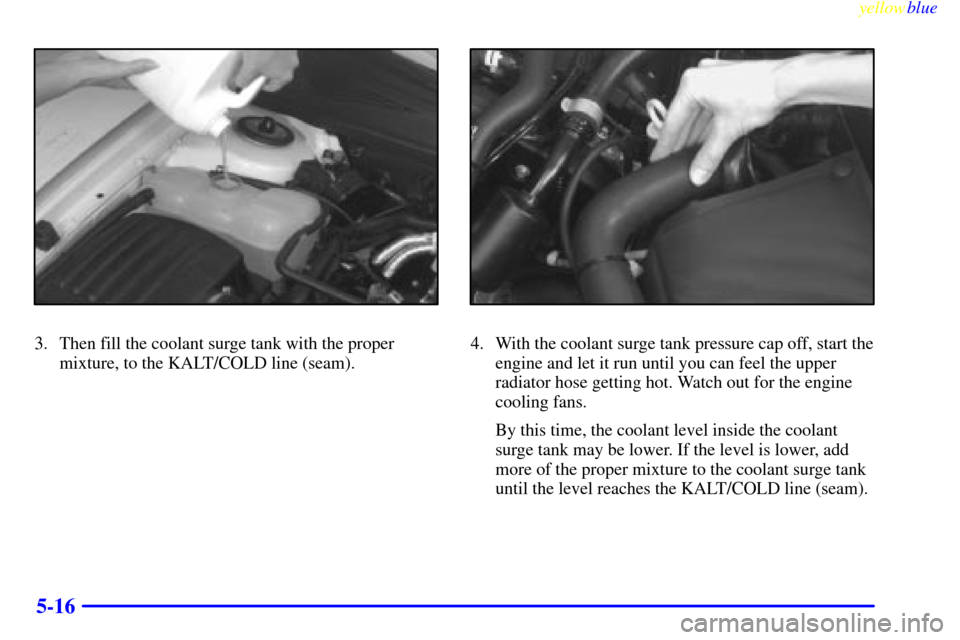
3. Then fill the coolant surge tank with the proper
mixture, to the KALT/COLD line (seam).4. With the coolant surge tank pressure cap off, start the
engine and let it run until you can feel the upper
radiator hose getting hot. Watch out for the engine
cooling fans.
By this time, the coolant level inside the coolant
surge tank may be lower. If the level is lower, add
more of the proper mixture to the coolant surge tank
until the level reaches the KALT/COLD line (seam).
Page 258 of 328
yellowblue
6-20
Surge Tank Pressure Cap
NOTICE:
The surge tank cap is a 14 psi (97 kPa)
pressure
-type cap and must be tightly installed to
prevent coolant loss and possible engine damage
from overheating.
If the surge tank pressure cap needs to be replaced, a
GM cap is recommended.
Thermostat
Engine coolant temperature is controlled by a thermostat
in the engine coolant system. The thermostat stops the
flow of coolant through the radiator until the coolant
reaches a preset temperature.
If the thermostat needs to be replaced, a GM thermostat
is recommended.
Engine Coolant
The cooling system in your vehicle is filled with
DEX
-COOL� engine coolant. This coolant is designed
to remain in your vehicle for 5 years or 150,000 miles
(240 000 km), whichever occurs first, if you add only
DEX
-COOL� extended life coolant.
The following explains your cooling system and how to
add coolant when it is low. If you have a problem with
engine overheating, see ªEngine Overheatingº in
the Index.
A 50/50 mixture of clean, drinkable water and
DEX
-COOL� coolant will:
�Give freezing protection down to
-34�F (-37�C).
�Give boiling protection up to 265�F (129�C).
�Protect against rust and corrosion.
�Help keep the proper engine temperature.
�Let the warning lights and gages work as
they should.
Page 259 of 328
yellowblue
6-21
NOTICE:
When adding coolant, it is important that you use
only DEX
-COOL� (silicate-free) coolant.
If coolant other than DEX-COOL is added to the
system, premature engine, heater core or
radiator corrosion may result. In addition, the
engine coolant will require change sooner
-- at
30,000 miles (50 000 km) or 24 months,
whichever occurs first. Damage caused by the use
of coolant other than DEX
-COOL� is not
covered by your new vehicle warranty.
What to Use
Use a mixture of one-half clean, drinkable water and
one
-half DEX-COOL� coolant which won't damage
aluminum parts. If you use this coolant mixture, you
don't need to add anything else.
CAUTION:
Adding only plain water to your cooling system
can be dangerous. Plain water, or some other
liquid like alcohol, can boil before the proper
coolant mixture will. Your vehicle's coolant
warning system is set for the proper coolant
mixture. With plain water or the wrong mixture,
your engine could get too hot but you wouldn't
get the overheat warning. Your engine could
catch fire and you or others could be burned. Use
a 50/50 mixture of clean, drinkable water and
DEX
-COOL� coolant.
Page 260 of 328
yellowblue
6-22
NOTICE:
If you use an improper coolant mixture, your
engine could overheat and be badly damaged.
The repair cost wouldn't be covered by your
warranty. Too much water in the mixture can
freeze and crack the engine, radiator, heater core
and other parts.
If you have to add coolant more than four times a year,
have your dealer check your cooling system.
NOTICE:
If you use the proper coolant, you don't have to
add extra inhibitors or additives which claim to
improve the system. These can be harmful.
Checking Coolant
The surge tank is located behind the air cleaner on the
passenger's side of the engine.
The cooling system when hot is under a lot of pressure.
If the low coolant warning light on the instrument panel
appears, you will need to add coolant.
Page 283 of 328
yellowblue
6-45
NOTICE:
The wrong wheel can also cause problems with
bearing life, brake cooling, speedometer or
odometer calibration, headlamp aim, bumper
height, vehicle ground clearance and tire or tire
chain clearance to the body and chassis.
See ªChanging a Flat Tireº in the Index for
more information.
Used Replacement Wheels
CAUTION:
Putting a used wheel on your vehicle is
dangerous. You can't know how it's been used or
how far it's been driven. It could fail suddenly
and cause an accident. If you have to replace a
wheel, use a new GM original equipment wheel.
Tire Chains
NOTICE:
Use tire chains only where legal and only when
you must. Use only SAE Class ªSº type chains
that are the proper size for your tires. Install
them on the rear tires and tighten them as tightly
as possible with the ends securely fastened. Drive
slowly and follow the chain manufacturer's
instructions. If you can hear the chains
contacting your vehicle, stop and retighten them.
If the contact continues, slow down until it stops.
Driving too fast or spinning the wheels with
chains on will damage your vehicle.