Page 248 of 368
yellowblue
6-8
Filling a Portable Fuel Container
CAUTION:
Never fill a portable fuel container while it is in
your vehicle. Static electricity discharge from the
container can ignite the gasoline vapor. You can
be badly burned and your vehicle damaged if this
occurs. To help avoid injury to you and others:
�Dispense gasoline only into
approved containers.
�Do not fill a container while it is inside a
vehicle, in a vehicle's trunk, pickup bed or
on any surface other than the ground.
�Bring the fill nozzle in contact with the
inside of the fill opening before operating
the nozzle. Contact should be maintained
until the filling is complete.
�Don't smoke while pumping gasoline.
Checking Things Under the Hood
CAUTION:
An electric fan under the hood can start up and
injure you even when the engine is not running.
Keep hands, clothing and tools away from any
underhood electric fan.
CAUTION:
Things that burn can get on hot engine parts and
start a fire. These include liquids like gasoline,
oil, coolant, brake fluid, windshield washer and
other fluids, and plastic or rubber. You or others
could be burned. Be careful not to drop or spill
things that will burn onto a hot engine.
ProCarManuals.com
Page 252 of 368

yellowblue
6-12
3800 Supercharged (Code 1) V6
Engine (If Equipped)
Your vehicle may have a 3800 Supercharged V6 engine.
The supercharger is a device which is designed to pump
more air into the engine than it would normally use.
This air is mixed with fuel, which creates increased
engine power. Since the supercharger is a pump and is
driven from an engine accessory drive belt, increased
pressure is available at all driving conditions.
The Powertrain Control Module (PCM), works with a
vacuum control to regulate the increased pressure
required during specific driving conditions. When this
increased pressure or boost is not desired, such as during
idling and light throttle cruising, the excess air that the
supercharger is pumping is routed through a bypass. All
of these controls working together provide high
performance character and fuel efficiency in the
3800 Supercharged (Code 1) V6 engine.
Engine Oil
If the LOW OIL light on the
instrument panel comes on,
it means you need to check
your engine oil level
right away.
For more information, see ªLow Oil Level Lightº in the
Index. You should check your engine oil level regularly;
this is an added reminder.
It's a good idea to check your engine oil every time you
get fuel. In order to get an accurate reading, the oil must
be warm and the vehicle must be on level ground.
ProCarManuals.com
Page 278 of 368
yellowblue
6-38
The vehicle should be properly prepared as follows:
�The vehicle must have all four tires on a perfectly
level surface.
�If necessary, pads may be used on an uneven surface.
�The vehicle should not have any snow, ice or mud
attached to it.
�The vehicle should be fully assembled and all other
work stopped while headlamp aiming is being done.
�There should not be any cargo or loading of the
vehicle, except it should have a full tank of fuel and
one person or 160 lbs. (75 kg) on the driver's seat.
�Close all doors.
�Tires should be properly inflated.
�Rock the vehicle to stabilize the suspension.
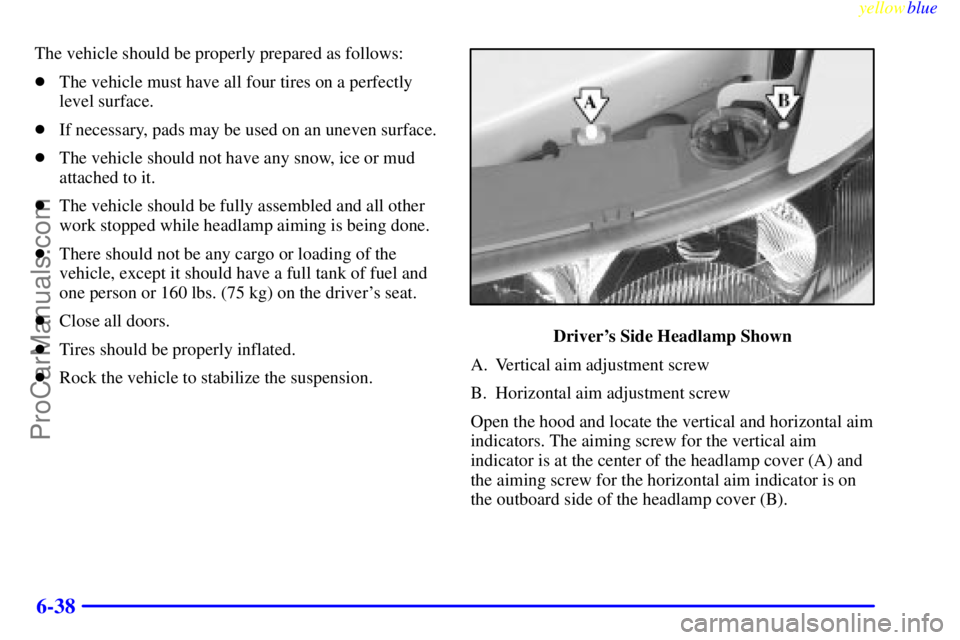
Driver's Side Headlamp Shown
A. Vertical aim adjustment screw
B. Horizontal aim adjustment screw
Open the hood and locate the vertical and horizontal aim
indicators. The aiming screw for the vertical aim
indicator is at the center of the headlamp cover (A) and
the aiming screw for the horizontal aim indicator is on
the outboard side of the headlamp cover (B).
ProCarManuals.com
Page 286 of 368

yellowblue
6-46 Inflation -- Tire Pressure
The Tire-Loading Information label, which is on the
inside of the trunk lid, shows the correct inflation
pressures for your tires when they're cold. ªColdº
means your vehicle has been sitting for at least three
hours or driven no more than 1 mile (1.6 km).
NOTICE:
Don't let anyone tell you that underinflation or
overinflation is all right. It's not. If your tires
don't have enough air (underinflation), you can
get the following:
�Too much flexing
�Too much heat
�Tire overloading
�Bad wear
�Bad handling
�Bad fuel economy.
NOTICE: (Continued)
NOTICE: (Continued)
If your tires have too much air (overinflation),
you can get the following:
�Unusual wear
�Bad handling
�Rough ride
�Needless damage from road hazards.
When to Check
Check your tires once a month or more.
Don't forget your compact spare tire. It should be at
60 psi (420 kPa).
How to Check
Use a good quality pocket
-type gage to check tire
pressure. You can't tell if your tires are properly inflated
simply by looking at them. Radial tires may look
properly inflated even when they're underinflated.
Be sure to put the valve caps back on the valve stems.
They help prevent leaks by keeping out dirt
and moisture.
ProCarManuals.com
Page 302 of 368

yellowblue
6-62
Finish Damage
Any stone chips, fractures or deep scratches in the finish
should be repaired right away. Bare metal will corrode
quickly and may develop into a major repair expense.
Minor chips and scratches can be repaired with touch
-up
materials available from your dealer or other service
outlets. Larger areas of finish damage can be corrected
in your dealer's body and paint shop.
Underbody Maintenance
Chemicals used for ice and snow removal and dust
control can collect on the underbody. If these are not
removed, accelerated corrosion (rust) can occur on the
underbody parts such as fuel lines, frame, floor pan
and exhaust system even though they have
corrosion protection.
At least every spring, flush these materials from the
underbody with plain water. Clean any areas where mud
and other debris can collect. Dirt packed in closed areas
of the frame should be loosened before being flushed.
Your dealer or an underbody car washing system can do
this for you.
Chemical Paint Spotting
Some weather and atmospheric conditions can create a
chemical fallout. Airborne pollutants can fall upon and
attack painted surfaces on your vehicle. This damage
can take two forms: blotchy, ringlet
-shaped
discolorations, and small irregular dark spots etched into
the paint surface.
Although no defect in the paint job causes this, Buick
will repair, at no charge to the owner, the surfaces of
new vehicles damaged by this fallout condition within
12 months or 12,000 miles (20 000 km) of purchase,
whichever occurs first.
ProCarManuals.com
Page 309 of 368
yellowblue
6-69
Fuse Description
3 Power Seats, Rear Defog,
Heated Seats
4 High Blower, Hazard Flasher,
Stoplamps, Power Mirror,
Door Locks
5 Ignition Switch, BTSI, Stoplamps,
ABS, Turn Signals, Cluster, Air
Bag, DRL Module
6 Cooling Fan
7 Interior Lamps, Retained
Accessory Power, Keyless Entry,
CEL TEL, Data Link, HVAC
Head, Cluster, Radio, AUX Power
(Power Drop), Cigarette Lighter
8 Ignition Switch, Wipers, Radio,
Steering Wheel Controls, Body
Control Module, AUX Power
(Power Drop), Power Windows,
Sunroof, HVAC Controls, DRL,
Rear Defog Relay
9 Cooling Fan 2
10 Cooling Fan 3Relay Description
11 Starter Solenoid
12 Cooling Fan 1
13 Ignition Main
14 Not Used
15 A/C Clutch
16 Horn
17 Fog Lamps
18 Fuel Pump, Speed Control
(L67 only)
19 Fuel Pump
20 Not Used
21 Generator
22 ECM
23 A/C Compressor Clutch
24 Cooling Fan
25 Electronic Ignition
26 Transaxle
ProCarManuals.com
Page 310 of 368
yellowblue
6-70
Fuse Description
27 Horn
28 Fuel Injector
29 Oxygen Sensor
30 Engine Emissions
31 Fog Lamps
32 Headlamp (Right)
33 Rear Compartment Release
34 Parking Lamps
35 Fuel PumpFuse Description
36 Headlamp (Left)
37 Spare
38 Spare
39 Spare
40 Spare
41 Spare
42 Spare
43 Fuse Puller
SYMBOL A/C Compressor Clutch Diode
ProCarManuals.com
Page 311 of 368

yellowblue
6-71
Replacement Bulbs
Exterior Lamps Bulb Number
Back
-Up 1156. . . . . . . . . . . . . . . . . . . . . . . . . . . . . . .
Center High
-Mounted Stop 3155. . . . . . . . . . . . . . . .
Front Parking/Turn Signal 4175 NAK. . . . . . . . . . . . .
Headlamp, High Beam 9005. . . . . . . . . . . . . . . . . . . .
Headlamp, Low Beam 9006. . . . . . . . . . . . . . . . . . . .
Stop/Tail/Turn Signal 3057. . . . . . . . . . . . . . . . . . . . .
Tail (Applique) 194. . . . . . . . . . . . . . . . . . . . . . . . . . .
Inside Lamps BulbNumber
Dome Lamp 9425542. . . . . . . . . . . . . . . . . . . . . . . . .
*For service information on these bulbs, contact your
dealer service department.
Capacities and Specifications
4T65E:
Automatic Transaxle
Pan Removal and Replacement 7.4 quarts (7.0 L). .
After Complete Overhaul 10.0 quarts (9.5 L). . . . .
* When draining/replacing converter, more fluid will
be needed.
Cooling System Including Reservoir
3800 (Code K) V6 12.3 quarts (11.6 L). . . . . . . . . . .
3800 Supercharged (Code 1) V6 12.3 quarts (11.6 L)
Refrigerant (R
-134a), Air Conditioning*1.88 lbs.
(0.85 kg)
*See ªAir Conditioning Refrigerantsº later in this
section.
Engine Crankcase
Oil and Filter Change 4.5 quarts (4.3 L). . . . . . . . . . .
Wheel Nut Torque100 lb
-ft (140 N´m) . . . . . . . . . .
Fuel Tank17.5 gallons (66.2 L) . . . . . . . . . . . . . . . . .
*Note: All capacities are approximate. When adding, be
sure to fill to the approximate level, as recommended in
this manual. See ªRecommended Fluids and Lubricantsº
in the Index.
ProCarManuals.com

