Page 220 of 400
yellowblue
4-32
CAUTION:
Do not load your vehicle any heavier than the
GVWR, or either the maximum front or rear
GAWR. If you do, parts on your vehicle can
break, and it can change the way your vehicle
handles. These could cause you to lose control
and crash. Also, overloading can shorten the life
of your vehicle.
NOTICE:
Your warranty does not cover parts or
components that fail because of overloading.
If you put things inside your vehicle -- like suitcases,
tools, packages, or anything else
-- they will go as fast
as the vehicle goes. If you have to stop or turn quickly,
or if there is a crash, they'll keep going.
CAUTION:
Things you put inside your vehicle can strike
and injure people in a sudden stop or turn, or in
a crash.
�Put things in the trunk of your vehicle. In a
trunk, put them as far forward as you can.
Try to spread the weight evenly.
�Never stack heavier things, like suitcases,
inside the vehicle so that some of them are
above the tops of the seats.
�Don't leave an unsecured child restraint in
your vehicle.
�When you carry something inside the
vehicle, secure it whenever you can.
Electronic Level Control
This feature keeps the rear of your vehicle level as the
load changes. It's automatic
-- you don't need to
adjust anything.
ProCarManuals.com
Page 247 of 400
yellowblue
5-19 Removing the Spare Tire and Tools
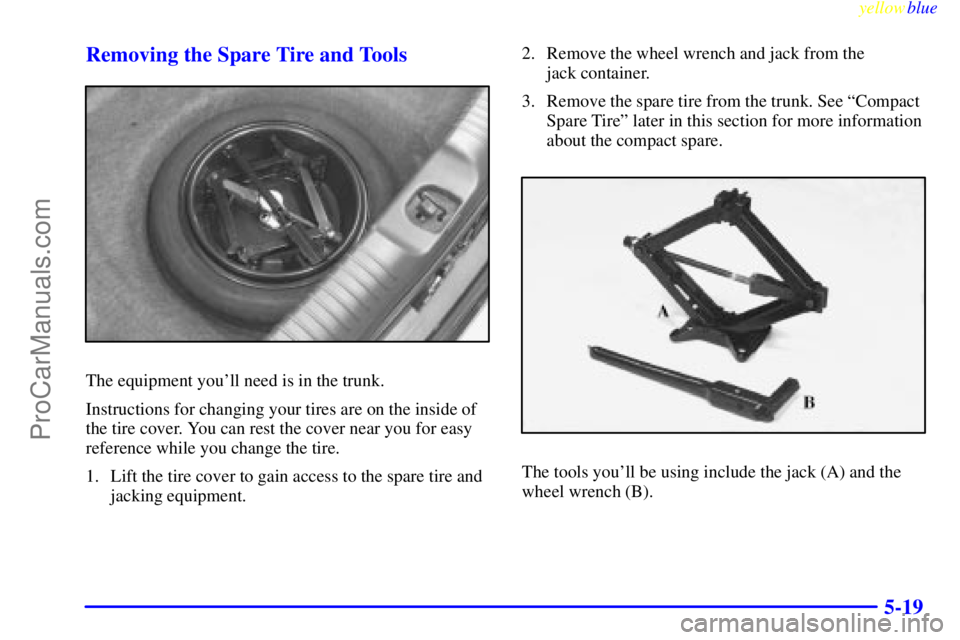
The equipment you'll need is in the trunk.
Instructions for changing your tires are on the inside of
the tire cover. You can rest the cover near you for easy
reference while you change the tire.
1. Lift the tire cover to gain access to the spare tire and
jacking equipment.2. Remove the wheel wrench and jack from the
jack container.
3. Remove the spare tire from the trunk. See ªCompact
Spare Tireº later in this section for more information
about the compact spare.
The tools you'll be using include the jack (A) and the
wheel wrench (B).
ProCarManuals.com
Page 253 of 400
yellowblue
5-25
NOTICE:
Improperly tightened wheel nuts can lead to
brake pulsation and rotor damage. To avoid
expensive brake repairs, evenly tighten the wheel
nuts in the proper sequence and to the proper
torque specification.
Store the wheel cover in the trunk until you have the
flat tire repaired or replaced.
NOTICE:
Wheel covers won't fit on your compact spare. If
you try to put a wheel cover on your compact
spare, you could damage the cover or the spare.
Storing the Flat Tire and Tools
CAUTION:
Storing a jack, a tire or other equipment in the
passenger compartment of the vehicle could
cause injury. In a sudden stop or collision, loose
equipment could strike someone. Store all these
in the proper place.
After you've put the compact spare tire on your vehicle,
you'll need to store the flat tire in your trunk. Use the
following procedure to secure the flat tire in the trunk.
Store the flat tire as far forward in the trunk as possible.
Store the jack and wheel wrench in their compartment in
the trunk.
ProCarManuals.com
Page 264 of 400
yellowblue
6-6
Filling Your Tank
CAUTION:
Gasoline vapor is highly flammable. It burns
violently, and that can cause very bad injuries.
Don't smoke if you're near gasoline or refueling
your vehicle. Keep sparks, flames and smoking
materials away from gasoline.
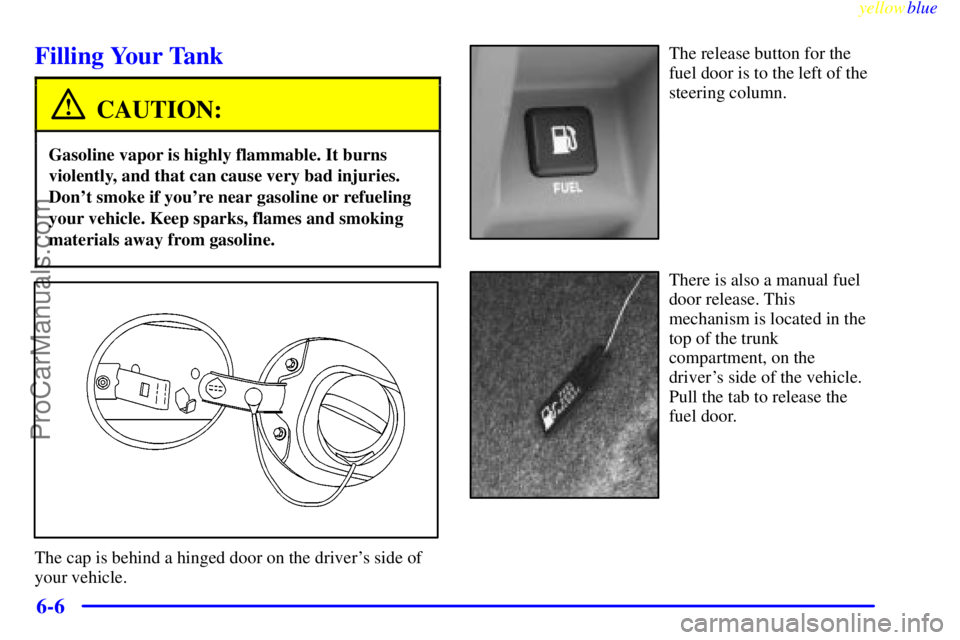
The cap is behind a hinged door on the driver's side of
your vehicle.
The release button for the
fuel door is to the left of the
steering column.
There is also a manual fuel
door release. This
mechanism is located in the
top of the trunk
compartment, on the
driver's side of the vehicle.
Pull the tab to release the
fuel door.
ProCarManuals.com
Page 266 of 400
yellowblue
6-8
NOTICE:
If you need a new cap, be sure to get the right
type. Your dealer can get one for you. If you get
the wrong type, it may not fit properly. This may
cause your malfunction indicator lamp to light
and your fuel tank and emissions system may be
damaged. See ªMalfunction Indicator Lampº in
the Index.
Filling a Portable Fuel Container
CAUTION:
Never fill a portable fuel container while it is in
your vehicle. Static electricity discharge from the
container can ignite the gasoline vapor. You can
be badly burned and your vehicle damaged if this
occurs. To help avoid injury to you and others:
�Dispense gasoline only into
approved containers.
�Do not fill a container while it is inside a
vehicle, in a vehicle's trunk, pickup bed or
on any surface other than the ground.
�Bring the fill nozzle in contact with the
inside of the fill opening before operating
the nozzle. Contact should be maintained
until the filling is complete.
�Don't smoke while pumping gasoline.
ProCarManuals.com
Page 298 of 400
yellowblue
6-40 Rear Turn Signal/Stoplamp
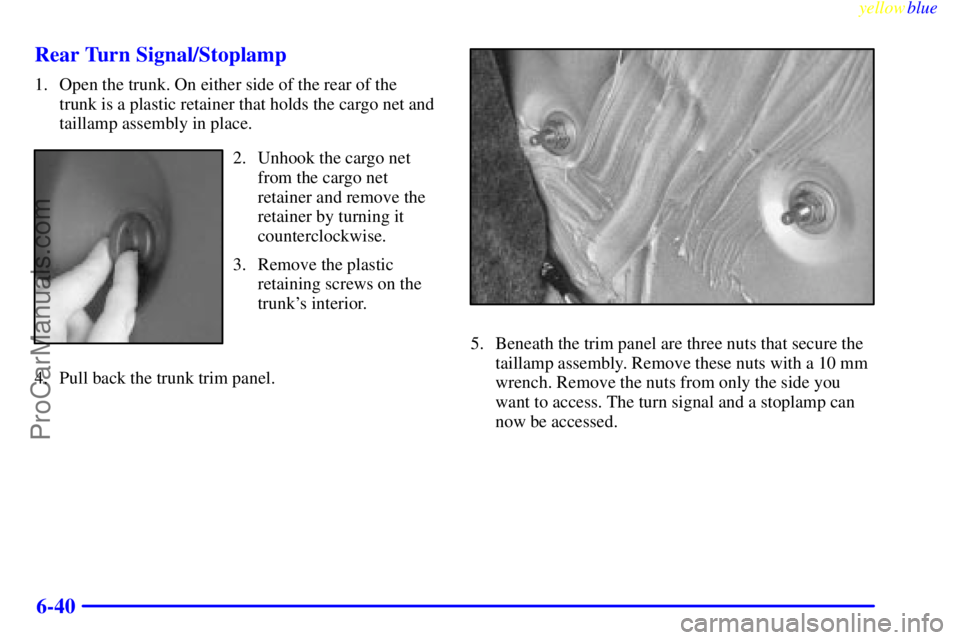
1. Open the trunk. On either side of the rear of the
trunk is a plastic retainer that holds the cargo net and
taillamp assembly in place.
2. Unhook the cargo net
from the cargo net
retainer and remove the
retainer by turning it
counterclockwise.
3. Remove the plastic
retaining screws on the
trunk's interior.
4. Pull back the trunk trim panel.
5. Beneath the trim panel are three nuts that secure the
taillamp assembly. Remove these nuts with a 10 mm
wrench. Remove the nuts from only the side you
want to access. The turn signal and a stoplamp can
now be accessed.
ProCarManuals.com
Page 300 of 400
yellowblue
6-42 Rear Turn Signals/Stoplamps/Back-Up
Lamps
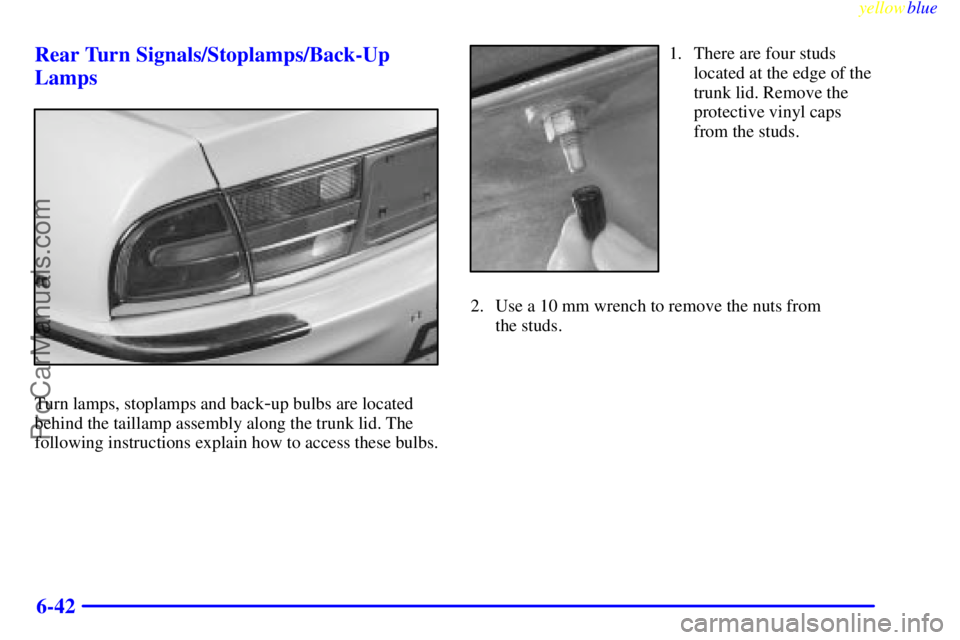
Turn lamps, stoplamps and back-up bulbs are located
behind the taillamp assembly along the trunk lid. The
following instructions explain how to access these bulbs.
1. There are four studs
located at the edge of the
trunk lid. Remove the
protective vinyl caps
from the studs.
2. Use a 10 mm wrench to remove the nuts from
the studs.
ProCarManuals.com
Page 301 of 400
yellowblue
6-43
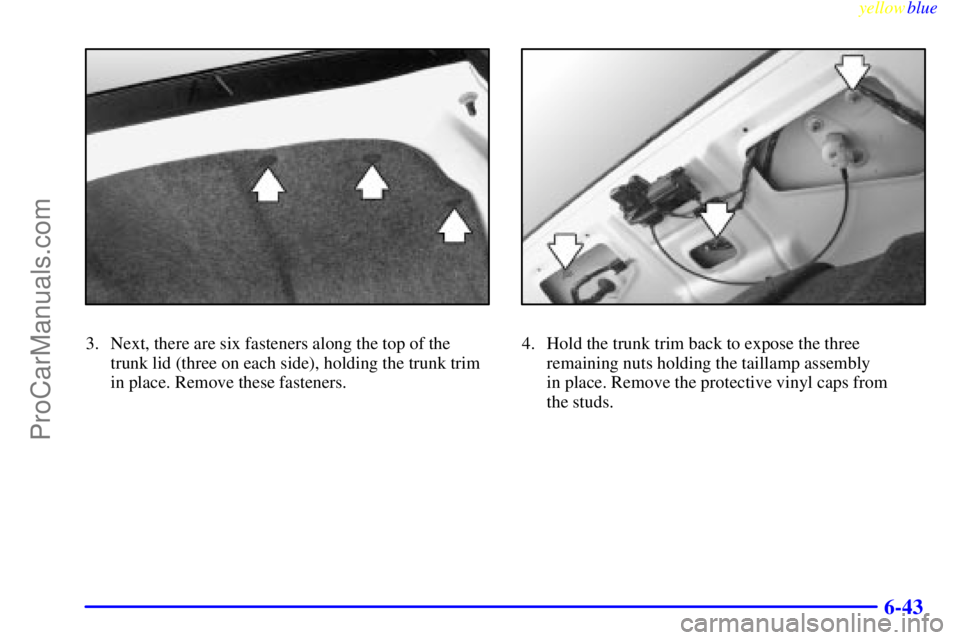
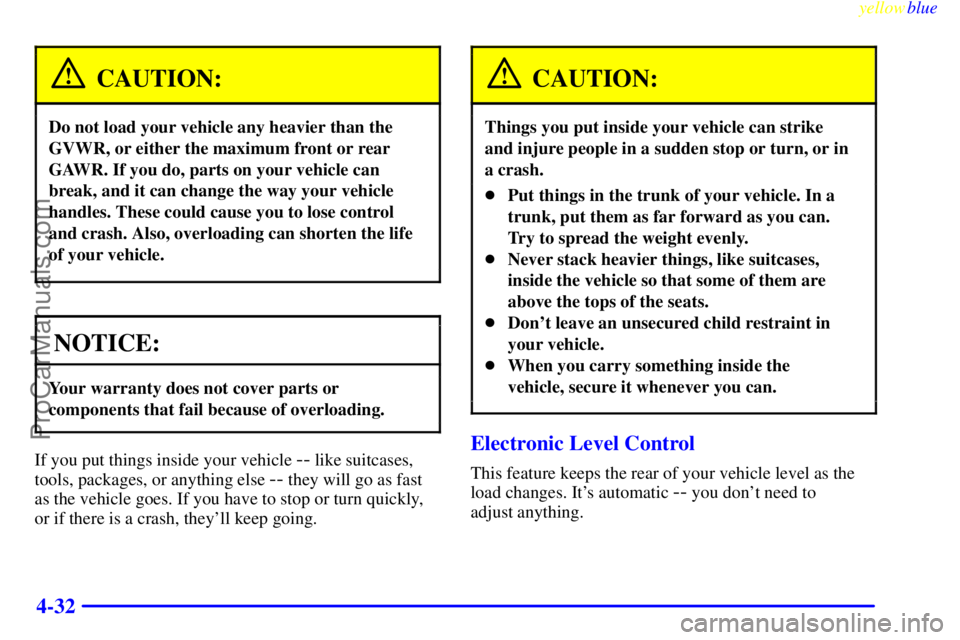
3. Next, there are six fasteners along the top of the
trunk lid (three on each side), holding the trunk trim
in place. Remove these fasteners.4. Hold the trunk trim back to expose the three
remaining nuts holding the taillamp assembly
in place. Remove the protective vinyl caps from
the studs.
ProCarManuals.com