Page 106 of 400
yellowblue
2-48 Front Reading Lamps
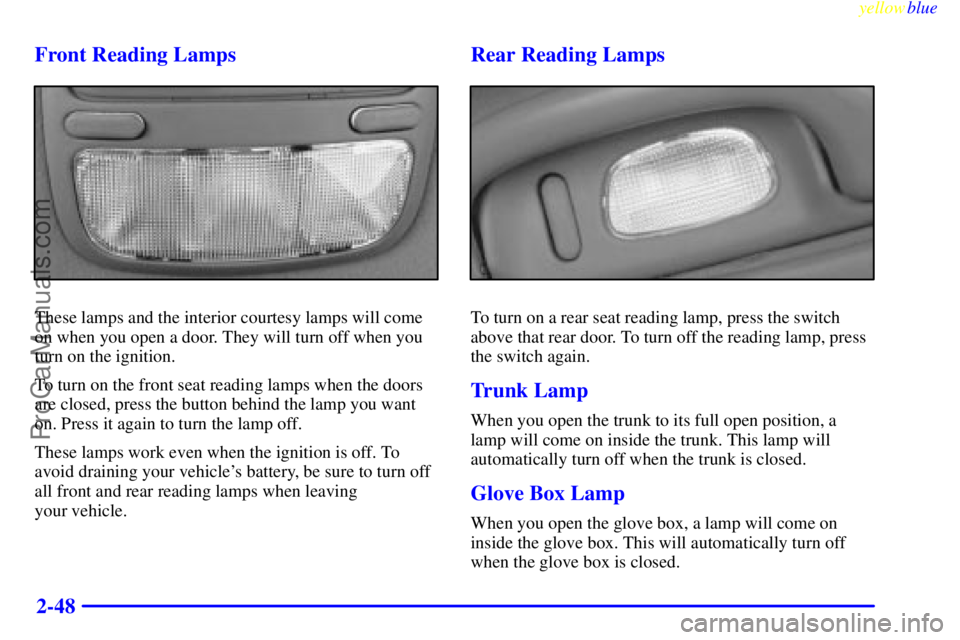
These lamps and the interior courtesy lamps will come
on when you open a door. They will turn off when you
turn on the ignition.
To turn on the front seat reading lamps when the doors
are closed, press the button behind the lamp you want
on. Press it again to turn the lamp off.
These lamps work even when the ignition is off. To
avoid draining your vehicle's battery, be sure to turn off
all front and rear reading lamps when leaving
your vehicle.
Rear Reading Lamps
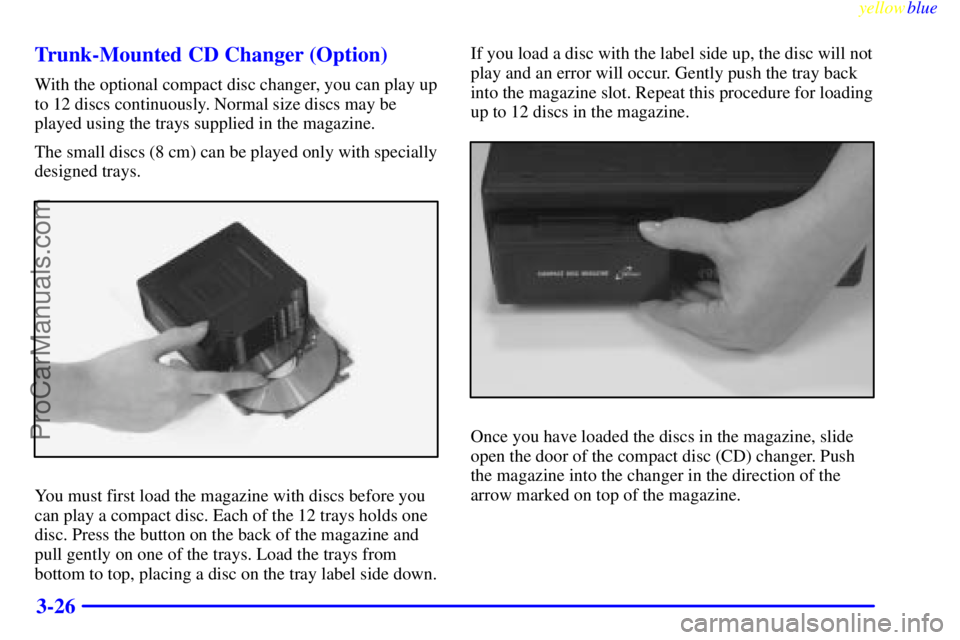
To turn on a rear seat reading lamp, press the switch
above that rear door. To turn off the reading lamp, press
the switch again.
Trunk Lamp
When you open the trunk to its full open position, a
lamp will come on inside the trunk. This lamp will
automatically turn off when the trunk is closed.
Glove Box Lamp
When you open the glove box, a lamp will come on
inside the glove box. This will automatically turn off
when the glove box is closed.
ProCarManuals.com
Page 118 of 400
yellowblue
2-60 Rear Seat Pass Through
Your vehicle is equipped with a rear storage armrest
with a pass
-through feature that allows for trunk access.
Pull the rear armrest down, then push down on the trunk
access panel latch to open the panel. To close, push the
access panel until it latches.
Convenience Net
Your vehicle has a convenience net. You'll see it just
inside the back wall of the trunk.
Put small loads, like grocery bags, behind the net. It can
help keep them from falling over during sharp turns or
quick starts and stops.
The net isn't for larger, heavier loads. Store them in the
trunk as far forward as you can.
You can unhook the net so that it will lie flat when
you're not using it.
Ashtrays and Cigarette Lighter
Front Ashtray
The front ashtray may be removed for cleaning. To
remove, grasp the sides and pull forward.
Rear Ashtray
The rear ashtrays are located on each rear door panel. To
remove the rear ashtray, open the lid and ease the
ashtray upward until the edge can be grasped to pull the
ashtray up and out.
NOTICE:
Don't put papers or other flammable things
into your ashtrays. Hot cigarettes or other
smoking materials could ignite them, causing a
damaging fire.
ProCarManuals.com
Page 127 of 400
yellowblue
2-69
The main components of your instrument panel are:
A. Air Outlet
B. Headlamps/Parking Lamps Switch
C. Turn Signal/Multifunction Lever
D. Instrument Cluster/Gages
E. Hazard Warning Flasher Switch
F. Climate Control System and Audio Steering Wheel
Controls
G. Gearshift Lever
H. Audio System
I. Air OutletJ. Fuel Button
K. Trunk Release and Lockout Button
L. Hood Release
M. Audio System Steering Wheel Controls
N. Ignition Switch
O. Traction Control Switch
P. Ashtray and Cigarette Lighter
Q. Climate Control System
R. Glove Box
S. Passenger Climate Control
ProCarManuals.com
Page 145 of 400

yellowblue
2-87
Tire Pressure Status: Press the GAGE INFO button
until TIRE PRESSURE appears in the display. TIRE
PRESSURE NORMAL is displayed when the Check
Tire Pressure System believes your vehicle's tire
pressures are normal. If a potential tire pressure problem
is detected, the display will show TIRE PRESSURE
LOW: CHECK TIRES. If you see the TIRE
PRESSURE LOW: CHECK TIRES message, you
should stop as soon as you can and check all your tires
for damage. (If a tire is flat, see ªIf a Tire Goes Flatº in
the Index.) Also check the tire pressure in all four tires
as soon as you can. See ªInflation
- Tire Pressureº and
ªCheck Tire Pressure Systemº in the Index.
There are times when you will have to reset (calibrate)
the Check Tire Pressure System. See ªCheck Tire
Pressure Systemº in the Index.
DIC Warnings and Messages
Other messages or warnings may appear in the DIC
display such as:
�WINDSHIELD WASHER FLUID LOW
�ENG COOLANT LOW
- CHECK LEVEL
�ENGINE OIL LOW
- CHECK LEVEL
�CHANGE ENGINE OIL SOON�TRACTION CONTROL SYSTEM ACTIVE
�DOOR AJAR
�TRUNK AJAR
Pressing any of the DIC control buttons will remove the
above messages or warnings from the DIC display.
DIC Display and
Personal Choice Programming
The DIC is used to program the personal choices of two
drivers. The drivers are recognized as DRIVER #1 and
DRIVER #2. The DIC will identify a person as UNKNOWN
DRIVER if they are neither DRIVER #1 nor DRIVER #2.
You will let the DIC know which driver you are by using
your remote keyless entry transmitter or by pressing one of
the MEMORY buttons located on the driver's door. Each
remote keyless entry transmitter was pre
-programmed to
belong to DRIVER #1 or DRIVER #2. Each transmitter may
be programmed differently for each driver.
After you press UNLOCK on your transmitter and the
ignition is in RUN, the DIC will automatically display
the identified driver number. The vehicle will recall the
personal choice settings that were last made to
correspond to your transmitter, including your radio and
comfort control settings. See ªComfort Controls,
Personal Choiceº in the Index.
ProCarManuals.com
Page 153 of 400

3-
yellowblue
3-1
Section 3 Comfort Controls and Audio Systems
In this section, you'll find out how to operate the comfort control and audio systems offered with your vehicle. Be
sure to read about the particular systems supplied with your vehicle.
3
-2 Comfort Controls
3
-2 Personal Choice Comfort Controls
(If Equipped)
3
-2 Dual Automatic ComforTemp Climate Control
3
-5 Air Conditioning
3
-6 Heating
3
-6 Defogging and Defrosting
3
-6 Rear Window Defogger
3
-7 Passenger Climate Control
3
-7 Ventilation System
3
-9 Passenger Compartment Air Filter
3
-10 Steering Wheel Controls for Climate Control
(If Equipped)
3
-10 Setting the Clock
3
-10 AM-FM Stereo with Cassette Tape Player
(If Equipped)3
-14 AM-FM Stereo with Cassette Tape Player and
Automatic Tone Control (If Equipped)
3
-17 AM-FM Stereo with Compact Disc Player and
Automatic Tone Control (If Equipped)
3
-21 AM-FM Stereo with Cassette Tape and
Compact Disc Player with Automatic Tone
Control (If Equipped)
3
-26 Trunk-Mounted CD Changer (If Equipped)
3
-29 Personal Choice Radio Controls (If Equipped)
3
-29 Theft-Deterrent Feature
3
-31 Audio Steering Wheel Controls (If Equipped)
3
-32 Understanding Radio Reception
3
-32 Tips About Your Audio System
3
-33 Care of Your Cassette Tape Player
3
-34 Care of Your Compact Discs
3
-35 Care of Your Compact Disc Player
3
-35 Heated Backlite Antenna
ProCarManuals.com
Page 178 of 400
yellowblue
3-26 Trunk-Mounted CD Changer (Option)
With the optional compact disc changer, you can play up
to 12 discs continuously. Normal size discs may be
played using the trays supplied in the magazine.
The small discs (8 cm) can be played only with specially
designed trays.
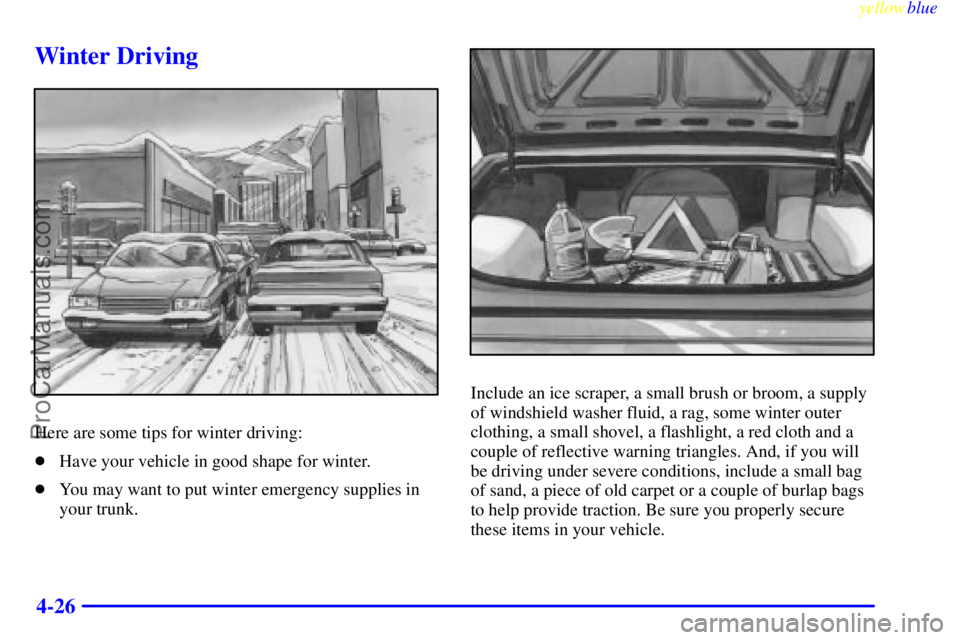
You must first load the magazine with discs before you
can play a compact disc. Each of the 12 trays holds one
disc. Press the button on the back of the magazine and
pull gently on one of the trays. Load the trays from
bottom to top, placing a disc on the tray label side down.If you load a disc with the label side up, the disc will not
play and an error will occur. Gently push the tray back
into the magazine slot. Repeat this procedure for loading
up to 12 discs in the magazine.
Once you have loaded the discs in the magazine, slide
open the door of the compact disc (CD) changer. Push
the magazine into the changer in the direction of the
arrow marked on top of the magazine.
ProCarManuals.com
Page 214 of 400
yellowblue
4-26
Winter Driving
Here are some tips for winter driving:
�Have your vehicle in good shape for winter.
�You may want to put winter emergency supplies in
your trunk.
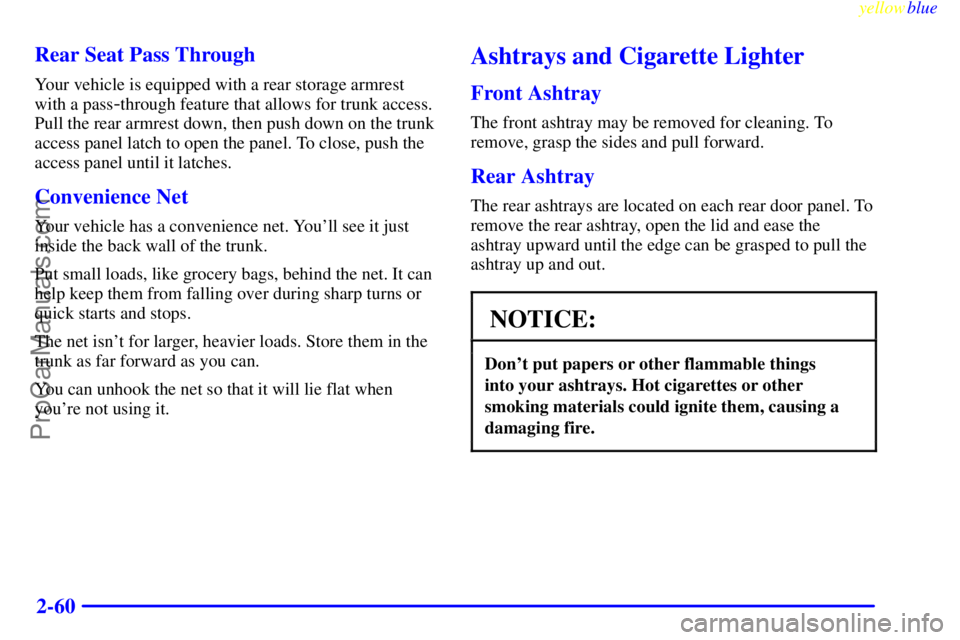
Include an ice scraper, a small brush or broom, a supply
of windshield washer fluid, a rag, some winter outer
clothing, a small shovel, a flashlight, a red cloth and a
couple of reflective warning triangles. And, if you will
be driving under severe conditions, include a small bag
of sand, a piece of old carpet or a couple of burlap bags
to help provide traction. Be sure you properly secure
these items in your vehicle.
ProCarManuals.com
Page 219 of 400

yellowblue
4-31
Loading Your Vehicle
Two labels on your vehicle show how much weight it
may properly carry. The Tire
-Loading Information label
found on the rear edge of the driver's door tells you the
proper size, speed rating and recommended inflation
pressures for the tires on your vehicle. It also gives you
important information about the number of people that
can be in your vehicle and the total weight that you can
carry. This weight is called the Vehicle Capacity Weight
and includes the weight of all occupants, cargo, and all
nonfactory
-installed options.
The other label is the Certification Label, found on the
rear edge of the driver's door. It tells you the gross
weight capacity of your vehicle, called the Gross
Vehicle Weight Rating (GVWR). The GVWR includes
the weight of the vehicle, all occupants, fuel and cargo.
Never exceed the GVWR for your vehicle, or the Gross
Axle Weight Rating (GAWR) for either the front or
rear axle.
And, if you do have a heavy load, you should spread it
out. Don't carry more than 176 pounds (80 kilograms) in
your trunk.
ProCarManuals.com