Page 79 of 368

yellowblue
2-23
Engine Coolant Heater (If Equipped)
In very cold weather, 0�F (-18�C) or colder, the engine
coolant heater can help. You'll get easier starting and
better fuel economy during engine warm
-up. Usually,
the coolant heater should be plugged in a minimum of
four hours prior to starting your vehicle.
To Use the Engine Coolant Heater
1. Turn off the engine.
2. Open the hood and unwrap the electrical cord.
3. Plug it into a normal, grounded 110
-volt AC outlet.
CAUTION:
Plugging the cord into an ungrounded outlet
could cause an electrical shock. Also, the wrong
kind of extension cord could overheat and cause
a fire. You could be seriously injured. Plug the
cord into a properly grounded three
-prong
11 0
-volt AC outlet. If the cord won't reach, use a
heavy
-duty three-prong extension cord rated for
at least 15 amps.
4. Before starting the engine, be sure to unplug and
store the cord as it was before to keep it away
from moving engine parts. If you don't, it could
be damaged.
Page 132 of 368

First Edition for Buick LeSabre Owner's Manual ± 1999
yellowblue
3-6
The ventilation system always allows fresh air to flow
through your vehicle when the vehicle is moving even
with the system in the OFF mode.
VENT: The VENT button allows outside air to flow
through your vehicle without the air conditioning
compressor working. Selecting VENT and the AUTO
button at the same time allows the system to control
automatically without the use of the air conditioning
compressor or the use of the RECIRC mode. To turn off
the VENT selection, push the VENT button again.
RECIRC: When RECIRC is selected, the system will
limit the amount of outside air entering your vehicle. This
is helpful when you are trying to cool the interior of the
vehicle quickly or limit the amount of outside air entering
your vehicle. RECIRC and AUTO may be selected at the
same time. The system will remain in RECIRC until the
ignition is turned off, then the system will return back to
the previously selected mode. Deselecting the RECIRC
button will also turn off the RECIRC function. RECIRC
can be selected in all manual airflow modes except
FRONT defrost and VENT.
FRONT: This selection is used to defrost the windshield
by directing the airflow toward the windshield.If FRONT is selected while in the AUTO mode, the fan
speed and the air temperature from the front defroster will
vary. If a manual fan speed setting is selected, the fan
speed will remain at that selection until another fan speed
selection is made or the AUTO mode is selected. To turn
off FRONT, press the AUTO or AIR FLOW button.
FRONT defrost will work better if any ice or snow is
cleared from the hood and the air inlet area between the
base of the windshield and the hood.
Air Conditioning
On hot days, open the windows long enough to let hot
inside air escape. This reduces the time it takes for your
vehicle to cool down. Then keep your windows closed
for the air conditioner to work its best.
If you have the electronic touch system, for quick
cool
-down on very hot days, use MAX with the
temperature and fan speed adjusted to COOL and
HIGH. If this setting is used for long periods of time, the
air in your vehicle may become too cold and dry.
For normal cooling on hot days, use NORM and adjust
the temperature and fan speed for your comfort. If
RECIRC is selected while in the NORM air
conditioning mode, the system works like MAX and
recirculates the air.
Page 206 of 368

First Edition for Buick LeSabre Owner's Manual ± 1999
yellowblue
5-4
2. Get the vehicles close enough so the jumper cables
can reach, but be sure the vehicles aren't touching
each other. If they are, it could cause a ground
connection you don't want. You wouldn't be able to
start your vehicle, and the bad grounding could
damage the electrical systems.
To avoid the possibility of the vehicles rolling, set
the parking brake firmly on both vehicles involved in
the jump start procedure. Put your automatic
transaxle in PARK (P) before setting the
parking brake.
3. Turn off the ignition on both vehicles. Unplug
unnecessary accessories plugged into the cigarette
lighter. Turn off all lamps that aren't needed as well
as radios. This will avoid sparks and help save both
batteries. In addition, it could save your radio!
NOTICE:
If you leave your radio on, it could be badly
damaged. The repairs wouldn't be covered by
your warranty.
4. Open the hoods and locate the batteries.
CAUTION:
An electric fan can start up even when the engine
is not running and can injure you. Keep hands,
clothing and tools away from any underhood
electric fan.
Page 212 of 368
First Edition for Buick LeSabre Owner's Manual ± 1999
yellowblue
5-10 If Steam Is Coming From Your Engine
AM530002
CAUTION:
Steam from an overheated engine can burn you
badly, even if you just open the hood. Stay away
from the engine if you see or hear steam coming
from it. Just turn it off and get everyone away
from the vehicle until it cools down. Wait until
there is no sign of steam or coolant before you
open the hood.
If you keep driving when your engine is
overheated, the liquids in it can catch fire. You or
others could be badly burned. Stop your engine if
it overheats, and get out of the vehicle until the
engine is cool.
NOTICE:
If your engine catches fire because you keep
driving with no coolant, your vehicle can be
badly damaged. The costly repairs would not be
covered by your warranty.
Page 213 of 368

First Edition for Buick LeSabre Owner's Manual ± 1999
yellowblue
5-11 If No Steam Is Coming From Your Engine
If you get an engine overheat warning but see or hear no
steam, the problem may not be too serious. Sometimes
the engine can get a little too hot when you:
�Climb a long hill on a hot day.
�Stop after high
-speed driving.
�Idle for long periods in traffic.
�Tow a trailer.
If you get the overheat warning with no sign of steam,
try this for a minute or so:
1. If your air conditioner is on, turn it off.
2. Turn on your heater to full hot at the highest fan
speed and open the window as necessary.
3. If you're in a traffic jam, shift to NEUTRAL (N);
otherwise, shift to the highest gear while
driving
-- AUTOMATIC OVERDRIVE (�)
or THIRD (3).If you no longer have the overheat warning, you can
drive. Just to be safe, drive slower for about 10 minutes.
If the warning doesn't come back on, you can
drive normally.
If the warning continues, pull over, stop, and park your
vehicle right away.
If there's still no sign of steam, idle the engine for three
minutes while you're parked. If you still have the
warning, turn off the engine and get everyone out of the
vehicle until it cools down.
You may decide not to lift the hood but to get service
help right away.
Page 240 of 368

yellowblue
6-4
If your vehicle is certified to meet California Emission
Standards (indicated on the underhood emission control
label), it is designed to operate on fuels that meet
California specifications. If such fuels are not available
in states adopting California emissions standards, your
vehicle will operate satisfactorily on fuels meeting
federal specifications, but emission control system
performance may be affected. The malfunction indicator
lamp on your instrument panel may turn on and/or your
vehicle may fail a smog
-check test. (See ªMalfunction
Indicator Lampº in the Index.) If this occurs, return to
your authorized Buick dealer for diagnosis to determine
the cause of failure. In the event it is determined that the
cause of the condition is the type of fuels used, repairs
may not be covered by your warranty.
Some gasolines that are not reformulated for low
emissions may contain an octane
-enhancing additive
called methylcyclopentadienyl manganese tricarbonyl
(MMT); ask your service station operator whether or not
the fuel contains MMT. General Motors does not
recommend the use of such gasolines. If fuels containing
MMT are used, spark plug life may be reduced and your
emission control system performance may be affected.
The malfunction indicator lamp on your instrument
panel may turn on. If this occurs, return to your
authorized Buick dealer for service.To provide cleaner air, all gasolines in the United States
are now required to contain additives that will help
prevent deposits from forming in your engine and fuel
system, allowing your emission control system to
function properly. Therefore, you should not have to add
anything to the fuel. In addition, gasolines containing
oxygenates, such as ethers and ethanol, and
reformulated gasolines may be available in your area to
contribute to clean air. General Motors recommends that
you use these gasolines, particularly if they comply with
the specifications described earlier.
NOTICE:
Your vehicle was not designed for fuel that
contains methanol. Don't use it. It can corrode
metal parts in your fuel system and also damage
plastic and rubber parts. That damage wouldn't
be covered under your warranty.
Page 244 of 368
yellowblue
6-8
Checking Things Under the Hood
CAUTION:
An electric fan under the hood can start up and
injure you even when the engine is not running.
Keep hands, clothing and tools away from any
underhood electric fan.
CAUTION:
Things that burn can get on hot engine parts and
start a fire. These include liquids like gasoline,
oil, coolant, brake fluid, windshield washer and
other fluids, and plastic or rubber. You or others
could be burned. Be careful not to drop or spill
things that will burn onto a hot engine.
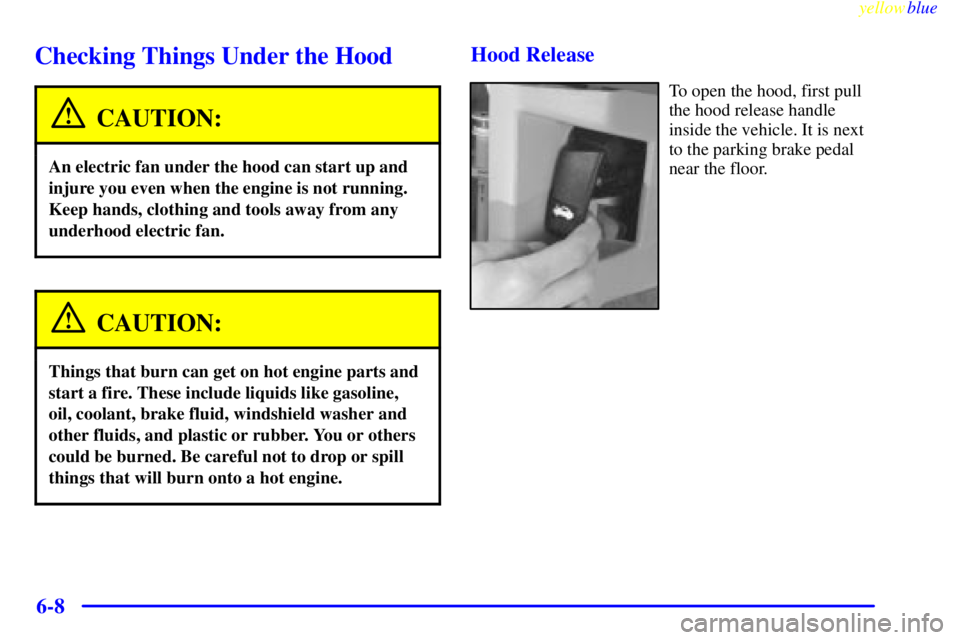
Hood Release
To open the hood, first pull
the hood release handle
inside the vehicle. It is next
to the parking brake pedal
near the floor.
Page 246 of 368
yellowblue
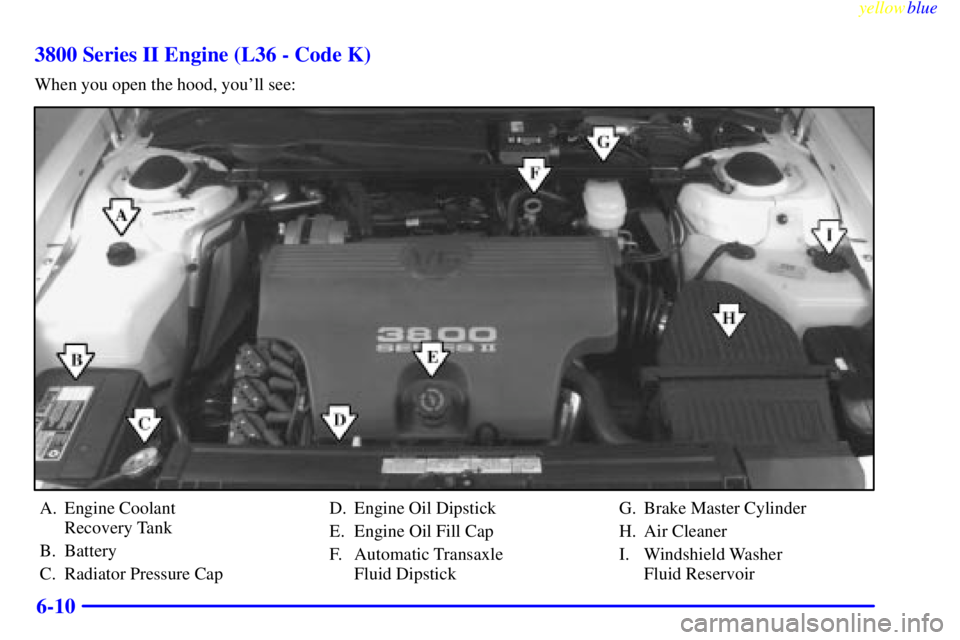
6-10 3800 Series II Engine (L36 - Code K)
When you open the hood, you'll see:
A. Engine Coolant
Recovery Tank
B. Battery
C. Radiator Pressure CapD. Engine Oil Dipstick
E. Engine Oil Fill Cap
F. Automatic Transaxle
Fluid DipstickG. Brake Master Cylinder
H. Air Cleaner
I. Windshield Washer
Fluid Reservoir