Page 25 of 344

yellowblue
1-19
The best way to protect the fetus is to protect the
mother. When a safety belt is worn properly, it's more
likely that the fetus won't be hurt in a crash. For
pregnant women, as for anyone, the key to making
safety belts effective is wearing them properly.
Right Front Passenger Position
To learn how to wear the right front passenger's safety belt
properly, see ªDriver Positionº earlier in this section.
The right front passenger's safety belt works the same
way as the driver's safety belt
-- except for one thing. If
you ever pull the shoulder portion of the belt out all the
way, you will engage the child restraint locking feature.
If this happens, just let the belt go back all the way and
start again.
Air Bag System
This part explains the air bag system.
Your vehicle has ªNext Generationº frontal
air bags
-- one air bag for the driver and another
air bag for the right front passenger.
Next Generation frontal air bags are designed to help
reduce the risk of injury from the force of an inflating
air bag. But even these air bags must inflate very
quickly if they are to do their job and comply with
federal regulations.
Page 26 of 344
yellowblue
1-20
Here are the most important things to know about the air
bag system:
CAUTION:
You can be severely injured or killed in a crash if
you aren't wearing your safety belt
-- even if you
have air bags. Wearing your safety belt during a
crash helps reduce your chance of hitting things
inside the vehicle or being ejected from it. Air
bags are ªsupplemental restraintsº to the safety
belts. All air bags
-- even Next Generation air
bags
-- are designed to work with safety belts,
but don't replace them. Air bags are designed to
work only in moderate to severe crashes where
the front of your vehicle hits something.
They aren't designed to inflate at all in rollover,
rear, side or low
-speed frontal crashes. And, for
unrestrained occupants, Next Generation air
bags may provide less protection in frontal
crashes than more forceful air bags have
provided in the past. Everyone in your vehicle
should wear a safety belt properly
-- whether or
not there's an air bag for that person.
CAUTION:
Air bags inflate with great force, faster than the
blink of an eye. If you're too close to an inflating
air bag, as you would be if you were leaning
forward, it could seriously injure you. This is true
even with Next Generation frontal air bags.
Safety belts help keep you in position before and
during a crash. Always wear your safety belt,
even with Next Generation air bags. The driver
should sit as far back as possible while still
maintaining control of the vehicle.
Page 27 of 344
yellowblue
1-21
CAUTION:
Children who are up against, or very close to, any
air bag when it inflates can be seriously injured or
killed. This is true even though your vehicle has
Next Generation frontal air bags. Air bags plus
lap
-shoulder belts offer the best protection for
adults, but not for young children and infants.
Neither the vehicle's safety belt system nor its air
bag system is designed for them. Young children
and infants need the protection that a child
restraint system can provide. Always secure
children properly in your vehicle. To read how, see
the part of this manual called ªChildrenº and see
the caution labels on the sunvisors and the right
front passenger's safety belt.
There is an air bag readiness
light on the instrument
panel, which shows the air
bag symbol.
The system checks the air bag electrical system for
malfunctions. The light tells you if there is an electrical
problem. See ªAir Bag Readiness Lightº in the Index
for more information.
Page 30 of 344

yellowblue
1-24
How does an air bag restrain?
In moderate to severe frontal or near
-frontal collisions,
even belted occupants can contact the steering wheel or the
instrument panel. Air bags supplement the protection
provided by safety belts. Air bags distribute the force of
the impact more evenly over the occupant's upper body,
stopping the occupant more gradually. But air bags would
not help you in many types of collisions, including
rollovers, rear impacts and side impacts, primarily because
an occupant's motion is not toward those air bags. Air
bags should never be regarded as anything more than a
supplement to safety belts, and then only in moderate to
severe frontal or near
-frontal collisions.
What will you see after an air bag inflates?
After an air bag inflates, it quickly deflates, so quickly
that some people may not even realize the air bag
inflated. Some components of the air bag module
-- the
steering wheel hub for the driver's air bag, or the
instrument panel for the right front passenger's
bag
-- will be hot for a short time. The parts of the bag
that come into contact with you may be warm, but not
too hot to touch. There will be some smoke and dust
coming from vents in the deflated air bags. Air bag
inflation doesn't prevent the driver from seeing or from
being able to steer the vehicle, nor does it stop people
from leaving the vehicle.
CAUTION:
When an air bag inflates, there is dust in the air.
This dust could cause breathing problems for
people with a history of asthma or other
breathing trouble. To avoid this, everyone in the
vehicle should get out as soon as it is safe to do so.
If you have breathing problems but can't get out
of the vehicle after an air bag inflates, then get
fresh air by opening a window or door.
In many crashes severe enough to inflate an air bag,
windshields are broken by vehicle deformation.
Additional windshield breakage may also occur from the
right front passenger air bag.
�Air bags are designed to inflate only once. After they
inflate, you'll need some new parts for your air bag
system. If you don't get them, the air bag system
won't be there to help protect you in another crash.
A new system will include air bag modules and
possibly other parts. The service manual for your
vehicle covers the need to replace other parts.
Page 31 of 344

yellowblue
1-25
�Your vehicle is equipped with a crash sensing and
diagnostic module, which records information about
the air bag system. The module records information
about the readiness of the system, when the sensors
are activated and driver's safety belt usage at
deployment. Some modules also record speed,
engine rpm, brake and throttle data.
�Let only qualified technicians work on your air bag
system. Improper service can mean that your air bag
system won't work properly. See your dealer
for service.
NOTICE:
If you damage the covering for the driver's or the
right front passenger's air bag, the bag may not
work properly. You may have to replace the air
bag module in the steering wheel or both the air
bag module and the instrument panel for the
right front passenger's air bag. Do not open or
break the air bag coverings.
Servicing Your Air Bag-Equipped Vehicle
Air bags affect how your vehicle should be serviced.
There are parts of the air bag system in several places
around your vehicle. You don't want the system to
inflate while someone is working on your vehicle. Your
dealer and the Century Service Manual have information
about servicing your vehicle and the air bag system. To
purchase a service manual, see ªService and Owner
Publicationsº in the Index.
CAUTION:
For up to 10 seconds after the ignition key is
turned off and the battery is disconnected, an air
bag can still inflate during improper service. You
can be injured if you are close to an air bag when
it inflates. Avoid yellow connectors. They are
probably part of the air bag system. Be sure to
follow proper service procedures, and make sure
the person performing work for you is qualified
to do so.
The air bag system does not need regular maintenance.
Page 32 of 344
yellowblue
1-26
Center Passenger Position
Lap Belt
If your vehicle has a bench seat, someone can sit in the
center position.
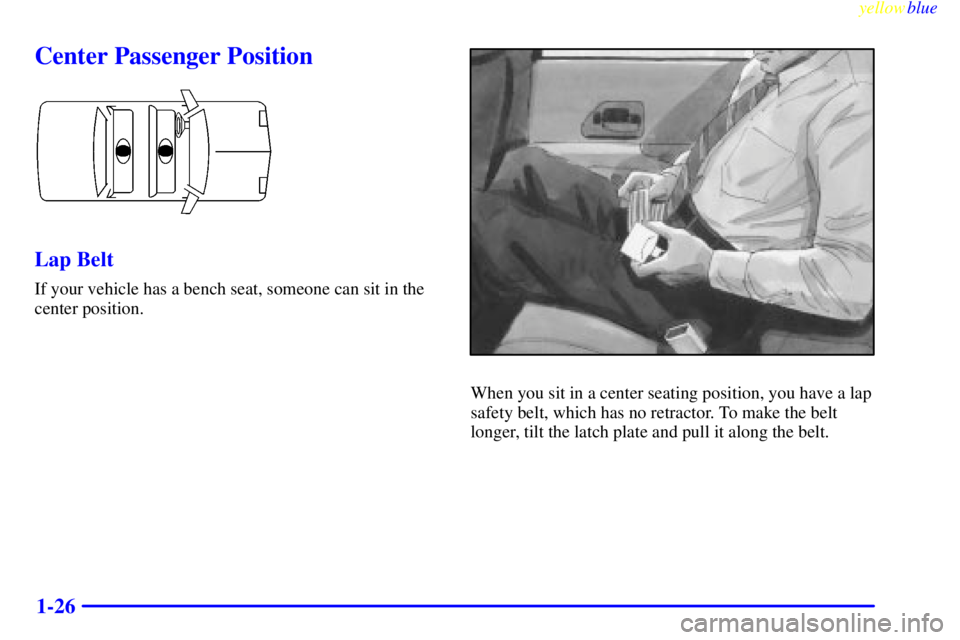
When you sit in a center seating position, you have a lap
safety belt, which has no retractor. To make the belt
longer, tilt the latch plate and pull it along the belt.
Page 33 of 344
yellowblue
1-27
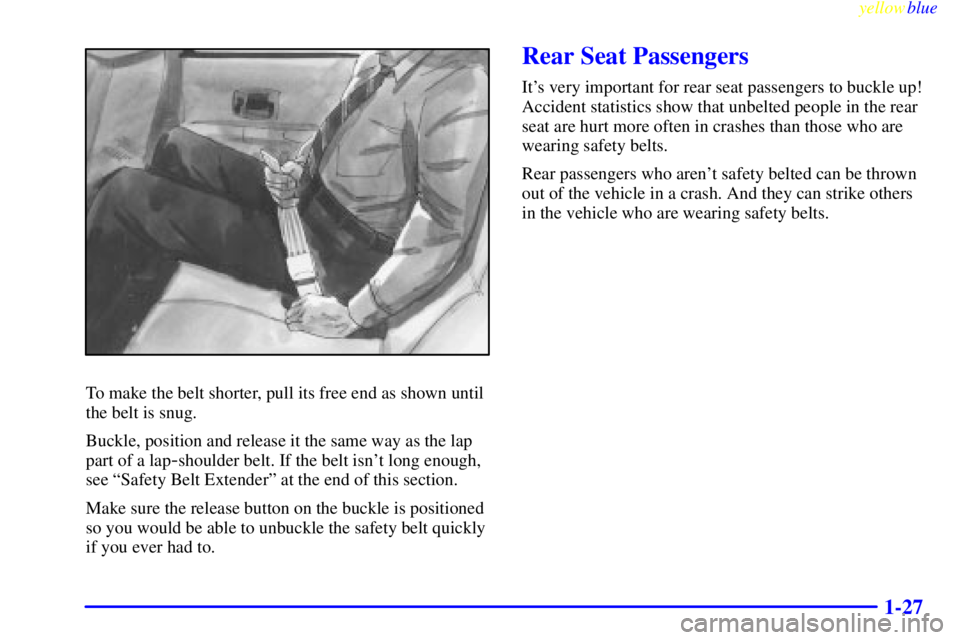
To make the belt shorter, pull its free end as shown until
the belt is snug.
Buckle, position and release it the same way as the lap
part of a lap
-shoulder belt. If the belt isn't long enough,
see ªSafety Belt Extenderº at the end of this section.
Make sure the release button on the buckle is positioned
so you would be able to unbuckle the safety belt quickly
if you ever had to.
Rear Seat Passengers
It's very important for rear seat passengers to buckle up!
Accident statistics show that unbelted people in the rear
seat are hurt more often in crashes than those who are
wearing safety belts.
Rear passengers who aren't safety belted can be thrown
out of the vehicle in a crash. And they can strike others
in the vehicle who are wearing safety belts.
Page 34 of 344
yellowblue
1-28 Rear Seat Outside Passenger Positions
Lap-Shoulder Belt
The positions next to the windows have lap
-shoulder
belts. Here's how to wear one properly.
1. Pick up the latch plate and pull the belt across you.
Don't let it get twisted.
The shoulder belt may lock if you pull the belt across
you very quickly. If this happens, let the belt go back
slightly to unlock it. Then pull the belt across you
more slowly.