1998 VOLVO V90 oil
[x] Cancel search: oilPage 106 of 175

1998 Volvo S90
Chapter 7 - Car care
pg. 97
Car care
Car care includes not only maintaining the appearance of the car, but al\
so
protecting the car exterior from the effects of air pollution, rain and \
mud.
The paintwork should also be touched up immediately, if damaged, to prev\
ent rust
formation.
Cleaning the upholstery pg. 98
Paintwork damage pg. 99
Washing the car pg. 100
Cleaning the upholstery
pg. 98
Cleaning the upholstery
The fabric can be cleaned with soapy water or a
detergent. For more difficult spots caused by oil,
ice cream, shoe polish, grease, etc., use a clothing/
clothing fabric stain remover.
The plastic in the upholstery can be washed with
soapy water or a mild detergent.
Leather upholstery/suede-like upholstery
(alcantera) can be cleaned with a soft cloth and
mild soap solution. For more difficult spots,
Volvo offers a leather care kit.
On no account must gasoline, naphtha or
similar cleaning agents be used on the plastic
or the leather since these can cause damage.
Cleaning the seat belts
Clean only with lukewarm water and mild soap
solution.
Bear in mind
l Take extra care when removing stains such as
ink or lipstick since the coloring can spread.
l Use solvents sparingly. Too much solvent can
damage the seat padding.
l Start from the outside of the stain and work
toward the center.
file:///K|/ownersdocs/1998/1998_SV90/98S90_097.htm (1 of 6)12/30/2006 \
1:52:47 PM
Page 109 of 175
1998 Volvo S90
plenty of water, to avoid scratching.
l Bird droppings: Remove from
paintwork as soon as possible.
Otherwise the finish may be
permanently damaged.
l A detergent can be used to
facilitate the softening of dirt and
oil.
l A water-soluble grease solvent
may be used in cases of sticky dirt.
However, use a washplace equipped
with a drainage separator.
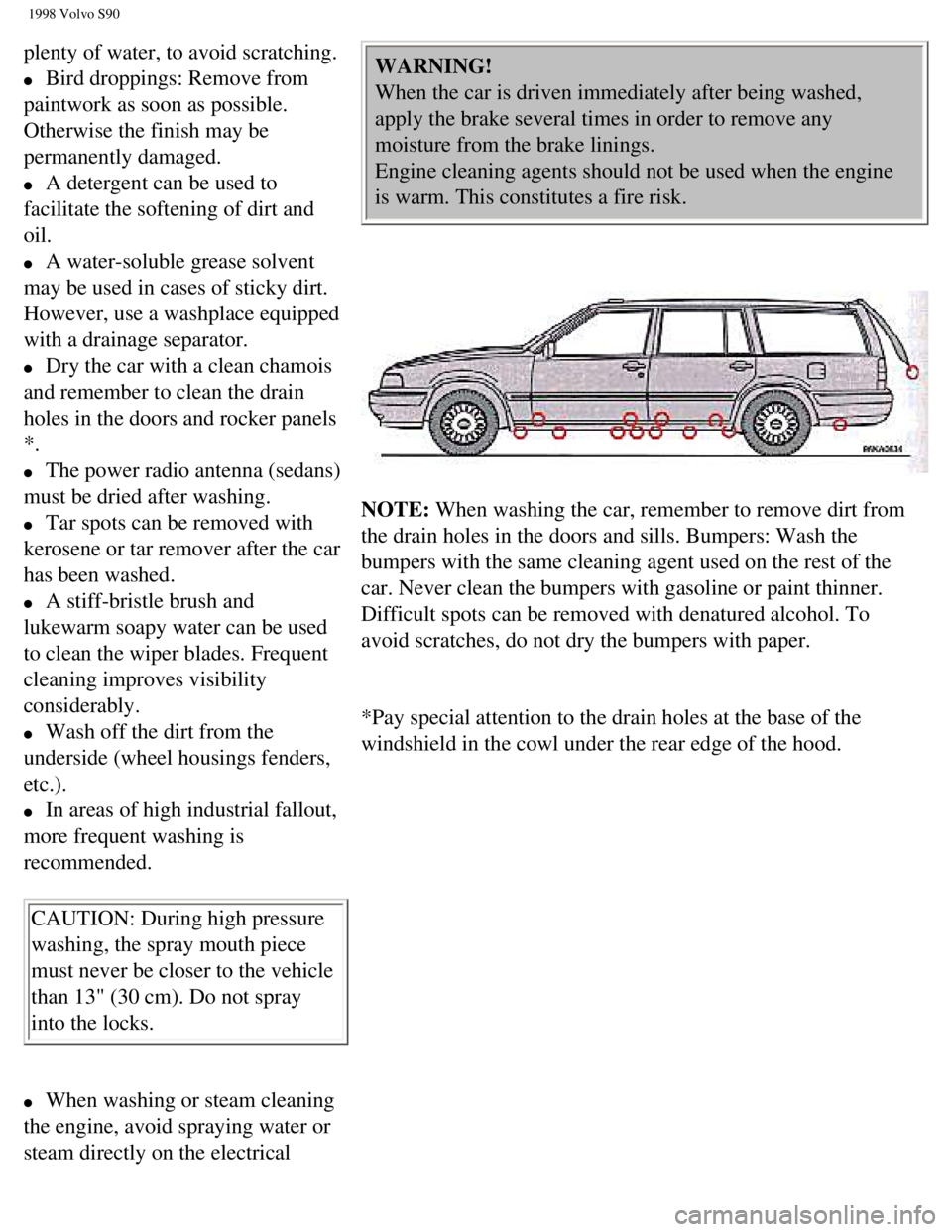
l Dry the car with a clean chamois
and remember to clean the drain
holes in the doors and rocker panels
*.
l The power radio antenna (sedans)
must be dried after washing.
l Tar spots can be removed with
kerosene or tar remover after the car
has been washed.
l A stiff-bristle brush and
lukewarm soapy water can be used
to clean the wiper blades. Frequent
cleaning improves visibility
considerably.
l Wash off the dirt from the
underside (wheel housings fenders,
etc.).
l In areas of high industrial fallout,
more frequent washing is
recommended.
CAUTION: During high pressure
washing, the spray mouth piece
must never be closer to the vehicle
than 13" (30 cm). Do not spray
into the locks.
l When washing or steam cleaning
the engine, avoid spraying water or
steam directly on the electrical
WARNING!
When the car is driven immediately after being washed,
apply the brake several times in order to remove any
moisture from the brake linings.
Engine cleaning agents should not be used when the engine
is warm. This constitutes a fire risk.
NOTE: When washing the car, remember to remove dirt from
the drain holes in the doors and sills. Bumpers: Wash the
bumpers with the same cleaning agent used on the rest of the
car. Never clean the bumpers with gasoline or paint thinner.
Difficult spots can be removed with denatured alcohol. To
avoid scratches, do not dry the bumpers with paper.
*Pay special attention to the drain holes at the base of the
windshield in the cowl under the rear edge of the hood.
file:///K|/ownersdocs/1998/1998_SV90/98S90_097.htm (4 of 6)12/30/2006 \
1:52:47 PM
Page 112 of 175

1998 Volvo S90
Chapter 8 - Volvo Service
pg. 103
Service - an investment
An investment which will pay dividends in the form of improved reliabili\
ty,
durability, and resale value.
Label information pg. 104
Maintenance service, Warranty pg. 105
Maintenance schedule pg. 106
Engine oil pg. 108
Servicing pg. 110
Fuel/emissions systems pg. 112
Engine compartment pg. 114
Lubrication, body pg. 115
Power steering fluid, brake fluid pg. 116
Drive belt pg. 117
Cooling system pg. 118
Washer fluid reservoir/nozzles pg. 119
Label information
pg. 104
1 Vehicle
Identification
Number
(VIN)*
VIN plate is
located on
top left
surface of
dashboard.
The VIN is
also stamped
on the right
hand door
pillar.
2 Vehicle
Emission
file:///K|/ownersdocs/1998/1998_SV90/98S90_103.htm (1 of 7)12/30/2006 \
1:52:48 PM
Page 116 of 175
 I= Inspect (Correct or Replace if ne\
cessary)
R= Replace L= Lubricate
Maintenance Operation thousand
miles
(thousand km")
1998 Volvo S90
Maintenance schedule
A= Adjust (Correct if necessary) I= Inspect (Correct or Replace if ne\
cessary)
R= Replace L= Lubricate
Maintenance Operation thousand
miles
(thousand km) 5
(8)
10
(16) 15
(25) 20
(32) 25
(40) 30
(48) 35
(56) 40
(64) 45
(72) 50
(80) 55
(88) 60
(96)
EMISSION SYSTEM
MAINTENANCE
Engine oil and filter R R R R R R R R R R R R
Engine drive belt (accessory belt) I R
Air cleaner filter R R
Spark plugs R R
Automatic transmission fluid I I I I I I
Timing belt - B 6304 S
4
1) See section "Engine oil" for detailed information.
NOTE: The oil should be changed at these intervals or after 750 hours of\
driving or after 12 months
which ever occurs first. See "Service Reminder indicator", page 19.
2) For services beyond 60,000 miles (96,000 km), consult your "Mainte\
nance Records booklet".
3) These intervals may apply, depending on actual driving conditions (\
see page 109 for details)
4) For proper functioning of the vehicle and its emission control syste\
m, Volvo recommends that the
file:///K|/ownersdocs/1998/1998_SV90/98S90_103.htm (5 of 7)12/30/2006 \
1:52:48 PM
Page 118 of 175
 Replace at 100,000 miles (160,000 km).
2) Brake fluid should be changed at owner request every second year (o\
nce a year if the car is driven in
mountainous areas or in areas wi")
1998 Volvo S90
1) Replace at 100,000 miles (160,000 km).
2) Brake fluid should be changed at owner request every second year (o\
nce a year if the car is driven in
mountainous areas or in areas with high humidity).
The following items should be checked weekly by the driver (it takes on\
ly a few minutes):
Engine oil level Windshield wipers
Brake fluid level Level of windshield washer fluid
Radiator coolant level
Tire pressure (all five tires)
Operation of all lights
Horns
The following should also be carried out at regular intervals:
Washing
Polishing
Cleaning
Contents | Top of Page
file:///K|/ownersdocs/1998/1998_SV90/98S90_103.htm (7 of 7)12/30/2006 \
1:52:48 PM
Page 119 of 175
1998 Volvo S90
Chapter 8 - (cont.)Engine oil
pg. 108
Checking the oil level
The oil level should be checked every
time the car is refuelled. This is
especially important during the engine
break-in period (up to the first service).
CAUTION: Not checking the oil level
regularly can result in serious engine
damage if the oil becomes too low.
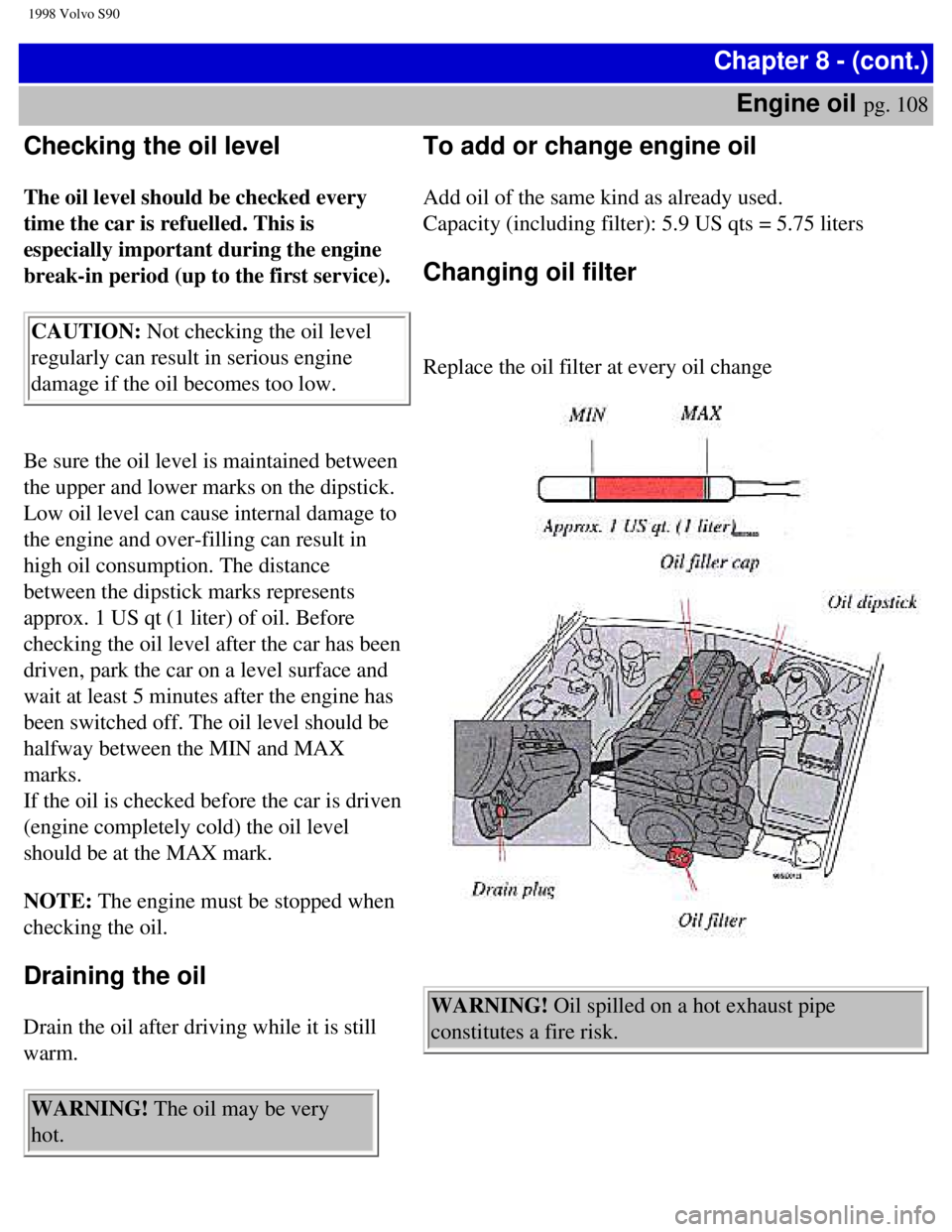
Be sure the oil level is maintained between
the upper and lower marks on the dipstick.
Low oil level can cause internal damage to
the engine and over-filling can result in
high oil consumption. The distance
between the dipstick marks represents
approx. 1 US qt (1 liter) of oil. Before
checking the oil level after the car has been
driven, park the car on a level surface and
wait at least 5 minutes after the engine has
been switched off. The oil level should be
halfway between the MIN and MAX
marks.
If the oil is checked before the car is driven
(engine completely cold) the oil level
should be at the MAX mark.
NOTE: The engine must be stopped when
checking the oil.
Draining the oil
Drain the oil after driving while it is still
warm.
WARNING! The oil may be very
hot.
To add or change engine oil
Add oil of the same kind as already used.
Capacity (including filter): 5.9 US qts = 5.75 liters
Changing oil filter
Replace the oil filter at every oil change
WARNING! Oil spilled on a hot exhaust pipe
constitutes a fire risk.
file:///K|/ownersdocs/1998/1998_SV90/98S90_108.htm (1 of 6)12/30/2006 \
1:52:49 PM
Page 120 of 175
1998 Volvo S90
If you change the engine oil and filter
yourself, your Volvo retailer can assist you
in disposing of the used oil. Engine oil can
be harmful to your skin - gloves should
worn when performing this work.
Engine oil pg. 109
Oil quality
Meeting API specification SG, SG/CD, SH or
Energy Conserving (EC) II
For best fuel economy and engine protection
consult with your authorized Volvo retailer for
recommended oils. Oils with a different quality
rating may not provide adequate engine
protection.
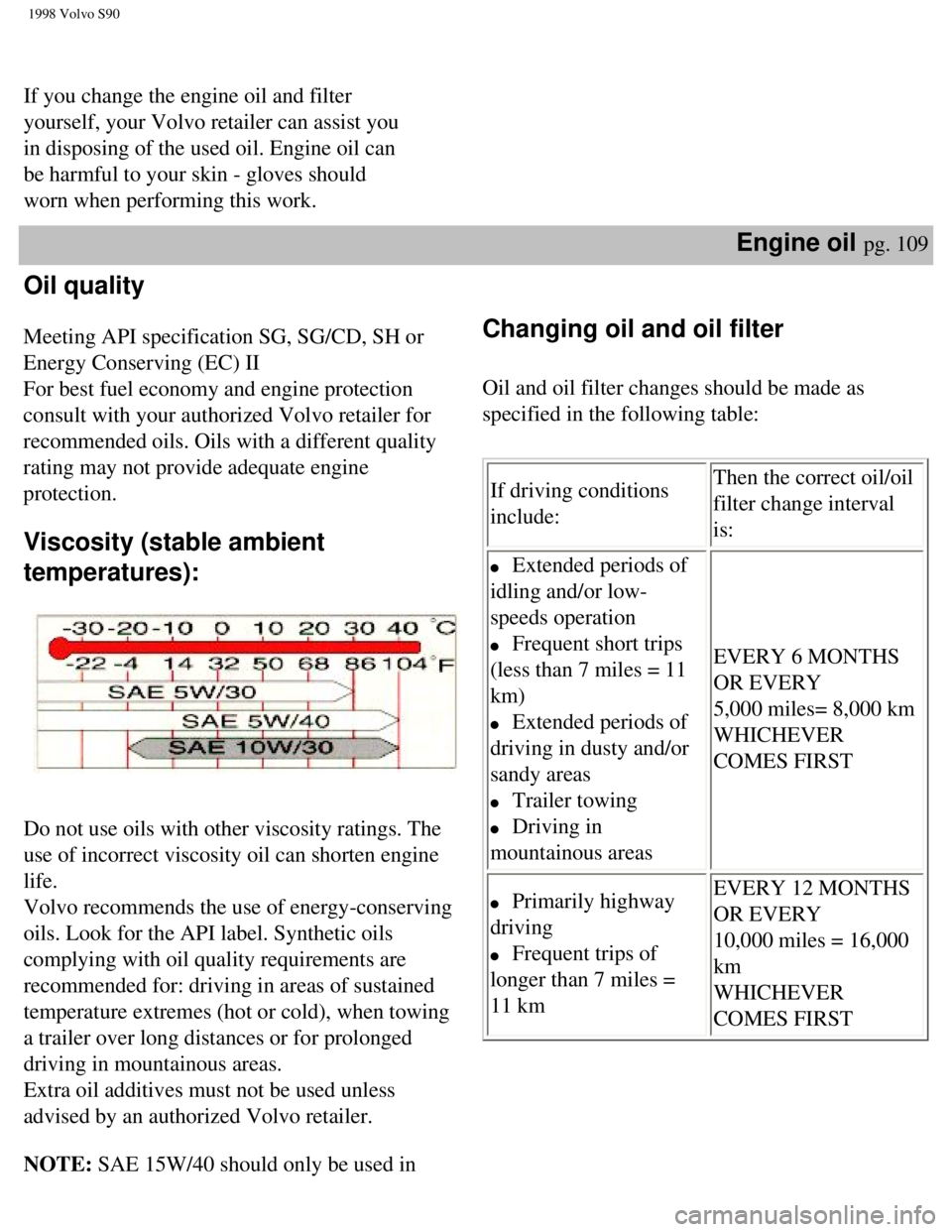
Viscosity (stable ambient
temperatures):
Do not use oils with other viscosity ratings. The
use of incorrect viscosity oil can shorten engine
life.
Volvo recommends the use of energy-conserving
oils. Look for the API label. Synthetic oils
complying with oil quality requirements are
recommended for: driving in areas of sustained
temperature extremes (hot or cold), when towing
a trailer over long distances or for prolonged
driving in mountainous areas.
Extra oil additives must not be used unless
advised by an authorized Volvo retailer.
NOTE: SAE 15W/40 should only be used in
Changing oil and oil filter
Oil and oil filter changes should be made as
specified in the following table:
If driving conditions
include: Then the correct oil/oil
filter change interval
is:
l Extended periods of
idling and/or low-
speeds operation
l Frequent short trips
(less than 7 miles = 11
km)
l Extended periods of
driving in dusty and/or
sandy areas
l Trailer towing
l Driving in
mountainous areas EVERY 6 MONTHS
OR EVERY
5,000 miles= 8,000 km
WHICHEVER
COMES FIRST
l Primarily highway
driving
l Frequent trips of
longer than 7 miles =
11 km EVERY 12 MONTHS
OR EVERY
10,000 miles = 16,000
km
WHICHEVER
COMES FIRST
file:///K|/ownersdocs/1998/1998_SV90/98S90_108.htm (2 of 6)12/30/2006 \
1:52:49 PM
Page 121 of 175

1998 Volvo S90
extreme operating conditions such as trailer
towing in sustained ambient temperatures over
104° F (40° C). However, SAE 10W-30 synthetic
oil would be a better alternative in such
conditions.
SAE 15W-40 should not be used under normal
operating conditions.
American Petroleum Institute
(API) labels. These labels certify
the oil conforms to the applicable
standards and specifications of
the API.
Servicing pg. 110
Torque exhaust and
intake manifold nuts
A loose manifold could alter air/
fuel ratio and cause an increase
in emissions and/or poor
driveability.
Air cleaner
Replace the air cleaner cartridge
with a new one every 30,000
miles (48,000 km). The
cartridge should be replaced
more often when driving under
dirty and dusty conditions, The
filter cannot be cleaned and,
therefore, should always be
replaced with a new one.
Vacuum fittings, hoses
and connections
Unstable idle, misfiring, or poor
emission control is often caused
by leaking vacuum hoses or
connections. Check hoses and
connections on distributor
vacuum unit, connections on
heater control servo systems and
hydraulic brake servo.
Fuel system cap, tank
and lines, and
connections
The effectiveness of the fuel
system to contain hydrocarbons
is dependent largely on a
leakfree system. Check for
proper sealing of gasoline filler
cap which contains "O" ring-
type seals. Check all
evaporative hoses in vehicle for
tightness. Check fuel lines under
vehicle and repair if necessary.
Fuel (line) filter
The fuel line filter is located
next to the fuel pump. This filter
should be replaced every
100,000 miles (160,000 km).
The filter is replaced as one
complete unit.
Replace more frequently if
contaminated fuel is introduced
into the tank (or if there is
reason to suspect that this has
occurred).
Timing belt
WARNING!
The distributor ignition
system operates at very high
voltages. Special safety
precautions must be followed
to prevent injury.
Always turn the ignition off
when:
l Replacing distributor
ignition components e.g.
plugs, coil, etc.
l Do not touch any part of
the distributor ignition system
while the engine is running.
This may result in unintended
movements and body injury.
Replacing spark plugs
The spark plugs should be
changed every 30,000 miles
(48,000 km). However, city
driving or fast highway driving
may necessitate changing after
15,000 miles (24,000 km) of
driving. When installing new
plugs, be sure to fit the right type
file:///K|/ownersdocs/1998/1998_SV90/98S90_108.htm (3 of 6)12/30/2006 \
1:52:49 PM