Page 160 of 214
T100(U)
160
CAUTION
If the emergency towing hook or eye-
let is used to get out when your ve-
hicle becomes stuck in the mud, sand
or other condition from which the ve-
hicle cannot be driven out under its
own power, make sure to observe the
precautions mentioned below. Other-
wise, excessive stress will be put on
the hook or eyelet and the towing
cable or chain may break, causing
serious injury or damage. If the towing vehicle can hardly
move, do not forcibly continue the
towing. Contact your Toyota dealer
or a commercial tow truck service
for assistance.
Tow the vehicle as straight ahead
as possible.
Keep away from the vehicle during
towing.
The following methods are effective to
use when your vehicle is stuck in the
mud, sand or other condition from
which the vehicle cannot be driven out
under its own power. Use extreme cau-
tion when towing the vehicle. In addi-
tion, keep away from the vehicles and
towing cable or chain when towing.
Remove the sand and soil in the front
and the back of the tires.
Place stones or wood under the tires. If you lose your keys
Many Toyota dealers can make a new
key if you can give them the key num-
ber.
See the suggestion given in ”Keys” in
Chapter 1
−2.
If your key is locked in the vehicle and
you cannot get a duplicate, many Toyota
dealers can still open the door for you,
using their special tools. If you must
break a window to get in, we suggest
breaking the smallest side window be-
cause it is the least expensive to replace.
Be extremely cautious to avoid cuts from
the glass.
—Tips for towing a stuck
vehicle (four
−wheel drive models)
Page 202 of 214

T100(U)
202
ENGINE LUBRICATION
Oil capacity (drain and ref
ill),
L (qt., Imp. qt.):
Two-wheel drive models 3RZ −FE engine
With filter 5.5 (5.8, 4.8)
Without filter 4.8 (5.1, 4.2)
5VZ −FE engine
With filter 5.2 (5.5, 4.6)
Without filter 4.9 (5.2, 4.3)
Four-wheel drive models With filter 4.7 (5.0, 4.1)
Without filter 4.4 (4.7, 3.9)
Oil grade: API grade SH, ”Energy-Conserving II”
or SJ, ”Energy-Conserving” multigrade
engine oil or ILSAC multigrade engine
oil is recommended.
Recommended oil viscosity (SAE):
COOLING SYSTEM
Total capacity, L (qt., Imp. qt.): Two-wheel drive models
With manual transmission 3RZ −FE engine
8.7 (9.2, 7.7)
5VZ −FE engine
10.0 (10.6, 8.8)
With automatic transmission
3RZ −FE engine
9.0 ( 9.5, 7.9)
5VZ −FE engine
9.9 (10.5, 8.7)
Four-wheel drive models With manual transmission
10.0 (10.6, 8.8)
With automatic transmission 9.9 (10.5, 8.7)
Coolant type: With ethylene-glycol antifreeze
(Do not use alcohol type.)
BATTERY
Open voltage
at 20 C (68 F):
12.6—12.8 V Fully charged
12.2—12.4 V Half charged
11.8—12.0 V Discharged
: Voltage that is checked 20 minutes after
the key is removed with all the lights
turned off
Charging rates: 5 A max. CLUTCH
Pedal freeplay, mm (in.):
5—15 (0.2—0.6)
Fluid type:
SAE J1703 or FMVSS No.116 DOT 3
MANUAL TRANSMISSION
Oil capacity, L (qt., Imp. qt.): 3RZ −FE engine
2.6 (2.7, 2.3)
5VZ −FE engine
Two-wheel drive models
2.6 (2.7, 2.3)
Four-wheel drive models 2.2 (2.3, 1.9)
Page 203 of 214

T100(U)203
Oil type:
Gear oil API GL −4 or GL −5
Recommended oil viscosity:
SAE 75W −90
AUTOMATIC TRANSMISSION
Fluid capacity (drain and refill),
L (qt., Imp. qt.): Two-wheel drive models Up to 1.6 (1.7, 1.4)
Four-wheel drive models
Up to 2.0 (2.1, 1.8)
Fluid type:
Automatic transmission fluid D−II or DEXRON
III (
DEXRON
II)
TRANSFER
Oil capacity, L (qt., Imp. qt.): 1.1 (1.2, 1.0)
Oil type: Gear oil API GL −4 or GL −5
Recommended oil viscosity: SAE 75W −90
DIFFERENTIAL
Oil capacity, L (qt., Imp. qt.): Two-wheel drive models 2.75 (2.9, 2.4)
Four-wheel drive models Front 1.9 (2.0, 1.7)
Rear 2.95 (3.1, 2.6) Oil type:
Hypoid gear oil API GL −5
Recommended oil viscosity: Front SAE 75W −90
Rear
Above −18 °C (0 °F)
SAE 90
Below −18 °C (0 °F)
SAE 80W or 80W −90
CHASSIS LUBRICATION
Wheel bearings: Lithium base wheel bearing grease,
NLGI No.2
Front drive shaft thrust bushings: Synthetic oil and lithium soap base
chassis grease, NLGI No.1
Propeller shafts: Spiders and slide yokes Lithium base chassis grease,
NLGI No.2
Double cardan joint Molybdenum-disulfide lithium base
chassis grease, NLGI No.2
BRAKES
Minimum pedal clearance when depressed
with the pressure of 490 N (50 kgf. 110
lbf) with the engine running, mm (in.): Two-wheel drive models
1-ton models 78 (3.1)
1/2-ton models 73 (2.9)
Four-wheel drive models 1-ton models 70 (2.8)
1/2-ton models 73 (2.9)
Pedal freeplay, mm (in.): 3—6 (0.12—0.24)
Pad wear limit, mm (in.): 1.0 (0.04)
Lining wear limit, mm (in.):
1.0 (0.04)
Parking brake adjustment when pulled with
the force of 196 N (20 kgf, 44 lbf):
11—17 clicks
Fluid type: SAE J1703 or FMVSS No.116 DOT 3
STEERING
Wheel freeplay: Less than 30 mm (1.2 in.)
Power steering fluid type: Automatic transmission fluid DEXRON
II or III
Page 212 of 214
T100(U)
212
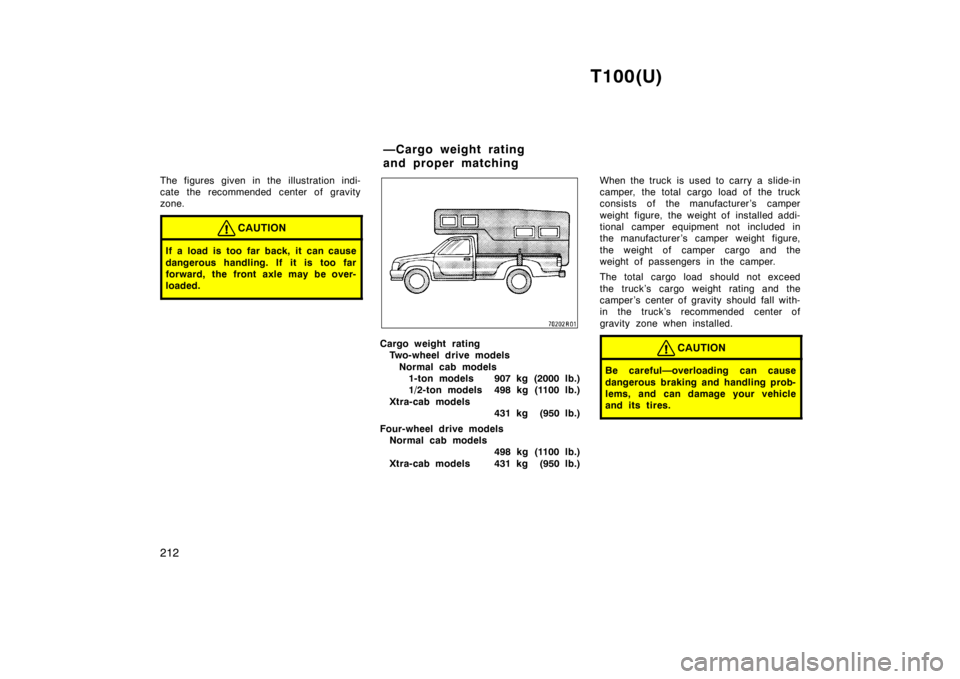
The figures given in the illustration indi-
cate the recommended center of gravity
zone.
CAUTION
If a load is too far back, it can cause
dangerous handling. If it is too far
forward, the front axle may be over-
loaded.
Cargo weight rating
Two-wheel drive models
Normal cab models 1-ton models 907 kg (2000 lb.)
1/2-ton models 498 kg (1100 lb.)
Xtra-cab models 431 kg (950 lb.)
Four-wheel drive models Normal cab models 498 kg (1100 lb.)
Xtra-cab models 431 kg (950 lb.) When the truck is used to carry a slide-in
camper, the total cargo load of the truck
consists of the manufacturer ’s camper
weight figure, the weight of installed addi-
tional camper equipment not included in
the manufacturer ’s camper weight figure,
the weight of camper cargo and the
weight of passengers in the camper.
The total cargo load should not exceed
the truck’s cargo weight rating and the
camper ’s center of gravity should fall with-
in the truck’s recommended center of
gravity zone when installed.CAUTION
Be careful—overloading can cause
dangerous braking and handling prob-
lems, and can damage your vehicle
and its tires.
—Cargo weight rating
and proper matching