Page 100 of 214

T100(U)
100
ST (Stereo reception) display
Your radio automatically changes to stereo
reception when a stereo broadcast is re-
ceived. ”ST” appears on the display. If the
signal becomes weak, the radio reduces
the amount of channel separation to prev-
ent the weak signal from creating noise.
If the signal becomes extremely weak, the
radio switches from stereo to mono recep-
tion.
TA P E
Push ”TAPE” to switch from radio or com-
pact disc operation to cassette operation.
If the audio system is off, you can turn
on the cassette player by pushing ”TAPE”.
In both cases, a cassette must already be
loaded in the player.
TRACK (Track up/down button):
Compact disc player
By using this button, you can skip up or
down to a different track.
Push either side of the track button until
the number of the track you want to listen
to appears on the display. If you want to
return the beginning of the current track,
push the down side of the button one
time, quickly.
TUNE (Tuning)
Your Toyota has an electronic tuning radio
(ETR). Push and release the ”
” (up) or
” ” (down) side of ”TUNE” to step up or
down the station band. (If you hear a
beep, you held the button too long and
the radio will go into the seek mode.)
VOL/PWR (Volume/Power)
Push ”VOL/PWR” to turn the audio system
on and off. Turn ”VOL/PWR” to adjust the
volume.
NOTICE
To ensure the correct audio system
operation: Be careful not to spill beverages
over the audio system.
Do not put anything other than a
cassette tape or Compact Disc into
the slot.
RADIO RECEPTION
Usually, a problem with radio reception
does not mean there is a problem with
your radio—it is just the normal result of
conditions outside the vehicle.
For example, nearby buildings and terrain
can interfere with FM reception. Power
lines or telephone wires can interfere with
AM signals. And of course, radio signals
have a limited range, and the farther you
are from a station, the weaker its signal
will be. In addition, reception conditions
change constantly as your vehicle moves.—Car audio system operating
hints
Page 181 of 214
T100(U)181
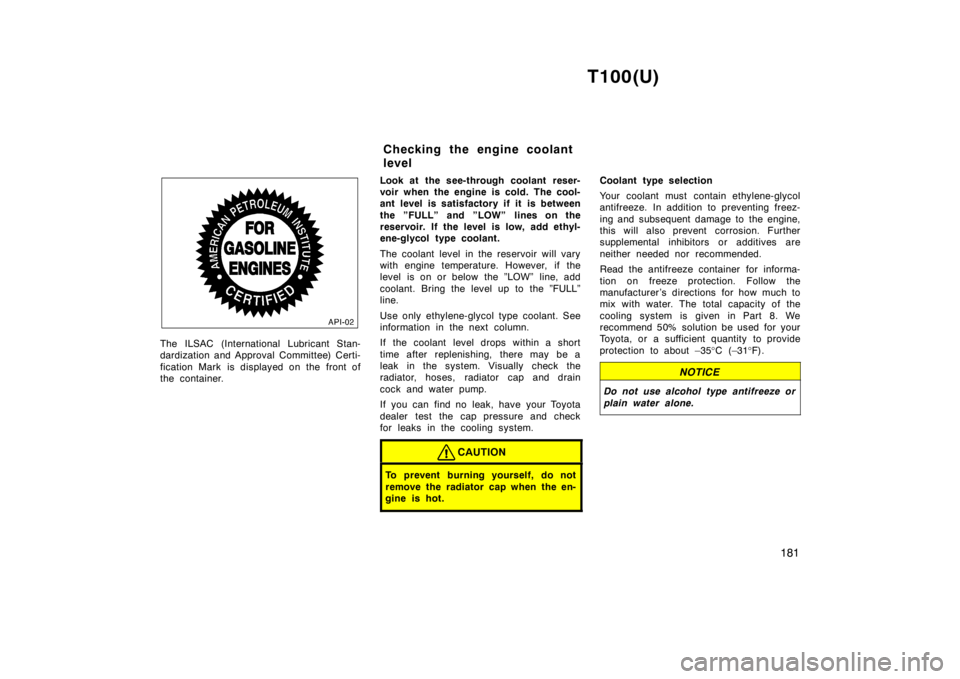
The ILSAC (International Lubricant Stan-
dardization and Approval Committee) Certi-
fication Mark is displayed on the front of
the container. Look at the see-through coolant reser-
voir when the engine is cold. The cool-
ant level is satisfactory if it is between
the ”FULL” and ”LOW” lines on the
reservoir. If the level is low, add ethyl-
ene-glycol type coolant.
The coolant level in the reservoir will vary
with engine temperature. However, if the
level is on or below the ”LOW” line, add
coolant. Bring the level up to the ”FULL”
line.
Use only ethylene-glycol type coolant. See
information in the next column.
If the coolant level drops within a short
time after replenishing, there may be a
leak in the system. Visually check the
radiator, hoses, radiator cap and drain
cock and water pump.
If you can find no leak, have your Toyota
dealer test the cap pressure and check
for leaks in the cooling system.
CAUTION
To prevent burning yourself, do not
remove the radiator cap when the en-
gine is hot.
Coolant type selection
Your coolant must contain ethylene-glycol
antifreeze. In addition to preventing freez-
ing and subsequent damage to the engine,
this will also prevent corrosion. Further
supplemental inhibitors or additives are
neither needed nor recommended.
Read the antifreeze container for informa-
tion on freeze protection. Follow the
manufacturer ’s directions for how much to
mix with water. The total capacity of the
cooling system is given in Part 8. We
recommend 50% solution be used for your
Toyota, or a sufficient quantity to provide
protection to about –35
°C (–31 °F).
NOTICE
Do not use alcohol type antifreeze or
plain water alone.
Checking the engine coolant level
Page 207 of 214

T100(U)207
17. RADIO 7.5 A: Radio, cassette tape
player, power antenna, power rear view
mirrors
18. CIG. 15 A: Cigarette lighter, digital
clock display, shift lock control system
(automatic transmission)
19. TURN 10 A: Turn signal lights, emer-
gency flashers
20. ECU-B 15 A: Anti-lock brake system,
SRS airbag system, cruise control sys-
tem, daytime running light system
21. DRL 7.5 A: Daytime running light sys-
tem
22. ECU-IG 20 A: Anti-lock brake system,
cruise control system 23. OBD 2 7.5 A:
On-board diagnosis sys-
tem
Fuses (type B)
24. AM1 40 A: Starting system, all compo-
nents in ”ENGINE”, ”IGN.”, ”WIPER”,
”GAUGES”. ”RADIO”, ”CIG.”, ”TURN”
and ”PWR” fuses
25. AM2 30 A: Starting system, all compo-
nents in ”ENGINE”, ”IGN.”, ”WIPER”,
”GAUGES”, ”RADIO”, ”CIG.” and
”TURN” fuses
26. HEATER 40 A: Air conditioning heating
system
27. PWR 30 A : Power door lock system,
power windows
Fuse (type C)
28. ABS 60 A: Anti-lock brake system
29. ALT 100 A: All components in ”A/C”,
”TAIL”, ”STOP”, ”ECU-B”, ”AM1” and
”HEATER” fuses
Page:
< prev 1-8 9-16 17-24