1998 TOYOTA T100 ECU
[x] Cancel search: ECUPage 45 of 214

T100(U)45
CAUTION
Make sure the seat belt is securely
locked. Also make sure the child re-
straint system is secure by pushing
and pulling it in different directions.
Follow all the installation instructions
provided by its manufacturer.
5. To remove the convertible seat, pressthe buckle −release button and allow the
belt to retract completely. The belt will
move freely again and be ready to
work for an adult or older child passen-
ger. Unlock the top strap.(C) BOOSTER SEAT INSTALLATION
A booster seat is used in forward −fac-
ing position only.
Page 68 of 214

T100(U)
68
Vehicles with cruise control–When the
cruise control is being used, even if you
downshift the transmission by turning off
the overdrive switch, engine braking will
not be applied because the cruise control
is not cancelled. For ways to decrease
the vehicle speed, see ”Cruise control” in
this chapter.
CAUTION
Be careful when downshifting on a
slippery surface. Abrupt shifting
could cause the vehicle to spin or
skid.
(c) Using ”2” and ”L” positions
The ”2” and ”L” positions are used for
strong engine braking as described pre-
viously.
With the selector lever in ”2” or ”L”, you
can start the vehicle in motion as with the
lever in ”D”.
With the selector lever in ”2”, the vehicle
will start in the first gear and automatical-
ly shift to the second gear.
With the selector lever in ”L”, the trans-
mission is engaged in the first gear.
NOTICE
Be careful not to overrev the en-
gine. Watch the tachometer to keep
engine rpm from going into the red
zone. The approxmate maximum al-
lowable speed for each position is
given below for your reference:
Two-wheel drive models—
”2” 100 km/h (62 mph)
”L” 55 km/h (34 mph)
Four-wheel drive models—
—Four-wheel drive control lever
in ”H2” and ”H4” ”2” 100 km/h (62 mph)
”L” 55 km/h (34 mph)
—Four-wheel drive control lever
in ”L4” ”2” 35 km/h (21 mph)
”L” 20 km/h (12 mph)
Do not continue hill climbing for a
long time in the ”2” or ”L” posi-
tion. This may cause severe auto-
matic transmission damage from
overheating. To prevent such dam-
age, use ”D” position for hill climb-
ing or hard towing.
(d) Backing up
1. Bring the vehicle to a complete stop.
2. With the brake pedal held down with your foot, shift the selector lever to the
”R” position.
NOTICE
Never shift into reverse while the ve-
hicle is moving.
(e) Parking
1. Bring the vehicle to a complete stop. Pull the parking brake lever up fully to
securely apply the parking brake.
With the brake pedal pressed down,
shift the selector lever to the ”P” posi-
tion.
CAUTION
While the vehicle is moving, never
attempt to move the selector lever
into ”P” position under any circum-
stances. Serious mechanical damage
and loss of vehicle control may re-
sult.
Page 124 of 214
T100(U)
124
Brake pad wear limit indicators
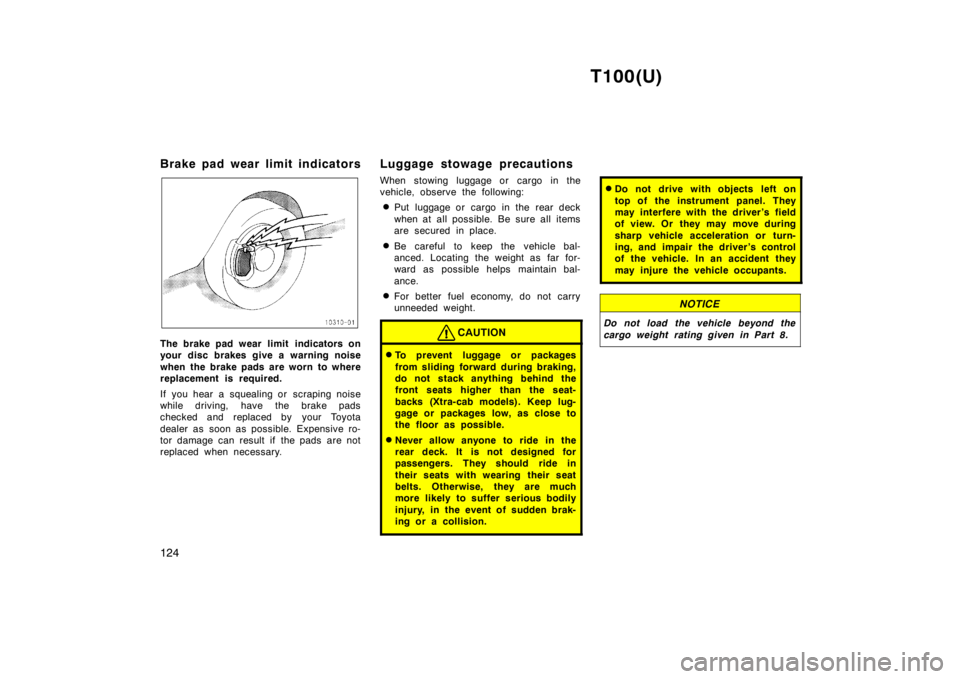
The brake pad wear limit indicators on
your disc brakes give a warning noise
when the brake pads are worn to where
replacement is required.
If you hear a squealing or scraping noise
while driving, have the brake pads
checked and replaced by your Toyota
dealer as soon as possible. Expensive ro-
tor damage can result if the pads are not
replaced when necessary.
Luggage stowage pr
ecautions
When stowing luggage or cargo in the
vehicle, observe the following: Put luggage or cargo in the rear deck
when at all possible. Be sure all items
are secured in place.
Be careful to keep the vehicle bal-
anced. Locating the weight as far for-
ward as possible helps maintain bal-
ance.
For better fuel economy, do not carry
unneeded weight.CAUTION
To prevent luggage or packages
from sliding forward during braking,
do not stack anything behind the
front seats higher than the seat-
backs (Xtra-cab models). Keep lug-
gage or packages low, as close to
the floor as possible.
Never allow anyone to ride in the
rear deck. It is not designed for
passengers. They should ride in
their seats with wearing their seat
belts. Otherwise, they are much
more likely to suffer serious bodily
injury, in the event of sudden brak-
ing or a collision.
Do not drive with objects left on
top of the instrument panel. They
may interfere with the driver’s field
of view. Or they may move during
sharp vehicle acceleration or turn-
ing, and impair the driver’s control
of the vehicle. In an accident they
may injure the vehicle occupants.
NOTICE
Do not load the vehicle beyond the
cargo weight rating given in Part 8.
Page 131 of 214
T100(U)131
Four-wheel drive models–Toyota recom-
mends not using four-wheel drive on
dry hard-surfaced roads, because four-
wheel driving will cause unnecessary
noise and wear, and poor fuel econo-
my.
Four-wheel drive models–In cold tem-
peratures, noise may occur when driv-
ing in two-wheel drive before the trans-
fer is warmed up. Therefore, first drive
in four-wheel drive until the transfer is
warmed up.
CAUTION
Before driving off, make sure the
parking brake is fully released and
the parking brake reminder light is
off.
Do not leave your vehicle unat-
tended while the engine is running.
Do not rest your foot on the brake
pedal while driving. It can cause
dangerous overheating, needless
wear, and poor fuel economy.
To drive down a long or steep hill,
reduce your speed and downshift.
Remember, if you ride the brakes
excessively, they may overheat and
not work properly.
Be careful when accelerating, up-
shifting, downshifting or braking on
a slippery surface. Sudden accelera-
tion or engine braking, could cause
the vehicle to spin or skid.
Do not drive in excess of the speed
limit. Even if the legal speed limit
permits it, do not drive over 140
km/h (85 mph) unless your vehicle
has high-speed capability tires.
Driving over 140 km/h (85 mph) may
result in tire failure, loss of control
and possible injury. Be sure to con-
sult a tire dealer to determine
whether the tires on your vehicle
are high-speed capability tires or
not before driving at such speeds.Do not continue normal driving
when the brakes are wet. If they are
wet, your vehicle will require a
longer stopping distance, and it
may pull to one side when the
brakes are applied. Also, the park-
ing brake will not hold the vehicle
securely.
Page 136 of 214
T100(U)
136
However, if towing with a fifth wheel
trailer, the cargo load must be distrib-
uted so that the tongue load is 19 to
21% of the total trailer weight. Never
load the trailer with more weight in
the back than in the front. About 60%
of the trailer load should be in the
front half of the trailer and the re-
maining 40% in the rear.
HITCHES Use only a weight carrying hitch de-
signed for the total trailer weight.
Toyota does not recommend using a
weight distribution (load equalizing)
hitch.
The hitch must be bolted securely to
the vehicle frame and installed accord-
ing to the hitch manufacturer ’s instruc-
tions.
If using a fifth wheel hitch, the center
of the king pin must be forward of the
axis of the vehicle’s rear wheels, and
installed according to the manufactur-
er ’s instructions.
The hitch ball and king pin should have
a light coat of grease.
Toyota recommends that the trailer
hitch, except fifth wheel hitch, be re-
moved when not towing to prevent inju-
ry and/or damage by the hitch in event
of a rear end collision. After removing
the hitch, the installation area should
be sealed to prevent entry of exhaust
fumes and mud.
NOTICE
Do not use an axle-mounting hitch as
it may cause damage to the axle
housing, wheel bearings, wheels and/
or tires.
BRAKES AND SAFETY CHAINS
Toyota recommends trailers with brakes
that conform to any applicable federal
and state/provincial regulations.
A safety chain must always be used
between the towing vehicle and the
trailer. Leave sufficient slack in the
chain for turns. The chain should cross
under the trailer tongue to prevent the
tongue from dropping to the ground in
case it becomes damaged or sepa-
rated. For correct safety chain proce-
dures, follow the hitch or trailer
manufacturer ’s recommendations.
CAUTION
If the total trailer weight exceeds
453 kg (1000 lb.), trailer brakes are
required.
Never tap into your vehicle’s hy-
draulic system as it would lower its
braking effectiveness.
Never tow a trailer without using a
safety chain securely attached to
both the trailer and the vehicle. If
damage occurs to the coupling unit
or hitch ball, there is danger of the
trailer wandering over into another
lane.
TIRES
Ensure that your vehicle’s tires are
properly inflated. See Chapter 7 −2 for
instructions.
The trailer tires should be inflated to
the pressure recommended by the trail-
er manufacturer in respect to the total
trailer weight.
Page 137 of 214

T100(U)137
TRAILER LIGHTS
Trailer lights must comply with federal,
state/provincial and local regulations.
See your local recreational vehicle
dealer or rental agency for the correct
type of wiring and relays for your trail-
er. Check for correct operation of the
turn signals and stop lights each time
you hitch up. Direct splicing may dam-
age your vehicle’s electrical system
and cause a malfunction of your lights.
BREAK-IN SCHEDULE Toyota recommends that you do not
tow a trailer with a new vehicle or a
vehicle with any new power train com-
ponent (engine, transmission, differen-
tial, wheel bearing, etc.) for the first
800 km (500 miles) of driving.
MAINTENANCE
If you tow a trailer, your vehicle will
require more frequent maintenance due
to the additional load. For this informa-
tion, please refer to the scheduled
maintenance information in the ”Own-
er ’s Manual Supplement/Maintenance
Schedule”.
Retighten all fixing bolts of the towing
ball and bracket after approximately
1000 km (600 miles) of trailer driving. PRE-TOWING SAFETY CHECK
Check that your vehicle remains level
when a loaded or unloaded trailer is
hitched. Do not drive if the vehicle has
an abnormal nose-up or nose-down
condition, and check for improper
tongue load, overload, worn suspension
or other possible causes.
Make sure the trailer cargo is securely
loaded so that it cannot shift.
Check that your rear view mirrors con-
form to any applicable federal, state/
provincial or local regulation. If not,
install the rear view mirrors required
for towing purpose.
TRAILER TOWING TIPS
When towing a trailer, your vehicle will
handle differently than when not tow-
ing. The three main causes of vehicle-
trailer accidents are driver error, exces-
sive speed and improper trailer loading.
Keep these in mind when towing: Before starting out, check operation of
the lights and all vehicle-trailer connec-
tions. After driving a short distance,
stop and recheck the lights and con-
nections. Before actually towing a trail-
er, practice turning, stopping and back-
ing with a trailer in an area away from
traffic until you learn the feel.
Backing with a trailer is difficult and
requires practice. Grip the bottom of
the steering wheel and move your hand
to the left to move the trailer to the
left. Move your hand to the right to
move the trailer to the right. (This pro-
cedure is generally opposite to that
when backing without a trailer). Also,
just turn the steering wheel a little at
a time, avoiding sharp or prolonged
turning. Have someone guide you when
backing to reduce the risk of an acci-
dent.
Because stopping distance may be in-
creased, vehicle-to-vehicle distance
should be increased when towing a
trailer. For each 16 km/h (10 mph) of
speed, allow at least one vehicle and
trailer length between you and the ve-
hicle ahead. Avoid sudden braking as
you may skid, resulting in jackknifing
and loss of control. This is especially
true on wet or slippery surfaces.
Avoid jerky starts or sudden accelera-
tion. If your vehicle has a manual
transmission, prevent excessive clutch
slippage by keeping engine rpm low
and not racing the engine. Always start
out in first gear.
Page 147 of 214

T100(U)147
1. Get the jack, jack handle and wheelnut wrench.
To prepare yourself for an emergency, you
should fam iliarize yourself with the use of
the jack, each of the tools and their stor-
age locations.When removing the jack, turn the joint by
hand towards the CONTRACT direction
until the jack is free. When storing, turn
the joint by hand towards the EXPAND
direction until the jack is firmly secured to
prevent it from flying forward during a
collision or sudden braking.To remove the spare tire:
1. Insert the end of the jack handle into the lowering screw and turn it counter-
clockwise.
2. After the tire is lowered completely to the ground, remove the holding brack-
et.
When storing the spare tire, put it in place
with the outer side of the wheel facing up.
Then secure the tire, taking care that the
tire goes straight up without catching on
any other part, to prevent it from flying
forward during a collision or sudden brak-
ing.
—Required tools and spare
tire (normal-cab models)
Page 148 of 214

T100(U)
148
1. Get the jack and tool bag.
To prepare yourself for an emergency, you
should fam iliarize yourself with the use of
the jack, each of the tools and their stor-
age locations. When removing the jack, turn the joint by
hand towards the CONTRACT direction
until the jack is free. When storing, turn
the joint by hand towards the EXPAND
direction until the jack is firmly secured to
prevent it from flying forward during a
collision or sudden braking.To remove the spare tire:
1. Insert the end of the jack handle exten- sion into the lowering screw and turn
it counterclockwise with the handle,
making sure the handle remains firmly
fitted onto the jack handle extension.
2. After the tire is lowered completely to the ground, remove the holding brack-
et.
When storing the spare tire, put it in place
with the outer side of the wheel facing up.
Then secure the tire, taking care that the
tire goes straight up without catching on
any other part, to prevent it from flying
forward during a collision or sudden brak-
ing.
—Required tools and
spare tire (Xtra-cab models)