name. SIENNA (U)
175
Luggage stowage precautions
When stowing luggage or cargo in the
vehicle, observe the following:
�Put luggage or cargo in the luggage
compartment when at all possible. Be
sure all items are secured in place.
�Be careful to keep the vehicle bal-
anced. Locating the weight as far for-
ward as possible helps maintain bal-
ance.
�For better fuel economy, do not carry
unneeded weight.
CAUTION
�To prevent luggage or packages
from sliding forward during braking,
do not stack anything in the lug-
gage compartment higher than the
seatbacks. Keep luggage or pack-
ages low, as close to the floor as
possible.
�Never allow anyone to ride in the
luggage compartment. It is not de-
signed for passengers. They should
ride in their seats with their seat
belts properly fastened. Otherwise,
they are much more likely to suffer
serious bodily injury, in the event
of sudden braking or a collision.
�Do not drive with objects left on
top of the instrument panel. They
may interfere with the driver’s field
of view. Or they may move during
sharp vehicle acceleration or turn-
ing, and impair the driver’s control
of the vehicle. In an accident they
may injure the vehicle occupants.
NOTICE
Do not load the vehicle beyond the
vehicle capacity weight specified in
Part 8.
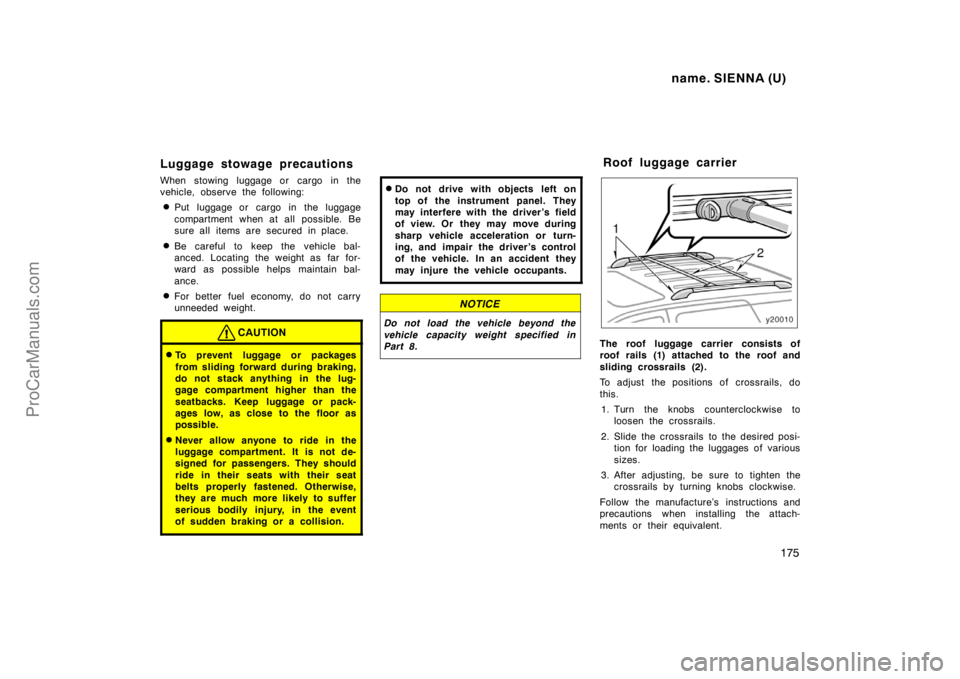
The roof luggage carrier consists of
roof rails (1) attached to the roof and
sliding crossrails (2).
To adjust the positions of crossrails, do
this.
1. Turn the knobs counterclockwise to
loosen the crossrails.
2. Slide the crossrails to the desired posi-
tion for loading the luggages of various
sizes.
3. After adjusting, be sure to tighten the
crossrails by turning knobs clockwise.
Follow the manufacture’s instructions and
precautions when installing the attach-
ments or their equivalent.
Roof luggage carrier
ProCarManuals.com
name. SIENNA (U)
183
CAUTION
�The total trailer weight (trailer
weight plus its cargo load) must
not exceed the following. Exceeding
this weight is dangerous. If towing
a trailer over 907 kg (2000 lb.), it is
necessary to use a sway control
device with a sufficient capacity.
Without towing package
907 kg (2000 lb.)
With towing package
1587 kg (3500 lb.)
�The gross combination weight (sum
of your vehicle weight plus its load
and the total trailer weight) must
not exceed the following.
Without towing package
3129 kg (6900 lb.)
With towing package
3537 kg (7800 lb.)�The gross vehicle weight must not
exceed the Gross Vehicle Weight
Rating (GVWR) indicated on the
Certification Label. The gross ve-
hicle weight is the sum of weights
of the unloaded vehicle, driver, pas-
sengers, luggage, hitch and trailer
tongue load. It also includes the
weight of any special equipment
installed on your vehicle.
�The load on either the front or rear
axle resulting from distribution of
the gross vehicle weight on both
axles must not exceed the Gross
Axle Weight Rating (GAWR) listed
on the Certification Label.
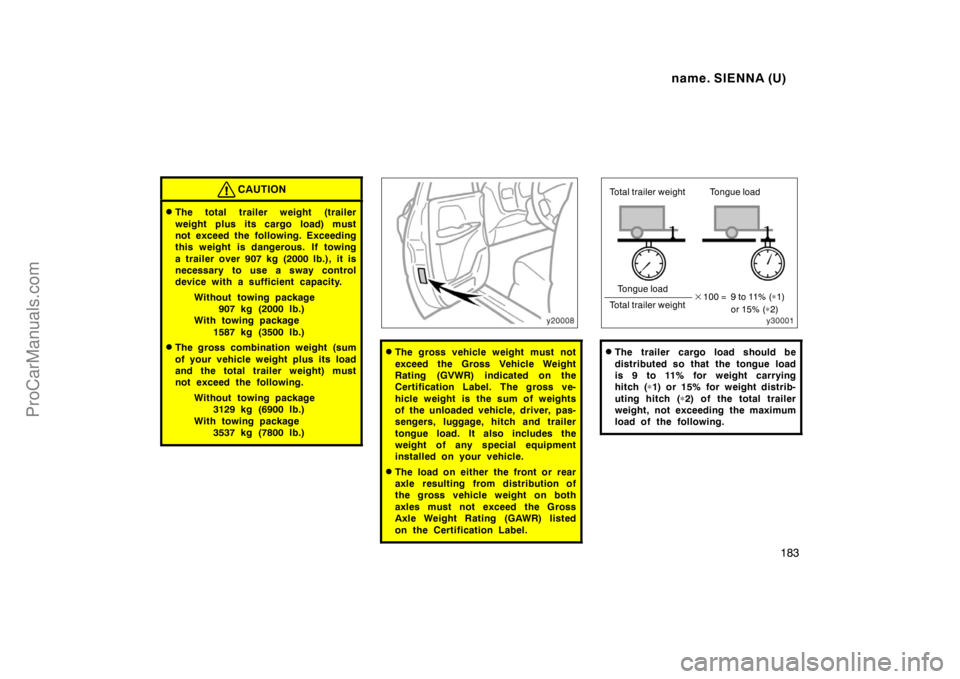
Total trailer weight Tongue load
Tongue load
Total trailer weight100 = �
9 to 11% (∗1)
or 15% (∗2)
�The trailer cargo load should be
distributed so that the tongue load
is 9 to 11% for weight carrying
hitch (∗1) or 15% for weight distrib-
uting hitch (∗2) of the total trailer
weight, not exceeding the maximum
load of the following.
ProCarManuals.com