Page 134 of 204
1998 COROLLA(U)
142
HITCHES
�Use only a hitch which is recom-
mended by the hitch manufacturer and
conforms to the total trailer weight re-
quirement.
�Follow the directions supplied by the
hitch manufacturer. Lubricate the hitch
ball with a light coat of grease.
�Toyota recommends removing the trail-
er hitch whenever you are not towing
a trailer to reduce the possibility of
additional damage caused by the hitch
if your vehicle is struck from behind.
NOTICE
Do not use axle−mounted hitches as
they can cause damage to the axle
housing, wheel bearings, wheels or
tires. Also, never install a hitch which
may interfere with the normal function
of an Energy Absorbing Bumper, if so
equipped.
BRAKES AND SAFETY CHAINS
�Toyota recommends trailers with
brakes that conform to any applica-
ble federal and state/provincial regu-
lations.
�A safety chain must always be used
between the towing vehicle and the
trailer. Leave sufficient slack in the
chain for turns. The chain should
cross under the trailer tongue to
prevent the tongue from dropping to
the ground in case it becomes dam-
aged or separated. For correct safety
chain procedures, follow the hitch or
trailer manufacturer ’s recommenda-
tions.
CAUTION
�If the total trailer weight exceeds
453 kg (1000 lb.), trailer brakes are
required.
�Never tap into your vehicle’s hy-
draulic system as it would lower its
braking effectiveness.
�Never tow a trailer without using a
safety chain securely attached to
both the trailer and the vehicle. If
damage occurs to the coupling unit
or hitch ball, there is danger of the
trailer wandering over into another
lane.
TIRES
�Ensure that your vehicle’s tires are
properly inflated. See Chapter 7−2 for
instructions.
�The trailer tires should be inflated to
the pressure recommended by the trail-
er manufacturer in respect to the total
trailer weight.
TRAILER LIGHTS
�Trailer lights must comply with federal,
state/provincial and local regulations.
See your local recreational vehicle
dealer or rental agency for the correct
type of wiring and relays for your trail-
er. Check for correct operation of the
turn signals and stop lights each time
you hitch up. Direct splicing may dam-
age your vehicle’s electrical system
and cause a malfunction of your lights.
BREAK−IN SCHEDULE
�Toyota recommends that you do not
tow a trailer with a new vehicle or a
vehicle with any new power train com-
ponent (engine, transmission, differen-
tial, wheel bearing, etc.) for the first
800 km (500 miles) of driving.
ProCarManuals.com
Page 136 of 204

1998 COROLLA(U)
144�
Remember that when making a turn,
the trailer wheels will be closer than
the vehicle wheels to the inside of the
turn. Therefore, compensate for this by
making a larger than normal turning
radius with your vehicle.
�Crosswinds and rough roads will ad-
versely affect handling of your vehicle
and trailer, causing sway. Pay attention
to the rear from time to time to pre-
pare yourself for being passed by large
trucks or buses, which may cause your
vehicle and trailer to sway. If swaying
happens, firmly grip the steering wheel
and reduce speed immediately but
gradually. Never increase speed. Steer
straight ahead. If you make no extreme
correction with the steering or brakes,
the vehicle and trailer will stabilize.
�Be careful when passing other ve-
hicles. Passing requires considerable
distance. After passing a vehicle, do
not forget the length of your trailer and
be sure you have plenty of room be-
fore changing lanes.
�In order to maintain engine braking effi-
ciency do not use fifth gear (manual
transmission) or overdrive (automatic
transmission).
�Because of the added load of the trail-
er, your vehicle’s engine may overheat
on hot days (at temperatures over
30�C [85�F]) when going up a long or
steep grade with a trailer. If the engine
coolant temperature gauge indicates
overheating, immediately turn off the air
conditioning (if in use), pull off the road
and stop in a safe spot. Refer to ”If
your vehicle overheats” in Part 4 of
this manual.
�Always place wheel blocks under both
the vehicle and trailer wheels when
parking. Apply the parking brake firmly.
Put the transmission in ”P” (automatic)
or in first or reverse (manual). Avoid
parking on a slope with a trailer, but
if it cannot be avoided, do so only
after performing the following:1. Apply the brakes and hold.
2. Have someone place wheel blocks un-
der both the vehicle and trailer wheels.
3. When the wheel blocks are in place,
release your brakes slowly until the
blocks absorb the load.
4. Apply the parking brake firmly.
5. Shift into first or reverse (manual) or
”P” (automatic) and turn off the engine.
When restarting out after parking on a
slope:
1. With the transmission in ”P” position
(automatic) or the clutch pedal de-
pressed (manual), start the engine.
(With an automatic transmission, be
sure to keep the brake pedal de-
pressed.)
2. Shift into gear.
3. Release the parking brake (also foot
brake on automatic transmission ve-
hicles) and slowly pull or back away
from the wheel blocks. Stop and apply
your brakes.
4. Have someone retrieve the blocks.
ProCarManuals.com
Page 178 of 204
1998 COROLLA(U)
186
To check the fluid level, simply look at
the see−through reservoir. The level
should be between the ”MAX” and
”MIN” lines on the reservoir.
It is normal for the brake fluid level to go
down slightly as the brake pads wear. So
be sure to keep the reservoir filled.
If the reservoir needs frequent refilling, it
may indicate a serious mechanical prob-
lem.
If the level is low, add SAE J1703 or
FMVSS No. 116 DOT 3 brake fluid to
the brake reservoir.
Remove and replace the reservoir cover
by hand.Use only newly opened brake fluid. Once
opened, brake fluid absorbs moisture from
the air, and excess moisture can cause a
dangerous loss of braking.
CAUTION
Take care when filling the reservoir
because brake fluid can harm your
eyes and damage painted surfaces. If
fluid gets in your eyes, flush your
eyes with clean water.
NOTICE
If you spill some of the fluid, be sure
to wash it off with water to prevent
it from damaging the parts or paint.
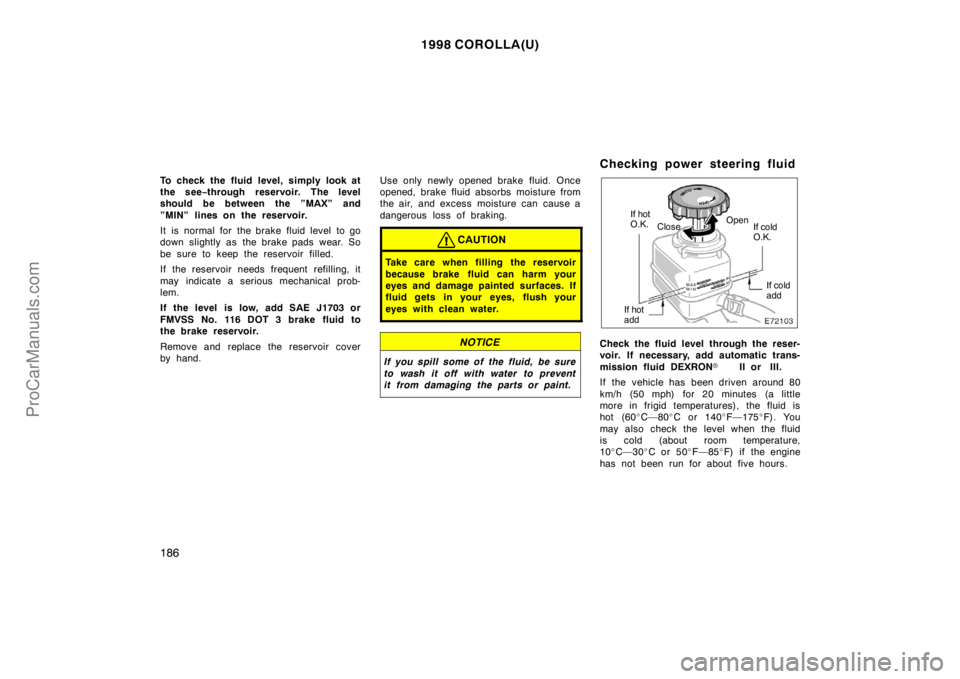
Checking power steering fluid
Close If hot
O.K.
If cold
O.K.
If cold
add
If hot
addOpen
Check the fluid level through the reser-
voir. If necessary, add automatic trans-
mission fluid DEXRON� II or III.
If the vehicle has been driven around 80
km/h (50 mph) for 20 minutes (a little
more in frigid temperatures), the fluid is
hot (60�C—80�C or 140�F—175�F). You
may also check the level when the fluid
is cold (about room temperature,
10�C—30�C or 50�F—85�F) if the engine
has not been run for about five hours.
ProCarManuals.com
Page 191 of 204
1998 COROLLA(U)
199
4. Release the bulb retaining spring
and remove the bulb. Install a new
bulb and the bulb retaining spring.
To install a bulb, align the tabs of the
bulb with the cutouts of the mounting
hole.5. Install the rubber cover with the
”TOP” mark upward, and snuggle on
the boss. Insert the connector.
Make sure the rubber cover fits snugly on
the connector and the headlight body.
Aiming is not necessary after replacing
the bulb. When aiming adjustment is nec-
essary, contact your Toyota dealer.Use a Phillips−head screwdriver.
—Parking, front side marker
and front turn signal lights
ProCarManuals.com
Page 202 of 204
1998 COROLLA(U)
210
Fuses (type B)
32. HTR 50 A: Air conditioning system,
”A/C” fuse
33. MAIN 40 A: Starter system, ”HEAD
(LH) or HEAD (LH−UPR), ”HEAD (RH)
or HEAD (RH−UPR), ”HEAD LH−Lo”
and ”HEAD RH−Lo fuses
34. RDI 30 A: Electric cooling fan
35. AM1 50 A: ”CIG”, ”TURN”, ”GAUGE”,
”ECU−IG”, and ”WIP” fuses
36. DEF 40 A: Rear window defogger,
”DEF I−UP/M−HTR” fuse
37. POWER 30 A: Power windows, electric
moon roof
Fuses (type C)
38. FL ABS 50 A: Anti−lock brake system
39. FL ALT 100 A: ”RDI”, ”CDS”, ”AM1”,
”POWER”, ”D/L”, ”TAIL”, OBD, ”FOG”,
”ECU−B”, ”STOP” and ”DEF”, ”HTR”
fuses
ProCarManuals.com