Page 164 of 233
’98 AVALON (USA/CANADA)−U
164
CAUTION
�Do not exceed 72 km/h (45 mph) or
the posted towing speed limit,
whichever is lower. Because insta-
bility (swaying) of a towing vehicle −
trailer combination usually in-
creases as the speed increases, ex-
ceeding 72 km/h (45 mph) may
cause loss of control.
�Slow down and downshift before
descending steep or long downhill
grades. Do not make sudden down-
shifts.
�Avoid holding the brake pedal down
too long or too frequently. This
could cause the brakes to overheat
and result in reduced braking effi-
ciency.
Getting more kilometers/mileage from a
liter/gallon of fuel is easy—just take it
easy. It will help make your vehicle last
longer, too. Here are some specific tips
on how to save money on both fuel and
repairs:
�Keep your tires inflated at the cor-
rect pressure. Underinflation causes
tire wear and wastes fuel. See Chapter
7 −2 for instructions.
�Do not carry unneeded weight in
your vehicle. Excess weight puts a
heavier load on the engine, causing
greater fuel consumption.
�Avoid lengthy warm −up idling. Once
the engine is running smoothly, begin
driving—but gently. Remember, howev-
er, that on cold winter days this may
take a little longer.
�Accelerate slowly and smoothly.
Avoid jackrabbit starts.
�Avoid long engine idling. If you have
a long wait and you are not in traffic,
it is better to turn off the engine and
start again later.
�Avoid engine lug or overrevving. Use
a gear position suitable for the road on
which you are travelling.
�Avoid continuous speeding up and
slowing down. Stop−and− go driving
wastes fuel.
�Avoid unnecessary stopping and
braking. Maintain a steady pace. Try
to time the traffic signals so you only
need to stop as little as possible or
take advantage of through streets to
avoid traffic lights. Keep a proper dis-
tance from other vehicles to avoid sud-
den braking. This will also reduce wear
on your brakes.
�Avoid heavy traffic or traffic jams
whenever possible.
�Do not rest your foot on the brake
pedal. This causes needless wear,
overheating and poor fuel economy.
�Maintain a moderate speed on high-
ways. The faster you drive, the greater
the fuel consumption. By reducing your
speed, you will cut down on fuel con-
sumption.
�Keep the front wheels in proper
alignment. Avoid hitting the curb and
slow down on rough roads. Improper
alignment not only causes faster tire
wear but also puts an extra load on
the engine, which, in turn, wastes fuel.
How to save fuel and make
your vehicle last longer, too
ProCarManuals.com
Page 177 of 233
’98 AVALON (USA/CANADA)−U
177
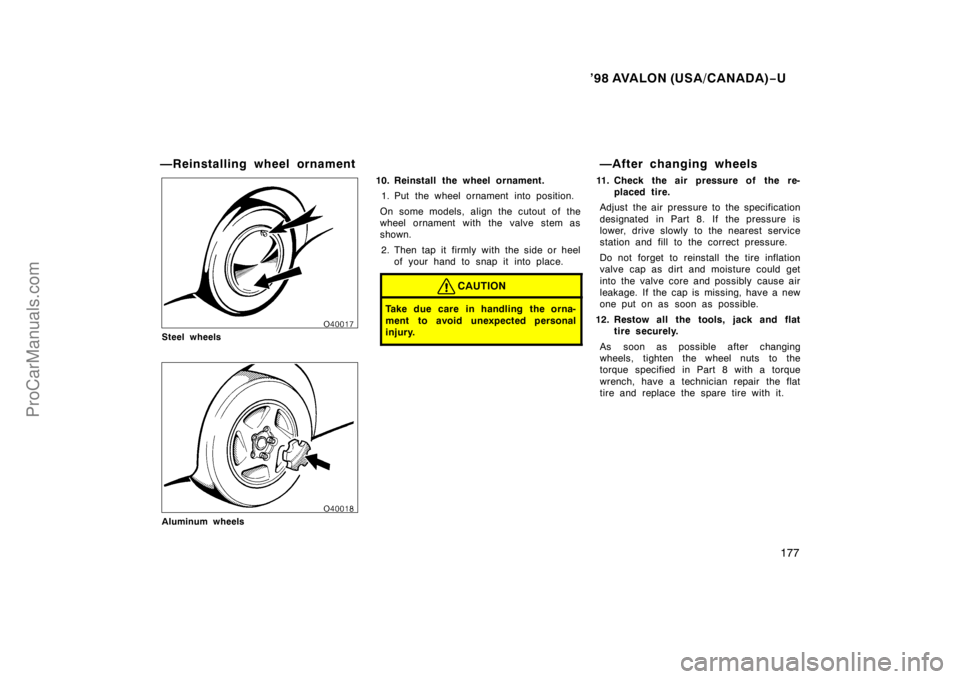
—Reinstalling wheel ornament
Steel wheels
Aluminum wheels
10. Reinstall the wheel ornament.
1. Put the wheel ornament into position.
On some models, align the cutout of the
wheel ornament with the valve stem as
shown. 2. Then tap it firmly with the side or heel of your hand to snap it into place.
CAUTION
Take due care in handling the orna-
ment to avoid unexpected personal
injury.
—After changing wheels
11. Check the air pressure of the re- placed tire.
Adjust the air pressure to the specification
designated in Part 8. If the pressure is
lower, drive slowly to the nearest service
station and fill to the correct pressure.
Do not forget to reinstall the tire inflation
valve cap as dirt and moisture could get
into the valve core and possibly cause air
leakage. If the cap is missing, have a new
one put on as soon as possible.
12. Restow all the tools, jack and flat tire securely.
As soon as possible after changing
wheels, tighten the wheel nuts to the
torque specified in Part 8 with a torque
wrench, have a technician repair the flat
tire and replace the spare tire with it.
ProCarManuals.com
Page 204 of 233

’98 AVALON (USA/CANADA)−U
204
Checking tire pressure
Keep your tire pressures at the proper
level.
The recommended cold tire pressures, tire
size and the vehicle capacity weight are
given in Part 8. They are also on the tire
pressure label as shown.
You should check the tire pressures every
two weeks, or at least once a month. And
do not forget the spare!
Incorrect tire pressure can reduce tire
life and make your vehicle less safe to
drive. Low tire pressure results in excessive
wear, poor handling, reduced fuel econo-
my, and the possibility of blowouts from
overheated tires. Also, low tire pressure
can cause poor sealing of the tire bead.
If the tire pressure is excessively low,
there is the possibility of wheel deforma-
tion and/or tire separation.
High tire pressure produces a harsh ride,
handling problems, excessive wear at the
center of the tire tread, and a greater
possibility of tire damage from road haz-
ards.
If a tire frequently needs refilling, have it
checked by your Toyota dealer.
The following instructions for checking
tire pressure should be observed:
�The pressure should be checked only
when the tires are cold.
If your ve-
hicle has been parked for at least 3
hours and has not been driven for
more than 1.5 km or 1 mile since, you
will get an accurate cold tire pressure
reading.
�Always use a tire pressure gauge.
The appearance of a tire can be mis-
leading. Besides, tire pressures that
are even just a few pounds off can
degrade handling and ride.
�Do not bleed or reduce tire pressure
after driving. It is normal for the tire
pressure to be higher after driving.
�Never exceed the vehicle capacity
weight. The passenger and luggage
weight should be located so that the
vehicle is balanced.
�Be sure to reinstall the tire inflation
valve caps. Without the valve caps,
dirt or moisture could get into the valve
core and cause air leakage. If the caps
have been lost, have new ones put on
as soon as possible.
ProCarManuals.com