Page 202 of 233
’98 AVALON (USA/CANADA)−U
202
Look at the see −through coolant reser-
voir when the engine is cold. The cool-
ant level is satisfactory if it is between
the ”FULL” and ”LOW” lines on the
reservoir. If the level is low, add ethyl-
ene −glycol type coolant.
The coolant level in the reservoir will vary
with engine temperature. However, if the
level is on or below the ”LOW” line, add
coolant. Bring the level up to the ”FULL”
line.
Use only ethylene− glycol type coolant.
See information in the next column.
If the coolant level drops within a short
time after replenishing, there may be a
leak in the system. Visually check the
radiator, hoses, radiator cap and drain
cock and water pump.
If you can find no leak, have your Toyota
dealer test the cap pressure and check
for leaks in the cooling system.
CAUTION
To prevent burning yourself, do not
remove the radiator cap when the en-
gine is hot.
Coolant type selection
Your coolant must contain ethylene −glycol
antifreeze. In addition to preventing freez-
ing and subsequent damage to the engine,
this will also prevent corrosion. Further
supplemental inhibitors or additives are
neither needed nor recommended.
Read the antifreeze container for informa-
tion on freeze protection. Follow the
manufacturer’s directions for how much to
mix with water. The total capacity of the
cooling system is given in Part 8. We
recommend 50 % solution be used for
your Toyota, or a sufficient quantity to
provide protection to about −35 �C ( −31 �F).
NOTICE
Do not use alcohol type antifreeze or
plain water alone.
Checking brake fluid
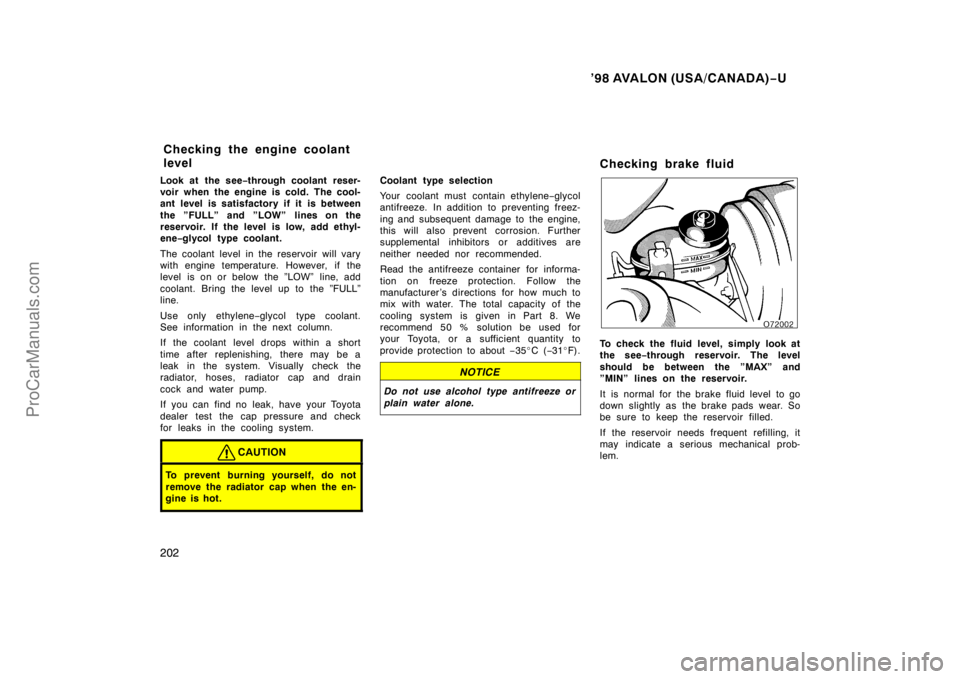
To check the fluid level, simply look at
the see −through reservoir. The level
should be between the ”MAX” and
”MIN” lines on the reservoir.
It is normal for the brake fluid level to go
down slightly as the brake pads wear. So
be sure to keep the reservoir filled.
If the reservoir needs frequent refi lling, it
may indicate a serious mechanical prob-
lem.
Checking the engine coolant
level
ProCarManuals.com
Page 211 of 233

’98 AVALON (USA/CANADA)−U
211
—Checking battery exterior
Terminals
Ground cable
Hold −down
clamp
Check the battery for corroded or loose
terminal connections, cracks, or loose
hold −down clamp.
a. If the battery is corroded, wash it off with a solution of warm water and bak-
ing soda. Coat the outside of the termi-
nals with grease to prevent further cor-
rosion.
b. If the terminal connections are loose, tighten their clamp nuts—but do not
overtighten.
c. Tighten the hold −down clamp only
enough to keep the battery firmly in
place. Overtightening may damage the
battery case.
NOTICE
� Be sure the engine and all accesso-
ries are off before performing main-
tenance.
� When checking the battery, remove
the ground cable from the negative
terminal (”—” mark) first and rein-
stall it last.
� Be careful not to cause a short cir-
cuit with tools.
� Take care no solution gets into the
battery when washing it.
—Checking battery fluid
Ty p e A
Green Dark Clear or
light yellow
Ty p e B Blue White Red
CHECKING BY THE HYDROMETER
Check the battery condition by the
hydrometer color.
Hydrometer colorConditionTy p e ATy p e B
GREENBLUEGood
DARKWHITECharging necessary. Have
battery checked by your
Toyota dealer.
CLEAR or
LIGHT
YELLOWREDHave battery checked by
your Toyota dealer.
ProCarManuals.com
Page 212 of 233
’98 AVALON (USA/CANADA)−U
212
Battery recharging precautions
During recharging, the battery is pro-
ducing hydrogen gas.
Therefore, before recharging:
1. If recharging with the battery installed on the vehicle, be sure to disconnect
the ground cable.
2. Be sure the power switch on the re- charger is off when connecting the
charger cables to the battery and when
disconnecting them.
CAUTION
�Always charge the battery in an un-
confined area. Do not charge the
battery in a garage or closed room
where there is not sufficient ventila-
tion.
�Only do a slow charge (5A or less).
Charging at a quicker rate is dan-
gerous. The battery may explode,
causing personal injuries.
NOTICE
Never recharge the battery while the
engine is running. Also, be sure all
accessories are turned off.
Checking and replacing fuses
Ty p e A
Ty p e B
Ty p e C Good
Blown
Good Blown
Blown
Good
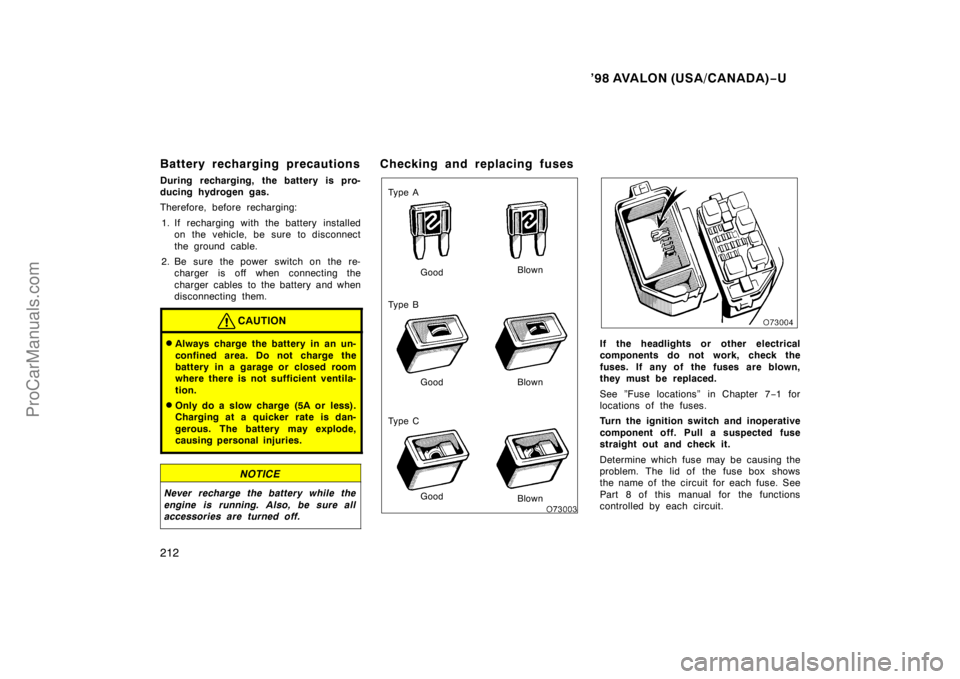
If the headlights or other electrical
components do not work, check the
fuses. If any of the fuses are blown,
they must be replaced.
See ”Fuse locations” in Chapter 7
−1 for
locations of the fuses.
Turn the ignition switch and inoperative
component off. Pull a suspected fuse
straight out and check it.
Determine which fuse may be causing the
problem. The lid of the fuse box shows
the name of the circuit for each fuse. See
Part 8 of this manual for the functions
controlled by each circuit.
ProCarManuals.com
Page 226 of 233

’98 AVALON (USA/CANADA)−U
226
Oil grade:
API grade SH, ”Energy −Conserving II”
or SJ, ”Energy −Conserving” multigrade
engine oil or ILSAC multigrade engine
oil is recommended.
Recommended oil viscosity (SAE):
COOLING SYSTEM
Total capacity, L (qt., Imp. qt.): 9.3 (9.8, 8.2)
Coolant type: With ethylene− glycol antifreeze (Do not
use alcohol type.) BATTERY
Open voltage
∗ at 20
�C (68 �F):
12.6—12.8 V Fully charged
12.2—12.4 V Half charged
11.8—12.0 V Discharged
∗: Voltage that is checked 20 minutes after the key is removed with all the lights
turned off
Charging rates: 5 A max.
AUTOMATIC TRANSAXLE
Automatic transmission Fluid capacity (drain and refill),
L (qt., Imp. qt.): Up to 3.5 (3.7, 3.1)
Differential Fluid capacity, L (qt., Imp. qt.):0.85 (0.9, 0.7)
Fluid type: Automatic transmission fluid D −II or
DEXRON �III (DEXRON �II) BRAKES
Minimum pedal clearance when depressed
with the pressure of 490 N (50 kgf, 110
lbf) with the engine running, mm (in.)
70 (2.8)
Pedal freeplay, mm (in.): 1—6 (0.04—0.24)
Pad wear limit, in. (mm): 1.0 (0.04)
Lining wear limit, in. (mm): 1.0 (0.04)
Parking brake adjustment when depressed
with the pressure of 294 N (30 kgf, 66.1
lbf): 3–6 clicks
Fluid type: SAE J1703 or FMVSS No. 116 DOT 3
STEERING
Wheel freeplay: Less than 30 mm (1.2 in.)
Power steering fluid type: Automatic transmission fluid
DEXRON �II or III
ProCarManuals.com
Page:
< prev 1-8 9-16 17-24