Page 188 of 395
If your vehicle starts to slide, ease your foot off the
accelerator pedal and quickly steer the way you want the
vehicle to go. If you start steering quickly enough, your
vehicle may straighten out. Always be ready for a
second skid if it occurs.
Of course, traction is reduced when water, snow, ice,
gravel or other material is on the road.
For safety, you’ll
want
to slow down and adjust your driving to these
conditions.
It is important to slow down on slippery
surfaces because stopping distance
will be longer and
vehicle control more limited.
While driving on
a surface with reduced traction, try
your best to avoid sudden steering, acceleration or
braking (including engine braking by shifting to a
lower gear). Any sudden changes could cause the tires
to slide. You may not realize the surface is slippery until
your vehicle is skidding. Learn to recognize warning
clues -- such as enough water, ice or packed snow on
the road to make a “mirrored surface”
-- and slow down
when you have any doubt.
Remember: Any anti-lock brake system
(ABS) helps
avoid only the braking skid.
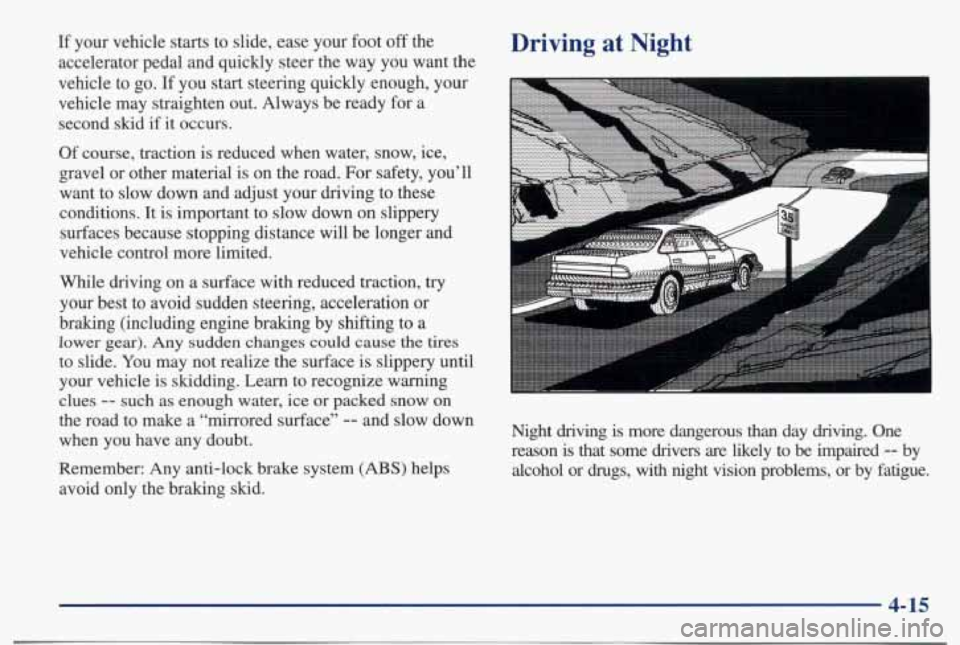
Driving at Night
..... ............ ........... ............ ........... ............ ...................I____
Night driving is more dangerous than day driving. One
reason is that some drivers are likely to
be impaired -- by
alcohol or drugs, with night vision problems, or
by fatigue.
4-15
Page 190 of 395

Driving in Rain and on Wet Roads Rain and wet roads can mean driving trouble. On a wet
road, you can’t stop, accelerate or turn as well because
your tire-to-road traction isn’t as good as on
dry roads.
And, if your tires don’t have much tread left, you’ll get
even less traction. It’s always wise to go slower and be
cautious if rain starts to fall while you
are driving. The
surface may get wet suddenly when your reflexes are
tuned for driving on dry pavement.
The heavier the rain, the harder it is to see. Even if your
windshield wiper blades are in good shape, a heavy rain
can make
it harder to see road signs and traffic signals,
pavement markings, the edge of the road
and even
people walking.
It’s wise to keep
your windshield wiping equipment in
good shape and keep your windshield washer tank filled
with washer fluid. Replace your windshield wiper
inserts when they show signs
of streaking or missing
areas on the windshield, or when strips
of rubber start to
separate from the inserts.
4-17
Page 210 of 395

Tbrn Signals When Towing a Trailer
When you tow a trailer, your vehicle may need a
different turn signal flasher and/or extra wiring. Check
with your Pontiac dealer. The green arrows on your
instrument panel will flash whenever
you signal a turn
or lane change. Properly hooked up, the trailer lamps
will also flash, telling other drivers you’re about to turn,
change lanes or stop.
When towing a trailer, the green arrows on your
instrument panel will flash for turns even if the bulbs
on
the trailer are burned out. Thus, you may think drivers
behind you are seeing your signal when they are not. It’s
important to check occasionally to be sure the trailer
bulbs are still working.
Your vehicle has bulb warning lights. When you plug a
trailer lighting system into your vehicle’s lighting
system, its bulb warning lights may not let you know
if
one of your lamps goes out. So, when you have a trailer
lighting system plugged in, be sure to check your
vehicle and trailer lamps from time to time to be sure
they’re all working. Once you disconnect the trailer
lamps, the bulb warning lights again can tell
you if one
of your vehicle lamps is out.
Driving On Grades
Reduce speed and shift to a lower gear before you start
down a long or steep downgrade.
If you don’t shift
down, you might have to use your brakes
so much that
they would get hot and no longer work well.
Parking on Hills
You really should not park your vehicle, with a trailer
attached, on a hill. If something goes wrong, your rig
could start to move. People can be injured, and both
your vehicle and the trailer can be damaged.
But if
you ever have to park your rig on a hill, here’s
how to do it:
1.
2.
3.
4.
5.
Apply your regular brakes, but don’t shift into
PARK (P) yet.
Have someone place chocks under the trailer wheels.
When the wheel chocks are in place, release the
regular brakes until
the chocks absorb the load.
Reapply the regular brakes. Then apply your parking
brake, and then shift to PARK (P).
Release the regular brakes.
4-37
Page 211 of 395
When You Are Ready to Leave After
Parking
on a Hill
1. Apply your regular brakes and hold the pedal down
while you:
Start your engine;
0 Shift into a gear; and
0 Release the parking brake.
2.
Let up on the brake pedal.
3. Drive slowly until the trailer is clear of the chocks.
4. Stop and have someone pick up and store the chocks.
Maintenance When Trailer Towing
Your vehicle will need service more often when you’re
pulling a trailer.
See the Maintenance Schedule for more
on
this. Things that are especially important in trailer
operation
are automatic transaxle fluid (don’t overfill),
engine oil, belt(s), cooling system and brake adjustment.
Each
of these is covered in this manual, and the Index
will help you find them quickly.
If you’re trailering, it’s
a good idea to review these sections before
you start
your trip.
Check periodically to see that all hitch nuts and bolts
Engine Cooling When Ier Towing
fight.
-
Your cooling system may temporarily overheat during
severe operating conditions. See “Engine Overheating”
in the Index.
4-38
Page 267 of 395

As shown in the chart, SAE 1OW-30 is best for your
vehicle. However,
you can use SAE 5W-30 if it's going
to be colder
than 60 "F (1 6" C) before your next oil
change. When it's very cold, you should use SAE
5W-30. These numbers on an oil container show its
viscosity,
or thickness. Do not use other viscosity oils,
such as
SAE 20W-50.
NOTICE:
Use only engine oil with the American Petroleum
Institute Certified For Gasoline Engines
"Starburst" symbol. Failure to use the
recommended
oil can result in engine damage
not covered by your warranty.
GM Goodwrench@ oil meets all the requirements for
your vehicle.
If you are in an area where the temperature falls below
-20°F (-29"C), consider using either an SAE 5W-30
synthetic oil or an SAE OW-30 oil. Both will provide
easier cold starting
and better protection for your engine
at extremely low temperatures.
Engine Oil Additives
Don't add anything to your oil. Your dealer is ready to
advise if you
think something should be added.
When to Change Engine Oil
If any one of these is true for you, use the short tripkity
maintenance schedule:
0
0
0
0
0
Most tsips are less than 5 to 10 miles (8 to 16 lun).
This is particularly important when outside
temperatures are below freezing.
Most
trips include extensive idling (such as fiequent
driving
in stop-and-go traffic).
Most trips are through dusty areas.
You frequently tow a trailer or use a carrier on top of
your vehicle.
The vehicle
is used for delivery service, police, taxi
or other commercial application.
Driving under these conditions causes engine oil to
break down sooner.
If any one of these is true for your
vehicle,
then you need to change your oil and filter
every
3,000 miles (5 000 km) or 3 months -- whichever
occurs
first.
6-16
Page:
< prev 1-8 9-16 17-24