1998 OPEL FRONTERA wiring
[x] Cancel search: wiringPage 4197 of 6000
DRIVE LINE CONTROL SYSTEM (TOD) 4B2–114
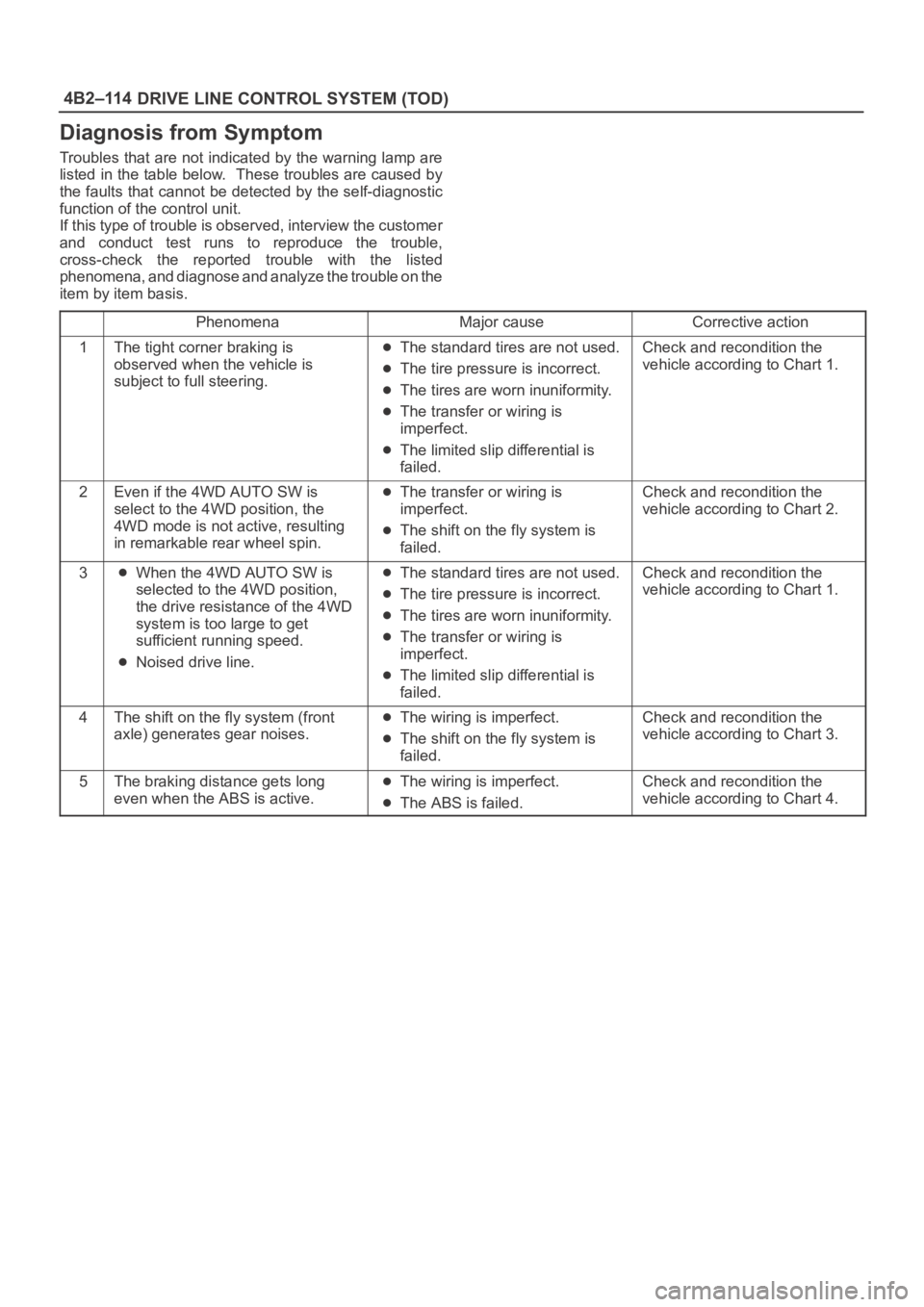
Diagnosis from Symptom
Troubles that are not indicated by the warning lamp are
listed in the table below. These troubles are caused by
the faults that cannot be detected by the self-diagnostic
function of the control unit.
If this type of trouble is observed, interview the customer
and conduct test runs to reproduce the trouble,
cross-check the reported trouble with the listed
phenomena, and diagnose and analyze the trouble on the
item by item basis.
PhenomenaMajor causeCorrective action
1The tight corner braking is
observed when the vehicle is
subject to full steering.The standard tires are not used.
The tire pressure is incorrect.
The tires are worn inuniformity.
The transfer or wiring is
imperfect.
The limited slip differential is
failed.
Check and recondition the
vehicle according to Chart 1.
2Even if the 4WD AUTO SW is
select to the 4WD position, the
4WD mode is not active, resulting
in remarkable rear wheel spin.The transfer or wiring is
imperfect.
The shift on the fly system is
failed.
Check and recondition the
vehicle according to Chart 2.
3When the 4WD AUTO SW is
selected to the 4WD position,
the drive resistance of the 4WD
system is too large to get
sufficient running speed.
Noised drive line.
The standard tires are not used.
The tire pressure is incorrect.
The tires are worn inuniformity.
The transfer or wiring is
imperfect.
The limited slip differential is
failed.
Check and recondition the
vehicle according to Chart 1.
4The shift on the fly system (front
axle) generates gear noises.The wiring is imperfect.
The shift on the fly system is
failed.
Check and recondition the
vehicle according to Chart 3.
5The braking distance gets long
even when the ABS is active.The wiring is imperfect.
The ABS is failed.
Check and recondition the
vehicle according to Chart 4.
Page 4208 of 6000
4C–2
DRIVE SHAFT SYSTEM
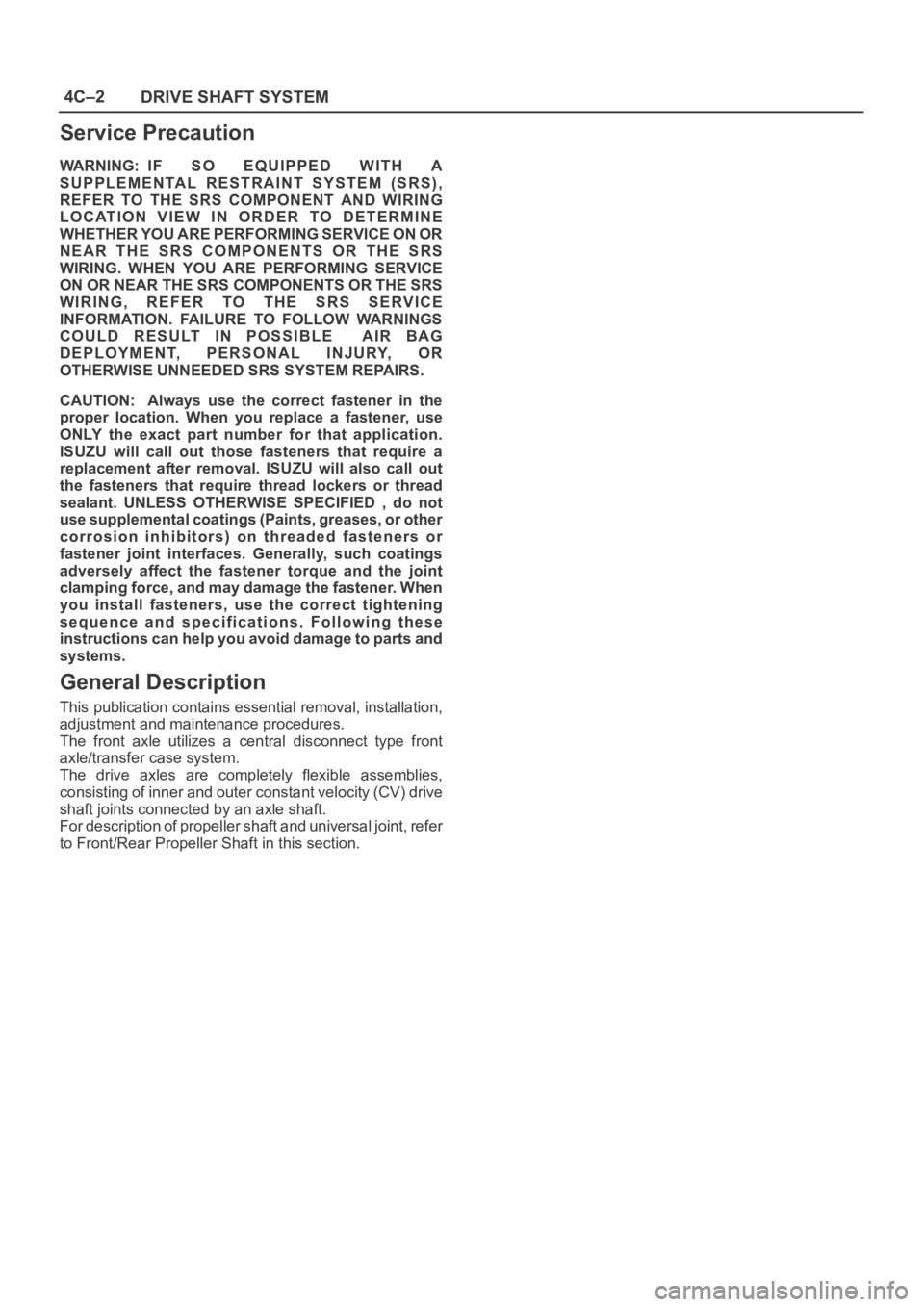
Service Precaution
WARNING: IF SO EQUIPPED WITH A
SUPPLEMENTAL RESTRAINT SYSTEM (SRS),
REFER TO THE SRS COMPONENT AND WIRING
LOCATION VIEW IN ORDER TO DETERMINE
WHETHER YOU ARE PERFORMING SERVICE ON OR
NEAR THE SRS COMPONENTS OR THE SRS
WIRING. WHEN YOU ARE PERFORMING SERVICE
ON OR NEAR THE SRS COMPONENTS OR THE SRS
WIRING, REFER TO THE SRS SERVICE
INFORMATION. FAILURE TO FOLLOW WARNINGS
COULD RESULT IN POSSIBLE AIR BAG
DEPLOYMENT, PERSONAL INJURY, OR
OTHERWISE UNNEEDED SRS SYSTEM REPAIRS.
CAUTION: Always use the correct fastener in the
proper location. When you replace a fastener, use
ONLY the exact part number for that application.
ISUZU will call out those fasteners that require a
replacement after removal. ISUZU will also call out
the fasteners that require thread lockers or thread
sealant. UNLESS OTHERWISE SPECIFIED , do not
use supplemental coatings (Paints, greases, or other
corrosion inhibitors) on threaded fasteners or
fastener joint interfaces. Generally, such coatings
adversely affect the fastener torque and the joint
clamping force, and may damage the fastener. When
you install fasteners, use the correct tightening
sequence and specifications. Following these
instructions can help you avoid damage to parts and
systems.
General Description
This publication contains essential removal, installation,
adjustment and maintenance procedures.
The front axle utilizes a central disconnect type front
axle/transfer case system.
The drive axles are completely flexible assemblies,
consisting of inner and outer constant velocity (CV) drive
shaft joints connected by an axle shaft.
For description of propeller shaft and universal joint, refer
to Front/Rear Propeller Shaft in this section.
Page 4262 of 6000
TRANSFER CASE (STANDARD TYPE)
4D1–1
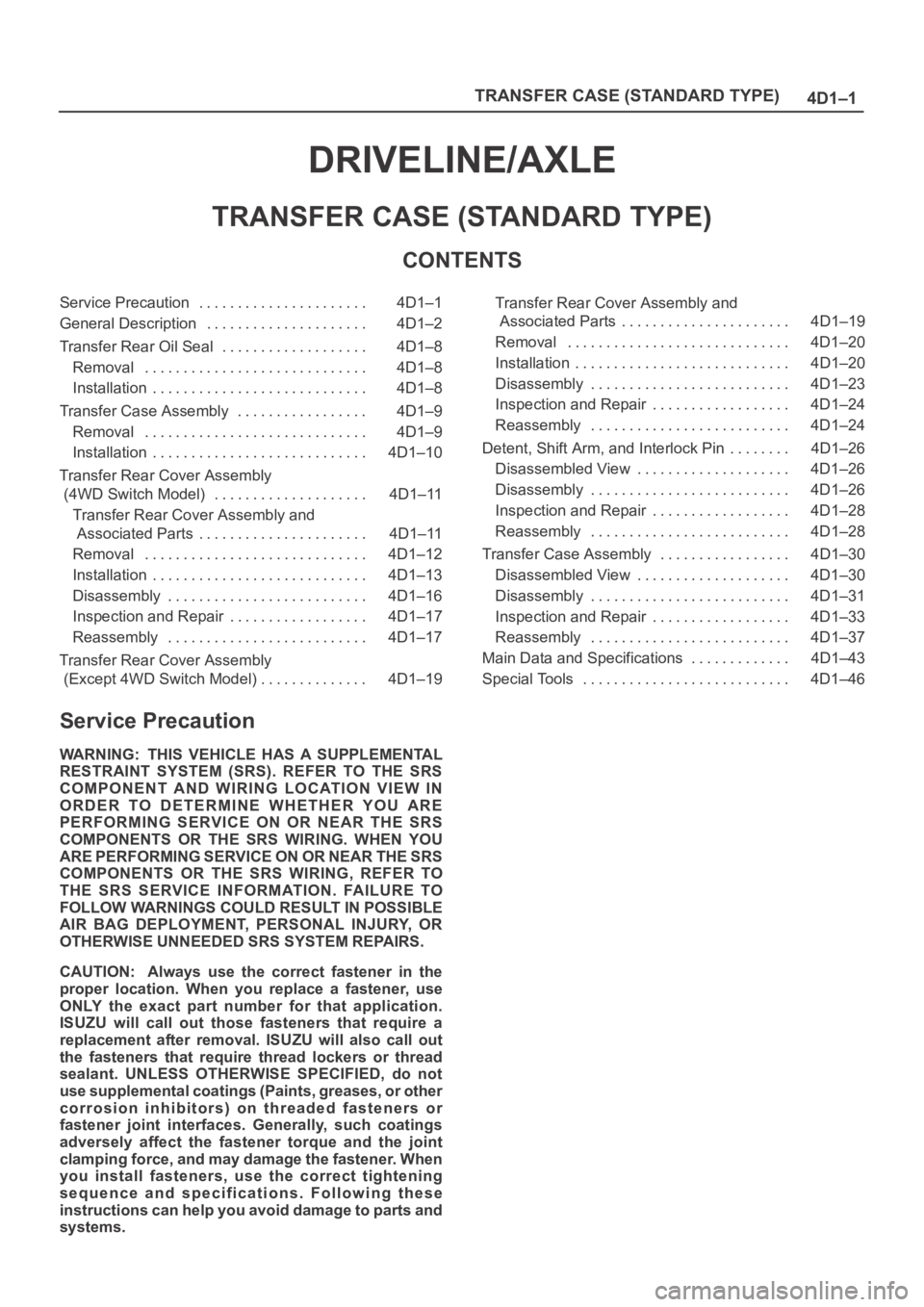
DRIVELINE/AXLE
TRANSFER CASE (STANDARD TYPE)
CONTENTS
Service Precaution 4D1–1. . . . . . . . . . . . . . . . . . . . . .
General Description 4D1–2. . . . . . . . . . . . . . . . . . . . .
Transfer Rear Oil Seal 4D1–8. . . . . . . . . . . . . . . . . . .
Removal 4D1–8. . . . . . . . . . . . . . . . . . . . . . . . . . . . .
Installation 4D1–8. . . . . . . . . . . . . . . . . . . . . . . . . . . .
Transfer Case Assembly 4D1–9. . . . . . . . . . . . . . . . .
Removal 4D1–9. . . . . . . . . . . . . . . . . . . . . . . . . . . . .
Installation 4D1–10. . . . . . . . . . . . . . . . . . . . . . . . . . . .
Transfer Rear Cover Assembly
(4WD Switch Model) 4D1–11. . . . . . . . . . . . . . . . . . . .
Transfer Rear Cover Assembly and
Associated Parts 4D1–11. . . . . . . . . . . . . . . . . . . . . .
Removal 4D1–12. . . . . . . . . . . . . . . . . . . . . . . . . . . . .
Installation 4D1–13. . . . . . . . . . . . . . . . . . . . . . . . . . . .
Disassembly 4D1–16. . . . . . . . . . . . . . . . . . . . . . . . . .
Inspection and Repair 4D1–17. . . . . . . . . . . . . . . . . .
Reassembly 4D1–17. . . . . . . . . . . . . . . . . . . . . . . . . .
Transfer Rear Cover Assembly
(Except 4WD Switch Model) 4D1–19. . . . . . . . . . . . . . Transfer Rear Cover Assembly and
Associated Parts 4D1–19. . . . . . . . . . . . . . . . . . . . . .
Removal 4D1–20. . . . . . . . . . . . . . . . . . . . . . . . . . . . .
Installation 4D1–20. . . . . . . . . . . . . . . . . . . . . . . . . . . .
Disassembly 4D1–23. . . . . . . . . . . . . . . . . . . . . . . . . .
Inspection and Repair 4D1–24. . . . . . . . . . . . . . . . . .
Reassembly 4D1–24. . . . . . . . . . . . . . . . . . . . . . . . . .
Detent, Shift Arm, and Interlock Pin 4D1–26. . . . . . . .
Disassembled View 4D1–26. . . . . . . . . . . . . . . . . . . .
Disassembly 4D1–26. . . . . . . . . . . . . . . . . . . . . . . . . .
Inspection and Repair 4D1–28. . . . . . . . . . . . . . . . . .
Reassembly 4D1–28. . . . . . . . . . . . . . . . . . . . . . . . . .
Transfer Case Assembly 4D1–30. . . . . . . . . . . . . . . . .
Disassembled View 4D1–30. . . . . . . . . . . . . . . . . . . .
Disassembly 4D1–31. . . . . . . . . . . . . . . . . . . . . . . . . .
Inspection and Repair 4D1–33. . . . . . . . . . . . . . . . . .
Reassembly 4D1–37. . . . . . . . . . . . . . . . . . . . . . . . . .
Main Data and Specifications 4D1–43. . . . . . . . . . . . .
Special Tools 4D1–46. . . . . . . . . . . . . . . . . . . . . . . . . . .
Service Precaution
WARNING: THIS VEHICLE HAS A SUPPLEMENTAL
RESTRAINT SYSTEM (SRS). REFER TO THE SRS
COMPONENT AND WIRING LOCATION VIEW IN
ORDER TO DETERMINE WHETHER YOU ARE
PERFORMING SERVICE ON OR NEAR THE SRS
COMPONENTS OR THE SRS WIRING. WHEN YOU
ARE PERFORMING SERVICE ON OR NEAR THE SRS
COMPONENTS OR THE SRS WIRING, REFER TO
THE SRS SERVICE INFORMATION. FAILURE TO
FOLLOW WARNINGS COULD RESULT IN POSSIBLE
AIR BAG DEPLOYMENT, PERSONAL INJURY, OR
OTHERWISE UNNEEDED SRS SYSTEM REPAIRS.
CAUTION: Always use the correct fastener in the
proper location. When you replace a fastener, use
ONLY the exact part number for that application.
ISUZU will call out those fasteners that require a
replacement after removal. ISUZU will also call out
the fasteners that require thread lockers or thread
sealant. UNLESS OTHERWISE SPECIFIED, do not
use supplemental coatings (Paints, greases, or other
corrosion inhibitors) on threaded fasteners or
fastener joint interfaces. Generally, such coatings
adversely affect the fastener torque and the joint
clamping force, and may damage the fastener. When
you install fasteners, use the correct tightening
sequence and specifications. Following these
instructions can help you avoid damage to parts and
systems.
Page 4308 of 6000
4D2–1 TRANSFER CASE (TOD)
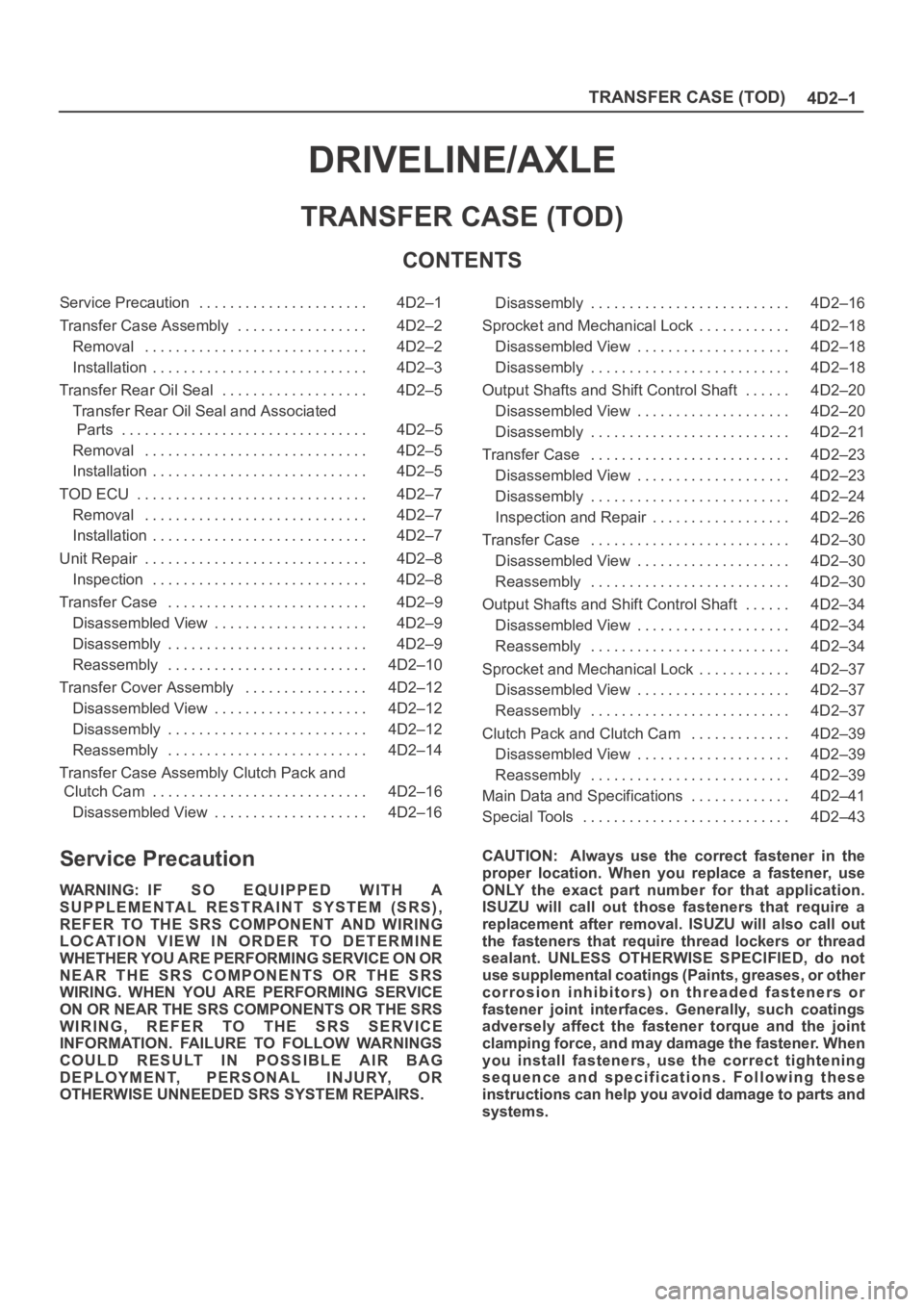
DRIVELINE/AXLE
TRANSFER CASE (TOD)
CONTENTS
Service Precaution 4D2–1. . . . . . . . . . . . . . . . . . . . . .
Transfer Case Assembly 4D2–2. . . . . . . . . . . . . . . . .
Removal 4D2–2. . . . . . . . . . . . . . . . . . . . . . . . . . . . .
Installation 4D2–3. . . . . . . . . . . . . . . . . . . . . . . . . . . .
Transfer Rear Oil Seal 4D2–5. . . . . . . . . . . . . . . . . . .
Transfer Rear Oil Seal and Associated
Parts 4D2–5. . . . . . . . . . . . . . . . . . . . . . . . . . . . . . . .
Removal 4D2–5. . . . . . . . . . . . . . . . . . . . . . . . . . . . .
Installation 4D2–5. . . . . . . . . . . . . . . . . . . . . . . . . . . .
TOD ECU 4D2–7. . . . . . . . . . . . . . . . . . . . . . . . . . . . . .
Removal 4D2–7. . . . . . . . . . . . . . . . . . . . . . . . . . . . .
Installation 4D2–7. . . . . . . . . . . . . . . . . . . . . . . . . . . .
Unit Repair 4D2–8. . . . . . . . . . . . . . . . . . . . . . . . . . . . .
Inspection 4D2–8. . . . . . . . . . . . . . . . . . . . . . . . . . . .
Transfer Case 4D2–9. . . . . . . . . . . . . . . . . . . . . . . . . .
Disassembled View 4D2–9. . . . . . . . . . . . . . . . . . . .
Disassembly 4D2–9. . . . . . . . . . . . . . . . . . . . . . . . . .
Reassembly 4D2–10. . . . . . . . . . . . . . . . . . . . . . . . . .
Transfer Cover Assembly 4D2–12. . . . . . . . . . . . . . . .
Disassembled View 4D2–12. . . . . . . . . . . . . . . . . . . .
Disassembly 4D2–12. . . . . . . . . . . . . . . . . . . . . . . . . .
Reassembly 4D2–14. . . . . . . . . . . . . . . . . . . . . . . . . .
Transfer Case Assembly Clutch Pack and
Clutch Cam 4D2–16. . . . . . . . . . . . . . . . . . . . . . . . . . . .
Disassembled View 4D2–16. . . . . . . . . . . . . . . . . . . . Disassembly 4D2–16. . . . . . . . . . . . . . . . . . . . . . . . . .
Sprocket and Mechanical Lock 4D2–18. . . . . . . . . . . .
Disassembled View 4D2–18. . . . . . . . . . . . . . . . . . . .
Disassembly 4D2–18. . . . . . . . . . . . . . . . . . . . . . . . . .
Output Shafts and Shift Control Shaft 4D2–20. . . . . .
Disassembled View 4D2–20. . . . . . . . . . . . . . . . . . . .
Disassembly 4D2–21. . . . . . . . . . . . . . . . . . . . . . . . . .
Transfer Case 4D2–23. . . . . . . . . . . . . . . . . . . . . . . . . .
Disassembled View 4D2–23. . . . . . . . . . . . . . . . . . . .
Disassembly 4D2–24. . . . . . . . . . . . . . . . . . . . . . . . . .
Inspection and Repair 4D2–26. . . . . . . . . . . . . . . . . .
Transfer Case 4D2–30. . . . . . . . . . . . . . . . . . . . . . . . . .
Disassembled View 4D2–30. . . . . . . . . . . . . . . . . . . .
Reassembly 4D2–30. . . . . . . . . . . . . . . . . . . . . . . . . .
Output Shafts and Shift Control Shaft 4D2–34. . . . . .
Disassembled View 4D2–34. . . . . . . . . . . . . . . . . . . .
Reassembly 4D2–34. . . . . . . . . . . . . . . . . . . . . . . . . .
Sprocket and Mechanical Lock 4D2–37. . . . . . . . . . . .
Disassembled View 4D2–37. . . . . . . . . . . . . . . . . . . .
Reassembly 4D2–37. . . . . . . . . . . . . . . . . . . . . . . . . .
Clutch Pack and Clutch Cam 4D2–39. . . . . . . . . . . . .
Disassembled View 4D2–39. . . . . . . . . . . . . . . . . . . .
Reassembly 4D2–39. . . . . . . . . . . . . . . . . . . . . . . . . .
Main Data and Specifications 4D2–41. . . . . . . . . . . . .
Special Tools 4D2–43. . . . . . . . . . . . . . . . . . . . . . . . . . .
Service Precaution
WARNING: IF SO EQUIPPED WITH A
SUPPLEMENTAL RESTRAINT SYSTEM (SRS),
REFER TO THE SRS COMPONENT AND WIRING
LOCATION VIEW IN ORDER TO DETERMINE
WHETHER YOU ARE PERFORMING SERVICE ON OR
NEAR THE SRS COMPONENTS OR THE SRS
WIRING. WHEN YOU ARE PERFORMING SERVICE
ON OR NEAR THE SRS COMPONENTS OR THE SRS
WIRING, REFER TO THE SRS SERVICE
INFORMATION. FAILURE TO FOLLOW WARNINGS
COULD RESULT IN POSSIBLE AIR BAG
DEPLOYMENT, PERSONAL INJURY, OR
OTHERWISE UNNEEDED SRS SYSTEM REPAIRS.CAUTION: Always use the correct fastener in the
proper location. When you replace a fastener, use
ONLY the exact part number for that application.
ISUZU will call out those fasteners that require a
replacement after removal. ISUZU will also call out
the fasteners that require thread lockers or thread
sealant. UNLESS OTHERWISE SPECIFIED, do not
use supplemental coatings (Paints, greases, or other
corrosion inhibitors) on threaded fasteners or
fastener joint interfaces. Generally, such coatings
adversely affect the fastener torque and the joint
clamping force, and may damage the fastener. When
you install fasteners, use the correct tightening
sequence and specifications. Following these
instructions can help you avoid damage to parts and
systems.
Page 4310 of 6000
4D2–3 TRANSFER CASE (TOD)
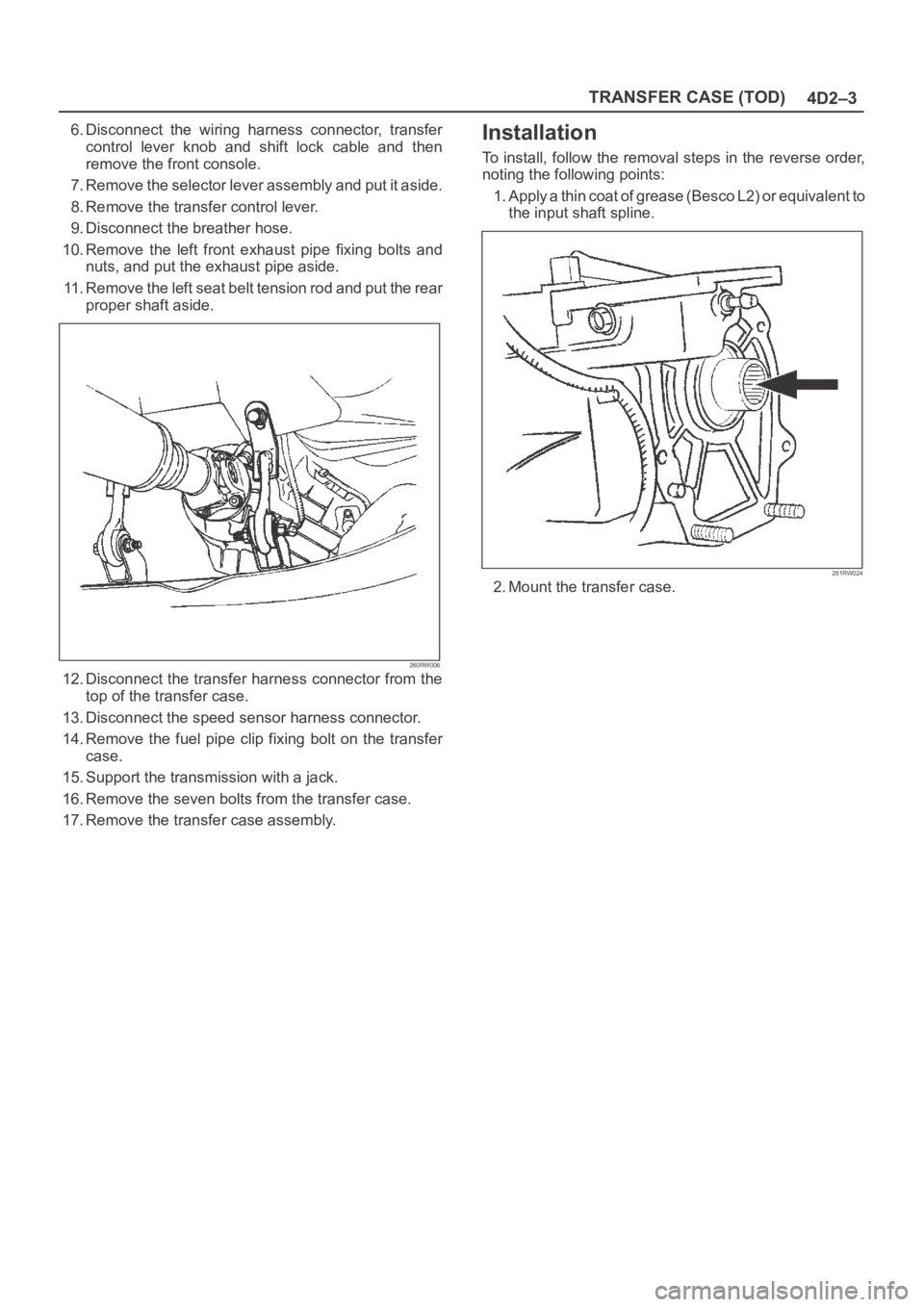
6. Disconnect the wiring harness connector, transfer
control lever knob and shift lock cable and then
remove the front console.
7 . R e m o v e t h e s e l e c t o r l e v e r a s s e m b ly a n d p u t i t a s i d e .
8. Remove the transfer control lever.
9. Disconnect the breather hose.
10. Remove the left front exhaust pipe fixing bolts and
nuts, and put the exhaust pipe aside.
11. Remove the left seat belt tension rod and put the rear
proper shaft aside.
260RW006
12. Disconnect the transfer harness connector from the
top of the transfer case.
13. Disconnect the speed sensor harness connector.
14. Remove the fuel pipe clip fixing bolt on the transfer
case.
15. Support the transmission with a jack.
16. Remove the seven bolts from the transfer case.
17. Remove the transfer case assembly.
Installation
To install, follow the removal steps in the reverse order,
noting the following points:
1. Apply a thin coat of grease (Besco L2) or equivalent to
the input shaft spline.
261RW024
2. Mount the transfer case.
Page 4352 of 6000
5A–2
BRAKE CONTROL SYSTEM
Chart B-16 FL Speed Sensor Disconnection
(DTC 51) 5A–50. . . . . . . . . . . . . . . . . . . . . . . . . . . .
Chart B-17 FR Speed Sensor Disconnection
(DTC 52) 5A–50. . . . . . . . . . . . . . . . . . . . . . . . . . . .
Chart B-18 RL Speed Sensor Disconnection
(DTC 53) 5A–51. . . . . . . . . . . . . . . . . . . . . . . . . . . .
Chart B-19 RR Speed Sensor Disconnection
(DTC 54) 5A–51. . . . . . . . . . . . . . . . . . . . . . . . . . . .
Chart B-20 FL Speed Sensor Short Circuit
(DTC 61) 5A–52. . . . . . . . . . . . . . . . . . . . . . . . . . . .
Chart B-21 FR Speed Sensor Short Circuit
(DTC 62) 5A–53. . . . . . . . . . . . . . . . . . . . . . . . . . . .
Chart B-22 RL Speed Sensor Short Circuit
(DTC 63) 5A–54. . . . . . . . . . . . . . . . . . . . . . . . . . . .
Chart B-23 RR Speed Sensor Short Circuit
(DTC 64) 5A–55. . . . . . . . . . . . . . . . . . . . . . . . . . . .
Chart B-24 Sensor Signal Input Abnormality
(DTC 65) 5A–56. . . . . . . . . . . . . . . . . . . . . . . . . . . . Sensor Signal Abnormality Criteria using
TECH 2 5A–56. . . . . . . . . . . . . . . . . . . . . . . . . . . . . .
Unit Inspection Procedure 5A–57. . . . . . . . . . . . . . . .
Chart C-1-1 FL Sensor Output Inspection
Procedure 5A–57. . . . . . . . . . . . . . . . . . . . . . . . . . .
Chart C-1-2 FR Sensor Output Inspection
Procedure 5A–58. . . . . . . . . . . . . . . . . . . . . . . . . . .
Chart C-1-3 RL Sensor Output Inspection
Procedure 5A–58. . . . . . . . . . . . . . . . . . . . . . . . . . .
Chart C-1-4 RR Sensor Output Inspection
Procedure 5A–59. . . . . . . . . . . . . . . . . . . . . . . . . . .
Chart TC-1 Sensor Output Inspection
Procedure (Use TECH 2) 5A–59. . . . . . . . . . . . . .
Chart C-2 Transmission Input Inspection
Procedure 5A–60. . . . . . . . . . . . . . . . . . . . . . . . . . .
Chart TC-2 Transmission Input Inspection
Procedure (Use TECH 2) 5A–61. . . . . . . . . . . . . .
Special Tools 5A–62. . . . . . . . . . . . . . . . . . . . . . . . . . .
Service Precaution
WARNING: IF SO EQUIPPED WITH A
SUPPLEMENTAL RESTRAINT SYSTEM (SRS),
REFER TO THE SRS COMPONENT AND WIRING
LOCATION VIEW IN ORDER TO DETERMINE
WHETHER YOU ARE PERFORMING SERVICE ON OR
NEAR THE SRS COMPONENTS OR THE SRS
WIRING. WHEN YOU ARE PERFORMING SERVICE
ON OR NEAR THE SRS COMPONENTS OR THE SRS
WIRING, REFER TO THE SRS SERVICE
INFORMATION. FAILURE TO FOLLOW WARNINGS
COULD RESULT IN POSSIBLE AIR BAG
DEPLOYMENT, PERSONAL INJURY, OR
OTHERWISE UNNEEDED SRS SYSTEM REPAIRS.
CAUTION: Always use the correct fastener in the
proper location. When you replace a fastener, use
ONLY the exact part number for that application.
ISUZU will call out those fasteners that require a
replacement after removal. ISUZU will also call out
the fasteners that require thread lockers or thread
sealant. UNLESS OTHERWISE SPECIFIED, do not
use supplemental coatings (Paints, greases, or other
corrosion inhibitors) on threaded fasteners or
fastener joint interfaces. Generally, such coatings
adversely affect the fastener torque and the joint
clamping force, and may damage the fastener. When
you install fasteners, use the correct tightening
sequence and specifications. Following these
instructions can help you avoid damage to parts and
systems.
Page 4355 of 6000
5A–5 BRAKE CONTROL SYSTEM
FR
Front Right
GEN
Generator
MV
Millivolts
RL
Rear Left
RR
Rear RightRPS
Revolution per Second
VDC
Vo l t s D C
VA C
Vo l t s A C
W/L
Warning Light
WSS
Wheel Speed Sensor
General Diagnosis
General Information
ABS malfunction can be classified into two types, those
which can be detected by the ABS warning light and those
which can be detected as a vehicle abnormality by the
driver.
In either case, locate the fault in accordance with the
“BASIC DIAGNOSTIC FLOWCHART” and repair.
Please refer to Section 5C for the diagnosis of
mechanical troubles such as brake noise, brake judder
(brake pedal or vehicle vibration felt when braking),
uneven braking, and parking brake trouble.
ABS Service Precautions
Required Tools and Items:
Box Wrench
Brake Fluid
Special Tool
Some diagnosis procedures in this section require the
installation of a special tool.
J-39200 High Impedance Multimeter
When circuit measurements are requested, use a circuit
tester with high impedance.
Computer System Service Precautions
The Anti-lock Brake System interfaces directly with the
Electronic Hydraulic Control Unit (EHCU) which is a
control computer that is similar in some regards to the
Powertrain Control Module. These modules are designed
to withstand normal current draws associated with
vehicle operation. However, care must be taken to avoid
overloading any of the EHCU circuits. In testing for opens
or shorts, do not ground or apply voltage to any of the
circuits unless instructed to do so by the appropriate
diagnostic procedure. These circuits should only be
tested with a high impedance multimeter (J-39200) or
special tools as described in this section. Power should
never be removed or applied to any control module with
the ignition in the “ON” position.
Before removing or connecting battery cables, fuses or
connectors, always turn the ignition switch to the “OFF”
position.
General Service Precautions
The following are general precautions which should be
observed when servicing and diagnosing the Anti-lock
Brake System and/or other vehicle systems. Failure toobserve these precautions may result in Anti-lock Brake
System damage.
If welding work is to be performed on the vehicle using
an electric arc welder, the EHCU and valve block
connectors should be disconnected before the
welding operation begins.
The EHCU and valve block connectors should never
be connected or disconnected with the ignition “ON” .
EHCU of the Anti-lock Brake System are not
separately serviceable and must be replaced as
assemblies. Do not disassemble any component
which is designated as non-serviceable in this
Section.
If only rear wheels are rotated using jacks or drum
tester, the system will diagnose a speed sensor
malfunction and the “ABS” warning light will
illuminate. But actually no trouble exists. After
inspection stop the engine once and re-start it, then
make sure that the “ABS” warning light does not
illuminate.
If the battery has been discharged
The engine may stall if the battery has been completely
discharged and the engine is started via jumper cables.
This is because the Anti-lock Brake System (ABS)
requires a large quantity of electricity. In this case, wait
until the battery is recharged, or set the ABS to a
non-operative state by removing the fuse for the ABS
(40A). After the battery has been recharged, stop the
engine and install the ABS fuse. Start the engine again,
and confirm that the ABS warning light does not light.
Note on Intermittents
As with virtually any electronic system, it is difficult to
identify an intermittent failure. In such a case duplicating
the system malfunction during a test drive or a good
description of vehicle behavior from the customer may be
helpful in locating a “most likely” failed component or
circuit. The symptom diagnosis chart may also be useful
in isolating the failure. Most intermittent problems are
caused by faulty electrical connections or wiring. When
an intermittent failure is encountered, check suspect
circuits for:
Suspected harness damage.
Poor mating of connector halves or terminals not fully
seated in the connector body (backed out).
Improperly formed or damaged terminals.
Page 4389 of 6000
5A–39 BRAKE CONTROL SYSTEM
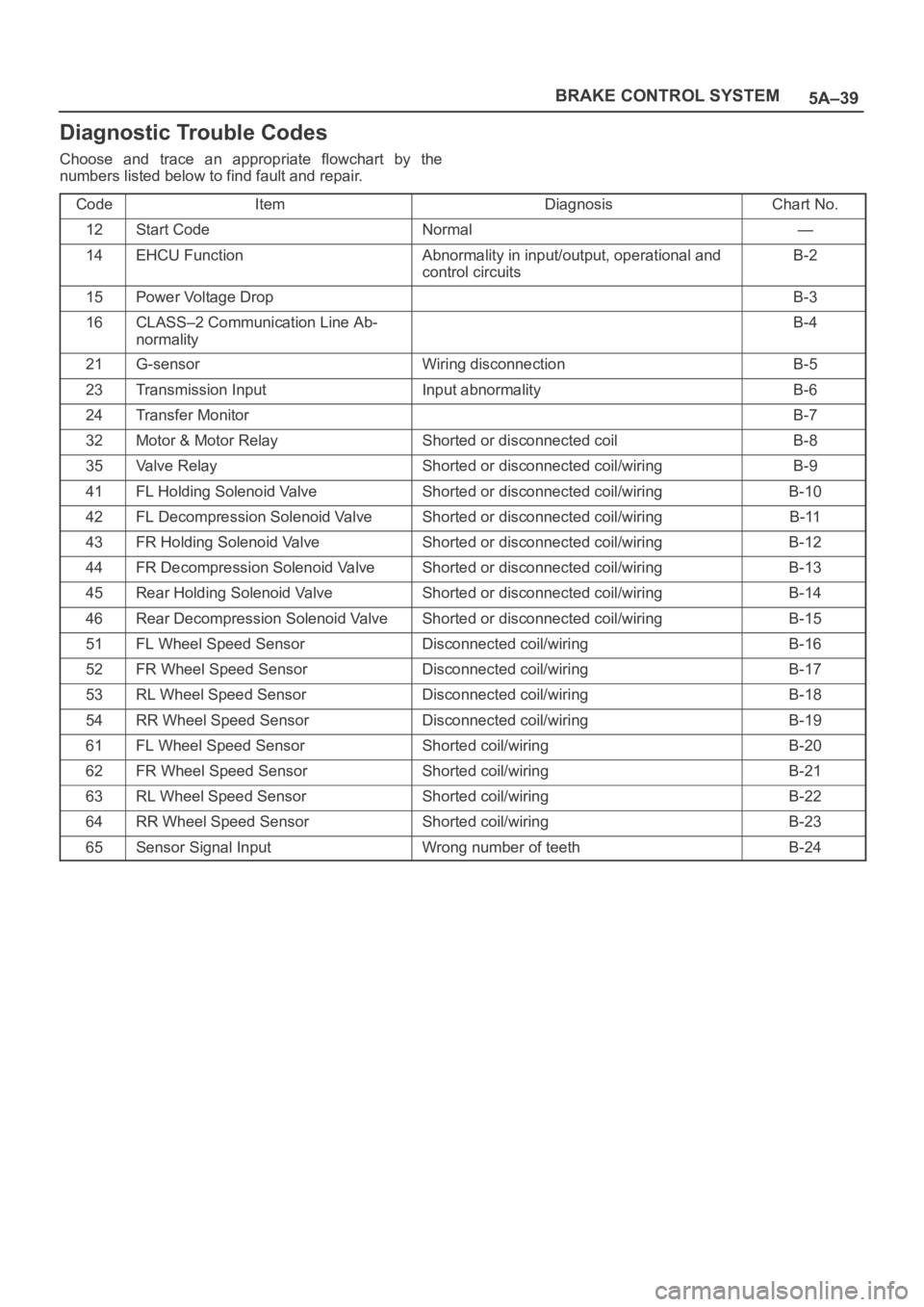
Diagnostic Trouble Codes
Choose and trace an appropriate flowchart by the
numbers listed below to find fault and repair.
Code
ItemDiagnosisChart No.
12Start CodeNormal—
14EHCU FunctionAbnormality in input/output, operational and
control circuitsB-2
15Power Voltage DropB-3
16CLASS–2 Communication Line Ab-
normalityB-4
21G-sensorWiring disconnectionB-5
23Transmission InputInput abnormalityB-6
24Transfer MonitorB-7
32Motor & Motor RelayShorted or disconnected coilB-8
35Valve RelayShorted or disconnected coil/wiringB-9
41FL Holding Solenoid ValveShorted or disconnected coil/wiringB-10
42FL Decompression Solenoid ValveShorted or disconnected coil/wiringB-11
43FR Holding Solenoid ValveShorted or disconnected coil/wiringB-12
44FR Decompression Solenoid ValveShorted or disconnected coil/wiringB-13
45Rear Holding Solenoid ValveShorted or disconnected coil/wiringB-14
46Rear Decompression Solenoid ValveShorted or disconnected coil/wiringB-15
51FL Wheel Speed SensorDisconnected coil/wiringB-16
52FR Wheel Speed SensorDisconnected coil/wiringB-17
53RL Wheel Speed SensorDisconnected coil/wiringB-18
54RR Wheel Speed SensorDisconnected coil/wiringB-19
61FL Wheel Speed SensorShorted coil/wiringB-20
62FR Wheel Speed SensorShorted coil/wiringB-21
63RL Wheel Speed SensorShorted coil/wiringB-22
64RR Wheel Speed SensorShorted coil/wiringB-23
65Sensor Signal InputWrong number of teethB-24