1998 OPEL FRONTERA oil change
[x] Cancel search: oil changePage 1324 of 6000
6E–207 ENGINE DRIVEABILITY AND EMISSIONS
Poor connection at PCM – Inspect the harness
connectors for backed-out terminals, improper mating,
broken locks, improperly formed or damaged
terminals, and poor terminal-to-wire connections.
Damaged harness – Inspect the wiring harness for
damage. If the harness appears to be OK, observe
Tech 2 display related to DTC P0351 while moving theconnector and wiring related to the ignition system. A
change in the display will indicate the location of the
fault.
Reviewing the Failure Records vehicle mileage since the
diagnostic test last failed may help determine how often
the condition that caused the DTC to be set occurs. This
may assist in diagnosing the condition.
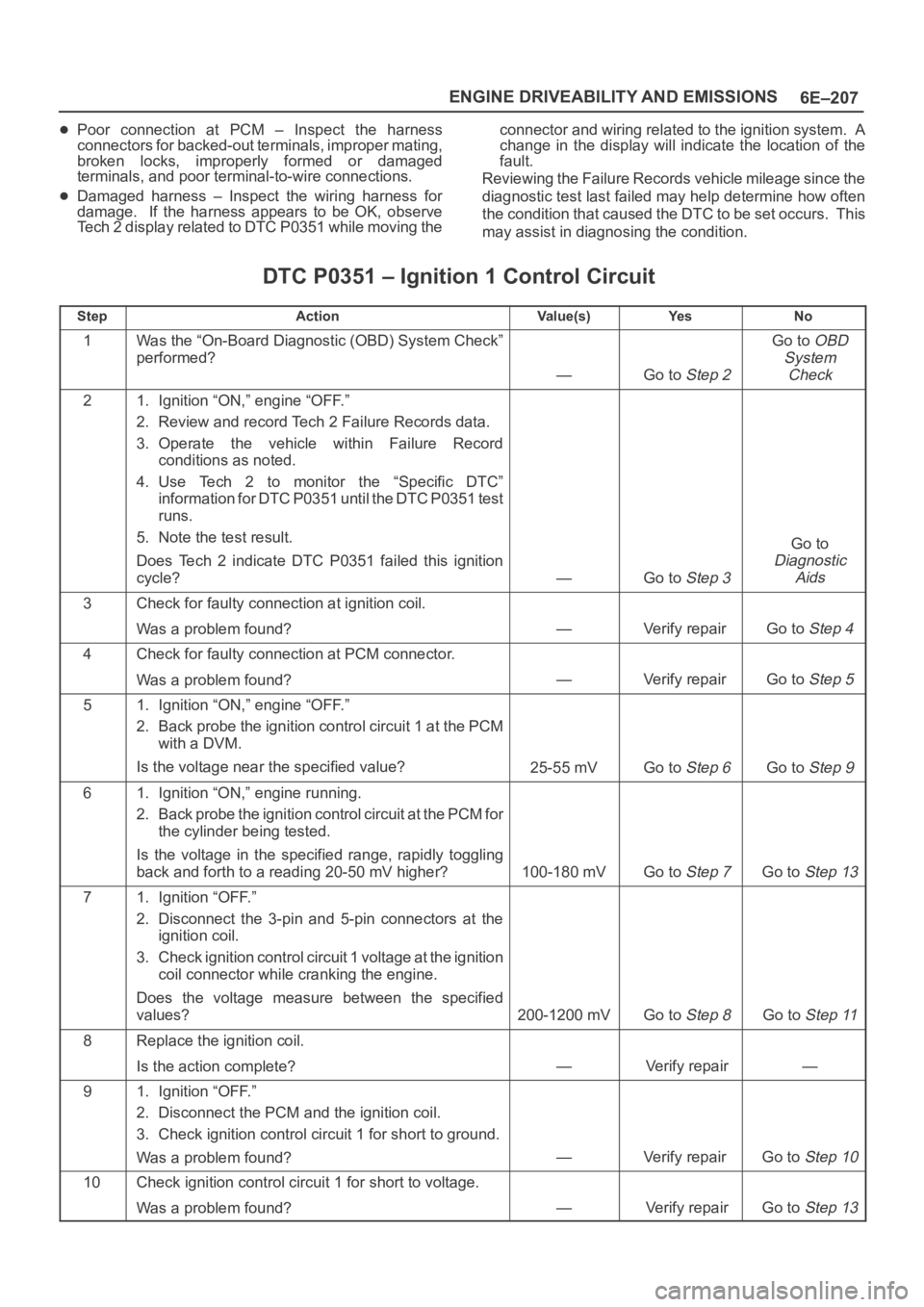
DTC P0351 – Ignition 1 Control Circuit
StepActionVa l u e ( s )Ye sNo
1Was the “On-Board Diagnostic (OBD) System Check”
performed?
—Go to Step 2
Go to OBD
System
Check
21. Ignition “ON,” engine “OFF.”
2. Review and record Tech 2 Failure Records data.
3. Operate the vehicle within Failure Record
conditions as noted.
4. Use Tech 2 to monitor the “Specific DTC”
information for DTC P0351 until the DTC P0351 test
runs.
5. Note the test result.
Does Tech 2 indicate DTC P0351 failed this ignition
cycle?
—Go to Step 3
Go to
Diagnostic
Aids
3Check for faulty connection at ignition coil.
Was a problem found?
—Verify repair Go to Step 4
4Check for faulty connection at PCM connector.
Was a problem found?
—Verify repair Go to Step 5
51. Ignition “ON,” engine “OFF.”
2. Back probe the ignition control circuit 1 at the PCM
with a DVM.
Is the voltage near the specified value?
25-55 mVGo to Step 6Go to Step 9
61. Ignition “ON,” engine running.
2. Back probe the ignition control circuit at the PCM for
the cylinder being tested.
Is the voltage in the specified range, rapidly toggling
back and forth to a reading 20-50 mV higher?
100-180 mVGo to Step 7Go to Step 13
71. Ignition “OFF.”
2. Disconnect the 3-pin and 5-pin connectors at the
ignition coil.
3. Check ignition control circuit 1 voltage at the ignition
coil connector while cranking the engine.
Does the voltage measure between the specified
values?
200-1200 mVGo to Step 8Go to Step 11
8Replace the ignition coil.
Is the action complete?
—Verify repair—
91. Ignition “OFF.”
2. Disconnect the PCM and the ignition coil.
3. Check ignition control circuit 1 for short to ground.
Was a problem found?
—Verify repair Go to Step 10
10Check ignition control circuit 1 for short to voltage.
Was a problem found?
—Verify repairGo to Step 13
Page 1327 of 6000
6E–210
ENGINE DRIVEABILITY AND EMISSIONS
Poor connection at PCM – Inspect the harness
connectors for backed-out terminals, improper mating,
broken locks, improperly formed or damaged
terminals, and poor terminal-to-wire connections.
Damaged harness – Inspect the wiring harness for
damage. If the harness appears to be OK, observe the
Tech 2 display related to DTC P0352 while moving theconnector and wiring related to the ignition system. A
change in the display will indicate the location of the
fault.
Reviewing the Failure Records vehicle mileage since the
diagnostic test last failed may help determine how often
the condition that caused the DTC to be set occurs. This
may assist in diagnosing the condition.
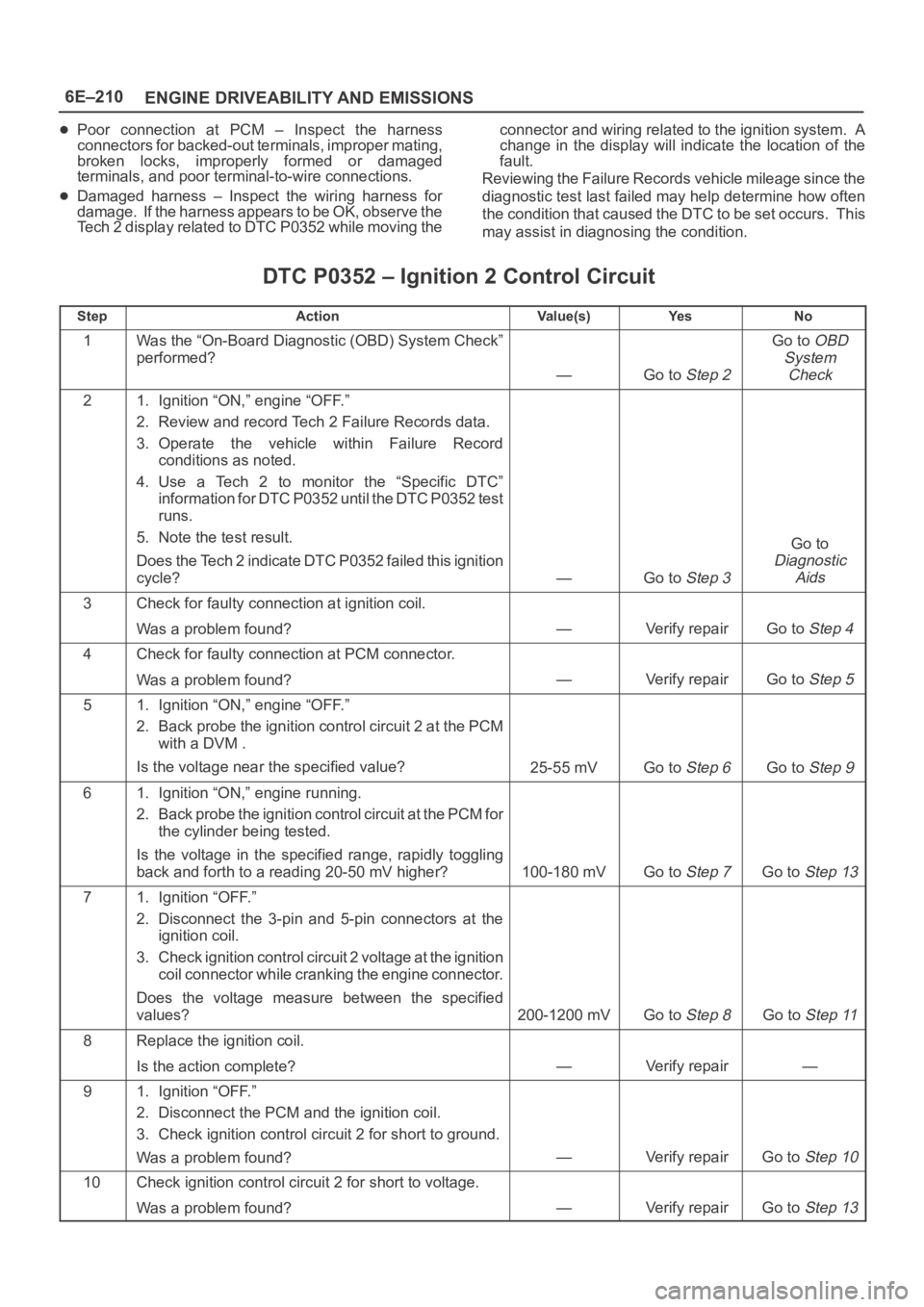
DTC P0352 – Ignition 2 Control Circuit
StepActionVa l u e ( s )Ye sNo
1Was the “On-Board Diagnostic (OBD) System Check”
performed?
—Go to Step 2
Go to OBD
System
Check
21. Ignition “ON,” engine “OFF.”
2. Review and record Tech 2 Failure Records data.
3. Operate the vehicle within Failure Record
conditions as noted.
4. Use a Tech 2 to monitor the “Specific DTC”
information for DTC P0352 until the DTC P0352 test
runs.
5. Note the test result.
Does the Tech 2 indicate DTC P0352 failed this ignition
cycle?
—Go to Step 3
Go to
Diagnostic
Aids
3Check for faulty connection at ignition coil.
Was a problem found?
—Verify repairGo to Step 4
4Check for faulty connection at PCM connector.
Was a problem found?
—Verify repairGo to Step 5
51. Ignition “ON,” engine “OFF.”
2. Back probe the ignition control circuit 2 at the PCM
with a DVM .
Is the voltage near the specified value?
25-55 mVGo to Step 6Go to Step 9
61. Ignition “ON,” engine running.
2. Back probe the ignition control circuit at the PCM for
the cylinder being tested.
Is the voltage in the specified range, rapidly toggling
back and forth to a reading 20-50 mV higher?
100-180 mVGo to Step 7Go to Step 13
71. Ignition “OFF.”
2. Disconnect the 3-pin and 5-pin connectors at the
ignition coil.
3. Check ignition control circuit 2 voltage at the ignition
coil connector while cranking the engine connector.
Does the voltage measure between the specified
values?
200-1200 mVGo to Step 8Go to Step 11
8Replace the ignition coil.
Is the action complete?
—Verify repair—
91. Ignition “OFF.”
2. Disconnect the PCM and the ignition coil.
3. Check ignition control circuit 2 for short to ground.
Was a problem found?
—Verify repairGo to Step 10
10Check ignition control circuit 2 for short to voltage.
Was a problem found?
—Verify repairGo to Step 13
Page 1330 of 6000
6E–213 ENGINE DRIVEABILITY AND EMISSIONS
Poor connection at PCM – Inspect the harness
connectors for backed-out terminals, improper mating,
broken locks, improperly formed or damaged
terminals, and poor terminal-to-wire connections.
Damaged harness – Inspect the wiring harness for
damage. If the harness appears to be OK, observe the
Tech 2 display related to DTC P0353 while moving theconnector and wiring related to the ignition system. A
change in the display will indicate the location of the
fault.
Reviewing the Failure Records vehicle mileage since the
diagnostic test last failed may help determine how often
the condition that caused the DTC to be set occurs. This
may assist in diagnosing the condition.
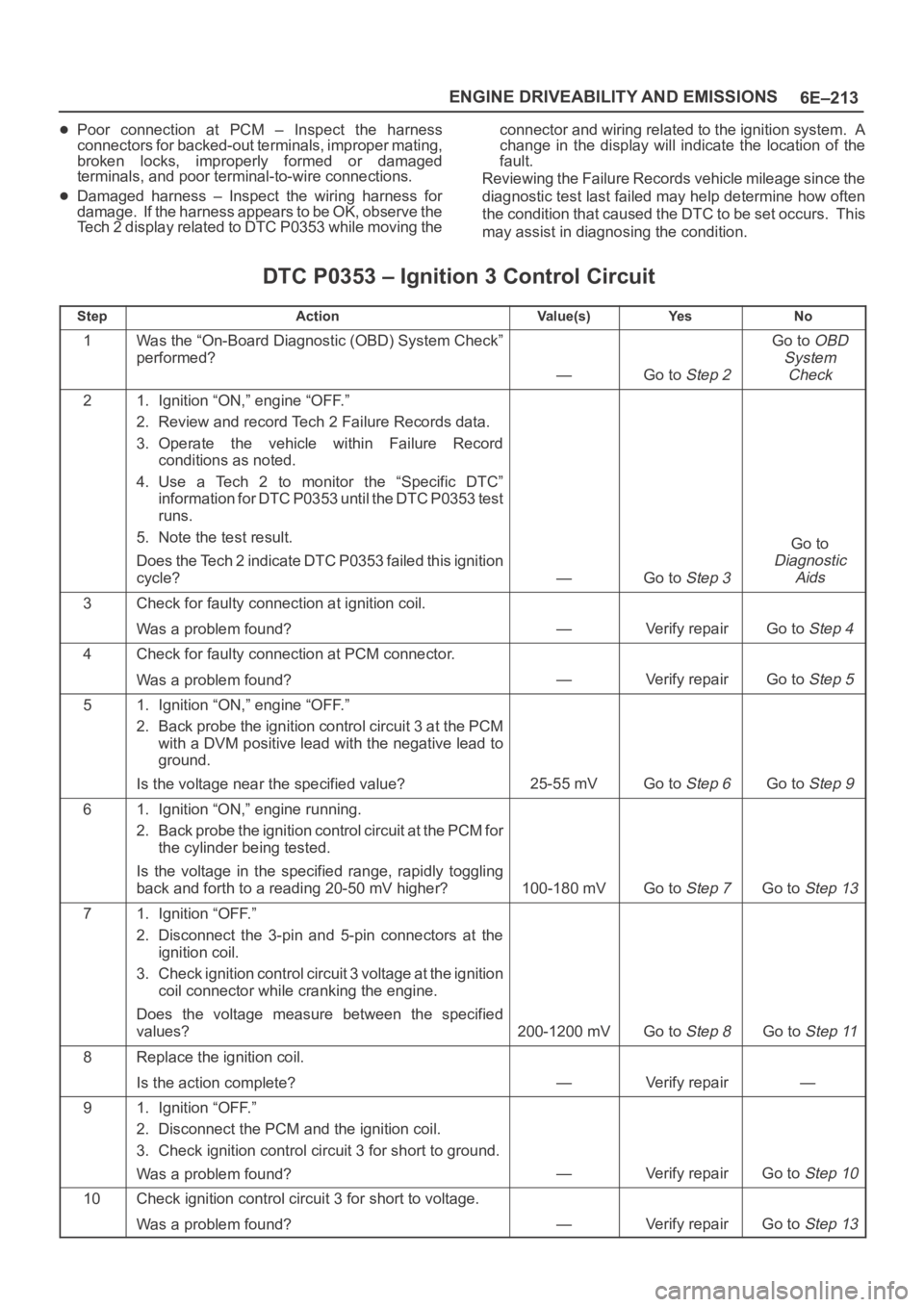
DTC P0353 – Ignition 3 Control Circuit
StepActionVa l u e ( s )Ye sNo
1Was the “On-Board Diagnostic (OBD) System Check”
performed?
—Go to Step 2
Go to OBD
System
Check
21. Ignition “ON,” engine “OFF.”
2. Review and record Tech 2 Failure Records data.
3. Operate the vehicle within Failure Record
conditions as noted.
4. Use a Tech 2 to monitor the “Specific DTC”
information for DTC P0353 until the DTC P0353 test
runs.
5. Note the test result.
Does the Tech 2 indicate DTC P0353 failed this ignition
cycle?
—Go to Step 3
Go to
Diagnostic
Aids
3Check for faulty connection at ignition coil.
Was a problem found?
—Verify repairGo to Step 4
4Check for faulty connection at PCM connector.
Was a problem found?
—Verify repairGo to Step 5
51. Ignition “ON,” engine “OFF.”
2. Back probe the ignition control circuit 3 at the PCM
with a DVM positive lead with the negative lead to
ground.
Is the voltage near the specified value?
25-55 mVGo to Step 6Go to Step 9
61. Ignition “ON,” engine running.
2. Back probe the ignition control circuit at the PCM for
the cylinder being tested.
Is the voltage in the specified range, rapidly toggling
back and forth to a reading 20-50 mV higher?
100-180 mVGo to Step 7Go to Step 13
71. Ignition “OFF.”
2. Disconnect the 3-pin and 5-pin connectors at the
ignition coil.
3. Check ignition control circuit 3 voltage at the ignition
coil connector while cranking the engine.
Does the voltage measure between the specified
values?
200-1200 mVGo to Step 8Go to Step 11
8Replace the ignition coil.
Is the action complete?
—Verify repair—
91. Ignition “OFF.”
2. Disconnect the PCM and the ignition coil.
3. Check ignition control circuit 3 for short to ground.
Was a problem found?
—Verify repairGo to Step 10
10Check ignition control circuit 3 for short to voltage.
Was a problem found?
—Verify repairGo to Step 13
Page 1333 of 6000
6E–216
ENGINE DRIVEABILITY AND EMISSIONS
Poor connection at PCM – Inspect the harness
connectors for backed-out terminals, improper mating,
broken locks, improperly formed or damaged
terminals, and poor terminal-to-wire connections.
Damaged harness – Inspect the wiring harness for
damage. If the harness appears to be OK, observe the
Tech 2 display related to DTC P0354 while moving theconnector and wiring related to the ignition system. A
change in the display will indicate the location of the
fault.
Reviewing the Failure Records vehicle mileage since the
diagnostic test last failed may help determine how often
the condition that caused the DTC to be set occurs. This
may assist in diagnosing the condition.
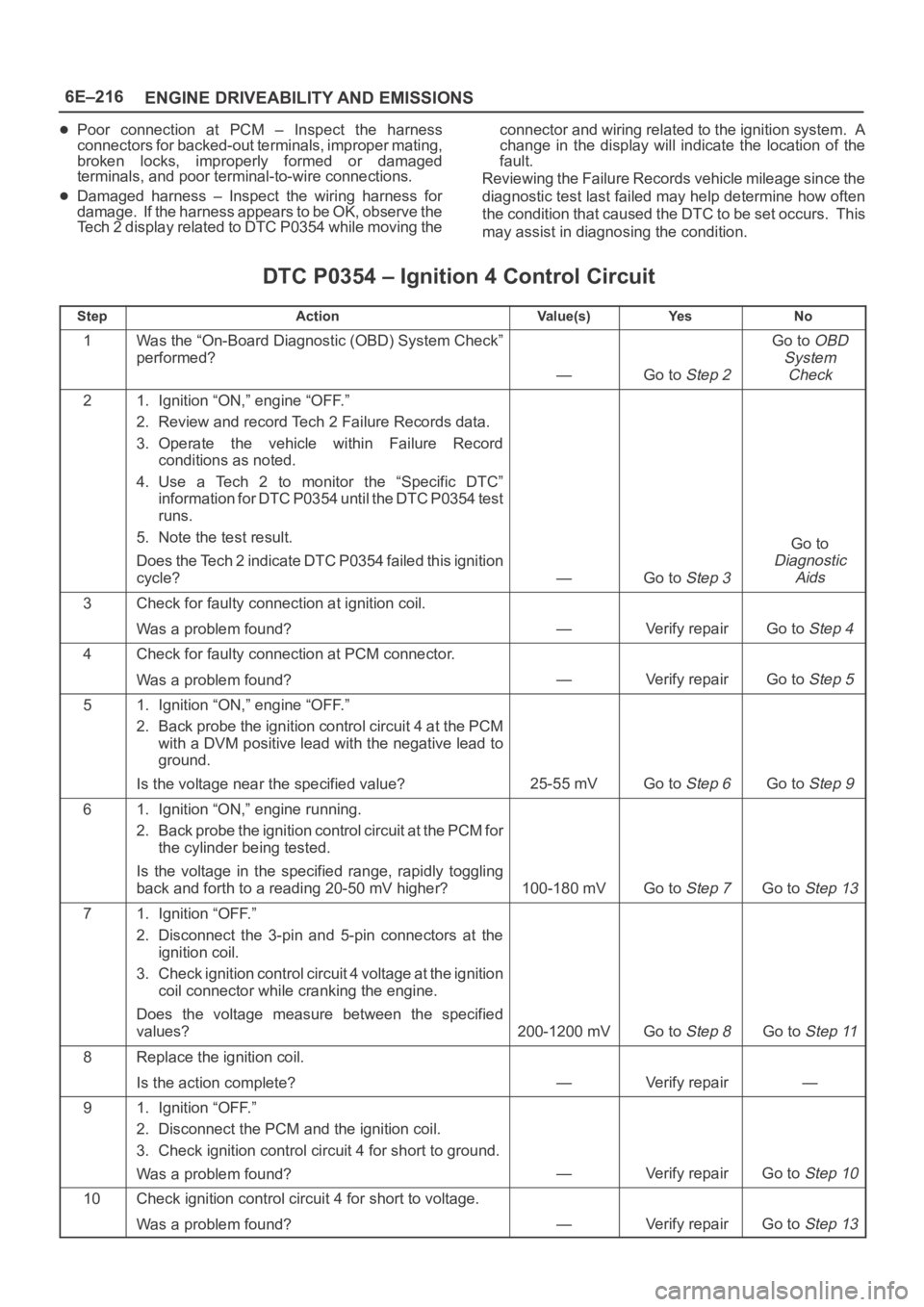
DTC P0354 – Ignition 4 Control Circuit
StepActionVa l u e ( s )Ye sNo
1Was the “On-Board Diagnostic (OBD) System Check”
performed?
—Go to Step 2
Go to OBD
System
Check
21. Ignition “ON,” engine “OFF.”
2. Review and record Tech 2 Failure Records data.
3. Operate the vehicle within Failure Record
conditions as noted.
4. Use a Tech 2 to monitor the “Specific DTC”
information for DTC P0354 until the DTC P0354 test
runs.
5. Note the test result.
Does the Tech 2 indicate DTC P0354 failed this ignition
cycle?
—Go to Step 3
Go to
Diagnostic
Aids
3Check for faulty connection at ignition coil.
Was a problem found?
—Verify repairGo to Step 4
4Check for faulty connection at PCM connector.
Was a problem found?
—Verify repairGo to Step 5
51. Ignition “ON,” engine “OFF.”
2. Back probe the ignition control circuit 4 at the PCM
with a DVM positive lead with the negative lead to
ground.
Is the voltage near the specified value?
25-55 mVGo to Step 6Go to Step 9
61. Ignition “ON,” engine running.
2. Back probe the ignition control circuit at the PCM for
the cylinder being tested.
Is the voltage in the specified range, rapidly toggling
back and forth to a reading 20-50 mV higher?
100-180 mVGo to Step 7Go to Step 13
71. Ignition “OFF.”
2. Disconnect the 3-pin and 5-pin connectors at the
ignition coil.
3. Check ignition control circuit 4 voltage at the ignition
coil connector while cranking the engine.
Does the voltage measure between the specified
values?
200-1200 mVGo to Step 8Go to Step 11
8Replace the ignition coil.
Is the action complete?
—Verify repair—
91. Ignition “OFF.”
2. Disconnect the PCM and the ignition coil.
3. Check ignition control circuit 4 for short to ground.
Was a problem found?
—Verify repairGo to Step 10
10Check ignition control circuit 4 for short to voltage.
Was a problem found?
—Verify repairGo to Step 13
Page 1336 of 6000
6E–219 ENGINE DRIVEABILITY AND EMISSIONS
Poor connection at PCM – Inspect the harness
connectors for backed-out terminals, improper mating,
broken locks, improperly formed or damaged
terminals, and poor terminal-to-wire connections.
Damaged harness – Inspect the wiring harness for
damage. If the harness appears to be OK, observe the
Tech 2 display related to DTC P0355 while moving theconnector and wiring related to the ignition system. A
change in the display will indicate the location of the
fault.
Reviewing the Failure Records vehicle mileage since the
diagnostic test last failed may help determine how often
the condition that caused the DTC to be set occurs. This
may assist in diagnosing the condition.
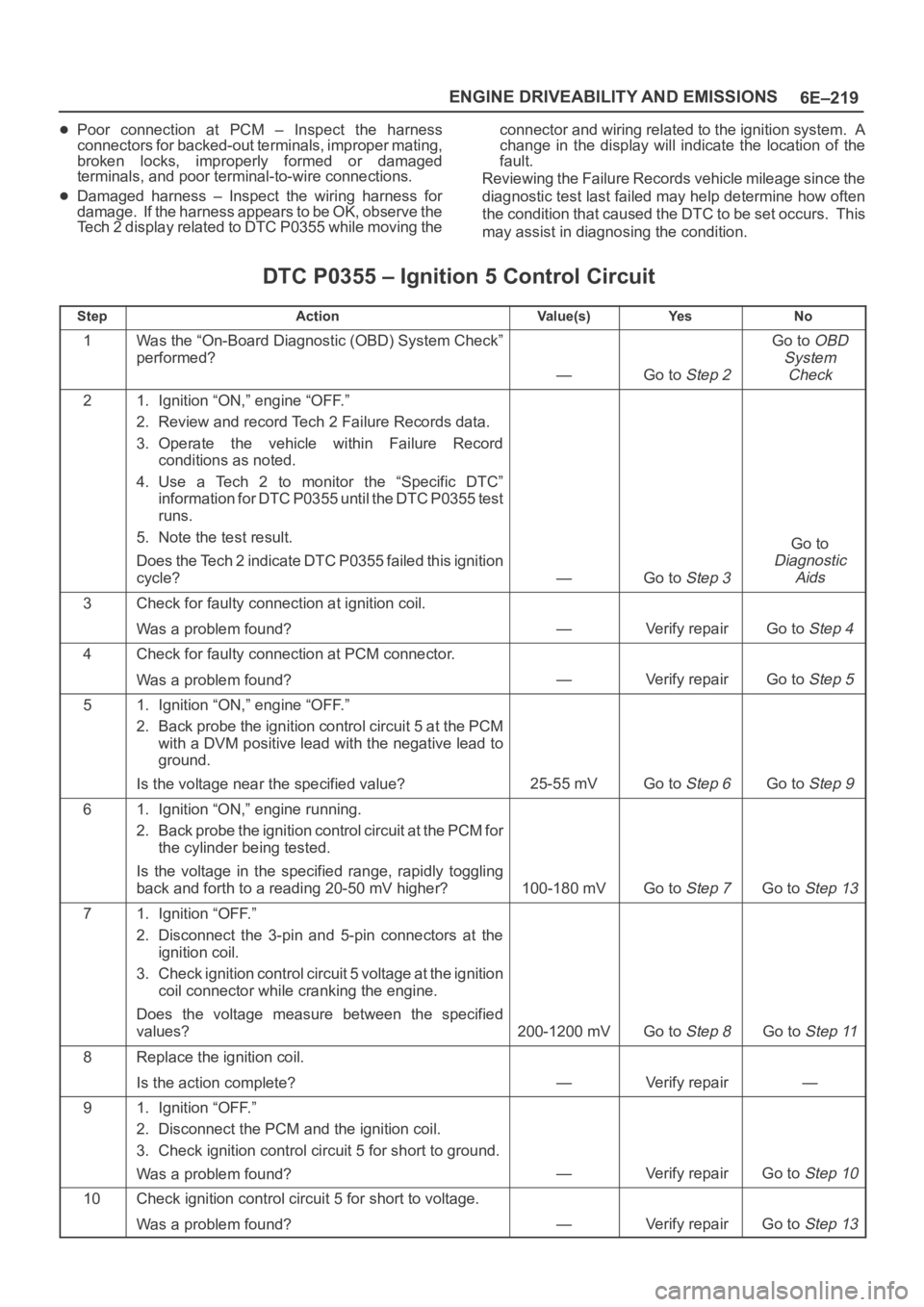
DTC P0355 – Ignition 5 Control Circuit
StepActionVa l u e ( s )Ye sNo
1Was the “On-Board Diagnostic (OBD) System Check”
performed?
—Go to Step 2
Go to OBD
System
Check
21. Ignition “ON,” engine “OFF.”
2. Review and record Tech 2 Failure Records data.
3. Operate the vehicle within Failure Record
conditions as noted.
4. Use a Tech 2 to monitor the “Specific DTC”
information for DTC P0355 until the DTC P0355 test
runs.
5. Note the test result.
Does the Tech 2 indicate DTC P0355 failed this ignition
cycle?
—Go to Step 3
Go to
Diagnostic
Aids
3Check for faulty connection at ignition coil.
Was a problem found?
—Verify repairGo to Step 4
4Check for faulty connection at PCM connector.
Was a problem found?
—Verify repairGo to Step 5
51. Ignition “ON,” engine “OFF.”
2. Back probe the ignition control circuit 5 at the PCM
with a DVM positive lead with the negative lead to
ground.
Is the voltage near the specified value?
25-55 mVGo to Step 6Go to Step 9
61. Ignition “ON,” engine running.
2. Back probe the ignition control circuit at the PCM for
the cylinder being tested.
Is the voltage in the specified range, rapidly toggling
back and forth to a reading 20-50 mV higher?
100-180 mVGo to Step 7Go to Step 13
71. Ignition “OFF.”
2. Disconnect the 3-pin and 5-pin connectors at the
ignition coil.
3. Check ignition control circuit 5 voltage at the ignition
coil connector while cranking the engine.
Does the voltage measure between the specified
values?
200-1200 mVGo to Step 8Go to Step 11
8Replace the ignition coil.
Is the action complete?
—Verify repair—
91. Ignition “OFF.”
2. Disconnect the PCM and the ignition coil.
3. Check ignition control circuit 5 for short to ground.
Was a problem found?
—Verify repairGo to Step 10
10Check ignition control circuit 5 for short to voltage.
Was a problem found?
—Verify repairGo to Step 13
Page 1339 of 6000
6E–222
ENGINE DRIVEABILITY AND EMISSIONS
Poor connection at PCM – Inspect the harness
connectors for backed-out terminals, improper mating,
broken locks, improperly formed or damaged
terminals, and poor terminal-to-wire connections.
Damaged harness – Inspect the wiring harness for
damage. If the harness appears to be OK, observe the
Tech 2 display related to DTC P0356 while moving theconnector and wiring related to the ignition system. A
change in the display will indicate the location of the
fault.
Reviewing the Failure Records vehicle mileage since the
diagnostic test last failed may help determine how often
the condition that caused the DTC to be set occurs. This
may assist in diagnosing the condition.
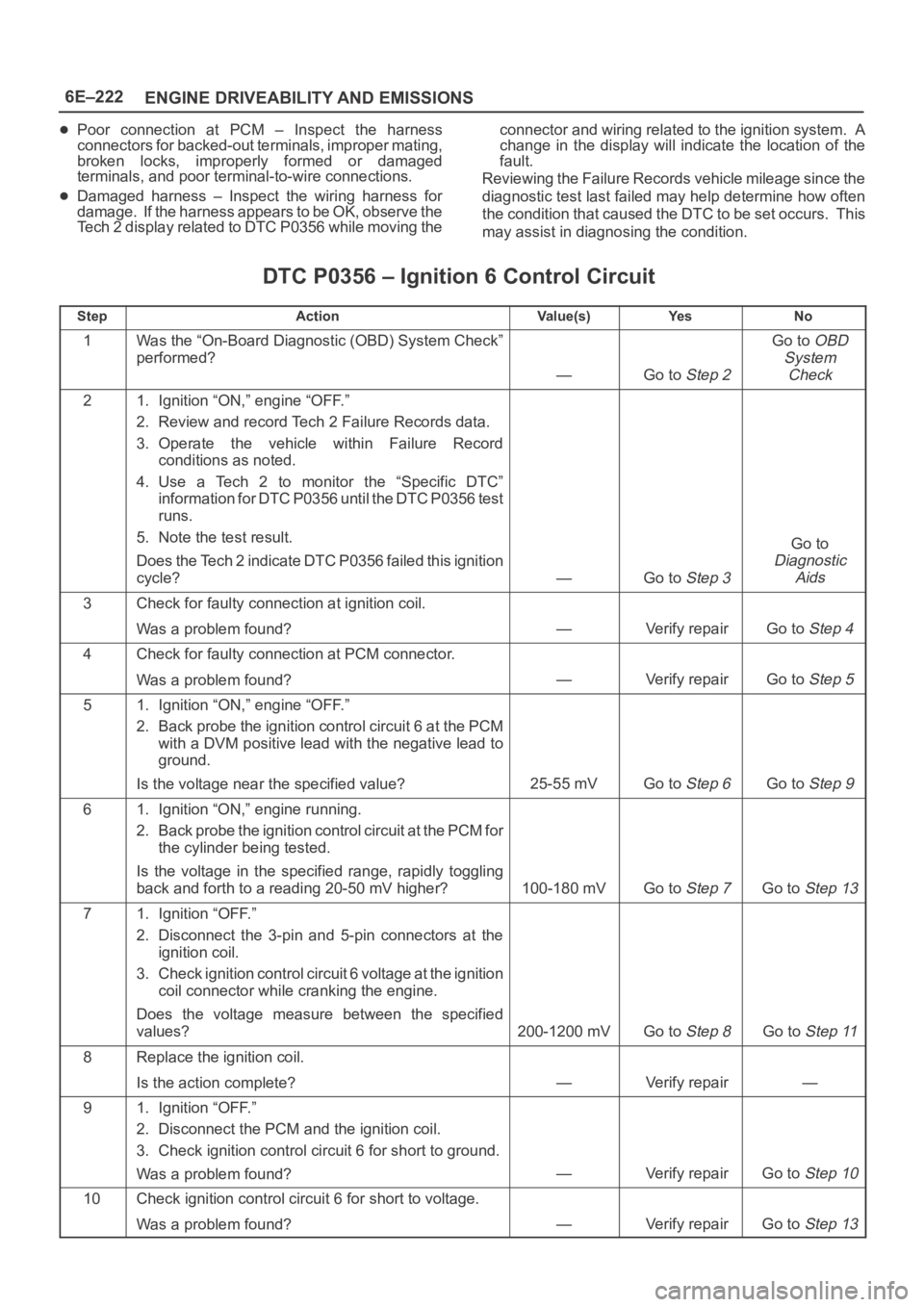
DTC P0356 – Ignition 6 Control Circuit
StepActionVa l u e ( s )Ye sNo
1Was the “On-Board Diagnostic (OBD) System Check”
performed?
—Go to Step 2
Go to OBD
System
Check
21. Ignition “ON,” engine “OFF.”
2. Review and record Tech 2 Failure Records data.
3. Operate the vehicle within Failure Record
conditions as noted.
4. Use a Tech 2 to monitor the “Specific DTC”
information for DTC P0356 until the DTC P0356 test
runs.
5. Note the test result.
Does the Tech 2 indicate DTC P0356 failed this ignition
cycle?
—Go to Step 3
Go to
Diagnostic
Aids
3Check for faulty connection at ignition coil.
Was a problem found?
—Verify repairGo to Step 4
4Check for faulty connection at PCM connector.
Was a problem found?
—Verify repairGo to Step 5
51. Ignition “ON,” engine “OFF.”
2. Back probe the ignition control circuit 6 at the PCM
with a DVM positive lead with the negative lead to
ground.
Is the voltage near the specified value?
25-55 mVGo to Step 6Go to Step 9
61. Ignition “ON,” engine running.
2. Back probe the ignition control circuit at the PCM for
the cylinder being tested.
Is the voltage in the specified range, rapidly toggling
back and forth to a reading 20-50 mV higher?
100-180 mVGo to Step 7Go to Step 13
71. Ignition “OFF.”
2. Disconnect the 3-pin and 5-pin connectors at the
ignition coil.
3. Check ignition control circuit 6 voltage at the ignition
coil connector while cranking the engine.
Does the voltage measure between the specified
values?
200-1200 mVGo to Step 8Go to Step 11
8Replace the ignition coil.
Is the action complete?
—Verify repair—
91. Ignition “OFF.”
2. Disconnect the PCM and the ignition coil.
3. Check ignition control circuit 6 for short to ground.
Was a problem found?
—Verify repairGo to Step 10
10Check ignition control circuit 6 for short to voltage.
Was a problem found?
—Verify repairGo to Step 13
Page 1368 of 6000
6E–251 ENGINE DRIVEABILITY AND EMISSIONS
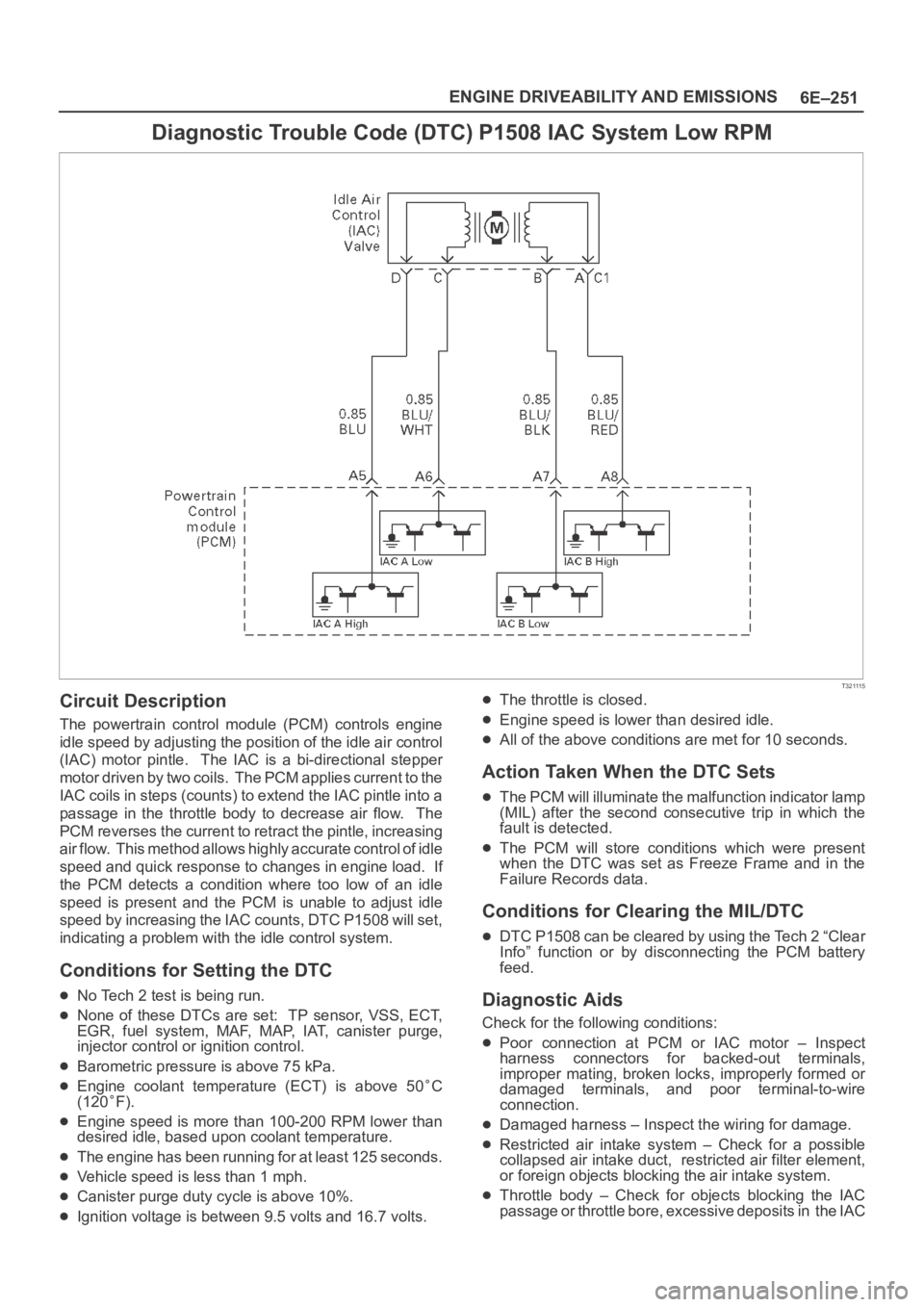
Diagnostic Trouble Code (DTC) P1508 IAC System Low RPM
T321115
Circuit Description
The powertrain control module (PCM) controls engine
idle speed by adjusting the position of the idle air control
(IAC) motor pintle. The IAC is a bi-directional stepper
motor driven by two coils. The PCM applies current to the
IAC coils in steps (counts) to extend the IAC pintle into a
passage in the throttle body to decrease air flow. The
PCM reverses the current to retract the pintle, increasing
air flow. This method allows highly accurate control of idle
speed and quick response to changes in engine load. If
the PCM detects a condition where too low of an idle
speed is present and the PCM is unable to adjust idle
speed by increasing the IAC counts, DTC P1508 will set,
indicating a problem with the idle control system.
Conditions for Setting the DTC
No Tech 2 test is being run.
None of these DTCs are set: TP sensor, VSS, ECT,
EGR, fuel system, MAF, MAP, IAT, canister purge,
injector control or ignition control.
Barometric pressure is above 75 kPa.
Engine coolant temperature (ECT) is above 50C
(120
F).
Engine speed is more than 100-200 RPM lower than
desired idle, based upon coolant temperature.
The engine has been running for at least 125 seconds.
Vehicle speed is less than 1 mph.
Canister purge duty cycle is above 10%.
Ignition voltage is between 9.5 volts and 16.7 volts.
The throttle is closed.
Engine speed is lower than desired idle.
All of the above conditions are met for 10 seconds.
Action Taken When the DTC Sets
The PCM will illuminate the malfunction indicator lamp
(MIL) after the second consecutive trip in which the
fault is detected.
The PCM will store conditions which were present
when the DTC was set as Freeze Frame and in the
Failure Records data.
Conditions for Clearing the MIL/DTC
DTC P1508 can be cleared by using the Tech 2 “Clear
Info” function or by disconnecting the PCM battery
feed.
Diagnostic Aids
Check for the following conditions:
Poor connection at PCM or IAC motor – Inspect
harness connectors for backed-out terminals,
improper mating, broken locks, improperly formed or
damaged terminals, and poor terminal-to-wire
connection.
Damaged harness – Inspect the wiring for damage.
Restricted air intake system – Check for a possible
collapsed air intake duct, restricted air filter element,
or foreign objects blocking the air intake system.
Throttle body – Check for objects blocking the IAC
passage or throttle bore, excessive deposits in the IAC
Page 1371 of 6000
6E–254
ENGINE DRIVEABILITY AND EMISSIONS
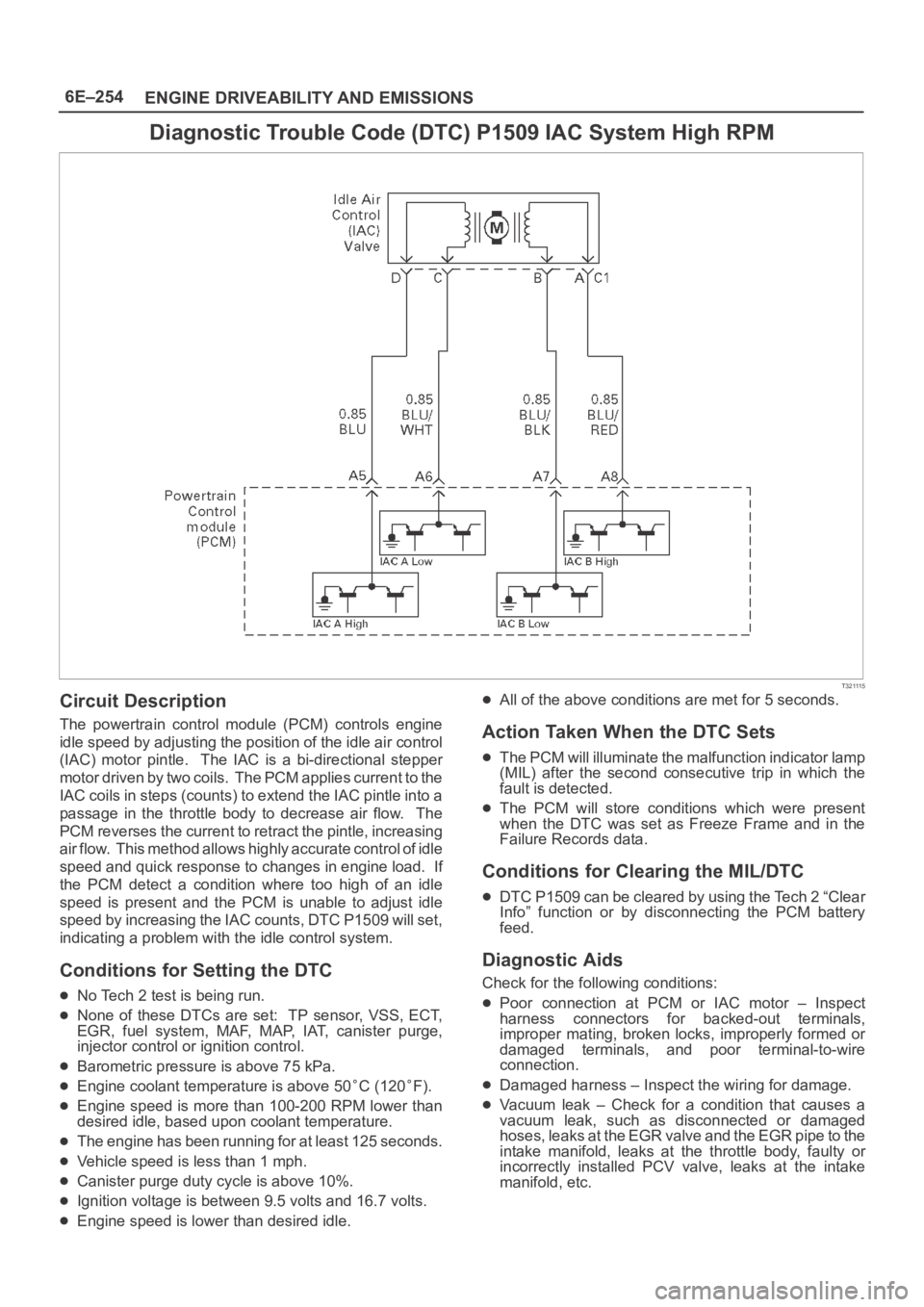
Diagnostic Trouble Code (DTC) P1509 IAC System High RPM
T321115
Circuit Description
The powertrain control module (PCM) controls engine
idle speed by adjusting the position of the idle air control
(IAC) motor pintle. The IAC is a bi-directional stepper
motor driven by two coils. The PCM applies current to the
IAC coils in steps (counts) to extend the IAC pintle into a
passage in the throttle body to decrease air flow. The
PCM reverses the current to retract the pintle, increasing
air flow. This method allows highly accurate control of idle
speed and quick response to changes in engine load. If
the PCM detect a condition where too high of an idle
speed is present and the PCM is unable to adjust idle
speed by increasing the IAC counts, DTC P1509 will set,
indicating a problem with the idle control system.
Conditions for Setting the DTC
No Tech 2 test is being run.
None of these DTCs are set: TP sensor, VSS, ECT,
EGR, fuel system, MAF, MAP, IAT, canister purge,
injector control or ignition control.
Barometric pressure is above 75 kPa.
Engine coolant temperature is above 50C (120F).
Engine speed is more than 100-200 RPM lower than
desired idle, based upon coolant temperature.
The engine has been running for at least 125 seconds.
Vehicle speed is less than 1 mph.
Canister purge duty cycle is above 10%.
Ignition voltage is between 9.5 volts and 16.7 volts.
Engine speed is lower than desired idle.
All of the above conditions are met for 5 seconds.
Action Taken When the DTC Sets
The PCM will illuminate the malfunction indicator lamp
(MIL) after the second consecutive trip in which the
fault is detected.
The PCM will store conditions which were present
when the DTC was set as Freeze Frame and in the
Failure Records data.
Conditions for Clearing the MIL/DTC
DTC P1509 can be cleared by using the Tech 2 “Clear
Info” function or by disconnecting the PCM battery
feed.
Diagnostic Aids
Check for the following conditions:
Poor connection at PCM or IAC motor – Inspect
harness connectors for backed-out terminals,
improper mating, broken locks, improperly formed or
damaged terminals, and poor terminal-to-wire
connection.
Damaged harness – Inspect the wiring for damage.
Vacuum leak – Check for a condition that causes a
vacuum leak, such as disconnected or damaged
h o s e s , l e a k s a t t h e E G R v a l v e a n d t h e E G R p i p e t o t h e
intake manifold, leaks at the throttle body, faulty or
incorrectly installed PCV valve, leaks at the intake
manifold, etc.