1998 OLDSMOBILE SILHOUETTE traction control
[x] Cancel search: traction controlPage 259 of 444
....... .... I -1 F
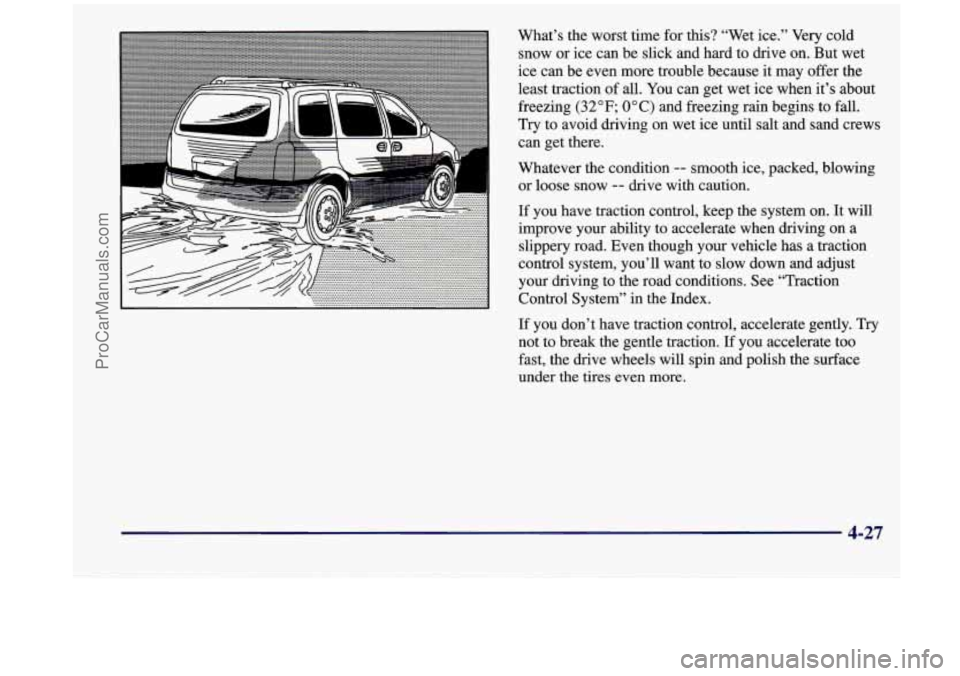
What’s the worst time for this? “Wet ice.” Very cold
snow or ice can be slick and hard to drive on. But wet
ice can be even more trouble because it may offer the
least traction
of all. You can get wet ice when it’s about
freezing
(32°F; 0” C) and freezing rain begins to fall.
Try to avoid driving
on wet ice until salt and sand crews
can get there.
Whatever the condition
-- smooth ice, packed, blowing
or loose snow
-- drive with caution.
If you have traction control, keep the system on. It will
improve your ability to accelerate when driving on a
slippery road. Even though your vehicle has a traction
control system, you’ll want to slow down and adjust
your driving to the road conditions. See “Traction
Control System” in the Index.
If you don’t have traction control, accelerate gently. Try
not to break the gentle traction.
If you accelerate too
fast, the drive wheels will spin and polish the surface
under the tires even more.
4-27
ProCarManuals.com
Page 310 of 444
I NOTICE:
Spinning your wheels can destroy parts of your
vehicle as well as the tires. If you spin the wheels
too fast while shifting your transaxle back and
forth, you can destroy your transaxle.
For information about using tire chains on your vehicle,
see “Tire Chains” in the Index.
Rocking Your Vehicle To Get It Out
First, turn your steering wheel left and right. That will
clear the area around your front wheels. If your vehicle
has traction control,
you should turn your traction
control system
off. (See “Traction Control System” in
the Index.) Then shift back and forth between
REVERSE (R) and a forward gear, spinning the wheels
as little as possible. Release the accelerator pedal while
you shift, and press lightly on the accelerator pedal
when the transaxle is in gear.
If that doesn’t get you out
after a few tries, you may need to be towed out.
If you
do need to be towed out, see “Towing Your Vehicle” in
the Index.
5-36
ProCarManuals.com
Page 353 of 444
CAUTION:
Mixing tires could cause you to lose control while
driving.
If you mix tires of different sizes or types
(radial and bias-belted tires), the vehicle may not
handle properly, and you could have a crash.
Using tires of different sizes may also cause
damage to your vehicle. Be sure to use the same
size and type tires on all wheels.
It’s all right to drive with your compact spare,
though. It was developed for use on your vehicle.
i A CAUTION: I
I If you use bias-ply tires on your vehicle, the
wheel rim flanges could develop cracks after
many miles of driving.
A tire and/or wheel could
fail suddenly, causing a crash. Use only radial-ply
tires with the wheels
on your vehicle.
Uniform Tire Quality Grading
The following information relates to the system
developed by the United States National Highway
Traffic Safety Administration, which grades tires by
treadwear, traction and temperature performance. (This
applies only to vehicles sold in the United States.) The
grades are molded on the sidewalls
of most passenger
car tires. The Uniform Tire Quality Grading system
does not apply to deep tread, winter-type snow tires,
space-saver or temporary use spare tires, tires with
nominal rim diameters of
10 to 12 inches (25 to 30 cm),
or to some limited-production tires.
While the tires available on General Motors passenger
cars and light trucks may vary with respect to these
grades, they must also conform to Federal safety
requirements and additional General Motors Tire
Performance Criteria
(TPC) standards.
6-43
ProCarManuals.com
Page 354 of 444

Treadwear Temperature -- A, B, C
The treadwear grade is a comparative rating based on
the wear rate
of the tire when tested under controlled
conditions on a specified government test course. For
example, a tire graded
150 would wear one and a half
(1 1/2) times as well on the government course as a tire
graded
100. The relative performance of tires depends
upon the actual conditions of their use, however, and
may depart significantly from the norm due to variations
in driving habits, service practices and differences in
road characteristics and climate.
Traction -- A, B, C
The traction grades, from highest to lowest, are A,
B, and C, and they represent the tire’s ability to stop
on wet pavement as measured under controlled
conditions on specified government test surfaces of
asphalt and concrete.
A tire marked C may have poor
traction performance.
Warning: The traction grade assigned to this tire is
based on braking (straight ahead) traction tests and
does not include cornering (turning) traction. The temperature grades
are
A (the highest), B, and C,
representing the tire’s resistance to the generation of
heat and its ability to dissipate heat when tested under
controlled conditions on a specified indoor laboratory
test wheel. Sustained high temperature can cause the
material of the tire to degenerate and reduce tire life, and
excessive temperature can lead to sudden tire failure.
The grade
C corresponds to a level of performance
which all passenger car tires must meet under the
Federal Motor Vehicle Safety Standard
No. 109. Grades
B and A represent higher levels of performance on the
laboratory test wheel than the minimum required by law.
Warning: The temperature grade for this tire is
established for a tire that
is properly inflated and not
overloaded. Excessive speed, underinflation, or
excessive loading, either separately or in combination,
can cause heat buildup and possible tire failure.
6-44
ProCarManuals.com
Page 369 of 444

Fuses Fuses
RR HVAC SWC ACCY
HAZARD
RR PWR SCKT
DRL
LH T/LP
RR DEFOG
FRT PWR SCKT
SIR
FRT HVAC LOW/MED BLWR Rear
Blower Motor, Rear
Heater-A/C Control, and
Temperature Door
Actuator (Rear)
Steering Wheel Radio Control
Switches
Turn Signal Switch
Rear Electric Accessory
Plug Housing
DRL Control Module
Not Used
Rear Window Defogger Relay
Front Electric Accessory
Plug Housing
Inflatable Restraint
Control Module
Heater-A/C Control MALL/RADIO/DIC
BCM, Driver Information
Display, Radio and Radio Rear Speaker Amplifier
STOP LAMP
ABS MOD BATT
CAN VENT
SOL
ELC CTSY LAMP
IGN 1
Stoplamp Switch to Stoplamps
Electronic Brake Control
Module/Electronic Brake
Traction Control Module (EBCM/EBTCM)
Evaporative Emissions (EVAP)
Canister Vent Solonoid Valve
Electronic Level Control (ELC)
Air Compressor and ELC
Relay, Trailer Harness
BCM
ALC Sensor, BCM, Electronic
Brake Control Indicator Lamp
Driver Module, Instrument
Panel Cluster, Rear Window
Wipermasher and
Multifunction Switch (Fog
Lamp SwitcWTraction Control
Switch) and Stoplamp/Torque
Converter Clutch (TCC) Switch
6-59
ProCarManuals.com
Page 370 of 444

Fuses
SUNROOF
RR WPR WSHR Sunroof
Control Module
Rear Window Wiper Motor,
Rear Window Wipermasher
and Multifunction Switch (Rear
Window Wipermasher Switch)
LH HEADLP LOW Not
Used
LH HEADLP
HIGH
ABSITCS IGN
ABS
SOL
Not Used
Electronic Brake Control
Module/Electronic Brake
Traction Control Module (EBCMEBTCM)
LH and RH Front Brake
Solenoid Valve
Fuses
HVAC/DRL Air Inlet Actuator, DRL Control
Module, Heater-A/C Control,
Temperature Door Actuator (Front) and Rear Window
Defogger Relay
BCM PRGRM Body Control Module (BCM)
RH HEADLP LOW Not Used
RH HEADLP
HIGH
PCM Not
Used
IGN MAIN Relay and PCM
6-60
ProCarManuals.com
Page 432 of 444

Jack. Tire .................................... 5-27
Jump Starting
................................... 5-3
Key Lock Cylinders Service ..................... 7-30
Keys
.......................................... 2-2
Labels CertificationRire
............................. 4-30
Service Parts Identification
..................... 6-55
Tire-Loading Information
...................... 4-30
Vehicle Identification Number
................... 6-55
Delayed Illumination
.......................... 2-62
Dome
...................................... 2- 63
Exit Lighting
................................ 2-62
Exterior
.................................... 2-59
Fog
........................................ 2-60
Illuminated Entry
............................. 2-6 1
Interior
..................................... 2- 61
OnReminder ................................ 2-59
Rearcargo
.................................. 2-63
Underhood
.................................. 6-11
Leaving Your Vehicle
............................. 2-7
Leaving Your Vehicle with the Engine Running
....... 2-36
Liftgate
....................................... 2- 20
Lirrhter ....................................... 2-77
Lamps
Lights
Air Baa Readiness ....................... 1.40. 2.87
Anti-LGck Brake System Warning
............ 2.89. 4.7
Brake System Warning
.................... 2.88. 6.28
Charging System Indicator
...................... 2-88 DoorAjar
................................... 2-97
Engine Temperature Warning
................... 2-92
Interior
..................................... 2-61
Low Coolant Warning
.................... 2.93, 6.23
Low Fuel Warning
............................ 2-98
Low Oil Level
.......................... 2.96. 6. 11
Low Traction
............................ 2.91. 4.9
Oil Pressure
................................. 2-96
Power Sliding Door
........................... 2-97
Safety Belt Reminder
..................... 1-25, 2.87
Service Engine Soon
.......................... 2-93
Traction Control System Warning
........... 2-90. 4-10
Loading Your Vehicle ........................... 4-30
Automatic Door
............................... 2-6
Cylinders
................................... 7-30
Door
........................................ 2.4
Ignition Transaxle Check
....................... 7-32
Key Lock Cylinder Service
..................... 7-30
Last Door Closed Locking
....................... 2-6
Lockout Deterrent
............................. 2-7
PowerDoor
.................................. 2-5
Sliding Door
................................. 2-14
Sliding Door Child Security
..................... 2-19
Sliding Door Delayed Locking
................... 2-7
Locks and Lighting Choices
...................... 2-40
Loss of Control
................................ 4-15
Low Coolant Warning Light
................. 2-93, 6-23
Low Fuel Warning Light
......................... 2-98
Low Oil Level Light
....................... 2-96, 6-11
Low Traction Light
......................... 2-91, 4-9
Lubricants and Fluids
............................ 7-34
Lubrication Service. Body
........................ 7-30
Locks
9-6
. ..
ProCarManuals.com
Page 437 of 444

Theft ......................................... 2-22
Theft-Deterrent Feature, CD Player
................ 3-21
THEFI'LOCK
.................................. 3-21
Thermostat
.................................... 6-24
ThirdGear
.................................... 2-32
Tilt Steering Wheel
............................. 2-52
Time, Setting the
................................ 3-9
Tire Chains
.................................... 6-46
TireLoading
................................... 4-30
Tire-Loading Information Label
................... 4-30
Tires
......................................... 6-39
Alignment and Balance
........................ 6-45
BuyingNew
................................. 6-42
Chains
..................................... 6-46
Changing a Flat
.............................. 5-24
Compact Spare
............................... 5-34
Inflation
.................................... 6-40
Inflation Check
............................... 7-29
Inspection and Rotation
........................ 6-41
Cleaning
.................................... 6-52
Loading
.................................... 4-30
Pressure
.................................... 6-40
Storing a Flat or Spare
......................... 5-33
Temperature
................................. 6-44
Traction
.................................... 6-44
Treadwe
ar ................................... 6-44
Uniform Quality Grading
....................... 6-43
Used Wheel Replacement
...................... 6-46
Wear Indicators
.............................. 6-42
Wheel Replacement
........................... 6-45
When It's Time for New
....................... 6-42
TopStrap
..................................... 1-76
TorqueLock
................................... 2-37 Torque.
Wheel Nut
......................... 5.32. 6.64
Towing a Trailer
................................ 4-33
Towing
Your Vehicle ............................. 5-7
Traction Control System
.......................... 4-9
Traction Control System Warning Light
........ 2.90. 4.10
Trailer
Brakes
..................................... 4-37
Hitches
..................................... 4-36
Driving on Grades
............................ 4-39
Drivingwith
................................. 4-37
Maintenance When Towing
..................... 4-40
ParkingonHills
.............................. 4-40
Safety Chains
................................ 4-37
Tongueweight
............................... 4-35
Total Weight on Tires
.......................... 4-36
Towing
..................................... 4-33
Turnsignals
................................. 4-39
Weight
..................................... 4-34
Transaxle Fluid, Automatic
....................... 6-18
Transmitters, Remote Lock Control
.................. 2-8
Transportation, Courtesy
.......................... 8-6
Trip Computer
................................ 2-101
Trip Odometer
................................. 2-85
TTY Users
...................................... 8-4
Turn Signal and Lane Change Signals ............... 2-53
Turn Signal Reminder Chime
..................... 2-53
Turn Signal/Multifunction Lever
................... 2-52
Turn Signals When Towing a Trailer
................ 4-39
Underbody Flushing Service
..................... 7-32
Underhood Fuse and Relay Center
................. 6-61
UnderhoodLamp
............................... 6-11
Underbody Maintenance
......................... 6-53
ProCarManuals.com