1998 NISSAN SENTRA engine
[x] Cancel search: enginePage 192 of 216
FUEL RECOMMENDATION
Your vehicle is designed to operate on
unleaded gasoline with an octane rating
of at least 87 AKI (Anti-Knock Index)
(Research octane number 91).
CAUTION
cUsing a fuel other than that specified
could adversely affect the emission
control devices and systems, and
could also affect the warranty cover-
age.
cUnder no circumstances should a
leaded gasoline be used, since this
will damage the three way catalyst.
Reformulated Gasoline
Some fuel suppliers are now producing re-
formulated gasolines. These gasolines are
specially designed to reduce vehicle emis-
sions. NISSAN supports efforts towards
cleaner air and suggests that you use refor-
mulated gasoline when available.
Gasoline containing oxygenates
Some fuel suppliers sell gasoline containing
oxygenates such as ethanol, MTBE andmethanol with or without advertising their
presence. NISSAN does not recommend
the use of fuels of which the oxygenate
content and the fuel compatibility for your
NISSAN cannot be readily determined. If in
doubt, ask your service station manager.
If you use oxygenate-blend gasoline, please
take the following precautions as the usage
of such fuels may cause vehicle performance
problems and/or fuel system damage.
cThe fuel should be unleaded and
have an octane rating no lower than
that recommended for unleaded
gasoline.
cIf an oxygenate-blend other than a
methanol blend is used, it should
contain no more than 10% oxygenate.
(MTBE may, however, be added up to
15%.)
cIf a methanol blend is used, it should
contain no more than 5% methanol
(methyl alcohol, wood alcohol). It
should also contain a suitable
amount of appropriate cosolvents
and corrosion inhibitors. If not prop-
erly formulated with appropriate co-
solvents and corrosion inhibitors,such methanol blends may cause
fuel system damage and/or vehicle
performance problems. At this time,
sufficient data is not available to en-
sure that all methanol blends are suit-
able for use in NISSAN vehicles.
If any driveability problems such as engine
stalling and hard hot-starting are experi-
enced after using oxygenate-blend fuels,
immediately change to a non-oxygenate
fuel or a fuel with a low blend of MTBE.
Take care not to spill gasoline during
refueling. Gasoline containing oxygen-
ates can cause paint damage.
After Market Fuel Additives
NISSAN does not recommend the use of
any fuel additives (i.e., fuel injector cleaners,
octane boosters, intake valve deposit re-
movers, etc.) which are sold commercially.
Many of these additives intended for gum,
varnish or deposit removal may contain ac-
tive solvents or similar ingredients that can
be harmful to the fuel system and engine.
Octane rating tips
In most parts of North America, you should
use unleaded gasoline with an octane rating
Technical and consumer information
10-3
ZX
Page 193 of 216
![NISSAN SENTRA 1998 B14 / 4.G Owners Manual of at least 87 AKI (Anti-Knock Index). How-
ever, you may use unleaded gasoline with
an octane rating as low as 85 AKI (Anti-
Knock Index) in high altitude areas (over
4,000 ft [1,219 m]) such as: Col](/manual-img/5/611/w960_611-192.png "NISSAN SENTRA 1998 B14 / 4.G Owners Manual of at least 87 AKI (Anti-Knock Index). How-
ever, you may use unleaded gasoline with
an octane rating as low as 85 AKI (Anti-
Knock Index) in high altitude areas (over
4,000 ft [1,219 m]) such as: Col")
of at least 87 AKI (Anti-Knock Index). How-
ever, you may use unleaded gasoline with
an octane rating as low as 85 AKI (Anti-
Knock Index) in high altitude areas (over
4,000 ft [1,219 m]) such as: Colorado, Mon-
tana, New Mexico, Utah, Wyoming, north-
eastern Nevada, southern Idaho, western
South Dakota, western Nebraska, and the
part of Texas which is directly south of New
Mexico.
Using unleaded gasoline with an octane
rating lower than stated above can cause
persistent, heavy ``spark knock.'' (``Spark
knock'' is a metallic rapping noise.) If
severe, this can lead to engine damage. If
you detect a persistent heavy spark
knock even when using gasoline of the
stated octane rating, or if you hear steady
spark knock while holding a steady
speed on level roads, have an authorized
NISSAN dealer correct the condition.
Failure to correct the condition is misuse
of the vehicle, for which NISSAN is not
responsible.
Incorrect ignition timing may result in spark
knock, after-run and/or overheating, which
may cause excessive fuel consumption or
engine damage. If any of the above symp-toms are encountered, have your vehicle
checked at an authorized NISSAN dealer or
other competent service facility.
However, now and then you may notice
light spark knock for a short time while
accelerating or driving up hills. This is
not a cause for concern, because you
get the greatest fuel benefit when there
is light spark knock for a short time
under heavy engine load.
10-4Technical and consumer information
ZX
Page 194 of 216

ENGINE OIL AND OIL FILTER
RECOMMENDATION
Selecting the correct oil
It is essential to choose engine oil with the
correct quality and viscosity to ensure sat-
isfactory engine life and performance. NIS-
SAN recommends the use of a low friction
oil (energy conserving oil) in order to im-
prove fuel economy and conserve energy.
Oils which do not have the specified quality
label should not be used as they could
cause engine damage.
Only those engine oils with the AmericanPetroleum Institute (API) CERTIFICATION
MARK on the front of the container should
be used. This type of oil supersedes the
existing API SG or SH and Energy Conserv-
ing II categories.
If you cannot find engine oil with the CER-
TIFICATION MARK, an API SG or SH, an
Energy Conserving II oil with the API Ser-
vice Symbol may be used. An oil with a
single designation SG or SH, or in combi-
nation with other categories (for example,
SG/CC or SG/CD) may also be used if one
with the API CERTIFICATION MARK can-
not be found.Mineral based or synthetic type oils may be
used in your NISSAN vehicle. However,
these oils must meet the API quality and
SAE viscosity ratings specified for your ve-
hicle. Do not mix mineral based and syn-
thetic type oils in the engine.
Oil additives
NISSAN does not recommend the use of oil
additives. The use of an oil additive is not
necessary when the proper oil type is used
and maintenance intervals are followed.
Oil which may contain foreign matter or has
been previously used should not be used.
Oil viscosity
The engine oil viscosity or thickness
changes with temperature. Because of this,
it is important to select the engine oil viscos-
ity based on the temperatures at which the
vehicle will be operated before the next oil
change. The chart ``Recommended SAE
viscosity number'' shows the recommended
oil viscosities for the expected ambient tem-
peratures. Choosing an oil viscosity other
than that recommended could cause seri-
ous engine damage.
ATI0645
Technical and consumer information10-5
ZX
Page 195 of 216

Selecting the correct oil filter
Your new NISSAN vehicle is equipped with
a high-quality genuine NISSAN oil filter.
When replacing, use a genuine NISSAN oil
filter or its equivalent for the reason de-
scribed in ``Change intervals''.
Change intervals
The oil and oil filter change intervals for your
engine are based on the use of the specified
quality oils and filters. Oil and filter other
than the specified quality, or oil and filter
change intervals longer than recommended
could reduce engine life. Damage to the
engine caused by improper maintenance or
use of incorrect oil and filter quality and/or
viscosity is not covered by the new NISSAN
vehicle warranties.
Your engine was filled with a high quality
engine oil when it was built. You do not have
to change the oil before the first recom-
mended change interval. Oil and filter
change intervals depend upon how you use
your vehicle.Operation under the following conditions
may require more frequent oil and filter
changes:
Ð repeated short distance driving at cold
outside temperatures,
Ð driving in dusty conditions,
Ð extensive idling,
Ð towing a trailer.
10-6Technical and consumer information
ZX
Page 197 of 216
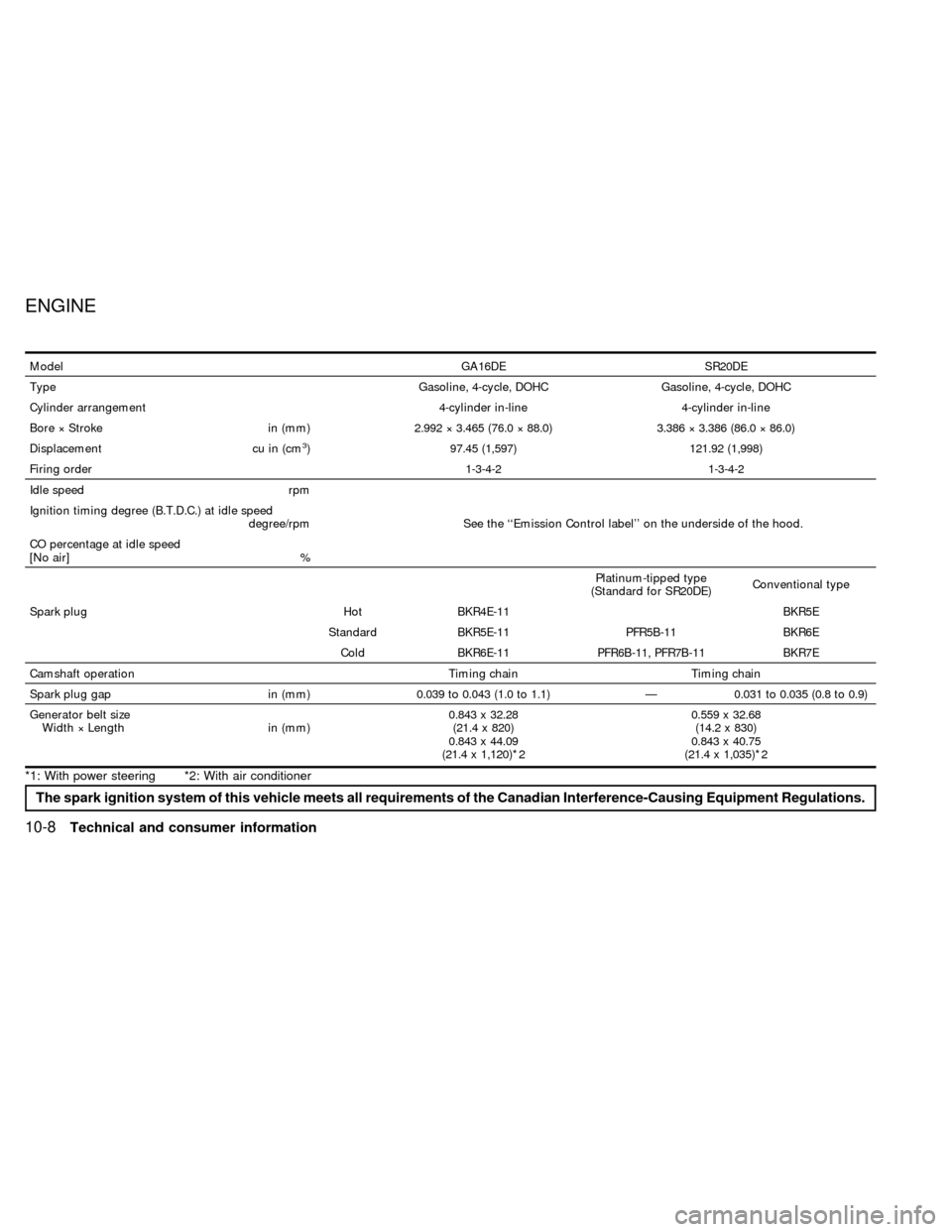
ModelGA16DE SR20DE
Type Gasoline, 4-cycle, DOHC Gasoline, 4-cycle, DOHC
Cylinder arrangement 4-cylinder in-line 4-cylinder in-line
Bore ý Stroke in (mm) 2.992 ý 3.465 (76.0 ý 88.0) 3.386 ý 3.386 (86.0 ý 86.0)
Displacement cu in (cm
3) 97.45 (1,597) 121.92 (1,998)
Firing order1-3-4-2 1-3-4-2
Idle speed rpm
See the ``Emission Control label'' on the underside of the hood. Ignition timing degree (B.T.D.C.) at idle speed
degree/rpm
CO percentage at idle speed
[No air] %
Platinum-tipped type
(Standard for SR20DE)Conventional type
Spark plug Hot BKR4E-11 BKR5E
Standard BKR5E-11 PFR5B-11 BKR6E
Cold BKR6E-11 PFR6B-11, PFR7B-11 BKR7E
Camshaft operation Timing chain Timing chain
Spark plug gap in (mm) 0.039 to 0.043 (1.0 to 1.1) Ð 0.031 to 0.035 (0.8 to 0.9)
Generator belt size
Width ý Length in (mm)0.843 x 32.28
(21.4 x 820)
0.843 x 44.09
(21.4 x 1,120)*20.559 x 32.68
(14.2 x 830)
0.843 x 40.75
(21.4 x 1,035)*2
*1: With power steering *2: With air conditioner
The spark ignition system of this vehicle meets all requirements of the Canadian Interference-Causing Equipment Regulations.
ENGINE
10-8Technical and consumer information
ZX
Page 199 of 216

When planning to travel in another coun-
try,you should first find out if the fuel avail-
able is suitable for your vehicle's engine.
Using fuel with too low an octane/cetane
rating may cause engine damage. All gaso-
line vehicles must be operated with un-
leaded gasoline. Therefore, avoid taking
your vehicle to areas where appropriate fuel
is not available.
When transferring the registration of
your vehicle to another country, state,
province or district,it may be necessary to
modify the vehicle to meet local laws and
regulations.
The laws and regulations for motor vehicle
emission control and safety standards vary
according to the country, state, province or
district. Therefore, vehicle specifications
may differ.
When any vehicle is to be taken into
another country, state, province or dis-
trict and registered, its modifications,
transportation, and registration are the
responsibility of the user. NISSAN is not
responsible for any inconvenience that
may result.
VEHICLE IDENTIFICATION
NUMBER (VIN) PLATE
The vehicle identification number (VIN)
plate is attached to the top of the instrument
panel on the driver's side. This number is
the identification for your vehicle and is
used in the vehicle registration.
VEHICLE IDENTIFICATION
NUMBER (Chassis number)
The chassis number is stamped as shown.
TI1050MATI1006
REGISTERING YOUR VEHICLE
IN ANOTHER COUNTRYVEHICLE IDENTIFICATION
10-10Technical and consumer information
ZX
Page 200 of 216

ENGINE SERIAL NUMBER
The engine serial number is stamped on the
engine as shown.
F.M.V.S.S. CERTIFICATION
LABEL
The Federal Motor Vehicle Safety Standard
(F.M.V.S.S.) certification label is affixed as
shown. This label contains valuable vehicle
information, such as: Gross Vehicle Weight
Ratings (GVWR), Gross Axle Weight Rating
(GAWR), month and year of manufacture,
Vehicle Identification Number, (VIN), etc.
Review it carefully.
ATI0608TI1032-AATI0606
Technical and consumer information10-11
ZX
Page 204 of 216
Your new vehicle was designed to be used
primarily to carry passengers and cargo.
Remember that towing a trailer places ad-
ditional loads on your vehicle's engine, drive
train, steering, braking and other systems.
ANISSAN Trailer Towing Guideis avail-
able from your NISSAN dealer. This guide
includes information on trailer towing ability
and the special equipment required for
proper towing.
Maximum load limits
Maximum trailer loads
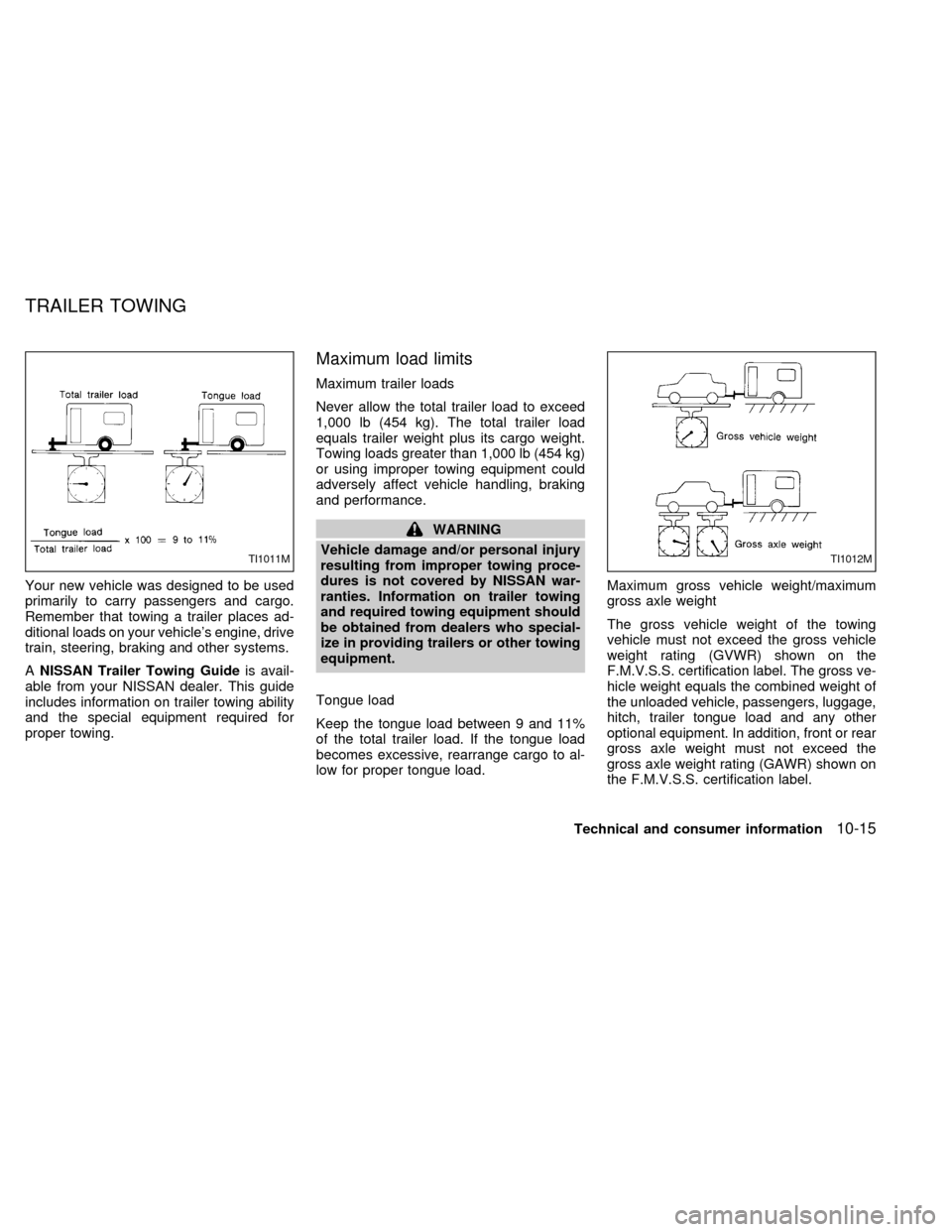
Never allow the total trailer load to exceed
1,000 lb (454 kg). The total trailer load
equals trailer weight plus its cargo weight.
Towing loads greater than 1,000 lb (454 kg)
or using improper towing equipment could
adversely affect vehicle handling, braking
and performance.
WARNING
Vehicle damage and/or personal injury
resulting from improper towing proce-
dures is not covered by NISSAN war-
ranties. Information on trailer towing
and required towing equipment should
be obtained from dealers who special-
ize in providing trailers or other towing
equipment.
Tongue load
Keep the tongue load between 9 and 11%
of the total trailer load. If the tongue load
becomes excessive, rearrange cargo to al-
low for proper tongue load.Maximum gross vehicle weight/maximum
gross axle weight
The gross vehicle weight of the towing
vehicle must not exceed the gross vehicle
weight rating (GVWR) shown on the
F.M.V.S.S. certification label. The gross ve-
hicle weight equals the combined weight of
the unloaded vehicle, passengers, luggage,
hitch, trailer tongue load and any other
optional equipment. In addition, front or rear
gross axle weight must not exceed the
gross axle weight rating (GAWR) shown on
the F.M.V.S.S. certification label.
TI1011MTI1012M
TRAILER TOWING
Technical and consumer information10-15
ZX